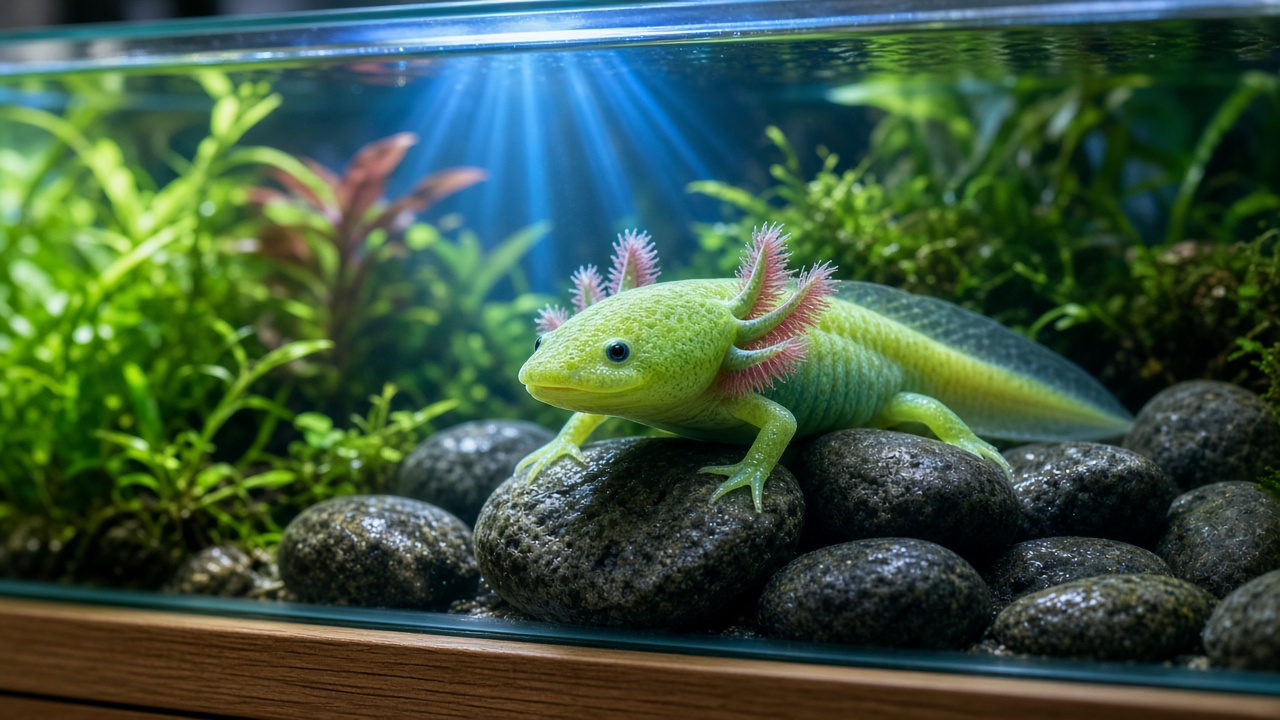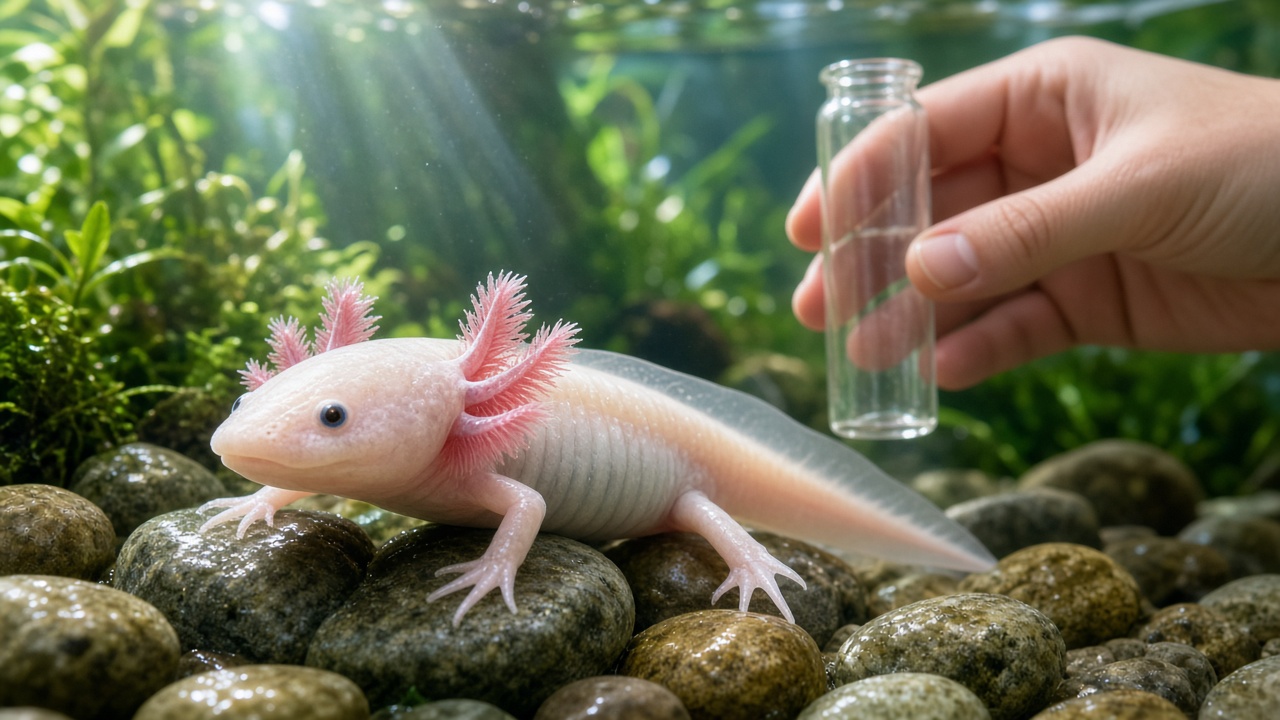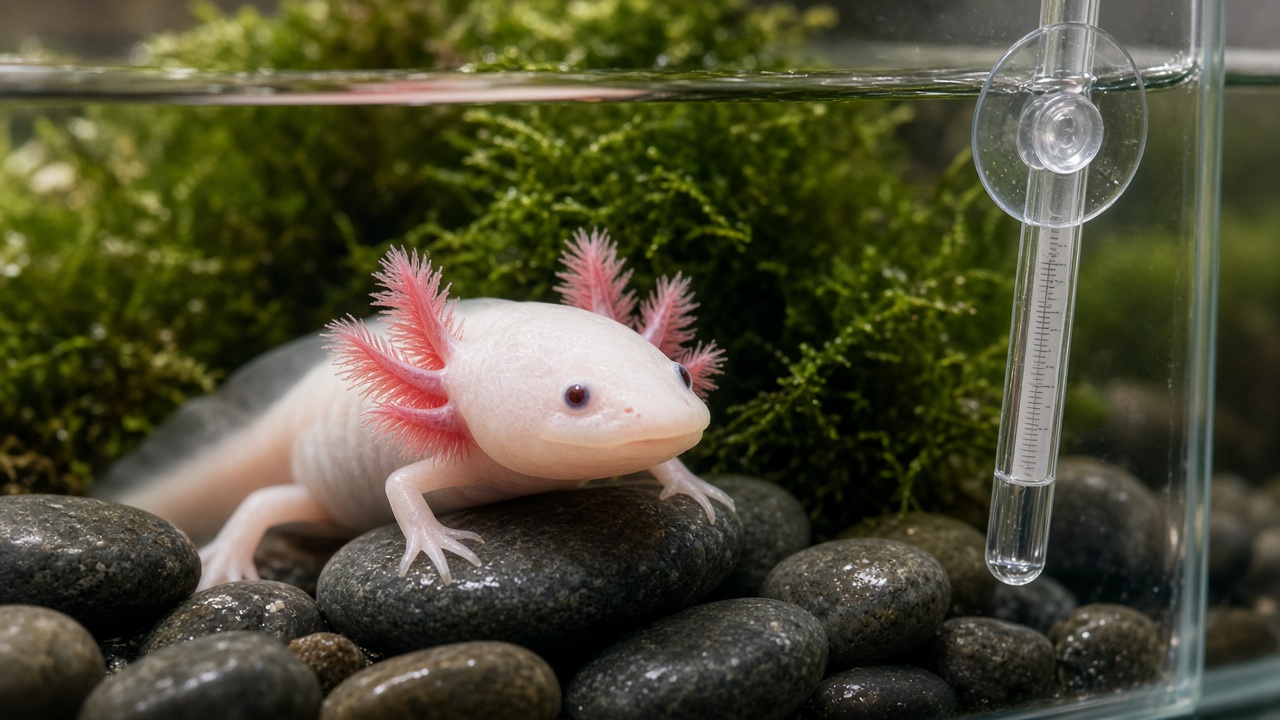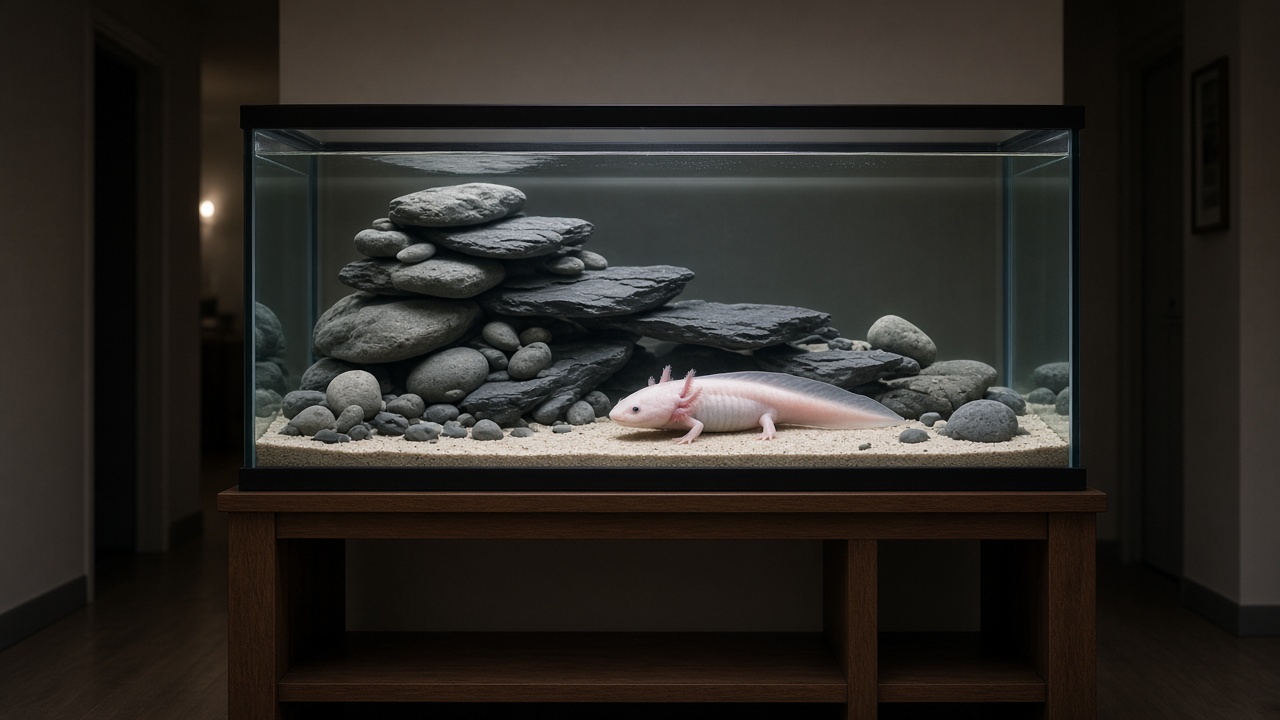
Quick answer: They are two different salamanders, so count the hind toes and note where the animal came from. Four hind toes and a North American waterway point to a mudpuppy. Five hind toes and a home tank usually point to an axolotl.
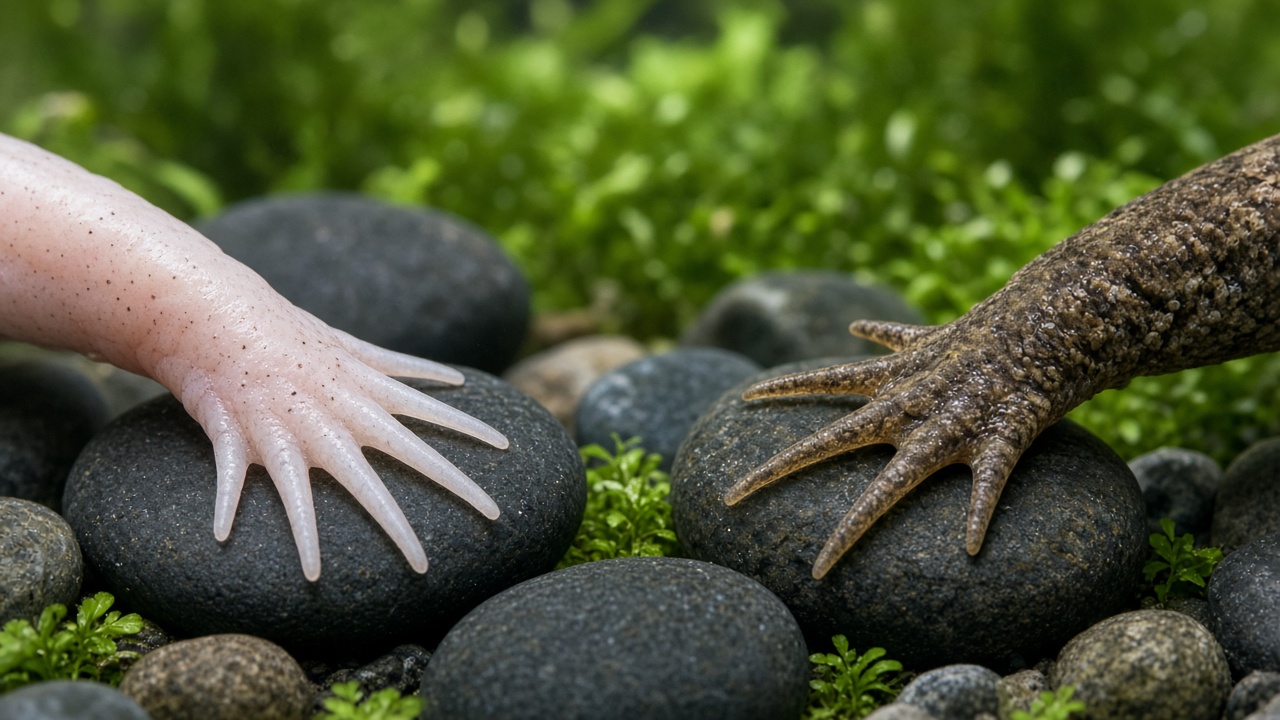
A mudpuppy has four toes on every foot; an axolotl has four front toes and five hind toes.
This page is a desk ID brief built from published species accounts.
COSEWIC’s 2023 status report lists adult mudpuppies from 20 to 49 cm. AmphibiaWeb lists axolotls up to about 40 cm, so length alone cannot name the animal.
What this desk included, and what it left out
We used one rule: each trait or product had to come from a page we actually read. It also had to help name a live animal or house a confirmed captive axolotl.
That is the Waterpuppy Toe-Count First Rule. We cover checks you can do with a ruler, a toe count, and a place name. We also cover currently sold tanks, filters, and water products whose maker pages list a volume, a flow rate, a dose, or a test count.
We left out wild-collection gear, mudpuppy sale, metamorphosis chemicals, and any product with no maker spec. We also left out ranked lists and price tiers.
Our research team compared the published numbers side by side and did not invent a lab trial. Where two accounts give different figures, we keep both numbers and name the source.
Use the Toe-Count First Rule
The first check is the hind foot, because these two species do not share the same toe count.
COSEWIC’s 2023 report describes the mudpuppy with four toes on each foot. AmphibiaWeb’s axolotl account states four fingers on each front leg and five toes on each back leg. If you can see the hind foot, you can finish the ID.
Work in this order:
- Count the hind toes first. Four means mudpuppy. Five means axolotl.
- Then look at the snout. COSEWIC calls the mudpuppy snout truncated.
- Then note the place. A North American river, lake, or bait-bucket find points to a mudpuppy.
- A pet-store tank, classroom tank, or Mexico City canal system points to an axolotl.
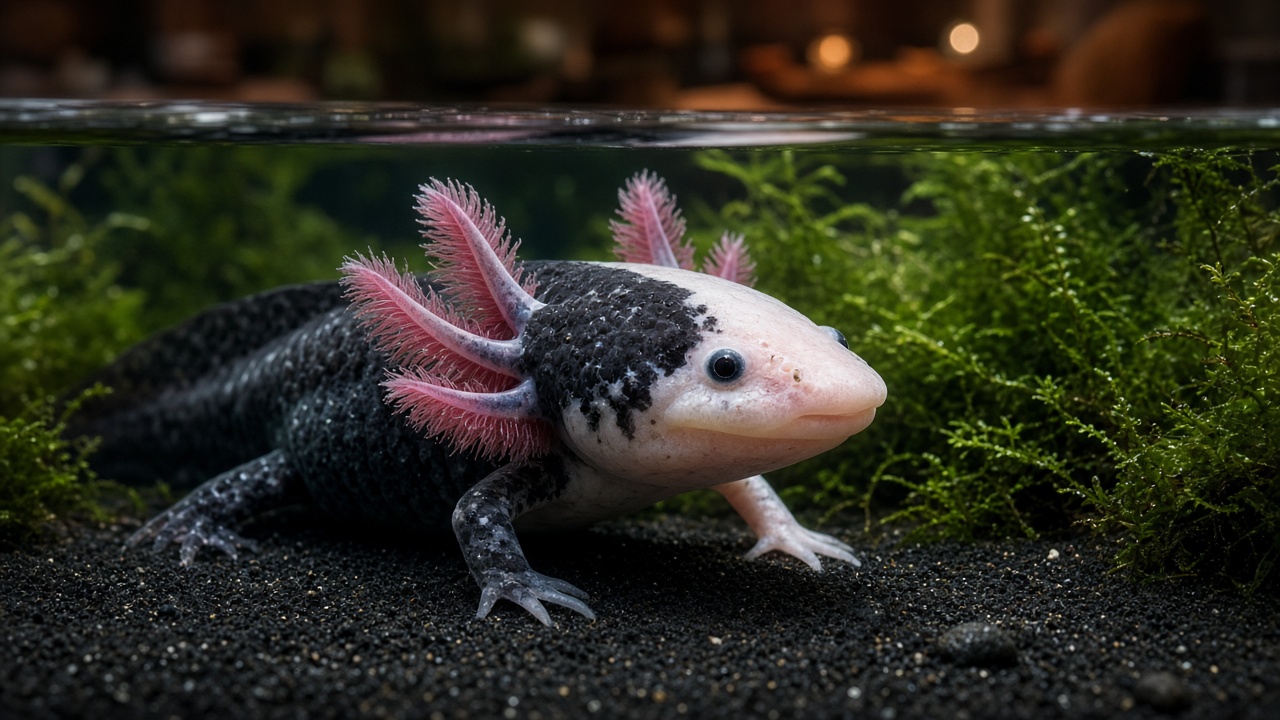
Do not start with color. Pink or white animals in the pet trade are almost always axolotls, while wild-type dark animals can be either species.
Both animals keep external gills as adults, so gills alone do not settle the name. Use the toe count, then the place.
Size ranges from the species accounts
Published lengths overlap, so size is a support check rather than the first check.
COSEWIC’s 2023 report lists adult mudpuppy total length as 20 to 49 cm. The same report names the largest reported Canadian specimen as 45.5 cm, taken at Long Point on Lake Erie.
AmphibiaWeb lists the axolotl as a large salamander that can reach about 40 cm. Our research team subtracted those published maxima, and the mudpuppy account’s top figure is 9 cm longer.
AmphibiaWeb also tracks wild axolotl growth by year:
- Up to 20 cm total length in the first year
- About 10 cm more in the second year
- Slower growth after that year
A 25 cm dark animal in a home tank can still be an axolotl. A 45 cm animal from a Great Lakes ice hole matches the mudpuppy account, not the axolotl account.
Use a simple ruler check:
- Under about 20 cm: either species, or a young animal. Go back to toes.
- About 20 to 40 cm: still either species. Toes and place decide.
- Over 40 cm from North American wild water: treat it as a mudpuppy unless the hind foot shows five toes.
COSEWIC also notes that mudpuppies have been captured at depths as great as 32 m. That is a wild-habitat figure, not a tank depth.
Range and status are ID clues
Place is the second hard check after toes, because the two species do not share a native range.
COSEWIC’s 2023 report maps mudpuppies across much of the east-central United States and into southern Manitoba, Ontario, and Quebec. In December 2023, COSEWIC split the Canadian animals into two units.
It designated the Manitoba population Threatened and the Great Lakes / St. Lawrence population Special Concern.
The same report says those Great Lakes animals now appear missing from 14 percent of past sites. Extent of occupancy dropped 7 percent from pre-1997 levels, and the index of area of occupancy dropped 14 percent. Those figures describe wild mudpuppies, not pet axolotls.
AmphibiaWeb limits wild axolotls to Lake Xochimilco and Lake Chalco, next to Mexico City, at an elevation of 2240 m. The same account cites an extent of occurrence of 468 km², which is a tiny wild map next to the mudpuppy’s multi-state range.
AmphibiaWeb lists the axolotl as Critically Endangered and on CITES Appendix II. It also records a wild decline of 80 percent since 2003, and survey density as low as 0.001 individuals per square meter.
COSEWIC’s 2023 report states that the mudpuppy is classified as Least Concern on the IUCN Red List. That global rank does not cancel the Canadian listings.
If you found the animal in the wild in North America, do not move it or put it in a display tank. Confirm the toes, then leave it in the water body. State and provincial rules vary, and this desk does not issue permits.
Color and life stage will fool you
Color is a weak check, and life stage is a weak check, because both species stay in the water as adults.
COSEWIC describes adult mudpuppy color as cream or rusty brown to gray or black, with darker blotches or spots. It notes a dark stripe through the eyes to the gills. Albino forms are rare, but have been captured in Quebec, so a pale wild mudpuppy is possible.
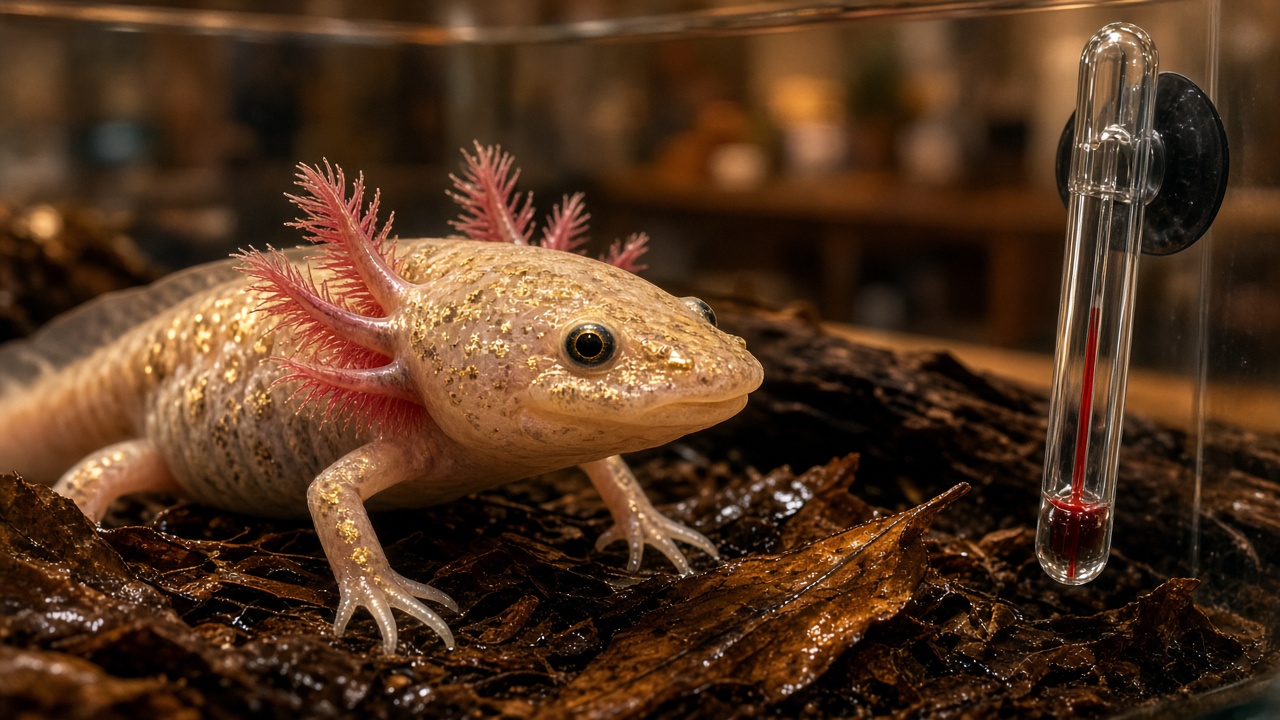
AmphibiaWeb describes wild axolotls as dark or black with white flecks and black spots. It then notes that several color mutations exist in laboratory lines. Pink, white, gold, and piebald animals in the trade are those captive lines, so color proves a captive strain, not that a mudpuppy is impossible.
Age numbers also fail as a first check. AmphibiaWeb says lab axolotls reach sexual maturity between 8 and 15 months and can live over 10 years.
COSEWIC says mudpuppies live more than 30 years. Canadian females first reproduce between ages 7 and 10, and generation time is 15 years.
AmphibiaWeb reports that, in rare lab cases, typically less than 1 percent, an axolotl will metamorphose. That animal then looks more like a land salamander and no longer shows the gilled axolotl form. Do not use a gill-less body to name a mudpuppy, because mudpuppies keep gills.
Skip these traps:
- “It is pink, so it cannot be a mudpuppy.” Rare pale mudpuppies exist in the COSEWIC account.
- “It is brown, so it cannot be an axolotl.” Wild-type axolotls are dark on AmphibiaWeb.
- “It is small, so it is a baby mudpuppy.” A first-year axolotl can already reach 20 cm.
Gear to match after you name the animal
Once the toes say axolotl, the job shifts from ID to cool, low-flow water. Once the toes say mudpuppy, the job is to leave a wild animal alone.
This section covers only currently sold tanks, filters, and water products whose maker pages list a volume, a flow, a dose, or a test count. After you confirm an axolotl, use the axolotl tank setup page for the cool-water housing steps.
AmphibiaWeb cites wild axolotl water at 16 to 20°C and pH between 7.4 and 8.2 in the 1980s. It also cites an optimal temperature of 18 to 20°C and an optimal hatching pH between 7 and 8. Those are published water bands, not a product claim.
Our research team compared the maker specs below. The Fluval Flex 32.5 Aquarium Kit lists 32.5 US gallons and a footprint of 32.5 inches by 15.35 inches. That floor area is about 499 square inches, which matters more than height for a bottom-walker.
The same Flex page lists a pump output of 214 US gallons per hour at 120 V. The Fluval U4 Underwater Filter page lists 260 US gallons per hour, which is 46 gallons per hour higher than the Flex pump. For a confirmed axolotl, higher flow is not automatically better, so baffle the outflow.
| Product | Maker-listed job | Published capacity or dose | Published flow, power, or test count |
|---|---|---|---|
| Fluval Flex 32.5 Aquarium Kit | Curved all-in-one tank | 32.5 US gal / 123 L; 32.5 in L × 15.35 in W × 15.75 in H | 214 US GPH; 21 W; 63 LEDs |
| Fluval U3 Underwater Filter | Internal filter | 24–40 US gal / 90–150 L | 155 US GPH; 6 W at 120 V |
| Fluval U4 Underwater Filter | Internal filter | 34–65 US gal / 130–240 L | 260 US GPH; 12 W at 120 V |
| API Freshwater Master Test Kit | Freshwater water tests | Four test tubes and a holding tray | Six listed levels: pH, high range pH, ammonia, nitrite, nitrate |
| Seachem Prime | Tap-water conditioner | 5 mL per 50 US gal of new water | Sizes from 50 mL to 4 L; emergency dose up to 5× |
Read those rows as attributes, not ranks:
- The Flex 32.5 kit is the only all-in-one tank in this set with a maker-listed length over 30 inches.
- The U3 filter’s 24 to 40 gallon band matches a single-adult home tank better than the U4’s 34 to 65 gallon band.
- The U4 filter’s 260 GPH output is the highest flow in this set, so it needs the strongest baffle for an axolotl.
- API’s kit lists four tubes and six parameters. Use it to read ammonia and nitrite before a captive animal goes in.
- Seachem’s page sets the Prime dose at 5 mL per 50 US gallons of new water. One cap thread is about 1 mL.
Do not buy a tropical heater kit as the main plan, because the published axolotl bands sit well below common tropical set points. If the room already sits in the 16 to 20°C band from AmphibiaWeb, a heater is the wrong tool.
FAQ
These answers repeat the same toe-count and place checks used in the sections above.
Is a mudpuppy the same animal as an axolotl?
No. They are different species in different families. COSEWIC treats the mudpuppy as Necturus maculosus, and AmphibiaWeb treats the axolotl as Ambystoma mexicanum. Shared gills do not make them one animal.
What is the fastest way to tell them apart?
Count the hind toes. COSEWIC gives the mudpuppy four toes on each foot, and AmphibiaWeb gives the axolotl five toes on each back foot. Then check the place the animal came from, because toes plus place settle most live IDs.
Can length alone name the animal?
No. COSEWIC’s mudpuppy range is 20 to 49 cm, and AmphibiaWeb’s axolotl maximum is about 40 cm. Those bands overlap for most adults you will see, so use toes first. Use the 45.5 cm Long Point record only as a high-end mudpuppy clue.
If I found one in a US lake, is it an axolotl?
Treat a wild North American find as a mudpuppy until the hind foot shows five toes. COSEWIC maps mudpuppies through the east-central United States, and AmphibiaWeb maps wild axolotls only to the Xochimilco and Chalco waters at 2240 m. Do not take a wild animal home.
Why do pet stores sell pink “water puppies”?
Those are captive-bred axolotl color lines. AmphibiaWeb notes lab color mutations and traces many lab stocks to 34 animals sent from Mexico City to Paris in 1864. Pink color is a trade trait, not a mudpuppy field mark.
What tank gear did this page include?
Only products whose maker pages list a volume, flow, dose, or test count, and that a keeper would use after a captive axolotl ID. The table names the Fluval Flex 32.5 Aquarium Kit, the Fluval U3 and U4 filters, the API Freshwater Master Test Kit, and Seachem Prime.
How long do the published accounts say each animal lives?
COSEWIC calls mudpuppies long-lived, more than 30 years, with a 15-year generation time. AmphibiaWeb says lab axolotls can live over 10 years. Those are account figures, not a promise for a home tank.