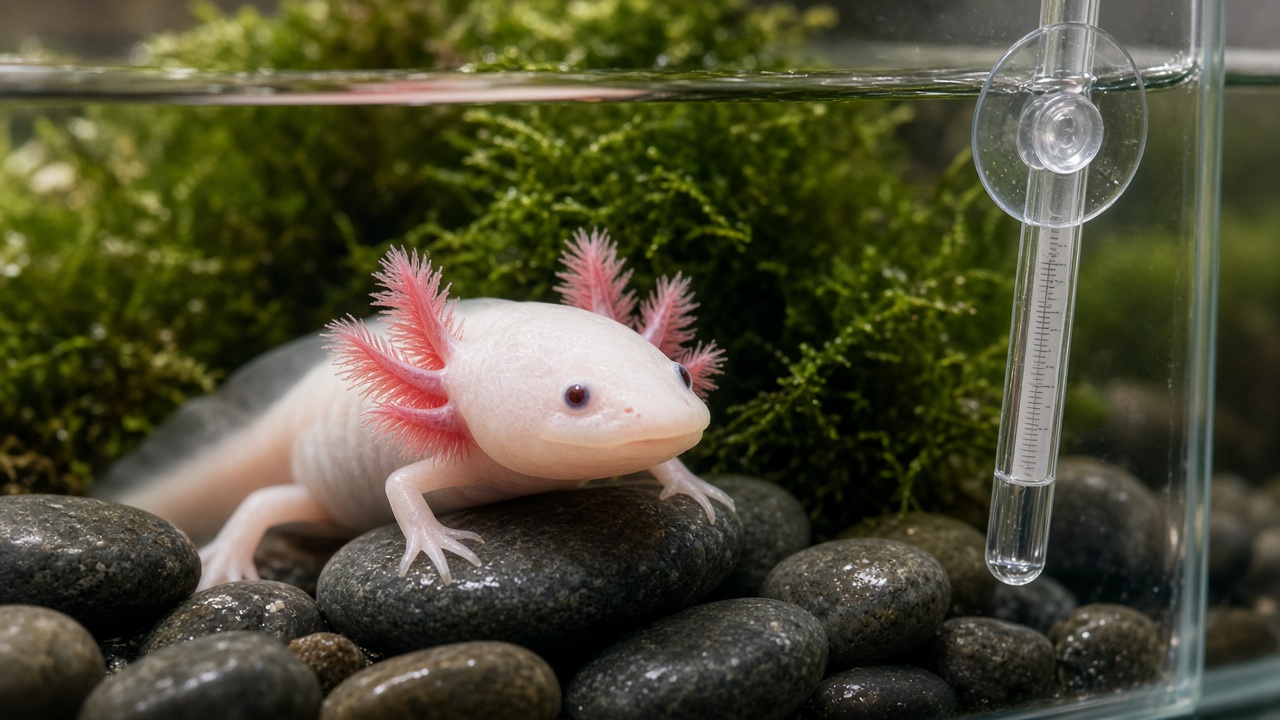
Quick answer: Keep axolotl water between 60 and 65°F. Skip the heater in a normal home. If the tank climbs toward 70°F, cool the room first, then add a fan or a chiller.
Axolotl water is safe at 60–65°F and is not safe when it stays above 72°F.
This page is a desk comparison of published temperature limits and cooling-gear specs.
Our selection rule is simple: a tool enters this article only if its maker page lists a numeric cooling spec. That spec can be a claimed degree drop, a wattage, a horsepower rating, or a tank-length limit. Heaters, ice packs, and decorative stick-on thermometers stay out.
The published safe range
Two independent care pages hold adult water in the same narrow band.
The University of Kentucky Ambystoma Genetic Stock Center keeps its colony at 15–18°C (60–65°F). That husbandry guide says the animals should never be kept above about 22°C (72°F).
API Fishcare lists the same hold range: 60–65°F (15–18°C). Those two pages agree on the target but not on every other number. We leave the splits in place and do not average them into a fake house figure.
API Fishcare also lists pH 7.2–7.6, ammonia 0 ppm, nitrite 0 ppm, and nitrate below 20 ppm. The same page lists GH at 7–14 dGH (125–250 ppm) and KH at least 3 dKH (50+ ppm).
The University of Kentucky guide keeps pH between about 6.5 and 8, which is wider than API Fishcare’s 7.2–7.6 line. Test the water you actually have.
API Fishcare says a grown animal can reach 10 inches and can live more than 10 years. Temperature is a long job, not a weekend tweak.
A betta fish water temp setup is built to stay warm. An axolotl tank is the opposite job. Do not copy a tropical heater kit.
What counts as too warm
Water at or above 70°F is already past API Fishcare’s stress mark.
API Fishcare says these animals become stressed in water above 70°F (21°C). The University of Kentucky guide sets a harder stop and says never keep them above about 22°C (72°F).
Those two lines sit two degrees apart, so treat 70°F as a warning and 72°F as the published ceiling.
The University of Kentucky guide also says warm water is dangerous and tells keepers to keep tanks out of direct sun.
Watch for these husbandry flags from that same guide when water runs warm:
- loss of appetite
- gill deterioration
- open skin sores
- swelling or fluid buildup
Those signs are copied from the colony page and are not a diagnosis. They are a reason to cool the water and get clinical help.
API Fishcare says these animals do not need a heater. In most homes the room is already near the top of the band. A heater set for tropical fish pushes the tank the wrong way.
How to cool water without guessing
Cool the room first, then pick a fan or a chiller from listed specs, not from guesswork.
Our research team analyzed the published spec sheets named in the table below. We compared claimed drop, listed watts, and compressor ratings.
Work in this order:
- Move the tank off a sunny wall and off a floor vent.
- Read a thermometer that sits in the water, not on the glass sticker.
- If water holds 60–65°F, stop and do not add cooling gear.
- If water sits at 66–70°F, start with room air and a surface fan.
- If water stays at or above 70°F after that, look at a compressor chiller.
hygger’s Autumn Cooling Fan page claims a 3–7°F (1.5–4°C) drop. API Fishcare’s hold range tops out at 65°F. A tank that starts at 72°F could land at 65–69°F if that claim holds.
That still sits on or above the top of the hold range.
The same hygger page lists a set range of 59–93°F (15–34°C). The upper half of that range is far above both published axolotl limits. Set the controller to the hold band and do not use the full dial.
A clip-on fan cools by moving air across the surface, which raises evaporation, so top off with dechlorinated water. A compressor chiller cools the water itself.
Hydrofarm’s page for the Active Aqua AACH10HP lists 1,020 BTU per hour and 190 watts.
Cooling gear compared by published specs
Our research team compared five currently listed tools by wattage, tank limit, and control range. The table uses maker-listed attributes only and has no rank column and no price column.
| Product | Type | Listed power | Maker limit | Control or claimed drop |
|---|---|---|---|---|
| hygger Autumn Cooling Fan | Surface fan | DC 5V; under 12 dB | Walls up to 1 inch (2.5 cm) | 3–7°F drop; 59–93°F set range |
| hygger HG051-2FAN | Dual-head fan | 2.2 W × 2 | Tank length 15.7 inches | 5 wind speeds |
| hygger HG051-3FAN | Triple-head fan | 2.2 W × 3 | Tank length 23.6 inches | 5 wind speeds |
| Active Aqua AACH10HP | 1/10 HP chiller | 190 W / 2.2 A | 10–40 gallon reservoir | 1,020 BTU/hr; 132–396 GPH |
| INKBIRD ITC-308 | Dual-relay controller | 120 VAC, 10 A, 1,200 W max | Switches other gear | −58 to 248°F; ±2°F accuracy |
Match fan heads to glass length. hygger’s HG051 table lists 15.7 inches for two heads and 23.6 inches for three heads.
API Fishcare names a 20-gallon Long as a good home tank. Pick the fan row by the length on hygger’s table, not by gallons alone.
Our research team analyzed the wattage lines on those maker pages. The Active Aqua AACH10HP lists 190 watts, and the hygger HG051-2FAN lists 2.2 watts per head, or 4.4 watts for two heads.
That is about 43 times more listed power on the compressor. hygger’s HG051-3FAN lists 2.2 watts × 3, or 6.6 watts. A fan is a small-gap tool, and a chiller is a hold-the-setpoint tool.
The hygger Autumn Cooling Fan page also lists 120° airflow and a body of 5.9 × 3.5 × 2.4 inches. hygger’s HG051 page lists a rimless-glass limit under 0.45 inches (1.1 cm), so check the tank rim before you buy that clamp.
Hydrofarm also lists a 17 × 10 × 15 inch case and 1/2-inch plus 3/4-inch fittings. API Fishcare asks for 15–20 gallons per axolotl, and Hydrofarm’s 10–40 gallon band covers that home volume on paper.
The INKBIRD ITC-308 page lists a control range of −50 to 120°C (−58 to 248°F) and ±1°C / ±2°F accuracy. It is not a chiller. It switches a cooling device on one relay, so use the cooling socket only.
INKBIRD’s page says the probe is IP68. The body and socket are not waterproof, so keep the box off splash.
Room setup that cuts heat first
Placement and lids change the load more than a small fan can.
The University of Kentucky guide says never house axolotls in direct sun, so start on an interior wall away from a window.
Do these cheap steps before you buy a compressor:
- Keep the tank off heating vents and off sunny glass.
- Kill unused lights, because lights add heat at the surface.
- Leave space behind a chiller so exhaust air can leave.
- Use a tight lid if a fan raises splash or jump risk.
API Fishcare prefers a long, wide tank because the animal walks the floor. A full axolotl tank setup covers footprint, sand, and flow, and this page only covers heat.
API Fishcare also wants low flow, but a chiller loop needs a pump. Baffle the return so the animal is not pushed around.
The University of Kentucky guide says rapidly circulating water is stressful, so slow the outlet and do not shut the pump off.
The University of Kentucky colony houses two adults in a ten-gallon aquarium as a lab rule of thumb. API Fishcare asks for 15–20 gallons per animal in a home tank, so use the API Fishcare volume for a pet display.
Water chemistry still matters when you cool
Cold water does not replace dechlorination or a finished cycle.
The University of Kentucky guide says never house axolotls in extremely soft or distilled water. It also says to remove chlorine, chloramines, and ammonia from municipal water.
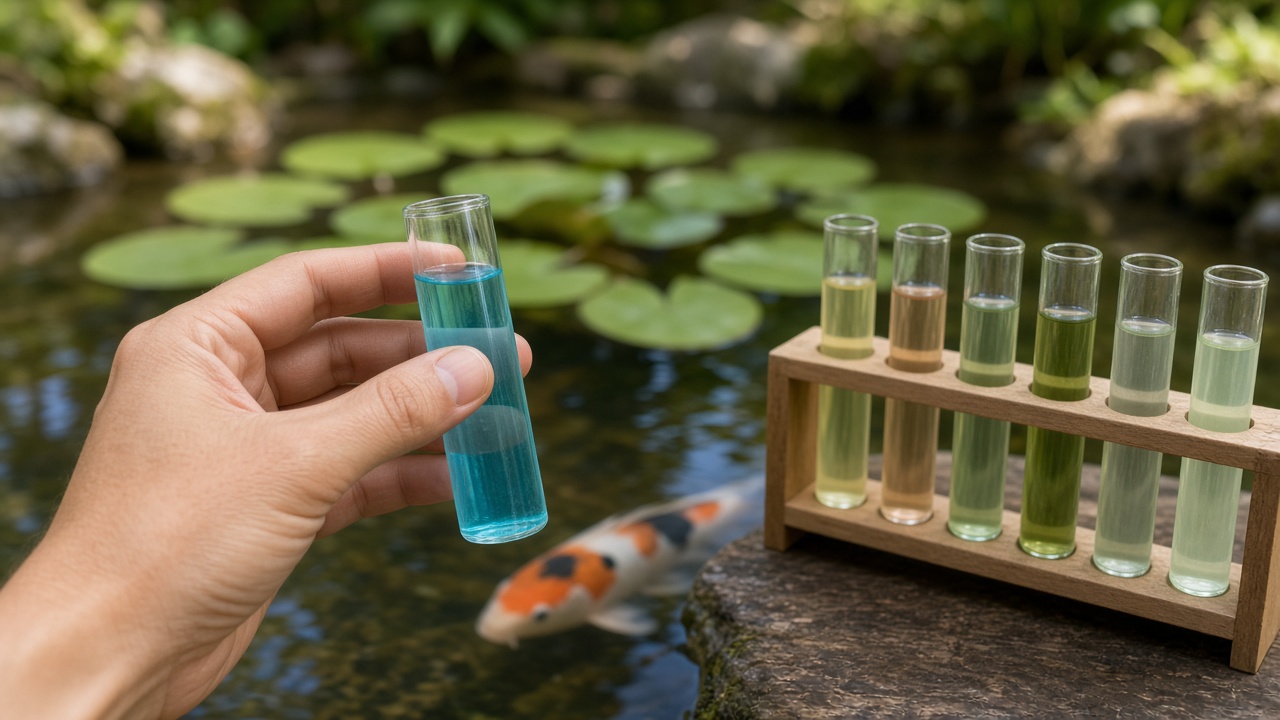
API Fishcare says to treat tap water before it enters the tank, so use a conditioner made for chlorine and chloramine. Our freshwater conditioner guide covers that step. Do not skip it because the tank feels cool.
API Fishcare wants weekly or biweekly water changes to keep nitrate below 20 ppm. Cooling gear does not eat waste.
A fan can raise evaporation, and a chiller adds hose joints, so both create new leak and top-off chores.
Check these items after you add a cooler:
- ammonia still 0 ppm
- nitrite still 0 ppm
- nitrate still under API Fishcare’s 20 ppm line
- GH still inside 7–14 dGH if you follow that page
- water level after a fan runs overnight
API Fishcare lists a 20-gallon Long or a 40-gallon Breeder as good boxes. Larger volume changes temperature more slowly, and that is not a license to skip the thermometer.
What this guide leaves out
This page skips ice bottles, heaters, and any gear without a numeric cooling spec.
No maker page in our source set lists a safe drop rate for ice bottles. Rapid swings are a husbandry risk, so we do not invent a schedule for them.
If a product is not in the table, it failed the selection rule. The University of Kentucky guide is a colony protocol, and API Fishcare is the closer match for a home display.
FAQ
What temperature should axolotl water be?
Keep it at 60–65°F. The University of Kentucky Ambystoma Genetic Stock Center holds its colony at 15–18°C (60–65°F). API Fishcare prints the same 60–65°F band.
Do not pick a warmer “room temperature” target.
Do axolotls need a heater?
No, not in a normal indoor room. API Fishcare says they do not need a heater and that water above 70°F stresses them. Add heat only if the room itself drops below 60°F for long stretches.
Is 70°F too hot for an axolotl?
Yes for long-term holding. API Fishcare marks stress above 70°F (21°C), and the University of Kentucky guide says never keep them above about 22°C (72°F). Treat 70°F as too high for a steady home tank.
Will a clip-on fan keep a 20-gallon tank cool enough?
Only if the gap is small. hygger’s Autumn Cooling Fan page claims a 3–7°F drop, and API Fishcare’s hold range ends at 65°F. A tank that sits at 76°F may not land inside that band.
When do I need a chiller instead of a fan?
Use a chiller when water stays at or above 70°F after you cool the room and run a fan. Hydrofarm lists the Active Aqua AACH10HP at 1,020 BTU per hour for a 10–40 gallon volume. Size the pump to the 132–396 GPH line on that page.
Can I use ice bottles to cool the tank?
We do not include ice bottles here. No maker page in our source set lists a safe drop rate for that method. Use room air, a listed fan, or a listed chiller instead.
How should I measure tank temperature?
Use a thermometer that reads the water, not only the room. The INKBIRD ITC-308 page lists ±2°F accuracy and a dual display. Keep the body dry, because INKBIRD says the probe is IP68 and the body is not.