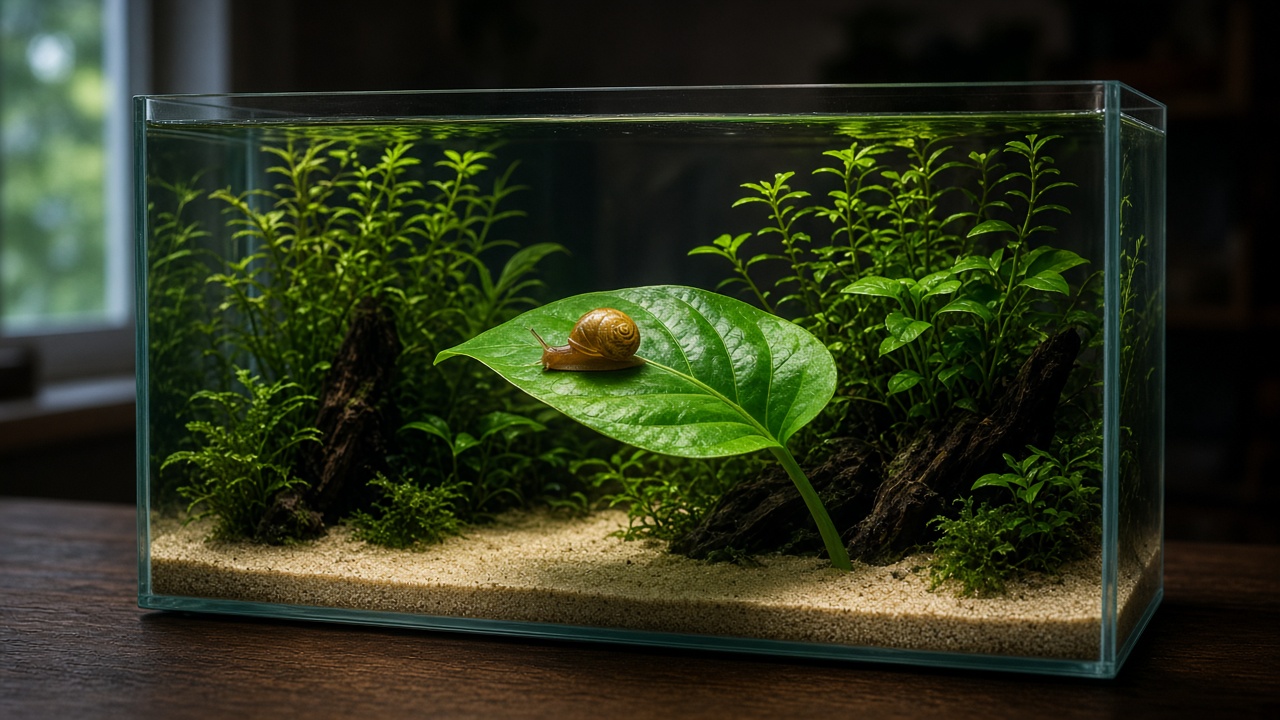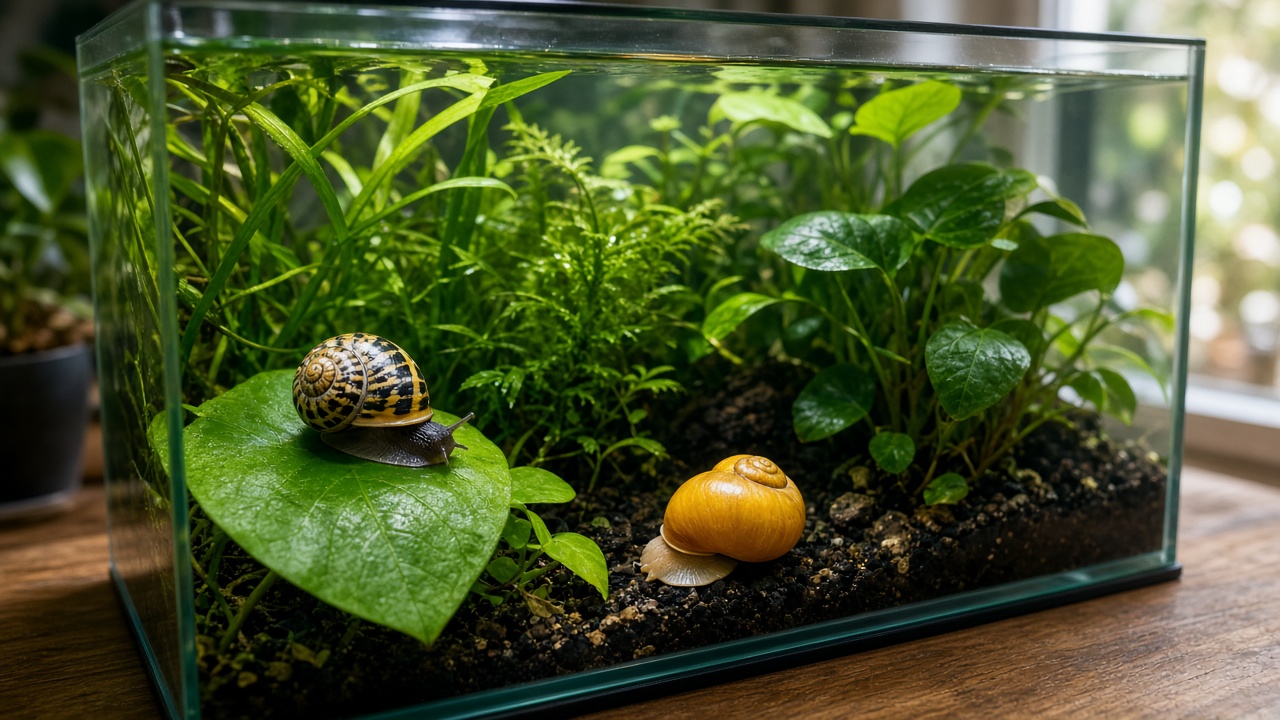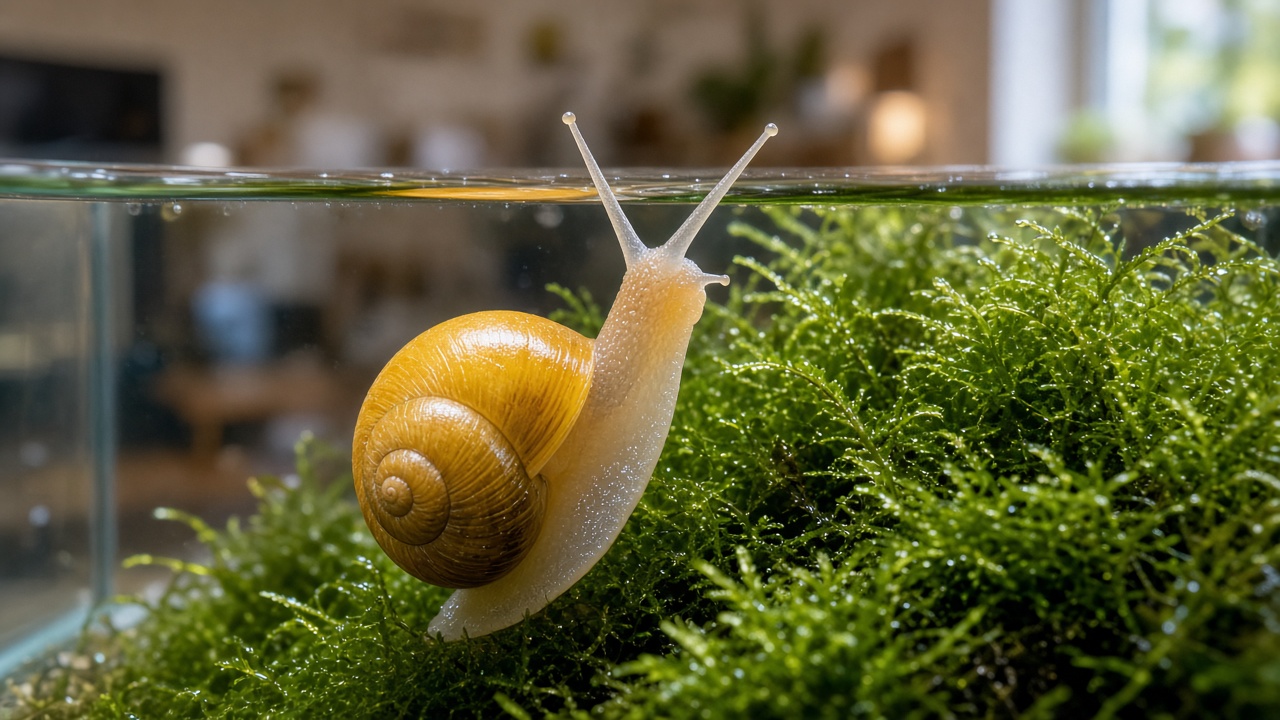
Quick answer: Mystery snails sold in U.S. shops are Pomacea diffusa. Keep them in a lidded freshwater tank with mineral hardness, sinking plant food, and dry air space for eggs. Never release them outdoors.
U.S. pet-trade mystery snails are Pomacea diffusa, a separate-sex apple snail that reaches 60 mm and lays 200–600 eggs above water.
This page is a Waterpuppy research-desk spec comparison of agency species pages and four current maker labels. We did not run tank trials, did not open wild snails, and did not review medications.
Our research team analyzed published specs only, and a product enters this guide only under the Waterpuppy Four-Label Filter. The maker page must list a protein percent, a calcium percent, or a printed dose.
We cover Pomacea diffusa sold as mystery snails. We do not cover channeled apple snails, island apple snails, saltwater snails, or unlabeled foods.
What U.S. shops sell as a mystery snail
The animal in the bag is a spike-topped applesnail with a raised spire, not a generic pond snail.
The U.S. Geological Survey species profile for Pomacea diffusa lists a rounded shell with 6 whorls. Color runs from yellowish to dark olive-brown, and many shells also show radial stripes.
The same USGS profile lists size as up to 60 mm in height. Typical measures are 42 mm high and 33 mm wide, and an older average of 38 mm also appears on that page.
The University of Florida IFAS Featured Creatures page on Florida applesnails gives the same species a height of 40–60 mm. IFAS notes that shops market it as a “golden applesnail” and also names the “albino mystery snail” as a trade form.
USGS states that sexes are separate and that Pomacea species have both lungs and gills, so these snails are not hermaphrodites.
USGS says applesnails feed mainly on plants, and the profile notes that P. diffusa will eat carcasses of dead aquatic animals. IFAS adds that they feed mostly on decaying vegetation.
Do not mix this species with larger invasive Pomacea. IFAS says USDA-APHIS, effective 5 April 2006, stopped interstate permits for other Pomacea, and the spike-topped applesnail is the listed exception.
Tank size we cover, and the setups we skip
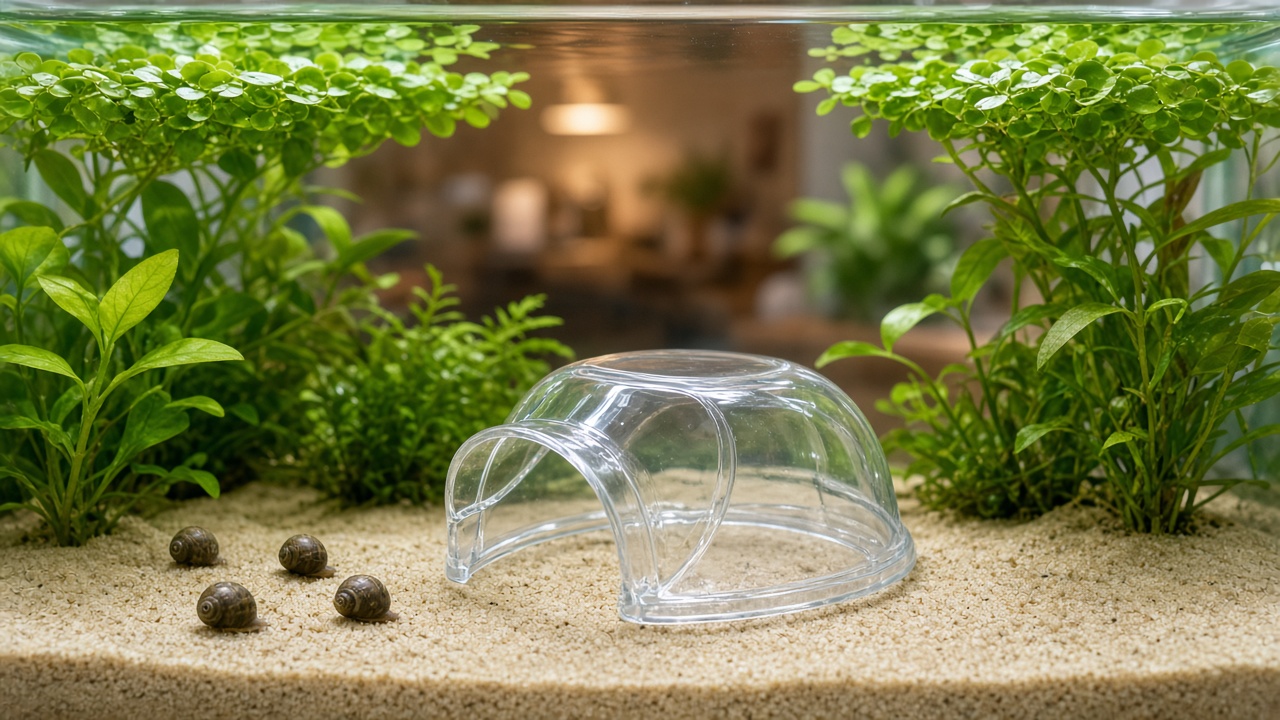
We cover lidded tanks large enough for a 60 mm adult and a dry clutch zone.
No agency page we read sets a gallon minimum. Our coverage rule is a 10-gallon tank for one adult. We add a second adult only when that 60 mm turning radius still fits under a tight lid.
We skip these setups:
- Open-top tanks with no lid
- Bowls and unfiltered jars
- Outdoor ponds and water gardens
- Tanks with no dry band under the lid
USGS says females lay eggs above the water on hard surfaces. A lid gives them that surface and also stops climbs out of the tank.
IFAS says eggs that sit under water will not hatch, so the water line must sit below the clutch. Leave a dry band of glass or plastic for the eggs.
USGS says the life span is several years. Plan the tank as a multi-year home, and do not treat the snail as a short clean-up tool.
Water, hardness, and temperature limits we can source
We only state water numbers that sit on the agency or maker pages we read.
IFAS says Florida Pomacea species are not known to withstand water below 10°C (50°F). Keep a room-heated tank above that floor. We do not invent an upper “ideal” band.
Seachem’s page for Equilibrium lists a planted-tank guide of about 1–2 meq/L, or 3–6 dH. Mystery-snail shells are mineral structures. Our coverage rule is to stay at or above that 3 dH floor on RO or very soft tap water.
Seachem’s Equilibrium directions are:
- Add 16 g (1 tablespoon) per 80 L (20 U.S. gallons) to raise GH by 1 meq/L (3 dH)
- Mix the powder in 1 L of water first
- Expect a short haze that clears in 15–30 minutes
- Do not dose it into evaporated top-off water
Seachem’s guaranteed analysis per 1 g lists:
- Calcium 8.06%
- Magnesium 2.41%
- Soluble potash (K2O) 23.0%
- Iron 0.11%
- Manganese 0.06%
Seachem’s Prime page lists 5 mL per 50 U.S. gallons of new water, and each cap thread is about 1 mL.
Prime notes from that same page:
- A double dose is listed as safe for very high chloramine
- Up to 5 times the normal dose is listed for emergency nitrite
- Use a half dose if temperature is above 30°C (86°F) and chlorine or ammonia is low
- Prime can be dosed every 24–48 hours
Seachem states that Prime removes chlorine and chloramine, binds ammonia, nitrite, and nitrate, and will not change pH.
Seachem also states that the ammonia bond holds for up to 48 hours. If the waste is still there after that window, the bind ends unless you dose again.
We do not print a hobby-blog pH band. We do not print nitrate “under 20 ppm” as a sourced fact, because those figures were not on the pages in our source set.
Diet from plant waste and labeled foods
Adults graze plants and waste, and labeled sinking foods fill gaps in a clean tank.
USGS says P. diffusa feeds mainly on plants and will also take animal carcasses. IFAS says they eat mostly decaying vegetation, so a spotless tank will not feed them.
The USGS profile notes that Howells found P. diffusa rejected rice sprouts and preferred rocks coated with algae film. That is why we treat leftover film and soft plant waste as the base diet.
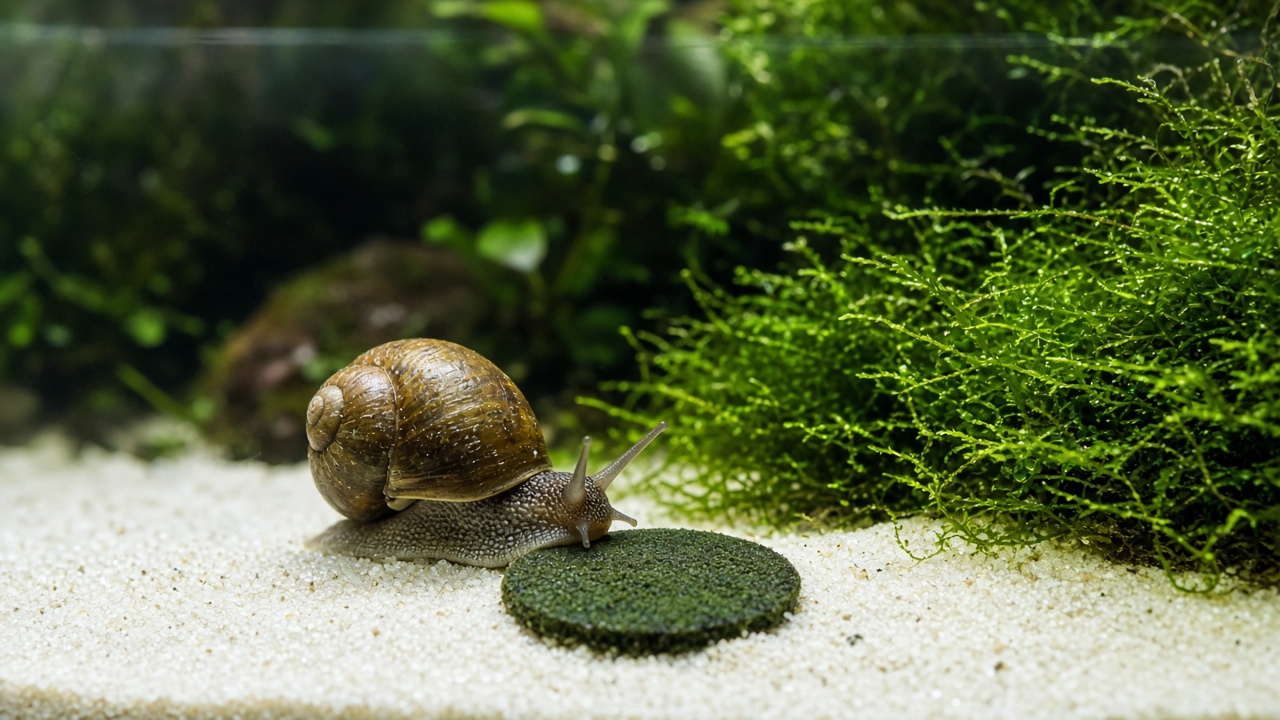
Hikari’s page for Tropical Algae Wafers lists a sinking disc for algae eaters. The guaranteed analysis is:
- Crude protein min. 33%
- Crude fat min. 4.0%
- Crude fiber max. 3.0%
- Moisture max. 10%
- Ash max. 17%
- Phosphorus min. 0.8%
Hikari’s feeding line is clear: feed no more than the animals will eat within 2 hours, then remove leftovers. Hikari lists pack sizes of 0.7 oz (20 g), 1.41 oz (40 g), 2.89 oz (82 g), and 8.8 oz (250 g).
Omega One’s page for Super Veggie Green Nori Seaweed lists a dried-seaweed food. The guaranteed analysis is:
- Crude protein min. 24%
- Crude fat min. 3%
- Crude fiber max. 3%
- Moisture max. 10%
Our research team compared those two food labels and did not rank them. Hikari lists more protein, while Omega One lists a seaweed sheet with a lower protein line.
Feed on a schedule you can clean up:
- Offer one Hikari wafer or a nori piece after lights-out.
- Check the tank at 2 hours if you used wafers.
- Lift any leftover food so it does not rot.
Blanched vegetables show up in many hobby write-ups, but no maker page in our set lists a zucchini dose. We mention vegetables only as extra plant matter, not as a labeled diet.
Hikari does not list a calcium percent on the Algae Wafers page, and that is why Seachem Equilibrium sits in the product set. Food protein and water minerals are separate lines on the labels.
Four current products, compared by label
The table below is an attribute grid from maker pages, not a ranking.
| Product | Form | Maker-listed protein | Maker-listed mineral | Maker dose or feeding window |
|---|---|---|---|---|
| Hikari Tropical Algae Wafers | Sinking disc | 33% min crude protein | 0.8% min phosphorus | Eat within 2 hours |
| Omega One Super Veggie Green Nori Seaweed | Dried seaweed sheet | 24% min crude protein | None listed | No hour window on the maker page |
| Seachem Prime | Liquid conditioner | Not a food | Not a mineral mix | 5 mL per 50 U.S. gallons of new water |
| Seachem Equilibrium | Mineral powder | Not a food | 8.06% calcium | 16 g per 20 U.S. gallons raises GH by 3 dH |
Seachem lists Prime bottle sizes of 50 mL, 100 mL, 250 mL, 500 mL, 1 L, 2 L, and 4 L. Equilibrium comes in 300 g, 600 g, and 4 kg.
Use the four products this way:
- Dose Seachem Prime into new tap water at 5 mL per 50 U.S. gallons
- Dose Seachem Equilibrium when GH sits below the 3 dH floor
- Offer Hikari Tropical Algae Wafers as the sinking meal
- Offer Omega One Super Veggie Green Nori as the seaweed meal
Do not stack two conditioners on the same change unless a maker page says to. Do not treat nori as a GH booster, because the Omega One page lists no calcium percent.
Breeding, egg clutches, and air space
A female needs a dry ledge, and clutches are large and sit above water.
USGS states that sexes are separate, so one snail cannot breed alone and you need both a male and a female.
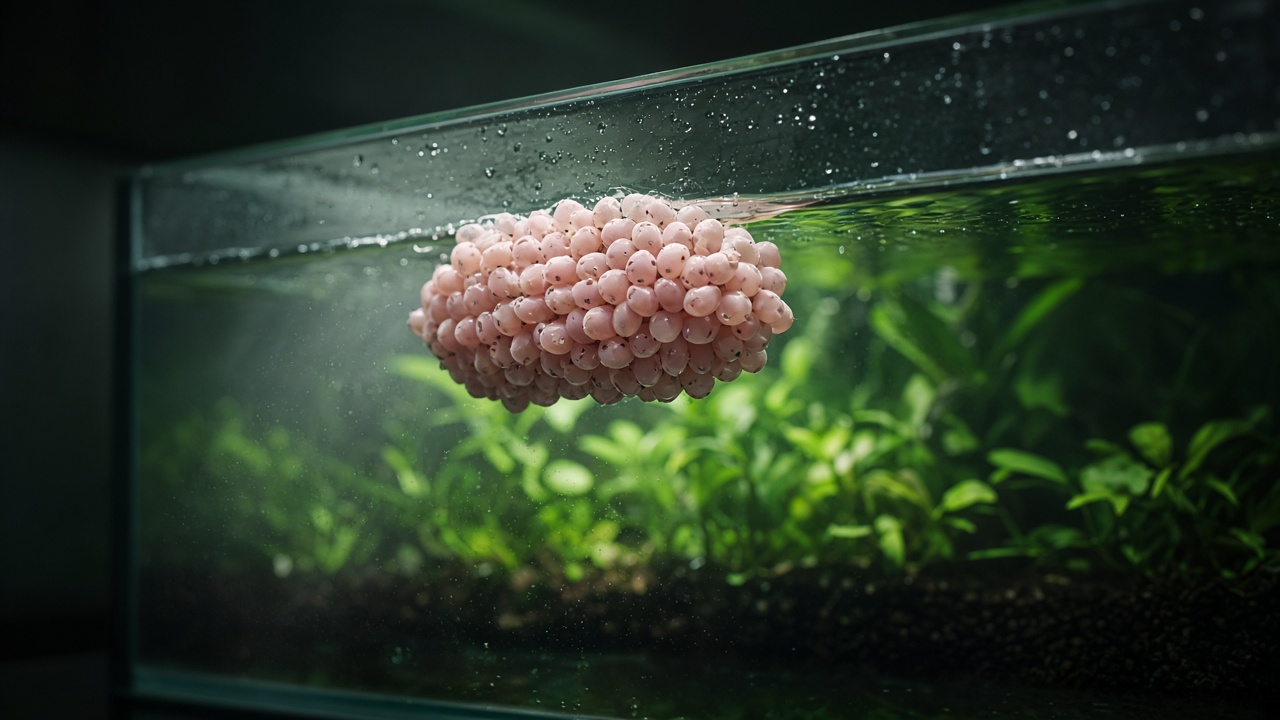
USGS says the female lays a clutch of 200–600 eggs, and each egg is 3 mm across. She lays them above the water on plants, rock, or concrete, and hatchlings then fall into the water.
USGS describes P. diffusa eggs as tan to salmon, and IFAS uses egg color to tell species apart.
Pink clutches often belong to other introduced Pomacea. Large white grape-like eggs belong to the native Florida applesnail.
IFAS says eggs that fall into the water will not hatch. If you do not want babies, lift the dry clutch, put it in the trash, and do not flush live snails.
Leave a dry gap under the lid so the clutch cannot sit in the surface film. We do not print an inch count, because no page in our set lists one.
Because USGS lists both lungs and gills, adults can spend time at the surface. That habit is normal, and it is also why a lid matters.
Legal shipping and outdoor release
Interstate rules treat most Pomacea as restricted, so do not dump tank snails.
IFAS states that, effective 5 April 2006, USDA-APHIS requires permits for import or interstate shipment of marine and freshwater snails. Permits are not being issued for Pomacea, except Pomacea diffusa.
IFAS says shipping other Pomacea without a permit violates U.S. federal law. Buy from sellers who name the species, and return mislabeled pink-egg stock to the seller.
USGS records wild P. diffusa in Florida and Hawaii, and the profile also notes possible establishment in Mobile, Alabama. USGS lists aquarium pets as one path for those records.
IFAS says never release applesnails from tanks into the wild. That sentence closes our coverage, and we do not cover wild control or outdoor ponds.
FAQ
Do mystery snails stay small?
They do not stay small. The U.S. Geological Survey lists adults up to 60 mm high, and typical shells are about 42 mm by 33 mm. Plan for a large foot and a large waste load.
Can one mystery snail have babies?
A single snail will not found a colony, because USGS says sexes are separate. A pair can produce 200–600 eggs per clutch.
What water temperature is too cold?
IFAS says Florida Pomacea species are not known to withstand water below 50°F (10°C), so keep the tank above that floor. We do not claim a single best temperature.
What should I feed them every day?
Offer a sinking plant food whose maker lists protein. Hikari Tropical Algae Wafers list 33% min protein and a 2-hour eat window. Omega One Super Veggie Green Nori lists 24% min protein as a dried-seaweed food.
How do I add calcium without guessing?
Seachem’s Equilibrium page lists 8.06% calcium, and the printed dose is 16 g per 20 U.S. gallons to raise GH by 3 dH. Test GH first on tap water. Dose only the new water on changes.
How do I treat tap water for a snail tank?
Seachem’s Prime page lists 5 mL per 50 U.S. gallons of new water. Add it to the change water, and do not skip conditioner on chlorinated tap.
Can I put them in a pond?
We do not cover outdoor ponds, and IFAS and USGS document wild populations from dumped pets. Keep mystery snails indoors and never release them.