Quick answer: Cut leftover food, then run an overnight baited trap and pick snails after lights-out. Keep copper for a fish-only tank with no shrimp, and do not dose it in a planted community tank.
Overnight baited traps plus leftover-food cuts clear pest snails without copper in community tanks. This page is a methods guide built from published maker specs. We did not run tank trials, did not dose copper, and did not inspect live plants in a warehouse.
How this page chose the six methods
We only kept standing-tank methods and products with a published trap size, wait, or copper ppm.
A method is in this guide only if you can run it with the display tank still filled. A named product is in this guide only if its current maker page lists a trap size, a one-night wait, or a copper ppm.
That standing-tank plus size-or-ppm rule is the only filter we used.
Our research team analyzed five current maker pages for listed sizes and doses. Three list a trap size, a one-piece pack, or a one-night wait, and two list a copper ppm target and a hold time.
We skipped bleach dips, full tank tear-downs, and any bottle whose maker page lists no size and no copper ppm. We also skipped mystery “snail killer” labels with no published concentration.
The six methods in this guide are:
- Cut leftover food so snails lose their fuel
- Pick snails after lights-out
- Run an overnight commercial trap
- Use a vegetable bait night with no bottle
- Add snail-eating livestock only if the tank can host them
- Use copper only in a fish-only hospital tank
Cut leftover food first
Snails boom when extra food sits on the sand and rotting leaves pile up.
Pest bladder snails and ramshorn snails eat leftover flakes, wafers, and rotting leaves. If you only pick snails and keep feeding the same way, the next clutch replaces them.
Do these food cuts while you run the overnight trap:
- Feed fish only what they finish in one sitting
- Lift uneaten flakes and wafers the same day
- Trim melting plant leaves before they fall
- Siphon detritus from the sand during the water change
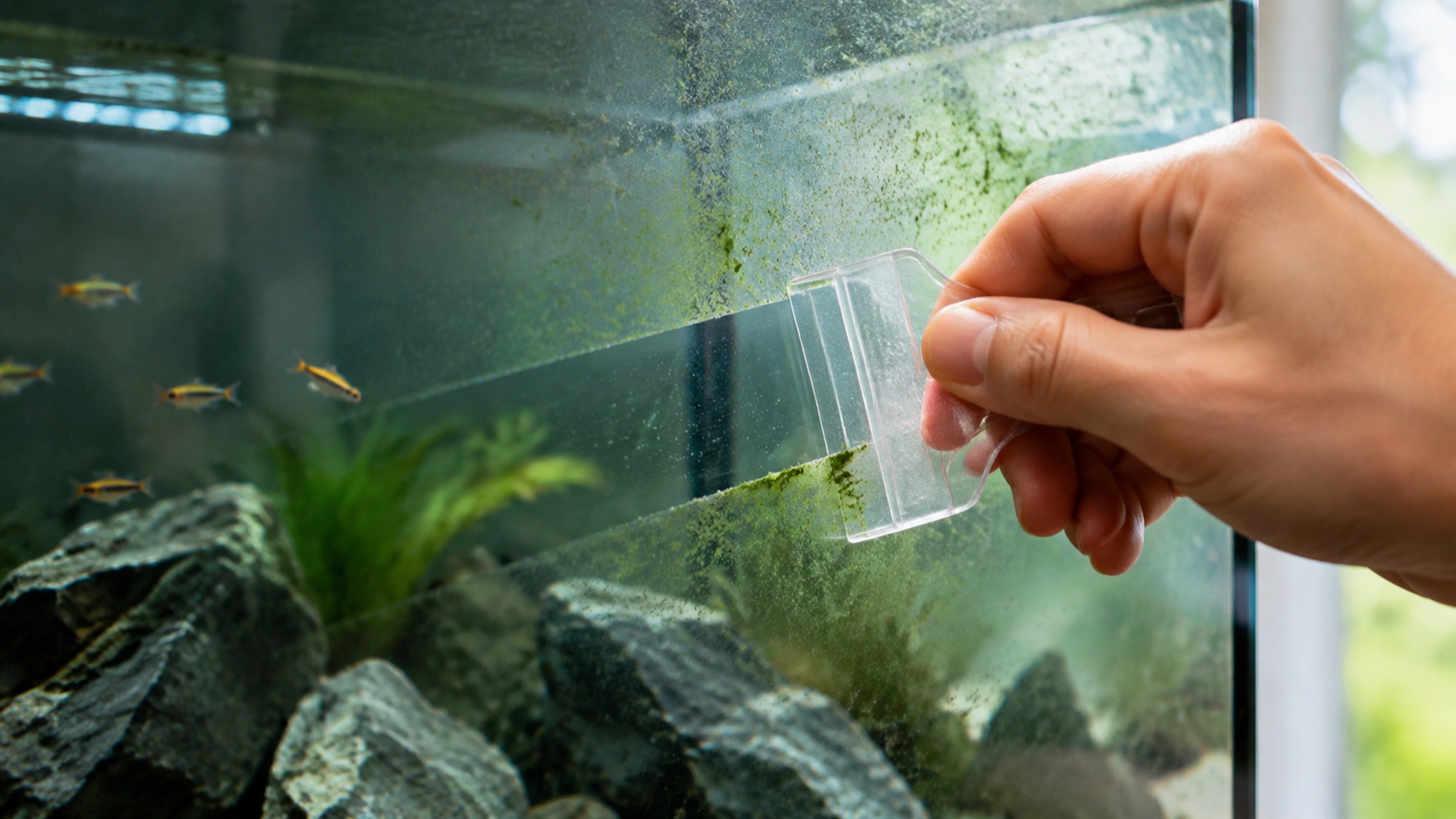
A bright LED light on a planted 20-gallon tank grows extra algae that snails also eat. Shorten the light period if green film covers the glass.
Do not starve your fish when you cut waste; remove only the meal they leave behind.
Pick snails after lights-out
Most pest snails climb the glass to feed after the lights go off.
Hand-picking is slow, but it still works on a small tank if you repeat it. A noon pass still misses snails that hide in the sand.
Use this nightly routine after the lights go off:
- Turn the tank lights off
- Wait until snails climb the glass
- Lift each snail with tweezers or a plastic card
- Drop them into a separate container of tank water
- Repeat the next night
This method does not kill eggs, so you will still see new hatchlings. Pair the nightly picks with leftover-food cuts and a trap.
Keep wanted mystery snails or nerite snails in a bowl of tank water while you pick, then put those keepers back when you finish.
Run an overnight baited trap
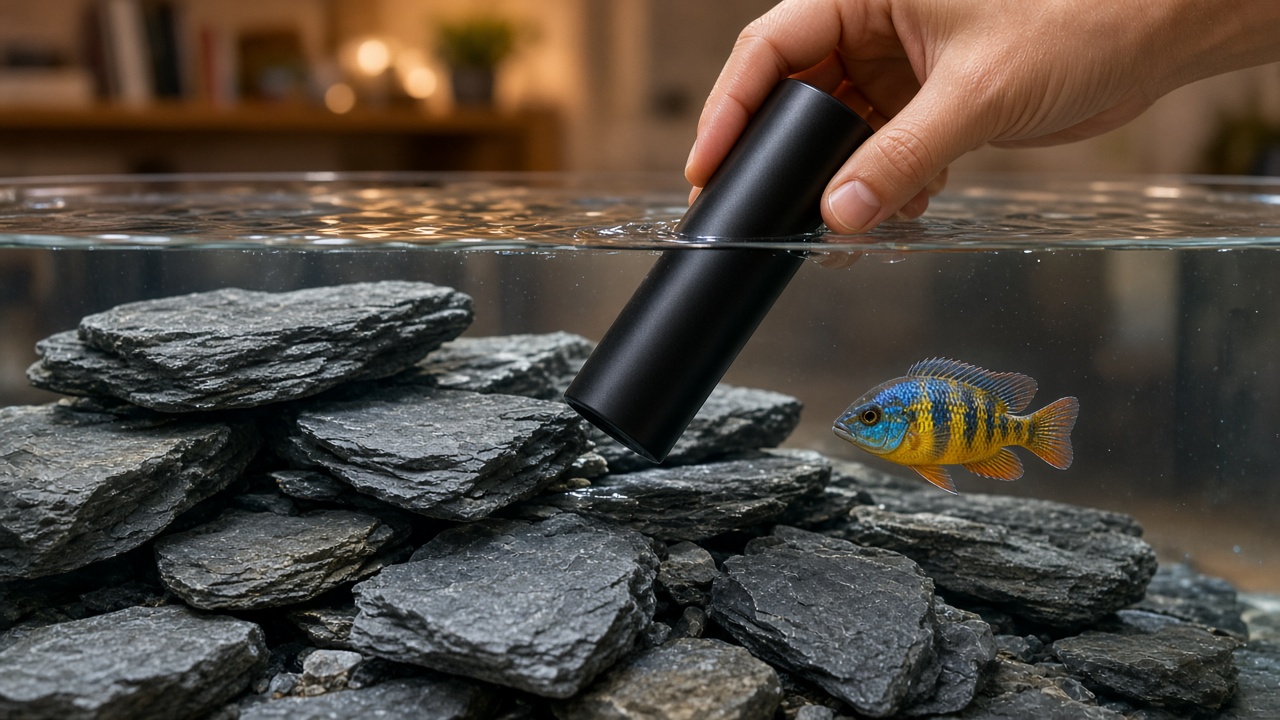
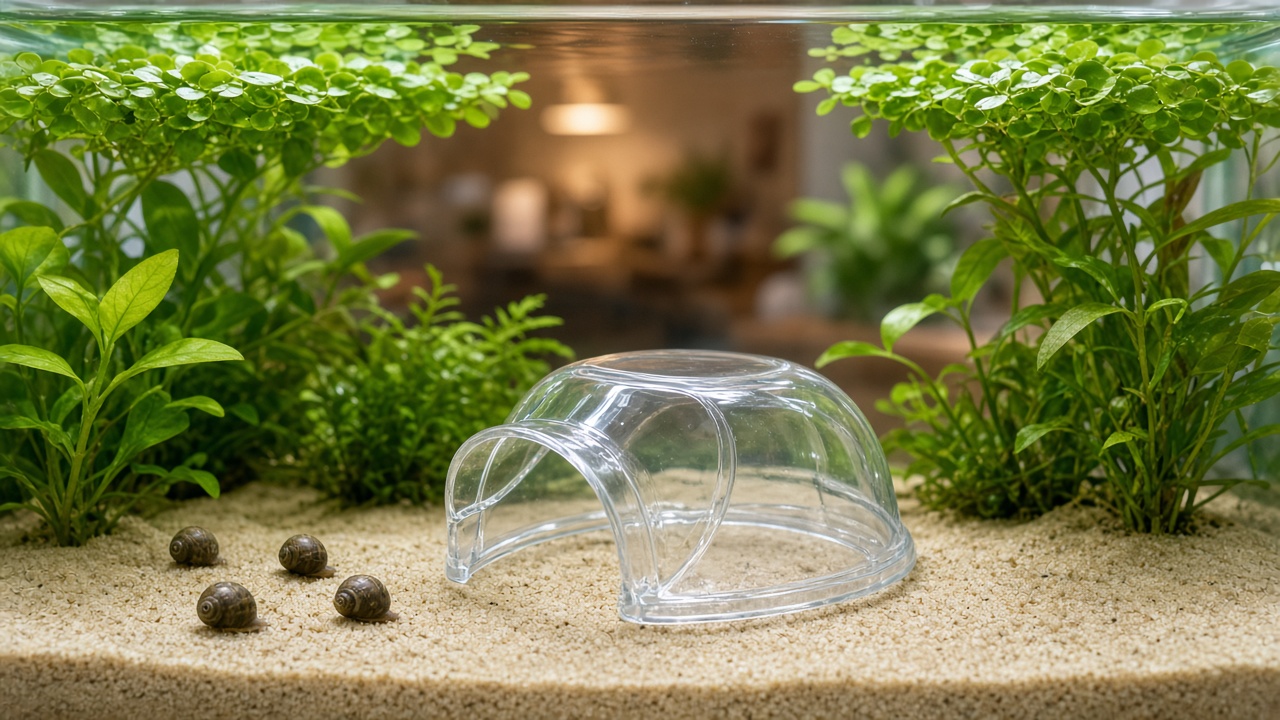
A closed bait chamber pulls snails in while you sleep and keeps bait off the open sand.
Our research team compared three current trap pages for listed size and wait time. Aquarium Co-Op’s Easy Snail Collector page lists a size of 1.9 in by 2.9 in by 4.9 in. The same page lists a 24-hour wait for that collector.
JBL’s LimCollect page lists a size of 11.7 cm by 9 cm and an overnight set. Sera’s snail collect page lists a one-piece pack as item 08585 and says pins block the way back.
Use any of those traps the same way:
- Place a small piece of sinking food in the bait chamber
- Set inlet pins or the lid as the maker page shows
- Press the trap against the sand
- Leave it overnight
- Lift it in the morning and empty the snails
Aquarium Co-Op’s Easy Snail Collector page says to check the collector daily, because some fish treat it as a cave. JBL’s LimCollect page says two small rods set the inlet height so fish stay out.
Sera’s snail collect page says pins in the entry also stop fish. Do not leave bait in after the maker’s listed wait, because rotting bait becomes more leftover food.
Empty trapped snails into a holding tub, then feed them to loaches or puffers if you keep those fish. Do not flush them if your local rules treat that as a release.
Use a vegetable bait night with no bottle
A slice of zucchini or lettuce can stand in when you have no commercial trap. Weight the slice so it stays on the sand, then lift it in the morning with the snails still on it.
Repeat the next night and keep cutting leftover food, or the bait itself becomes the next meal.
Compare current traps and copper bottles
Traps list a size and a wait, while copper bottles list a ppm and a hold time.
The table below is an attribute comparison, not a ranking. Our research team pulled every cell from the named maker page and left price out.
| Product | Maker-listed job | Size or dose from the maker page | Invertebrate note | Wait or hold time |
|---|---|---|---|---|
| Aquarium Co-Op Easy Snail Collector | Overnight snail collection | 1.9 in × 2.9 in × 4.9 in | Wide opening lets fish and shrimp out | 24 hours |
| JBL LimCollect II | Chemical-free snail trap | 11.7 cm × 9 cm; item 6140100 | Two inlet rods to keep fish out | Overnight |
| sera snail collect | Reduce multiplying snails | 1 pc; item 08585 | Pins block fish entry | Overnight bait set |
| Seachem Cupramine | Copper for fish parasites | Freshwater target 0.25 mg/L | Remove all invertebrates | 14 days at full strength |
| Fritz Coppersafe | Chelated copper for fish parasites | 5 ml per 4 U.S. gallons; 1.5–2.0 ppm | Not recommended for snails and other invertebrates | Up to 30 days |
Read the copper rows as last-resort tools, not as community-tank shortcuts, because both copper maker pages treat invertebrates as a remove-or-avoid case.
Add snail-eating livestock only when the tank can host them
Assassin snails and loaches eat pest snails, but they also eat shrimp or small fish in some setups.
This method fails the size-or-ppm product test, so we name no livestock brand and we quote no head-count.
Use livestock only if all of these are true:
- You want some snails gone, not every invertebrate gone
- Your fish list can live with the hunter
- You still cut leftover food
Assassin snails hunt other snails, but they do not clean a tank in one night. Loaches and puffers eat snails too, and some loaches stay too large for a small community tank.
Some puffers nip fins, so skip hunters in a shrimp tank if you want the shrimp. Skip them as well if you keep nerite snails you paid for.
Livestock does not replace the overnight trap; it is a slow follow-up after you cut leftover food.
Use copper only in a fish-only hospital tank
Copper kills snails, and it also kills shrimp and other invertebrates you meant to keep.
Seachem’s Cupramine page lists a freshwater target of 0.25 mg/L for 14 days. It also lists a four-fold gap between the 0.2 mg/L minimum useful dose and the 0.8 mg/L toxic dose. The same page says to remove all invertebrates and to skip water conditioners during treatment.
Fritz Aquatics’ Coppersafe page lists a dose of 1 teaspoon, which is 5 ml, per 4 U.S. gallons. It lists a therapeutic range of 1.5 ppm to 2.0 ppm.
The same Fritz page says the level can hold up to 30 days and that snails and other invertebrates are not recommended. The 4 oz bottle, 118 mL, is listed as treating up to 94 gallons.
Those two ppm targets are not interchangeable, so do not mix the bottles.
If you still choose copper, use a bare fish-only hospital tank:
- Move only the fish you mean to treat
- Remove shrimp, snails you want, and carbon
- Dose only to the maker’s listed ppm
- Keep a quiet air pump running for gas exchange
- Test copper before any extra dose
- Hold the listed time, then remove copper with carbon
Seachem’s Cupramine page says reducing agents make copper more toxic and that Cu+ is 10 times more toxic than Cu2+. The same page says to prep tap water 48 hours ahead if you must use a conditioner, then add copper back to the new water.
Fritz Aquatics’ Coppersafe page says to keep aeration and water flow on. It also says some decor can pull copper down below the listed range.
A mass snail die-off in the display tank dumps ammonia, which is one more reason to keep copper out of a planted community tank.
After copper is gone, treat new tap water with a freshwater water conditioner. Do that only when the copper course is finished and the maker’s wait is over.
Stop new snails from arriving
New plants and extra algae restart the snail boom after you clear the tank.
Most pest snails arrive as eggs on plants, not as adults you can see. A clean trap stretch fails if the next plant order brings a new clutch.
Use this plant-intake checklist before new plants enter the display tank:
- Rinse new plants in a bucket of dechlorinated water
- Rub leaves and stems and look for clear jelly eggs
- Hold new plants in a spare tub and watch for hatchlings
- Repeat the overnight trap in that tub
Keep leftover food low after the tank looks clear, because one heavy feeding stretch can refill the glass with new snails.
If you want a planted look, set the light period to match plant need, not an all-day grow-everything habit. Extra film algae on the glass is still snail chow.
A regular siphon still matters in a cleared tank, because eggs and leftover wafers hide in the sand after each feeding.
FAQ
Will one overnight trap remove every snail?
No, one night misses snails that stay in the sand and also misses eggs. Aquarium Co-Op’s Easy Snail Collector page lists a 24-hour wait, not a one-and-done claim. JBL’s LimCollect page also frames the tool as an overnight set, so run the trap on more than one night and cut leftover food.
Can I put copper in a shrimp tank to kill snails?
No, Seachem’s Cupramine page says to remove all invertebrates before you dose. Fritz Aquatics’ Coppersafe page says snails and other invertebrates are not recommended. Copper that kills pest snails also kills shrimp, so use a trap in a shrimp tank.
How long should I leave a commercial snail trap in the tank?
Follow the maker’s listed wait, then empty the trap. Aquarium Co-Op’s Easy Snail Collector page lists 24 hours and a daily check. JBL’s LimCollect page says to place the trap overnight, and Sera’s snail collect page describes a bait-and-pin set, not a long soak.
What do I do with the snails I catch?
Move them to a holding tub of tank water from the display. Feed them to loaches or puffers if you keep those fish. Do not dump them into local water, and empty the trap each morning so bait does not rot.
Do assassin snails get rid of bladder snails?
They hunt other snails, but they work slowly in a fed tank. They also fail if leftover food stays high on the sand. Use them only if your tank can host them and you do not need to keep shrimp or paid ornamental snails.
Do brighter LED lights cause snail blooms?
Lights do not hatch snails by themselves on clean plants. They grow algae that snails eat once leftover food is already high. If the glass stays green, shorten the light period, keep trapping, and pair that with leftover-food cuts.