Quick answer: Size the skimmer to pond surface area and to the pump’s real GPH at head height. A buried box with a rigid basket fits most liner ponds. Use an in-pond unit only when you cannot cut the liner.
Size a pond skimmer by surface area and real pump GPH, not by pond gallons. This page is a 2026 spec desk on six currently sold models. We did not run flow trials, did not bury a box, and did not rank units.
What we included
The takeaway is the inclusion cut: the maker page must list max flow and a weir or intake size.
Our research team analyzed published specs on maker pages for units sold in 2026. A unit entered only when both numbers sat on that page.
We left out floating battery rings, UV lamps sold as skimmers, and waterfall boxes. We also left out any brand whose current HTML product page we did not read.
Top 7 Pond skimmer
The picks below are the 7 pond skimmers on sale right now, listed with what each suits best and an honest drawback. Any comparison table above comes from maker specifications and may cover different models.
1. Sepetrel Pool Skimmer Net with Pole
Best for: Budget-conscious manual surface debris removal
We compared this to automated systems and found it serves as a reliable low-cost tool for quick surface cleanups. Owners report it is best suited for small ponds where debris buildup is minimal and manageable by hand.
Pros: Extremely affordable; Simple assembly Cons: Requires manual labor
2. The Pond Guy ClearSkim Skimmer
Best for: Small to medium residential pond filtration
Owners report that this unit integrates well into existing pond landscapes for consistent surface cleaning. We compared its capacity to similar mid-range skimmers and found it strikes a solid balance between flow rate and basket size.
Pros: Effective debris containment; Durable construction Cons: Requires pond edge installation
3. Siftary 2-in-1 Manual Pond Skimmer for Both Surface and Bottom
Best for: Versatile dual-action manual pond maintenance
We compared this to single-purpose nets and found the 2-in-1 functionality adds significant value for pond owners. Reports indicate it is an excellent choice for those who prefer manual maintenance over installing permanent plumbing.
Pros: Surface and bottom utility; Ergonomic design Cons: Not for continuous filtration
4. TidyMister Pool Skimmer Hot Tub Skimmer Spa Net with 12'' Aluminum
Best for: Quick cleaning for hot tubs and spas
We compared this to larger pond tools and determined it is perfectly sized for tight spa environments. Owners report it is ideal for removing floating leaves and insects before they sink to the bottom.
Pros: Compact size; Lightweight aluminum pole Cons: Small mesh capacity
5. ROMIVO Hot Tub Skimmer Net with Ultra Fine Mesh
Best for: Capturing fine particulate and pollen
Owners report that the ultra-fine mesh is highly effective at catching debris that standard nets miss. We compared this to coarser alternatives and concluded it is the best pick for maintaining water clarity in small water features.
Pros: Ultra-fine mesh; Easy to maneuver Cons: Mesh can clog quickly
6. Original DeSkuzzer 3.0 54” Pond Skimmer
Best for: Large-scale manual surface debris collection
We compared the DeSkuzzer 3.0 to standard hand nets and found its wide design covers more surface area per pass. Owners report it is a robust solution for clearing large amounts of floating algae or leaves in one go.
Pros: Wide reach; Sturdy build quality Cons: Bulky to store
7. Waterscapes International PS4500 Pond Skimmer
Best for: High-volume permanent pond debris management
Owners report that this unit is a workhorse for larger ponds requiring constant surface skimming. We compared its construction to entry-level models and found it is built for long-term reliability in demanding aquatic environments.
Pros: High flow capacity; Professional-grade filtration Cons: Complex installation process
Comparison: Pond skimmer at a Glance
| Product | Best for | Approx. price | Where to buy |
|---|---|---|---|
| Sepetrel Pool Skimmer Net with Pole | Budget-conscious manual surface debris removal | $11.99 | Check price |
| The Pond Guy ClearSkim Skimmer | Small to medium residential pond filtration | $279.99 | Check price |
| Siftary 2-in-1 Manual Pond Skimmer for Both Surface and Bottom | Versatile dual-action manual pond maintenance | $179.99 | Check price |
| TidyMister Pool Skimmer Hot Tub Skimmer Spa Net with 12'' Aluminum | Quick cleaning for hot tubs and spas | $7.99 | Check price |
| ROMIVO Hot Tub Skimmer Net with Ultra Fine Mesh | Capturing fine particulate and pollen | $15.99 | Check price |
| Original DeSkuzzer 3.0 54” Pond Skimmer | Large-scale manual surface debris collection | $235.95 | Check price |
| Waterscapes International PS4500 Pond Skimmer | High-volume permanent pond debris management | $278.86 | Check price |
Want to browse every option? See the full range of pond skimmer on Amazon →
How a pond skimmer works
The takeaway is simple: the skimmer pulls the top film so leaves hit a basket before they sink.
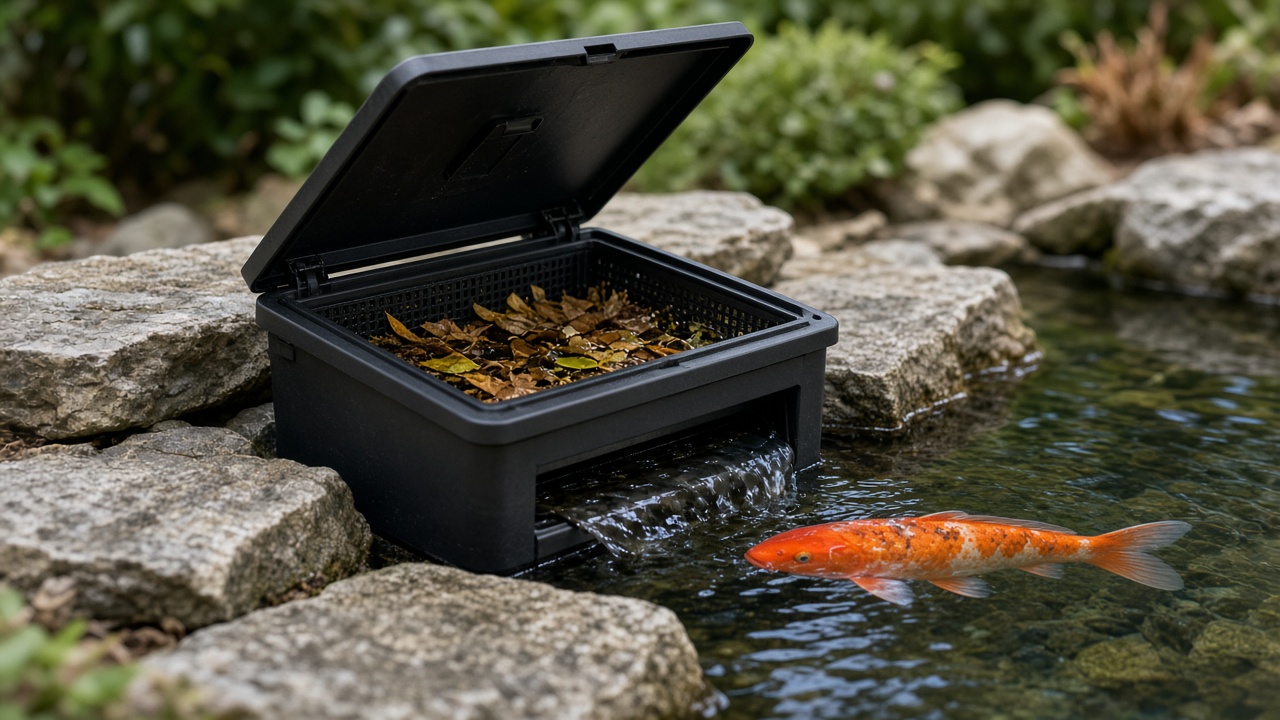
A weir or float opening sits at the waterline, and surface water then drops into a chamber. A pump in or after that chamber sends water to a waterfall or filter, while the basket or net is the first trap.
A pond skimmer is not an indoor tank filter. Indoor gear hangs on glass or sits in a cabinet, which is why our hang-on-back aquarium filters page stays on glass tanks.
A sponge filter for a betta tank stays inside still water and does not skim an outdoor surface. Sealed indoor canisters are a different job, and our canister filter picks cover that indoor path.
Size by surface area and pump flow
The takeaway is the Waterpuppy Two-Number Rule: use surface area first, then listed GPH.
Maker pages in this set rate box skimmers by square feet of pond surface, and they do not rate those boxes by total gallons.
Measure length times width at the waterline, and use that area, not a volume guess.
Aquascape’s Signature Series pages step those surface ratings in three jumps:
- Signature Series 200: up to 200 square feet
- Signature Series 400: up to 400 square feet
- Signature Series 1000: up to 1,000 square feet
The manufacturer’s page for the Signature Series 1000 also lists 93 square meters for that same 1,000-square-foot rating. OASE’s page for the AquaSkim 40 US rates the intake at a maximum pond surface of 40 square meters.
EasyPro’s Axiom pages in this set do not list a square-foot pond size. They list flow only, so do not invent a surface rating for those two boxes.
Pick the larger of the two limits when they disagree. If surface area fits a small box but the pump’s real GPH does not, move up a size.
Write down both numbers before you buy:
- Pond surface in square feet, or square meters if you use the OASE listing
- Pump GPH at the real head height, not the pump’s zero-head label
A wide, shallow pond needs more surface pull than a deep, compact pond of the same gallons. That is why volume is the wrong first number.
Weir width and listed GPH
The takeaway is this: weir width and listed max GPH set the safe pump range.
A weir is the slot at the waterline, and a wider slot can pass more surface water before the chamber starves or overflows.
Our research team compared the six maker pages in this article, and listed maximum pump flow on those pages spans 3,000 GPH to 11,100 GPH.
Three of the six models list a 6-inch weir. Those three are the Aquascape Signature Series 200, the Signature Series 400, and the EasyPro PSA5000 Axiom.
The manufacturer’s page for the Signature Series 1000 lists an 8-inch weir and a pump flow rate up to 10,000 GPH. The EasyPro page for the PSA11000 Axiom lists a 10-inch weir and a maximum flow of 185 gallons per minute, or 11,100 GPH.
EasyPro is the only maker in this set that prints both a max and a recommended band:
- PSA5000 Axiom: max 5,100 GPH; recommended 3,600 to 4,560 GPH
- PSA11000 Axiom: max 11,100 GPH; recommended 8,100 to 9,900 GPH
Only the OASE AquaSkim 40 US page in this set publishes a minimum pump capacity. That page lists 6,057 liters per hour as the minimum and 15,900 liters per hour as the maximum.
Those liter figures convert to about 1,600 GPH and about 4,200 GPH. Use the maker’s liter numbers if your pump curve is metric.
Do not size the skimmer to the pump’s sticker GPH at zero head. Use the flow the pump still makes at your waterfall height.
If the real flow sits above the skimmer’s listed max, the chamber can run dry. If the real flow sits far below the listed range, the weir may barely draw.
Baskets, nets, and mats
The takeaway is that the catcher type changes how often you lift the lid.
A net is light and cheap to swap, while a rigid basket holds more wet leaves before it slumps.
Aquascape splits the line on this point. The manufacturer’s page for the Signature Series 200 lists a debris net, while the Signature Series 400 and 1000 pages list a rigid basket.
The Signature Series 400 and 1000 pages also list a filter mat. The Signature Series 200 page does not list a mat, and it lists an optional brush cartridge as item 99772.
EasyPro’s Axiom pages describe a one-piece aluminum-framed debris net. The pump chamber sits behind that net, not beside it.
OASE’s AquaSkim 40 US page lists a 1.4-liter filter basket. The same page lists a 170-millimeter basket diameter and a 10-millimeter particle pass size.
Use this catcher split when you choose:
- Net: lighter lift; empty more often in heavy leaf fall
- Rigid basket: more wet volume; check the lid less often
- In-pond 1.4-liter basket: small hold; plan frequent pulls
- Filter mat or brush panel: extra fine trap after the coarse catcher
The Signature Series 200 page lists overflow as optional. The 400 and 1000 pages list overflow as included, which matters when rain raises the pond.
Six current models compared
The takeaway is an attribute grid, not a ranking: match the row to surface area and real GPH.
Our research team compared only listed fields. A “Not listed” cell means the maker page did not publish that number.
| Model | Maker-listed pond size | Max listed pump flow | Weir or intake | Debris catcher | Exterior size |
|---|---|---|---|---|---|
| Aquascape Signature Series 200 | Up to 200 sq ft | 3,000 GPH | 6 in weir | Net | 20 × 17.5 × 17.5 in |
| Aquascape Signature Series 400 | Up to 400 sq ft | 4,000 GPH | 6 in weir | Rigid basket | 21.4 × 18 × 21 in |
| Aquascape Signature Series 1000 | Up to 1,000 sq ft | 10,000 GPH | 8 in weir | Rigid basket | 21 × 22 × 26.5 in |
| OASE AquaSkim 40 US | Up to 40 m² | 15,900 LPH | 170 mm basket | 1.4 L basket | 350 × 800 mm |
| EasyPro PSA5000 Axiom | Not listed | 5,100 GPH | 6 in weir | Aluminum-framed net | 29 × 19 × 21 in |
| EasyPro PSA11000 Axiom | Not listed | 11,100 GPH | 10 in weir | Aluminum-framed net | 33 × 19 × 23 in |
The manufacturer’s page for the Signature Series 200 lists item 43020 and a packaged weight of 14.75 pounds. The Signature Series 400 page lists item 43021, a packaged weight of 25 pounds, and a locking weir door.
The Signature Series 1000 page lists item 43022 and a packaged weight of 34 pounds. It also lists two bulkhead ports and an adjustable-height faceplate.
OASE’s AquaSkim 40 US page lists SKU 57395. Height adaptation is 11 to 36 inches, and the page lists a 3-plus-2-year guarantee.
The EasyPro PSA5000 page lists dual 2-inch spinweld bulkheads. The PSA11000 page lists dual 2-inch fittings plus one 3-inch fitting.
Read the row as a match test, not a score:
- Under 200 square feet and at or under 3,000 GPH: Signature Series 200
- Up to 400 square feet and at or under 4,000 GPH: Signature Series 400
- Up to 1,000 square feet and at or under 10,000 GPH: Signature Series 1000
- No liner cut, metric pump curve, up to 40 m²: AquaSkim 40 US
- Need a printed recommended GPH band near 4,000 GPH: PSA5000 Axiom
- Need a 10-inch weir and up to 11,100 GPH: PSA11000 Axiom
A long or L-shaped pond can leave a dead corner that one intake cannot fix. Add a second intake or move the return so surface water travels across the pond.
Place the intake across from the return
The takeaway is placement: put the skimmer where surface water already wants to go.
Set the box on the side opposite the waterfall or return. Leaves then drift toward the weir instead of circling in a dead bay.
Keep the weir at the normal waterline. OASE’s AquaSkim 40 US page lists a water-level change of up to 6 inches, which is why an in-pond unit can ride evaporation.
A buried box does not ride the water. Evaporation can drop the water below the weir, and then the skimmer sucks air and the pump cavitates.
Aquascape’s Signature Series 1000 page lists an adjustable faceplate for that problem. You can reset the opening after the liner settles.
Check these site limits before you dig:
- Leave room to lift the basket straight up
- Do not bury the lid under a path you cannot open
- Keep the pump cord and pipe on the dry side of the liner flange
- Set the box on packed soil so it does not sink and tilt the weir
The Signature Series 400 and 1000 pages list a locking weir door you can close for service. Close it when you drain the chamber, and empty the basket when the weir draw starts to sag.
The AquaSkim 40 US page lists an 80-millimeter tube and a 350-millimeter base. Ballast that base with stones so the unit does not float.
FAQ
What is a pond skimmer?
A pond skimmer is a surface intake with a basket or net. It pulls floating debris before that debris sinks and rots. Buried boxes also hide the pump, while in-pond units sit on the floor and float at the waterline.
Do I size a pond skimmer by gallons?
No. The Aquascape Signature Series pages in this set rate boxes by square feet of surface, not by gallons. OASE’s AquaSkim 40 US page rates surface in square meters, and EasyPro’s Axiom pages skip surface area and list flow only.
What flow rate does a pond skimmer need?
Use the maker’s listed maximum, and the recommended band when one exists. The EasyPro PSA5000 page lists 5,100 GPH max and 3,600 to 4,560 GPH recommended. Stay at or under the max at real head height, not the pump’s zero-head sticker.
Should I pick a net or a rigid basket?
Pick a net for a small pond with light debris, and pick a rigid basket when wet leaves would collapse a net. Aquascape puts a net on the Signature Series 200 and a rigid basket on the 400 and 1000. OASE’s 1.4-liter basket is a third path for in-pond use.
Can I add a skimmer to a finished pond?
Yes, if you can cut and flange the liner, or if you use an in-pond unit. EasyPro’s Axiom pages describe a flange above the opening for rock work. OASE’s AquaSkim 40 US sits on a 350-millimeter base you ballast with stones.
How often should I empty the basket?
Empty it when the weir draw weakens or the catcher is more than half full. A 1.4-liter OASE basket will fill faster than a rigid Aquascape basket. Fall leaf drop shortens that interval, and a clogged catcher can starve the pump.
Does a pond skimmer replace a biological filter?
No. A skimmer is mechanical pre-filtration at the surface, so bacteria still need media in a waterfall box, a pad, or a separate filter. Size the skimmer to surface and GPH, and size biological media to fish load and volume.