Quick answer: Buy a bank-mounted panel kit of 55 watts or more for a garden pond. Use a 1- to 2-watt panel kit only for a birdbath or tub. Choose a floating aerating fountain only for large, open water.
A solar pond fountain with no listed battery pack does not spray after sunset. This page is a spec comparison of five kits our research team pulled from maker pages. We did not run any pump in a pond, measure spray height, or open a sealed unit.
Which kits this page covers
We only cover solar kits whose maker page lists a flow figure and at least one power figure.
That is the Waterpuppy Spec Scan rule. A power figure can be panel watts, a panel count, or a listed battery runtime. Flow can be gallons per hour or gallons per minute.
We left out three groups on purpose:
- AC pond pumps sold without a solar panel
- Lake fountains sold as electric-only floats
- Birdbath floaters that list no flow number
Our research team compared five live maker pages and used only numbers those pages print.
The five kits in this scan are:
- Sunnydaze Solar Water Fountain Pump Kit (JRS-150)
- Sunnydaze Solar Pump and Panel Kit with Battery Pack (SL-P103E)
- Poposoap 55W 580GPH Solar Fountain Pump
- Poposoap SPF390 120W 1600GPH Solar Pond Filter Fountain
- EasyPro ASF100 Outdoor Water Solutions Aerify Solar Aerating Fountain
Top 7 Solar pond fountain
The picks below are the 7 solar pond fountains on sale right now, listed with what each suits best and an honest drawback. Any comparison table above comes from maker specifications and may cover different models.
1. Mademax Solar Bird Bath Fountains
Best for: Small bird baths on a strict budget
We compared entry-level options and found this model ideal for minimalists. Owners report that it performs best in shallow bird baths where the water flow remains consistent under bright sun.
Pros: Extremely affordable; Simple plug-and-play setup Cons: Requires direct sunlight to operate
2. Mademax Upgraded Solar Fountain with 4 Easy Install Nozzle and Fixer
Best for: Beginners needing nozzle variety and stability
This fountain stands out for its included hardware that keeps the unit centered in the water. Owners report that the varied nozzle selection allows for quick aesthetic adjustments to the spray height.
Pros: Includes multiple spray patterns; Integrated fixer prevents drifting Cons: Plastic components feel lightweight
3. Solar Fountain Water Pump for Bird Bath
Best for: Minimalist DIY water feature projects
When evaluating basic solar pond fountains, this model emerged as the most utilitarian choice. Owners report it is best suited for small containers where a gentle, intermittent water movement is desired.
Pros: Lowest price point; Compact form factor Cons: Lacks advanced filtration or battery
4. AISITIN 3.5W Solar Fountain Pump for Bird Bath Separated Design & 8
Best for: Customizable spray patterns in smaller ponds
We compared this to integrated models and found the separated design offers superior placement flexibility. Owners report that the 3.5W panel provides enough power for a reliable, varied display.
Pros: Separated panel design; Eight distinct spray heads Cons: Cable length limits placement
5. 100W Floating Solar Pond Fountain Pump Kit for Ponds Deeper Than 3
Best for: Large, deep garden ponds requiring aeration
For those managing larger water features, we compared this heavy-duty kit against smaller consumer pumps. Owners report that it is a robust solution for maintaining oxygen levels in ponds deeper than three feet.
Pros: High-capacity 100W output; Designed for deep water circulation Cons: Significant upfront investment
6. Antfraer 8W Solar Water Pump with Dry-Run Protection
Best for: Protecting the pump from dry-run damage
We compared this model to standard pumps and noted the inclusion of safety features that extend the motor's lifespan. Owners report that the dry-run protection is essential for preventing burnout during low-water conditions.
Pros: Includes dry-run protection; Efficient 8W power delivery Cons: Requires frequent cleaning of intake
7. POPOSOAP 8W Solar Pond Filter with Built-in 3000mAh Battery Backup
Best for: Maintaining fountain operation during cloudy weather
When looking at reliability, we compared this filtered fountain to non-battery models. Owners report that the battery backup is a game-changer for maintaining consistent water movement even when clouds obscure the sun.
Pros: Integrated 3000mAh battery backup; Built-in filtration capability Cons: More complex setup than basic floats
Comparison: Solar pond fountain at a Glance
| Product | Best for | Approx. price | Where to buy |
|---|---|---|---|
| Mademax Solar Bird Bath Fountains | Small bird baths on a strict budget | $16.79 | Check price |
| Mademax Upgraded Solar Fountain with 4 Easy Install Nozzle and Fixer | Beginners needing nozzle variety and stability | $18.98 | Check price |
| Solar Fountain Water Pump for Bird Bath | Minimalist DIY water feature projects | $8.99 | Check price |
| AISITIN 3.5W Solar Fountain Pump for Bird Bath Separated Design & 8 | Customizable spray patterns in smaller ponds | $19.99 | Check price |
| 100W Floating Solar Pond Fountain Pump Kit for Ponds Deeper Than 3 | Large, deep garden ponds requiring aeration | $479.00 | Check price |
| Antfraer 8W Solar Water Pump with Dry-Run Protection | Protecting the pump from dry-run damage | $25.49 | Check price |
| POPOSOAP 8W Solar Pond Filter with Built-in 3000mAh Battery Backup | Maintaining fountain operation during cloudy weather | $56.99 | Check price |
Want to browse every option? See the full range of solar pond fountain on Amazon →
Panel, float, and spray forms
The form of the kit decides where the panel sits and how the spray starts.
The Waterpuppy Three-Form Rule splits the market into a bank-mounted panel kit, a floating aerating kit, and a small spray-head kit.
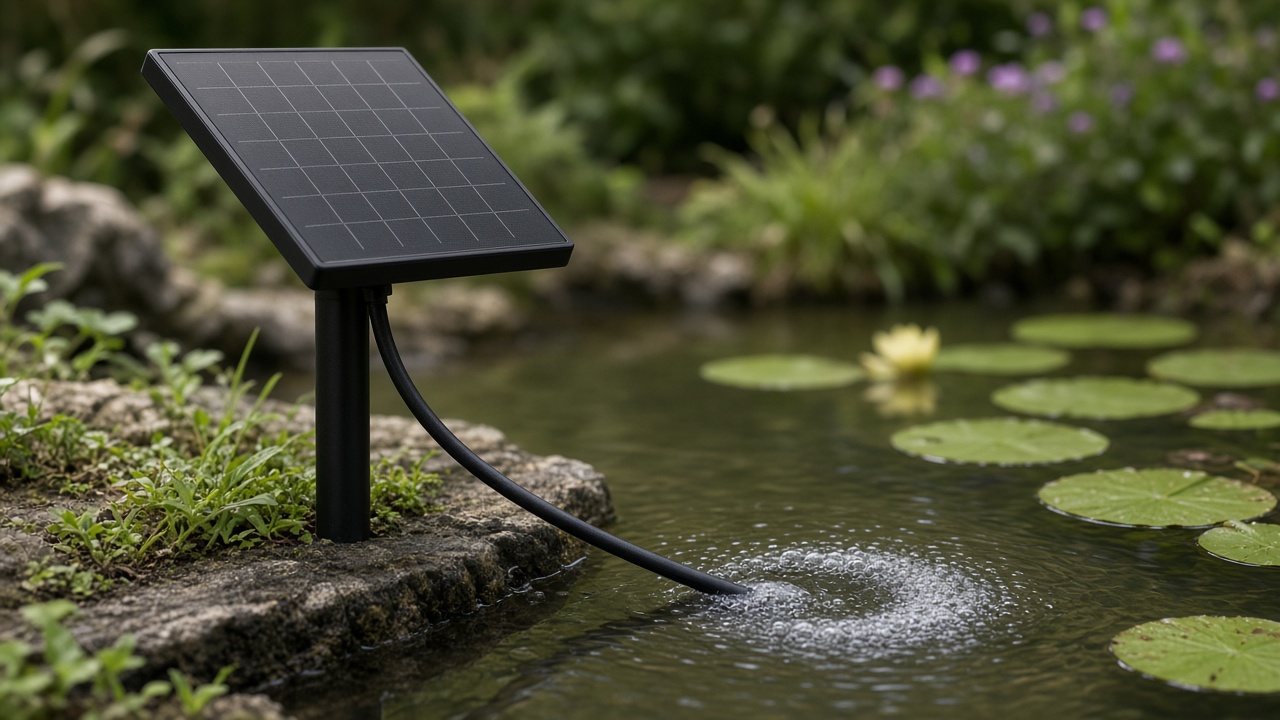
A panel kit keeps the solar board on land, and a cord runs to a pump in the water. That lets you park the panel in sun while the pond sits in shade.
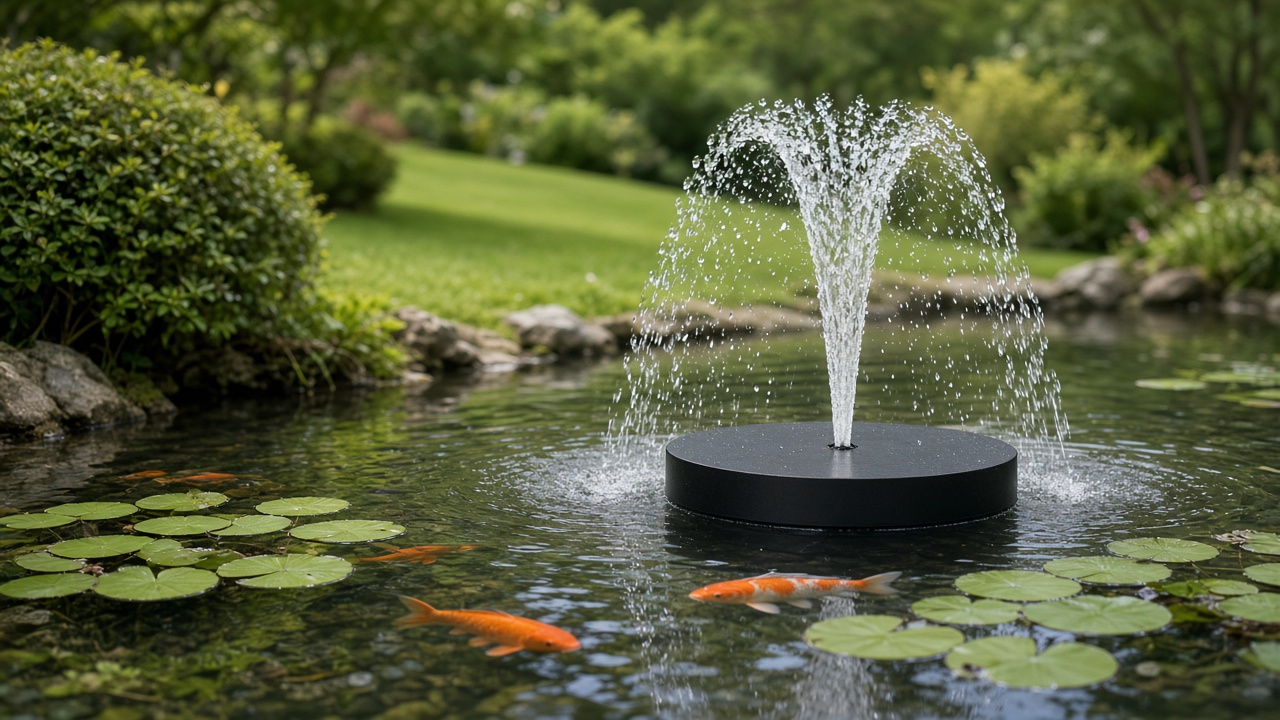
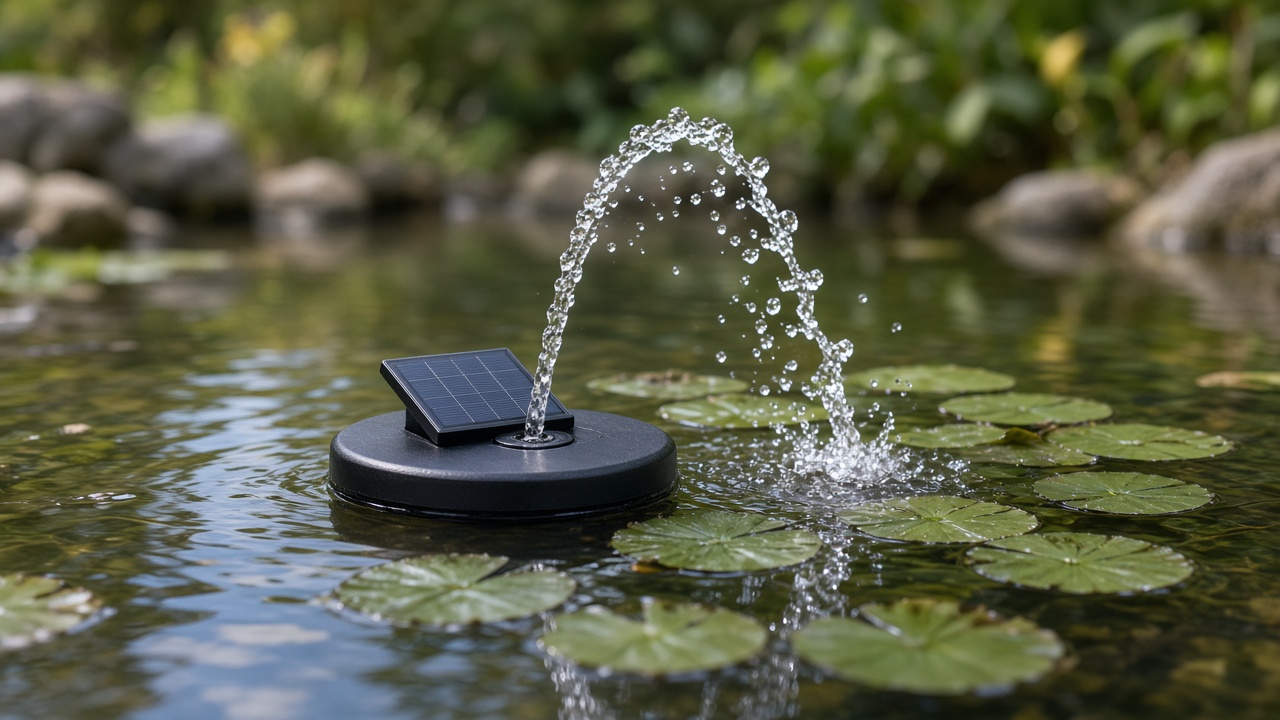
A float kit rides on the surface, and the pump hangs under a float or frame. The EasyPro ASF100 is this form. EasyPro’s page says it uses four bi-facial panels and a 100-foot cord.
A spray kit is about the nozzle set, not the power source. Small panel kits often ship several heads. Large pond kits may add a diverter so one pump can feed a jet and a second outlet.
Use this split when you shop:
- Panel on a stake: small tubs, birdbaths, and shaded ponds with a sunny bank
- Foldable or dual panel on land: garden ponds that need real flow
- Float with a shore array: large, open water with room for a panel rack
Sunnydaze Decor’s page for the JRS-150 lists a 1.3-watt panel and 40 gallons per hour. That is a spray kit for a small basin, not a pond circulator.
Five kits compared by listed specs
Listed flow jumps from 40 GPH on a 1.3-watt kit to 500 GPM on a four-panel float.
Read the table as printed maker figures, not as a yard test. Shade, lift, and nozzle size will cut the listed peak flow.
| Model | Form | Listed panel power | Listed max flow | Listed max lift | Night run listed | Maker pond note |
|---|---|---|---|---|---|---|
| Sunnydaze Solar Water Fountain Pump Kit (JRS-150) | Bank panel plus spray heads | 1.3 watts | 40 GPH | 20 inches | None | Small fountain or birdbath |
| Sunnydaze Solar Pump and Panel Kit with Battery Pack (SL-P103E) | Bank panel plus battery | 2 watts | 65 GPH | 36 inches | Up to 4 hours | Pond, garden, or birdbath |
| Poposoap 55W 580GPH Solar Fountain Pump | Foldable bank panel plus spray | 55 watts | 580 GPH | 14.7 feet | None; direct solar | Excellent in 500–2,000 gal ponds |
| Poposoap SPF390 120W 1600GPH Solar Pond Filter Fountain | Dual bank panels plus filter box | 120 watts | 1,600 GPH | 19.3 feet | None; does not run at night | 800–3,000 gal ponds |
| EasyPro ASF100 Aerify Solar Aerating Fountain | Float plus four-panel array | 4 bi-facial panels | 500 GPM | Not listed | Direct-drive solar | Ponds up to one acre; 18-inch minimum depth |
Comparing those listed figures gives a simple ratio. The Sunnydaze 1.3-watt kit claims 40 GPH, or about 31 GPH per listed watt. The Poposoap 55-watt kit claims 580 GPH, or about 11 GPH per listed watt.
That gap is not a quality score. Small kits list high flow per watt because the jet is short.
Other listed figures that change the install:
- Sunnydaze Decor’s JRS-150 page lists a 4.25-inch-square panel and a pump 1.5 inches square and 1 inch tall
- Sunnydaze Decor’s SL-P103E page lists a panel 10 inches wide, 7.5 inches high, and 2 inches thick
- Poposoap’s 55-watt page lists pump power at 40 watts and noise below 40 dB
- Poposoap’s SPF390 120-watt page lists a 9-inch minimum depth and a 42.7-inch maximum product height
- EasyPro’s ASF100 page lists a panel array 130 inches wide by 82 inches high
The Waterpuppy Spec Scan uses those printed sizes to flag fit: a 130-inch array needs a clear bank, and a 4.25-inch board does not.
How to match wattage to pond size
Use the maker’s own gallon range, not a generic “bigger is better” rule.
Start with the volume the maker prints, then check lift and depth. A tall jet wastes flow, and a shallow pond can run a pump dry.
Match the kit this way:
- Write down your pond’s gallons, or length times width times average depth times 7.5.
- Read the maker’s gallon line on the product page.
- Check the listed minimum depth against your shallow end.
- Check the listed max lift against the jet height you want.
- If the kit lists no battery, plan for daylight-only spray.
Poposoap’s 55-watt page says 500–2,000 gallon ponds get “excellent” flow. It says 2,000–4,000 gallon ponds get “good” flow if you add a cascade or spillway. It says ponds over 4,000 gallons need more than one pump.
Poposoap’s SPF390 120-watt page lists 800–3,000 gallons, a 19.3-foot max lift, and a 1,600 GPH max flow. That kit also lists a filter box with sponges and bio-balls.
EasyPro’s ASF100 page does not use a gallon range. It says the float is for shallow or remote ponds up to one acre. It lists a minimum depth of 18 inches and flow up to 500 GPM.
500 GPM is 30,000 GPH. That is EasyPro’s printed GPM times 60. It is not a backyard kit.
Sunnydaze Decor’s two kits stay in the small-water lane:
- JRS-150: 40 GPH and 20 inches of lift
- SL-P103E: 65 GPH and 36 inches of lift
If your pond is a few hundred gallons and you want a short jet, those two kits match their own pages. If you want turnover in a 1,000-gallon liner, look at the Poposoap 55-watt or 120-watt pages instead.
Size by the gallon and depth numbers the maker prints, not by a “koi” label.
Sun, shade, and night run
Direct-solar kits follow the sun, and only a listed battery pack keeps spray after dark.
The Department of Energy’s Solar Radiation Basics page explains why output swings. The greatest solar energy reaches the ground around solar noon.
That same Department of Energy page gives two loss figures. Direct beam solar radiation can drop by 10 percent on a clear, dry day. It can drop by 100 percent on a thick, cloudy day.
Season matters as much as clouds. Denver sits near 40 degrees latitude. The Department of Energy’s Solar Radiation Basics page says Denver gets nearly three times more solar energy in June than in December.
The Earth’s axis tilt is 23.5 degrees on that same page.
What that means for a pond kit:
- Place the panel where it sees midday sun, not just morning sun
- Expect winter spray to shrink even if the kit still “works”
- Treat a cloud break as a flow cut, not as a broken pump
- Buy a listed battery only if you need evening spray
Sunnydaze Decor’s SL-P103E page is the only kit in this scan that lists a battery pack. The product description says a full charge runs the pump for up to 4 hours. The page also says the system switches back to the panel when the battery is empty.
Poposoap’s SPF390 120-watt page states the kit is direct solar and does not operate at night. Poposoap’s 55-watt page also describes a direct solar panel with no night-run claim.
EasyPro’s ASF100 page calls the unit a direct-drive solar fountain. It lists four bi-facial panels and a MaxEnergy controller. It does not list a night battery.
A battery pack only stores some of the day’s charge. If the panel sat in shade all day, the pack will not fill.
Keep the intake clear
A clogged intake drops spray even when the panel is in full sun.
Debris, string algae, and silt choke a small impeller first, and a large float still needs a clear screen. Clean on a schedule, not after the jet dies.
Use this care list:
- Lift the pump or float and rinse the intake screen.
- Pull the impeller cover if the maker’s page says it is detachable.
- Flush nozzles with pond water, not a metal pick.
- Wipe dust and pollen off the panel face.
- Recheck water depth against the listed minimum.
Maker pages already flag this work. Sunnydaze Decor’s JRS-150 page says to disassemble and clean the pump once a month. It also says to check the water inlet if the pump stops.
Poposoap’s 55-watt page lists dry-run protection and a two-way filter, plus two extra filters. Poposoap’s SPF390 120-watt page lists tool-free clips on the filter box and a detachable pump.
EasyPro’s ASF100 page lists a debris screen in the turn-key system. The same page lists a 2-year fountain warranty and a 15-year solar-panel warranty.
Warranty length is not a spray-height score. Sunnydaze Decor and Poposoap both list a 1-year warranty on the kits in this scan.
FAQ
These answers use the same maker figures as the table.
Does a solar pond fountain work on a cloudy day?
A direct-solar kit can still spin under thin cloud, but flow will fall. The Department of Energy’s Solar Radiation Basics page says thick cloud can cut direct beam radiation by 100 percent. Poposoap’s SPF390 120-watt page says light cloud can drop performance and that the kit does not run at night.
Will a solar pond fountain run at night?
Only if the maker page lists a battery pack and a runtime. Sunnydaze Decor’s SL-P103E page says a full charge runs the pump for up to 4 hours. The other four kits in this scan are direct solar and stop when the panel is dark.
How many watts do I need for a garden pond?
Use the maker’s gallon line, then the watt figure. Poposoap’s 55-watt page calls 500–2,000 gallons an excellent fit. Poposoap’s SPF390 120-watt page lists 800–3,000 gallons, while a 1.3-watt or 2-watt Sunnydaze kit is for a small basin.
Can a floating solar fountain sit in a shallow pond?
Only if the pond meets the listed minimum depth. EasyPro’s ASF100 page lists 18 inches as the minimum operating depth. Poposoap’s SPF390 120-watt page lists a 9-inch minimum, and the 55-watt page lists a 4.3-inch minimum.
How often should I clean the pump?
Follow the maker’s own interval when one is printed. Sunnydaze Decor’s JRS-150 page says to clean the pump once a month. Clean sooner if the jet shrinks while the panel is in noon sun.
Do I need a filter box with a solar fountain?
Only if you want the extra media the maker lists. Poposoap’s SPF390 120-watt page includes a filter box with sponges and bio-balls. The Poposoap 55-watt fountain pump page lists a dual-layer pump filter, not a full filter box.
Where should I place the solar panel?
Place it where midday sun hits the face. The Department of Energy’s Solar Radiation Basics page says the greatest solar energy arrives around solar noon. Bank-mounted kits can sit on a sunny lawn while the pond sits under trees.