Quick answer: Keep a small group of swordtails in a heated tank of at least 80 liters. Hold pH at 7.0–8.0 and feed an algae-rich flake or granule. Expect live young after 24 to 30 days.
OATA’s care sheet sets swordtails at 80 litres, 22–27°C, pH 7.0–8.0, and an omnivore flake or granule.
This page is a desk comparison of the OATA care sheet, the FishBase species record, and four current food labels. We did not keep a swordtail colony, run water trials, or collect wild fish.
Our research team analyzed those published specs under one rule, the Livebearer Label Rule. A food enters only if the maker page names tropical community fish or livebearers, and prints a feeding clock or a guaranteed-analysis number.
We skip cichlid, goldfish, betta, and koi diets. We also skip wild-caught locality fish, hybrids sold as sword-platies, and any tank under OATA’s 80-litre floor.
What a swordtail is
A swordtail is a Central American livebearer sold for heated home tanks, not a pond carp.
FishBase lists the species as Xiphophorus hellerii and gives the English name green swordtail.
FishBase records two adult sizes.
- Males: 14.0 cm total length
- Females: 16.0 cm total length
- Common length on the same page: 2.8 cm total length
OATA’s care sheet uses a smaller hobby band of 8–12 cm for swordtails. Plan the tank for FishBase’s 16 cm female, not the 2.8 cm shop fish.
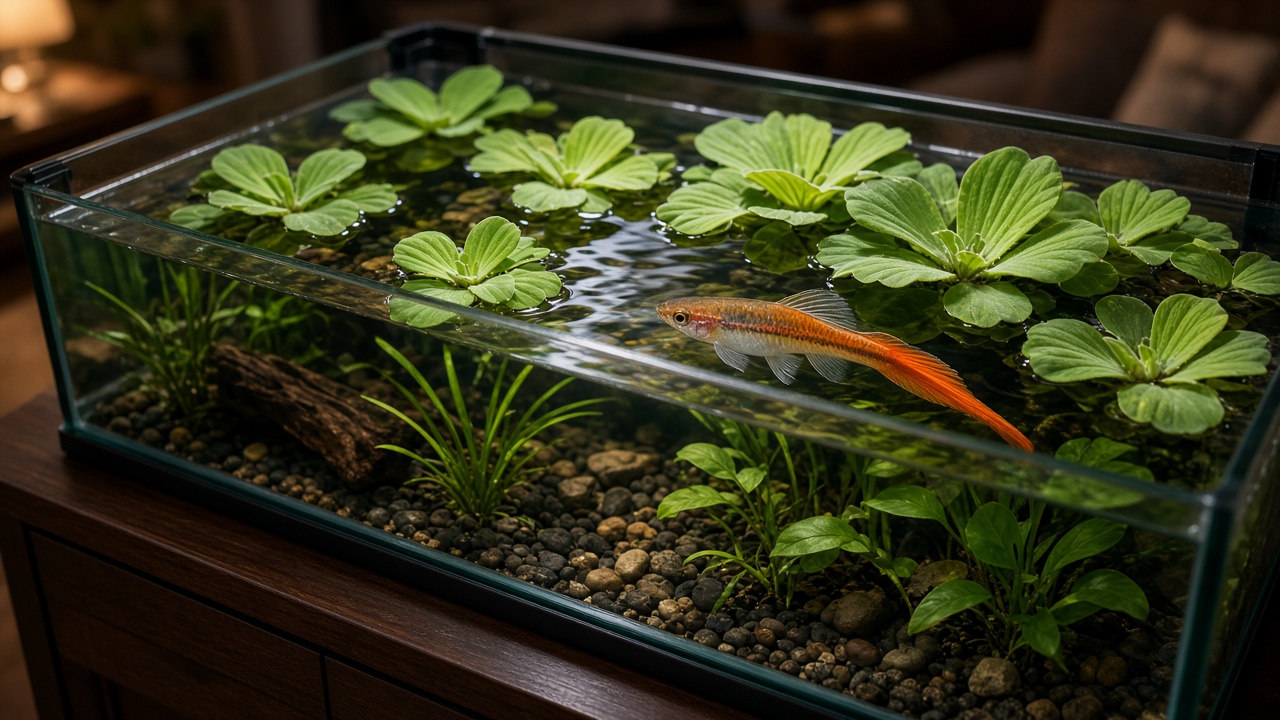
OATA says platies stay at 6–8 cm and lack the tail extension, and only male swordtails carry the sword. Females have a triangular anal fin, and males have a gonopodium.
FishBase lists sexual maturity after eight to twelve months. OATA says the fish can live several years in a mature, filtered tank.
FishBase assessed the species as IUCN Least Concern on 29 March 2018. The same record sets the trophic level at 3.2 based on food items.
Adults on that page use fast streams, weedy canals, and warm springs, and they eat worms, crustaceans, insects, and plant matter.
Tank size: 80 liters and 80 cm
OATA’s floor is 80 liters, and FishBase’s floor is 80 cm of tank length, so you need both.
OATA recommends at least an 80 litre aquarium for swordtails, which is about 21 US gallons. The same sheet sets platies at 45 litres, and that is not the swordtail number.
FishBase’s aquarium note is a minimum size of 80 cm, which is about 31.5 inches of swimming length. A short, tall hex tank can hold the volume and still fail the 80 cm line.
- Volume floor: 80 litres on OATA’s care sheet
- Length floor: 80 cm on FishBase
- Group floor: at least three fish on OATA, at two females per male
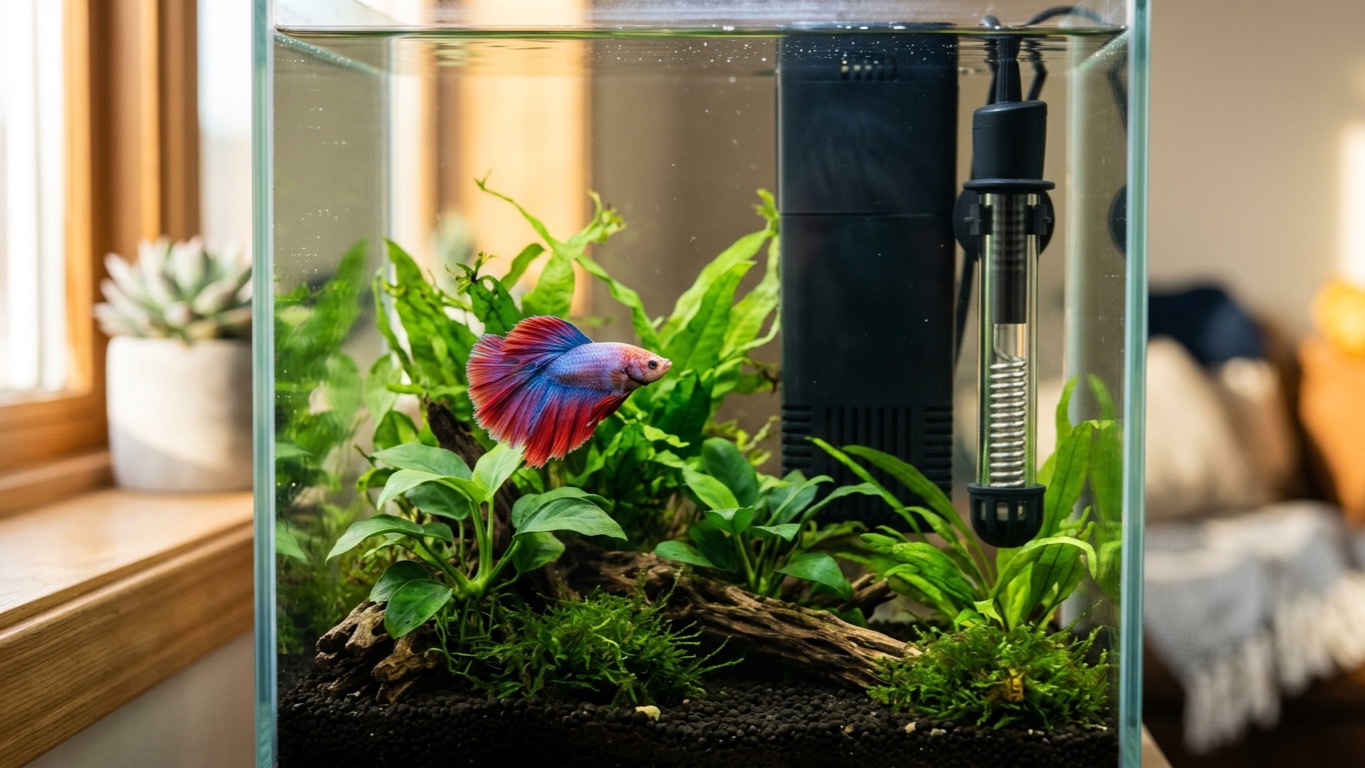
OATA says more groups need more volume, so do not stack a second trio in the same 80-litre box. That sheet also calls for a filter, a heater, gravel or sand, and plants or ornaments for cover.
Leave open water in the middle so the fish can swim. OATA lists a secure lid as optional but recommended, and says to keep the tank away from drafts, heat vents, direct sun, and loud vibration.
Water numbers to hold
Hold ammonia and nitrite at zero, and keep pH between 7.0 and 8.0.
OATA and FishBase both print pH 7.0–8.0. The temperature bands are close, but they are not identical.
- Swordtail temperature on OATA: 22–27°C, about 72–81°F
- Temperature on FishBase: 22–28°C, about 72–82°F
- Platy temperature on OATA, for contrast: 17–27°C
Stay inside OATA’s 22–27°C swordtail band, because FishBase’s extra degree is a published range, not a reason to run hotter.
OATA’s chemistry list is the weekly target.
- Ammonia: 0 mg per litre
- Nitrite: 0 mg per litre
- Nitrate: no more than 20 mg per litre above your tap water
- General hardness: 4–12 °dH
- Carbonate hardness: 3–10 °dkH
FishBase lists hardness as 9–19 dH, so the overlap of those two published bands is 9–12 dH. If your tap sits below 9 dH, you are outside FishBase’s range, even if you still sit inside OATA’s 4–12 °dH band.
OATA says test weekly for ammonia, nitrite, nitrate, pH, and hardness, and change 25% of the water at least once every week. Treat replacement water with a dechlorinator before it goes in.
OATA’s sheet names that step and does not name a brand, so we do not add one here. Rinse filter media in the old tank water, not under the tap, and confirm the heater still holds 22–27°C.
OATA’s add-fish method is a timed float, not a dump.
- Switch off the tank lights.
- Float the bag for 10 minutes.
- Add small amounts of tank water to the bag for up to 20 minutes.
- Release the fish and keep bag water out of the tank.
Do not add a full group on day one, because OATA warns that extra waste can outrun the filter bacteria and cause new-tank syndrome.
OATA says even small ammonia or nitrite can stress these fish. Watch for clamped fins, flashing, or a sudden color change, then test the water and ask your retailer.
Diet and the four foods we compared
Feed an algae-rich flake or granule, and stop when the fish finish the serving.
OATA says swordtails are omnivores, and the staple on that sheet is a good-quality flake or granule with a high algae content. Frozen or live daphnia, small bloodworm, or tubifex are extras, not the only meal.
OATA’s clock is once a day, and only what they eat in a few minutes. Maker labels on the four foods we compared print a busier clock, and our research team copied both without picking a winner.
Hikari’s Fancy Guppy page names swordtails on the livebearer line.
- Crude protein: min. 50%
- Crude fat: min. 8.0%
- Phosphorus: min. 1.0%
- Crude fiber: max. 2.0%
Hikari’s Micro Pellets page is for tetras, barbs, and other small-mouthed tropical fish.
- Crude protein: min. 43%
- Crude fat: min. 7%
- Phosphorus: min. 1.1%
- Packs: 0.77 oz (22 g), 1.58 oz (45 g), and 2.82 oz (80 g)
The protein gap on those two Hikari pages is seven points. Fancy Guppy is the livebearer bag, and Micro Pellets is the small-mouth community bag.
API Tropical Flakes does not print a protein percent on the product page we used. That page says to feed twice a day, and only what fish eat within 3 minutes.
It claims the food can produce up to 30% less ammonia. It names menhaden and squid, plus tetras, angelfish, discus, barbs, and guppies.
Tetra’s TetraMin Tropical Flakes page does not print a protein percent or a feeding clock. It does print eight pack sizes, from 0.42 oz (12 g) to 4.25 lb (2.05 kg).
| Product | Form | Maker-listed number | Maker feeding rule | Who the maker names |
|---|---|---|---|---|
| Hikari Tropical Fancy Guppy | Soft granule | Crude protein min. 50%; fat min. 8.0%; phosphorus min. 1.0% | 2–3 times daily; finish in a few minutes | Guppies, platies, swordtails, and mollies |
| Hikari Tropical Micro Pellets | Soft granule | Crude protein min. 43%; fat min. 7%; phosphorus min. 1.1% | 2–3 times daily; finish in a few minutes | Tetras, barbs, and small-mouthed tropicals |
| API Tropical Flakes | Flake | Up to 30% less ammonia, per the product page | Twice a day; finish within 3 minutes | Tetras, angelfish, discus, barbs, and guppies |
| Tetra TetraMin Tropical Flakes | Flake | Eight packs, 0.42 oz (12 g) to 4.25 lb (2.05 kg) | Not listed on that product page | Tropical flake diet; no species list on that page |
If two clocks disagree, use the shorter one in your hand. OATA’s once-a-day line is the most conservative published cap we compared.
Remove leftovers after the listed window, because extra food becomes the ammonia OATA sets at zero.
Tank mates that fit the heat band
Share the tank only with peaceful tropical fish that use the same heat and pH.
OATA says platies and swordtails are generally peaceful, and it also warns that large swordtails can be boisterous and may chase timid fish. OATA’s ratio is two females to each male, and at least three fish in the group.
That ratio is a stress rule for swordtails, not a license to add other species. Swordtails need OATA’s 22–27°C band, so they fail a cool goldfish tank.
Our guide on what fish can live with goldfish keeps goldfish in unheated water. Do not move a swordtail into that setup.
An oscar is the other mismatch, and our oscar fish care brief treats that cichlid as a large predator.
A 16 cm swordtail is prey on that prey list, not a roommate.
Koi belong in a backyard pond, not in this heated glass box. Our koi fish care guide treats koi as outdoor pond carp, not indoor livebearers.
OATA says breeding is likely if platies and swordtails share a tank. If you want a clean swordtail line, do not house them with platies.
Breeding numbers you should expect
A female can drop live young after 24 to 30 days, and the count is not one number.
OATA lists 20–80 fry after a pregnancy of 24–30 days. FishBase lists 20 to 200 young after the same 24-to-30-day window.
OATA is the hobby range, and FishBase is the wider species range, so either way one birth can refill a small tank.
FishBase also notes a tendency for sex reversal from female to male under some conditions. That is a published species note, not a home method.
OATA says community breeding often fails unless plants are thick, because adults eat fry. The same sheet says to move the female to a large breeding net, then move her away from the young.
Rear fry on specialist feeds until they can eat the staple and are harder to swallow. OATA does not print a fry count for a first meal, so we do not invent one.
Do not release extra fish or plants into local water. OATA says that step is illegal in its jurisdiction and can harm wild habitats.
FishBase also flags the species as a potential pest after introductions.
FAQ
How big of a tank do swordtails need?
OATA’s care sheet sets at least an 80 litre aquarium for swordtails, about 21 US gallons. FishBase adds a minimum aquarium length of 80 cm, about 31.5 inches. A short hex tank can meet the volume and still fail the length.
What water temperature and pH do swordtails need?
OATA lists 22–27°C and pH 7.0–8.0. FishBase lists 22–28°C and the same pH 7.0–8.0. Hold ammonia and nitrite at 0 mg per litre, and keep nitrate no more than 20 mg per litre above tap water, per OATA.
What do swordtail fish eat?
OATA calls them omnivores and asks for a flake or granule with high algae content. Hikari Tropical Fancy Guppy names swordtails and lists a minimum of 50% crude protein.
Hikari Tropical Micro Pellets lists 43% protein for small-mouthed tropicals. API Tropical Flakes says to feed twice a day within 3 minutes.
How many swordtails should I keep together?
OATA says keep at least three, at two females per male. That ratio lowers stress on females and other tank mates. Add fish slowly after the filter is mature.
How many babies do swordtails have?
OATA lists 20–80 fry after 24–30 days. FishBase lists 20–200 young after the same 24-to-30-day gestation. Thick plants or a breeding net raise the odds that fry survive.
Can swordtails live with goldfish, oscars, or koi?
No. Swordtails need OATA’s 22–27°C heated water, and goldfish care on this site is a cool, unheated plan. Oscars eat smaller fish, and koi are outdoor pond carp.
How often should I change the water?
OATA strongly recommends a 25% partial change at least once every week. Test in the same week so ammonia and nitrite stay at zero.