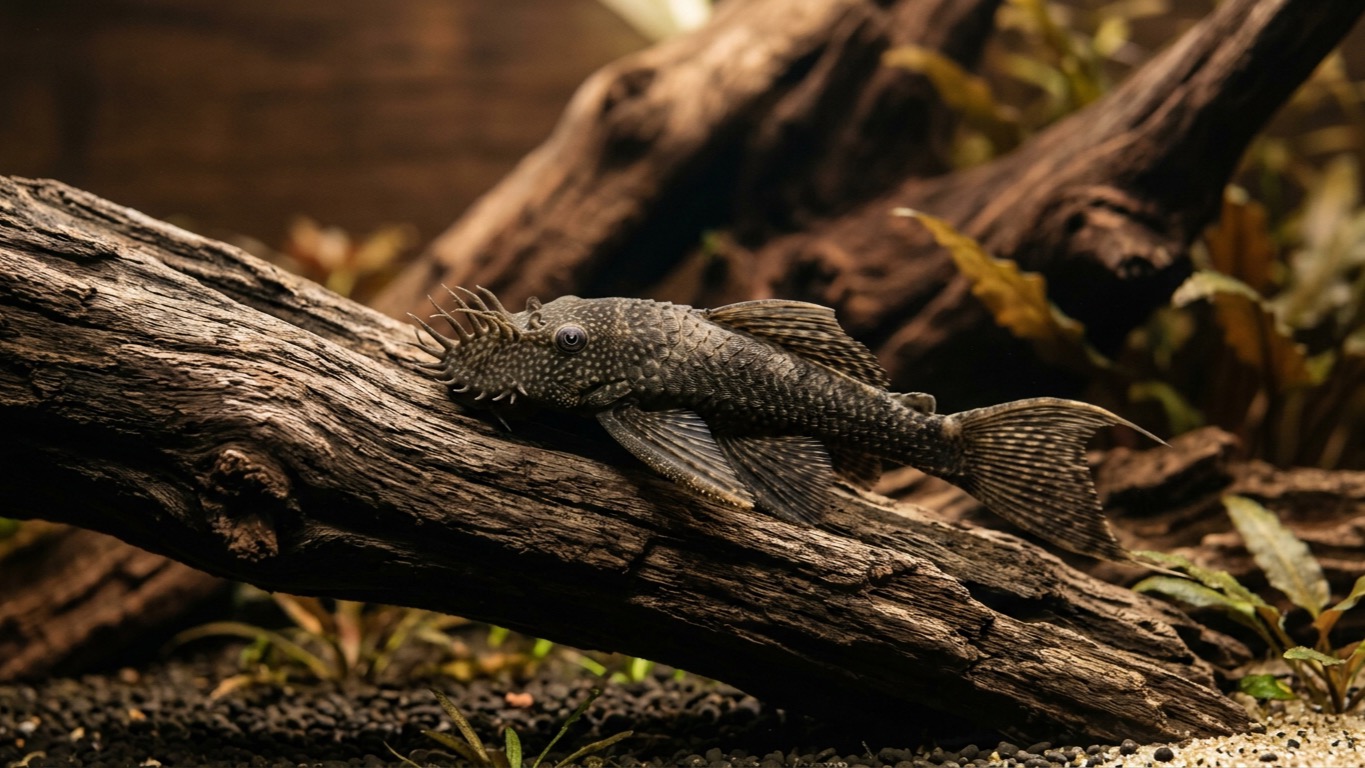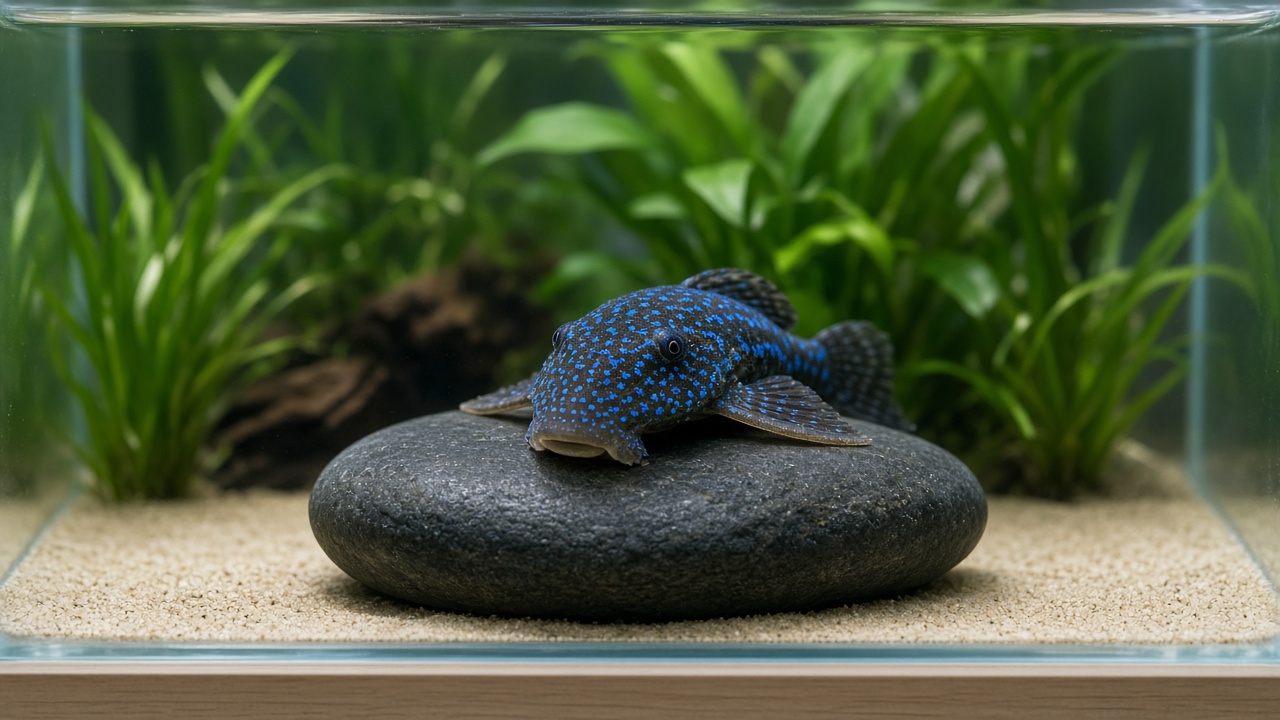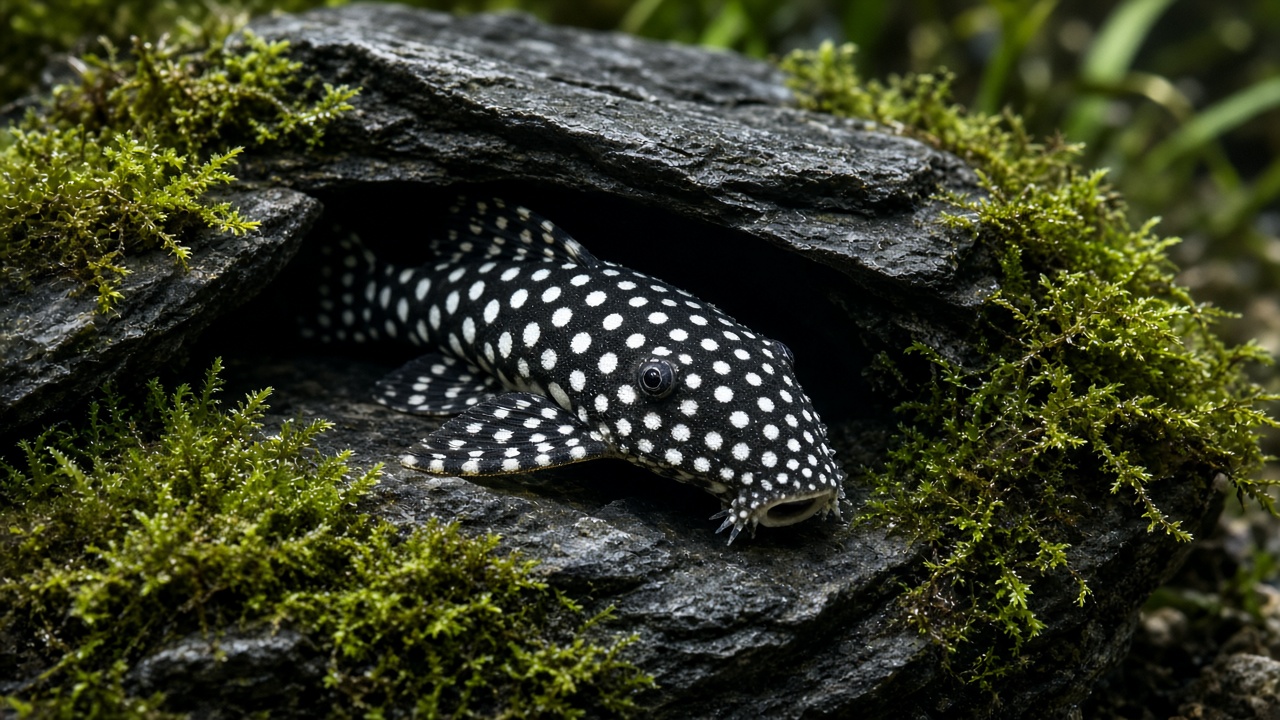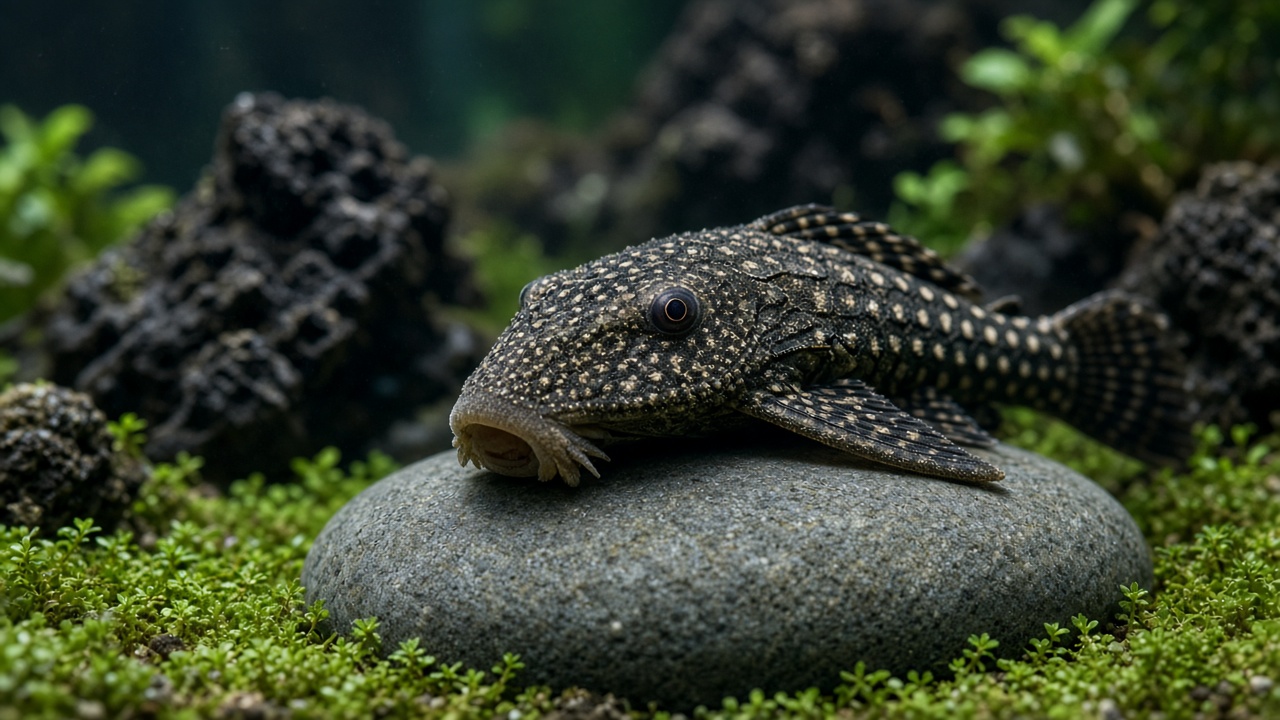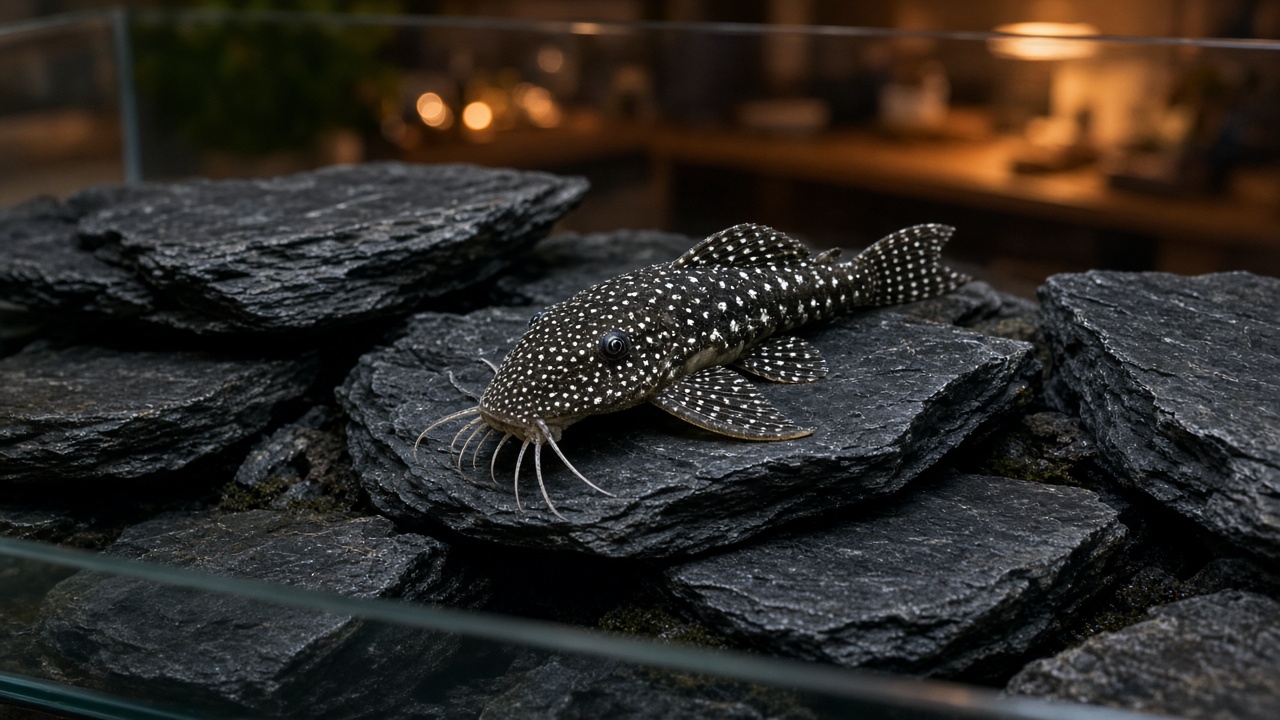
Quick answer: Keep one adult vampire pleco in a 50-gallon or larger tank with strong flow and a meaty sinking diet. This spotted South American catfish is not an algae eater. Give it one private cave and skip extra bottom suckers.
FishBase lists the vampire pleco, Leporacanthicus galaxias, at 21.1 cm standard length.
This page is a desk comparison of published species records and current maker specs.
Selection rule: We included only Leporacanthicus galaxias and products whose maker page lists a number we can quote. We left out bristlenose look-alikes, algae-wafer-only diets, and any filter whose maker lists a tank under 50 US gallons.
What a vampire pleco is
A vampire pleco is a spotted armored catfish from fast tropical rivers, not a glass-cleaning algae eater.
FishBase files the species as Leporacanthicus galaxias Isbrücker and Nijssen, 1989. Shops also sell it as galaxy pleco or L029.
FishBase lists it as freshwater and demersal, which means it lives on the bottom. The same record lists the fish as harmless to people.
FishBase maps it to southern tributaries of the middle and lower Amazon, plus the Madeira, Tocantins, and Guamá rivers. It also lists the Ventuari River in the upper Orinoco.
FishBase lists the IUCN Red List status as Least Concern, with an assessment date of 16 November 2020. That status is a wild-stock note, not a care score for your tank.
FishBase also lists CITES as Not Evaluated. Do not treat that blank as a permit or a ban.
This is not the same fish as a bristlenose pleco. Bristlenose stay smaller and eat more plant matter.
Adult size from published records
Plan the tank around FishBase’s 21.1 cm body length, not the larger hobby figures.
FishBase lists a maximum standard length of 21.1 cm SL for males and unsexed fish. Standard length is the body without the tail, or about 8.3 inches.
FishBase also lists a maximum published weight of 235.27 g. That is about 8.3 ounces.
Our research team analyzed those two FishBase numbers against common shop claims of 25 cm. We use the 21.1 cm record because it is the published database figure.
A young fish in a shop can look tiny. It still grows toward that 21.1 cm body.
Do not buy one for a 20-gallon tank and hope it “stays small.” The published adult size is already larger than many community tanks.
Tank size and the 50-gallon floor
One adult needs a 50-gallon class tank with a long floor and one defensible cave.
We call this the 50-Gallon Floor Rule. Fluval’s 407 canister listing starts at 50 US gallons, and that is the smallest tank class we kept.
Comparing published specs, Fluval lists the 407 for 50 to 100 US gallons, or 150 to 500 liters. Filters listed under 50 US gallons failed our cutoff.
Floor length matters more than tank height. A tall 50-gallon cube still wastes the bottom this demersal fish uses.
Setup we include:
- a tank in the 50-gallon class or larger
- one tight cave the fish can own
- smooth sand or rounded gravel, not sharp rock
- wood or rock that leaves a swim lane
- a lid so the fish stays in the tank
Setup we skip:
- tanks under 50 US gallons
- two vampire plecos in that same 50-gallon class
- a second bottom sucker sharing one cave
- bare glass with no hide
Give the fish one cave it can block with its body. Add a second cave only when you add a much larger tank.
Water, flow, and filtration
Hold FishBase’s published bands and move a lot of clean water.
FishBase lists a pH range of 6.2 to 7.2. Stay inside that band and keep it still.
FishBase lists a tropical temperature of 22°C to 25°C. That is about 72°F to 77°F.
Do not chase a new pH every week. A still reading inside that FishBase band beats a swing.
API’s Freshwater Master Test Kit page says to test weekly. The kit checks ammonia, pH, high-range pH, nitrite, and nitrate.
API’s page says a pH of 7.0 is neutral. The kit ships with four test tubes, a holding tray, and a laminated color card.
API also says it has made aquarium products for almost 60 years.
Weekly test steps:
- Fill a tube and add the drops listed on the API card.
- Wait the time on the card, then match the color in good light.
- Keep ammonia and nitrite at the lowest printed color.
- Change water if nitrate sits at the high end of the card.
- Match new water to the tank temperature before you pour.
Seachem’s Prime page says to use 1 capful, or 5 mL, for each 200 L (50 US gallons) of new water. Each cap thread is about 1 mL.
Prime directions we quote:
- a double dose is listed as safe for high chloramine
- up to 5 times the normal dose may be used to bind nitrite in an emergency
- use a half dose if the water is above 30°C (86°F) and chlorine or ammonia is low
- Prime can be dosed every 24 to 48 hours
- the bind holds those compounds for up to 48 hours
Seachem lists bottle sizes of 50 mL, 100 mL, 250 mL, 500 mL, 1 L, 2 L, and 4 L. Seachem also says Prime is up to 5 times more concentrated than competing products.
Seachem says Prime will not change pH. That matters inside FishBase’s narrow 6.2 to 7.2 band.
A 10-gallon change then needs about 1 mL of Prime, or one cap thread. Dose the new water, not a guess.
Fluval lists the 407’s pump output at 383 US GPH (1450 LPH) at 120 V / 60 Hz. The same listing gives a filter circulation of 245 US GPH (930 LPH).
Comparing those two Fluval numbers, the water that actually moves after media and hoses is 245 GPH, not 383. Use 245 when you size flow.
Fluval lists these 407 hardware numbers:
- canister volume 9.2 L
- basket volume 4.2 L
- vertical pre-filter 1074 cm²
- size 9.5 in L × 7 in W × 19.3 in H (24 × 18 × 49 cm)
- 23 W at 120 V / 60 Hz
That 245 GPH circulation on a 50-gallon tank turns the water about 4.9 times per hour. A meaty diet makes that turnover useful.
Point a spray bar or powerhead along the long wall so the bottom is not a dead zone. Leave the cave mouth out of the strongest blast.
Diet
Feed a sinking carnivore pellet, then add meaty frozen foods, not an algae wafer as the staple.
Hikari UK’s Sinking Carnivore Pellets page lists a minimum of 47% protein. The same page lists a 74 g pack.
Hikari Sales USA lists that diet in 2.61 oz (74 g) and 2.2 lb (1 kg) packs. Both pages aim it at bottom-feeding carnivores, including catfish.
Hikari UK’s feeding line is two to three times daily, in an amount the fish will finish in a few minutes. Remove leftovers so protein does not rot on the sand.
Hikari UK also names catfish, sharks, bichirs, eels, and stingrays as target fish. A vampire pleco fits that catfish line.
Feed steps:
- Drop sinking pellets near the cave after lights dim.
- Feed two or three times a day, per Hikari UK.
- Use only what disappears in a few minutes.
- Siphon crumbs you can still see.
- Add a thawed meaty food on some nights if the pellets are all eaten.
Do not use an algae wafer as the only food. Hikari’s listed protein is for a carnivore, not a grazer.
FishBase does not list a tank diet on the summary we used. We therefore quote maker feed rates, not a wild gut study
Skip live feeder fish. Hikari’s page frames the pellet as a nutrient mix without the parasites or bacteria live foods can carry.
Tank mates
Keep mid-water fish that ignore the floor, and do not add a second bottom sucker in the 50-gallon class.
FishBase lists this species as demersal. Our rule is one bottom sucker per 50-gallon class tank.
Tank mates we include:
- mid-water tetras or rasboras that stay above the sand
- larger, calm characins that will not fit in the pleco’s mouth
- one vampire pleco with its own cave
Tank mates we skip:
- a second vampire pleco in the same 50-gallon class
- bristlenose, common plecos, or other suckers sharing the floor
- tiny shrimp a 21.1 cm catfish can eat
- slow, long-finned fish that rest on the same wood
A bristlenose pleco looks similar in a shop bag. It is a different care plan and a different diet.
If you want two vampire plecos, you leave our 50-gallon floor. You then need more floor, more flow, and one cave per fish.
Do not add this fish to a tank that already has a large territorial catfish on the glass. The published record does not give a fight score, so we just do not stack bottom fish.
Gear compared by listed attributes
We compared only products whose maker pages list a number we could quote.
| Product | Maker-listed role | Key listed number | Listed size or range |
|---|---|---|---|
| Hikari Sinking Carnivore Pellets | Bottom-feeding carnivores | min. 47% protein | 74 g and 1 kg packs |
| Fluval 407 Canister Filter | Canister filter | 245 US GPH circulation | 50–100 US gal |
| Seachem Prime | Fresh and saltwater conditioner | 5 mL per 50 US gal | 50 mL to 4 L |
| API Freshwater Master Test Kit | Freshwater test kit | 6 parameters | 4 tubes; test weekly |
Hikari’s 47% protein is the diet number we kept. Fluval’s 245 GPH is the flow number we kept.
Seachem’s 5 mL per 50 gallons is the water-change dose. API’s six parameters and weekly schedule are the test plan.
Each row is a different job.
Skip a hang-on filter whose box lists fewer than 50 US gallons. That product fails the same cutoff as a 29-gallon tank.
FAQ
How big do vampire plecos get?
FishBase lists a maximum standard length of 21.1 cm SL, or about 8.3 inches of body without the tail. The same record lists a maximum published weight of 235.27 g. Shop photos of small juveniles are not adult size.
What size tank does a vampire pleco need?
Our 50-Gallon Floor Rule starts at the 50 US gallon class, which is also the bottom of Fluval’s 407 listing. One adult gets that tank, one cave, and no extra bottom sucker. A taller tank with a short floor still fails the rule.
Do vampire plecos eat algae?
They are not algae-wafer fish. Hikari UK lists Sinking Carnivore Pellets at a minimum of 47% protein and aims the food at carnivorous catfish. Use that sinking pellet as the staple, then add meaty frozen foods.
Can I keep two vampire plecos together?
Not inside our 50-gallon class. FishBase lists the species as demersal, so two adults would share one floor. We only cover a pair when the tank is much larger and each fish has its own cave.
What water temperature and pH do they need?
FishBase lists 22°C to 25°C, or about 72°F to 77°F, and pH 6.2 to 7.2. Hold those bands still. API’s kit page says to test weekly, and Seachem’s Prime page says the conditioner will not change pH.
How often should I feed a vampire pleco?
Hikari UK says to feed Sinking Carnivore Pellets two to three times daily, in an amount the fish finishes in a few minutes. Drop the pellets near the cave after lights dim. Siphon what is left.
Are vampire plecos the same as bristlenose plecos?
No. FishBase lists this species as Leporacanthicus galaxias at 21.1 cm SL. A bristlenose is a smaller, more plant-eating fish with a different care page.