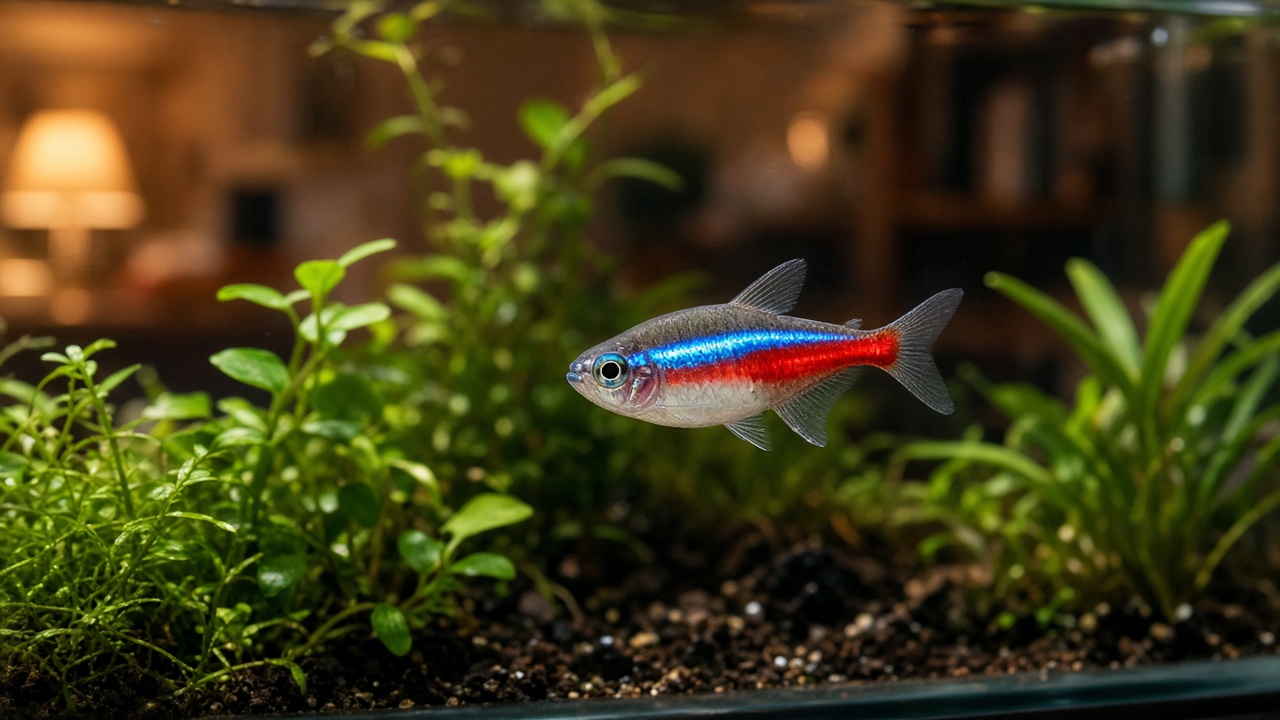
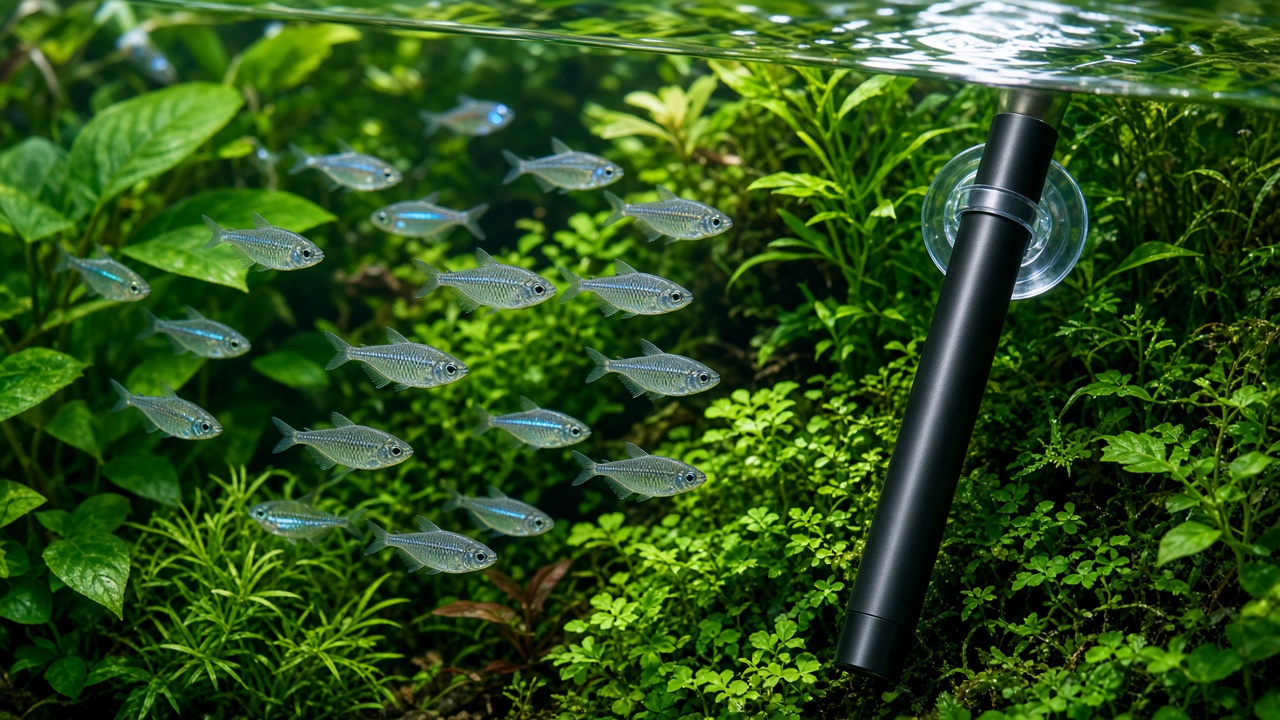
Quick answer: Keep five or more x-ray tetras in a tank at least 60 centimeters long. Feed a small tropical flake or micro pellet two to three times a day. Pair them only with other small, peaceful fish.
An x-ray tetra reaches 4.5 centimeters and needs a 60-centimeter tank for five fish. This page is a desk brief on records and labels, and
Our research team used the Label-and-Length Rule for every number on this page. A food entered the table only if its maker page listed a minimum crude-protein number.
A tank rule entered this page only if FishBase stated a centimeter length. We left out gallon-only hobby notes, marine foods, and goldfish formulas.
What an x-ray tetra is
An x-ray tetra is a small South American tetra with a see-through body.
FishBase lists the species as Pristella maxillaris and sets maximum length at 4.5 centimeters total length. That 4.5 centimeter cap is the adult size we use when we talk about tank mates.
The IUCN Red List assessed the species as Least Concern on 16 November 2020. That assessment assumes a total population greater than 10,000 fish.
IUCN also sets generation length at 1 year and says 1 to 10 percent of the population sits in protected areas. Those two figures are conservation counts, not tank stocking math.
The IUCN page names Brazil, French Guiana, Guyana, Suriname, and Venezuela as resident countries. In Brazil, the same page lists Amapá, Maranhão, Pará, and Tocantins.
FishBase maps the fish to the Amazon, the Orinoco, and coastal rivers of the Guianas. The IUCN page adds that some inland records may belong to a look-alike species, Pristella ariporo.
FishBase describes a shop-floor mark you can check against a photo. The humeral spot is round and about as large as the pupil.
The dorsal fin has a black spot lined with white above and yellow below. Pelvic and anal fins share that same color pattern on the FishBase record.
The IUCN account calls the fish an egg-laying omnivore that feeds on tiny invertebrates, algae, and other plant material. FishBase adds worms, small crustaceans, and insects to that list.
Both records describe calm, plant-heavy water rather than a bare open river. FishBase also prints a trophic level of 3.2 based on those food items, which places the fish in the mid-consumer range.
Tank length and layout
FishBase sets the smallest aquarium at 60 centimeters long, and that length is the only tank number we used.
A 60-centimeter face gives a school room to turn as one group.
FishBase also calls the species pelagic, meaning the fish use open water and not just the floor. IUCN places wild fish in slow rivers, swamps, and small lakes, usually among dense aquatic plants.
IUCN lists rivers, creeks, swamps, lakes, marshes, and pools as suitable resident habitat. Use that record as a layout cue, not as a plant-shopping list.
- Leave an open swim lane down the center.
- Plant the sides and back for cover.
- Keep flow gentle, not a strong stream.
We also did not name a heater wattage, because wattage is a tank-by-tank choice and not a species label.
School size and behavior
FishBase calls for a group of five or more x-ray tetras, and that count is our school floor.
FishBase calls the species gregarious and non-aggressive, so a lone fish has no group to match that record.
Five fish is the smallest group we will name on this page. A larger school still fits the same 60-centimeter length rule if the tank face stays that long.
IUCN marks the species as congregatory year-round, which means they live in groups rather than as a short display pair. Watch for tight grouping and calm swimming once the group is in.
Scatter and hiding mean the group is too small or the tank is too short. FishBase also rates fishing vulnerability at 10 of 100, and that score is a wild-stock note rather than a tank-care grade.
Water values from the species records
Published values are 24 to 28 °C and pH 6.0 to 8.0 on the FishBase record.
FishBase also lists hardness up to 35 dH for this species. In Fahrenheit, 24 °C is 75 °F and 28 °C is 82 °F.
Stay inside those bands and do not chase a single “perfect” number that no source on this page prints. A swing outside pH 6.0 to 8.0 leaves the FishBase range.
IUCN notes no species-specific threat from collection for the ornamental trade, and habitat change is the pressure listed on that assessment.
We also did not set a nitrate cap, because that figure does not appear on the FishBase or IUCN pages we read.
Diet and four labeled foods
Use a small daily food whose maker page lists a protein number.
FishBase and IUCN both treat the species as an omnivore, so a staple flake or micro pellet can cover that mix. Our research team compared four foods that are sold now, and each maker page lists a minimum crude-protein figure.
The four listed protein floors run from 39% to 46%. That spread is the only rank-free comparison we made from the labels.
We applied the Label-and-Length Rule to the foods below.
- Include the food if the maker page lists minimum crude protein.
- Include it if the page frames the food as a daily tropical or freshwater diet.
- Exclude goldfish formulas, marine foods, and pages with no protein number.
| Product | Form | Min. crude protein | Min. crude fat | Max. moisture | Maker feeding note |
|---|---|---|---|---|---|
| Hikari Tropical Micro Pellets | Granule | 43% | 7% | 10% | Two to three times daily |
| Fluval Bug Bites Tropical Flakes | Flake | 46% | 8% | 6% | Two or three times daily, two minutes |
| Omega One Freshwater Flakes | Flake | 39% | 11% | 8.5% | Not listed on the maker page |
| Omega One Super Color Flakes | Flake | 42% | 12% | 8.5% | Not listed on the maker page |
Hikari’s page for Tropical Micro Pellets names tetras as a target fish and lists 43% minimum crude protein. The same page lists 7% minimum crude fat and 10% maximum moisture.
Hikari also lists 7% maximum crude fiber, 17% maximum ash, and 1.1% minimum phosphorus. Package sizes on that page are 0.77 ounce (22 g), 1.58 ounce (45 g), and 2.82 ounce (80 g).
The Fluval page for Bug Bites Tropical Flakes lists 46% minimum crude protein, 8% minimum crude fat, and 6% maximum moisture. The same Fluval page lists 0.7% minimum phosphorus and 0.9% minimum calcium.
Fluval also lists 25,000 IU/kg minimum vitamin A, 110 IU/kg minimum vitamin E, and 440 mg/kg minimum ascorbic acid. The flake label prints 2.0% minimum omega-3 fatty acids and 2.7% minimum omega-6 fatty acids.
The Fluval flake page we read is the 18 g (0.63 ounce) pack, and black soldier fly larvae are the first ingredient on that page. Omega Sea’s page for Freshwater Flakes lists 39% minimum crude protein, 11% minimum crude fat, and 8.5% maximum moisture.
That Freshwater Flakes page also lists 2% maximum crude fiber and 8% maximum ash, with salmon and whole herring as the first ingredients. Omega Sea’s page for Super Color Flakes lists 42% minimum crude protein, 12% minimum crude fat, and 8.5% maximum moisture.
The Super Color page also lists 2% maximum crude fiber and 8% maximum ash. Both Omega Sea flake pages list 0.42 ounce, 1 ounce, 2.2 ounce, 5.3 ounce, and 5 pound packs.
Feed from the labels that print a schedule:
- Hikari Tropical Micro Pellets: two to three times daily, only what fish finish in a few minutes.
- Fluval Bug Bites Tropical Flakes: two or three times daily, only what fish finish in two minutes.
- Omega One flakes: the two maker pages we read do not print a minute limit.
Do not mix a protein number from one brand into another brand’s feeding note. Comparing published specs is the only method we used for this table.
Tank mates that stay small
Pair them with fish that cannot swallow a 4.5 centimeter adult.
FishBase calls the species non-aggressive, and IUCN places it among dense plants rather than among large predators. Skip fish with mouths that can eat a 4.5 centimeter tetra, including large cichlids and other big hunters.
Other small, calm tetras fit the same niche on a community tank. If you want a second small tetra, use our ember tetra care guide for that species.
Those extra sizes are not in our source list.
Shrimp and snails are a gray zone because FishBase lists small crustaceans as wild food. Adult shrimp may be safe in a planted tank, but tiny young shrimp may not.
CITES status on the FishBase record is Not Evaluated, and that is a trade-law note rather than a tank-mate rule.
What the spawn record does and does not say
FishBase records 300 to 400 eggs in one spawn and says reproduction is easily carried out.
IUCN calls the fish an egg-layer and does not publish a fry-care method.
If you want eggs, start from those two facts only:
- The adults scatter eggs.
- One spawn can hold 300 to 400 eggs.
Treat extra breeding steps as unproven on this page. FishBase also says the species is used in the aquarium trade.
IUCN says the same and adds that wild-collection volume is not published. That number is not on the FishBase or IUCN pages we read.
FAQ
How many x-ray tetras should I keep?
Keep five or more, because FishBase states groups of five or more individuals. A pair or a trio does not match that record, so add fish only if the tank still meets the 60-centimeter length rule.
What tank size do x-ray tetras need?
FishBase sets the minimum aquarium size at 60 centimeters, and we do not swap that figure for a gallon number. A shorter tank fails the only length rule on this page.
How big do x-ray tetras get?
FishBase lists a maximum length of 4.5 centimeters total length. Plan cover and tank mates around that adult size, and do not expect a much larger fish.
What do x-ray tetras eat?
They are omnivores on both records we used. FishBase lists worms, small crustaceans, and insects, and IUCN adds algae and other plant material. A daily flake or micro pellet with a printed protein number covers both sides.
What water temperature do they need?
FishBase lists 24 to 28 °C, which is 75 to 82 °F. Stay inside that band, because
Can x-ray tetras live with ember tetras?
Both are small, calm tetras, so they can share a peaceful community if the tank is long enough for both schools. Check the other species on our ember tetra care page before you mix them.
Are x-ray tetras hard to keep?
FishBase calls them robust and peaceful, and IUCN lists them as Least Concern with a stable population trend. Hard still means a 60-centimeter tank and a group of five, and it does not mean a bowl.