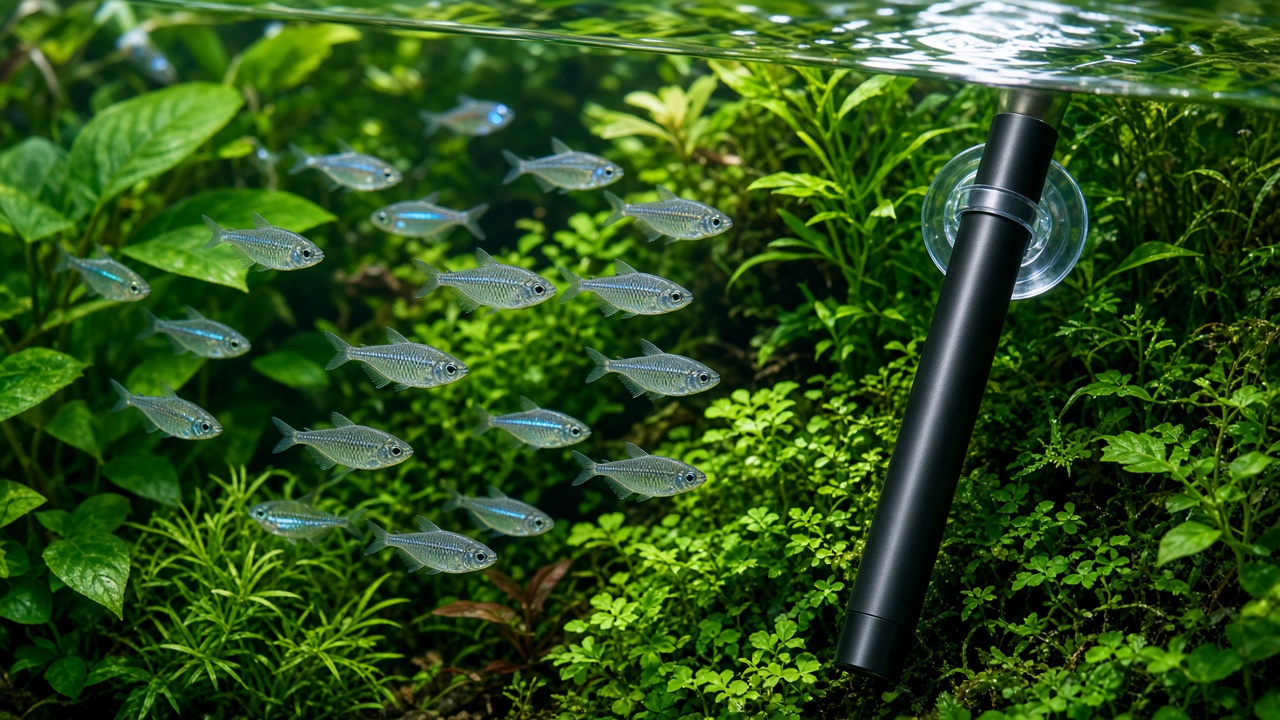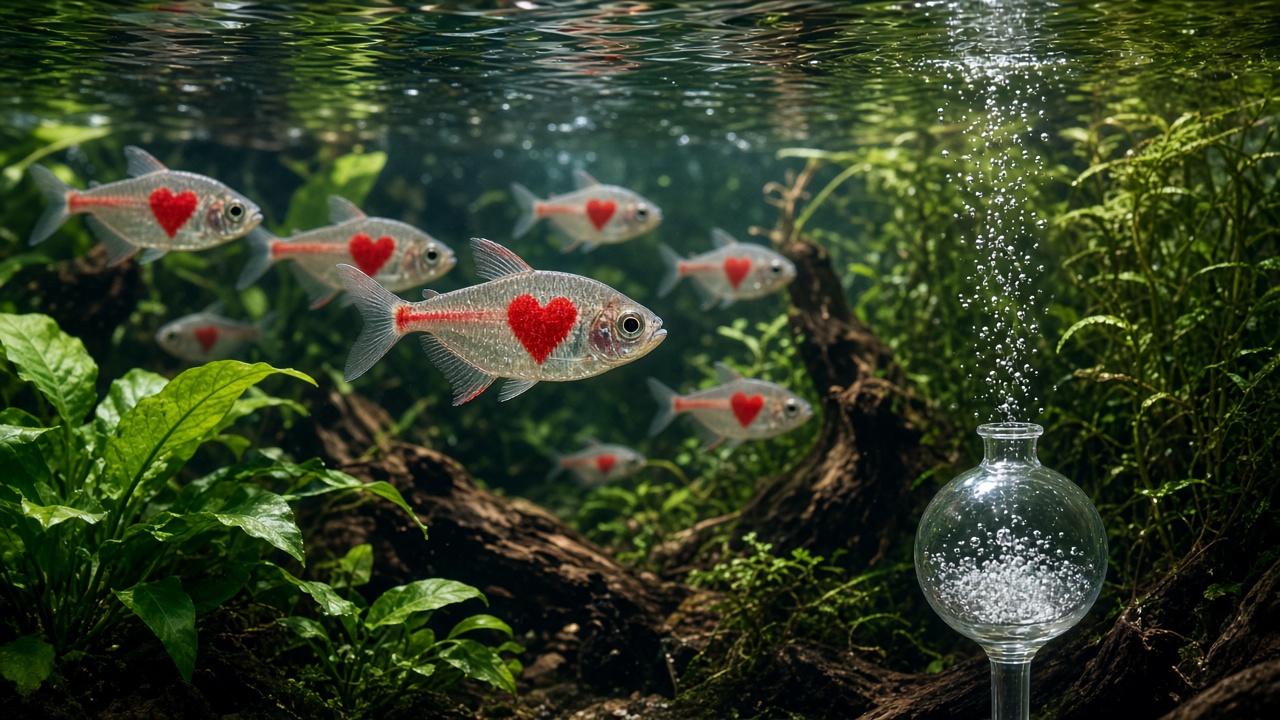
Quick answer: Keep bleeding heart tetras in a long 20-gallon tank, in a school of five or more. Feed a small tropical flake or micro pellet. Choose calm, similar-size tank mates.
Keep bleeding heart tetras in a tank at least 80 cm long, in a school of five or more. This page is a research-desk care brief. We did not breed a colony, run water trials, or open livestock boxes.
Selection rule: We only cover freshwater community tanks of 20 gallons or larger, and products whose maker page lists a tropical or small-fish use. We skip saltwater kits, betta-only cubes, and any SKU we could not match to a current maker page.
Our research team analyzed published species records and maker specs, then compared listed sizes, protein figures, and kit contents only. We did not rank products.
What a bleeding heart tetra is
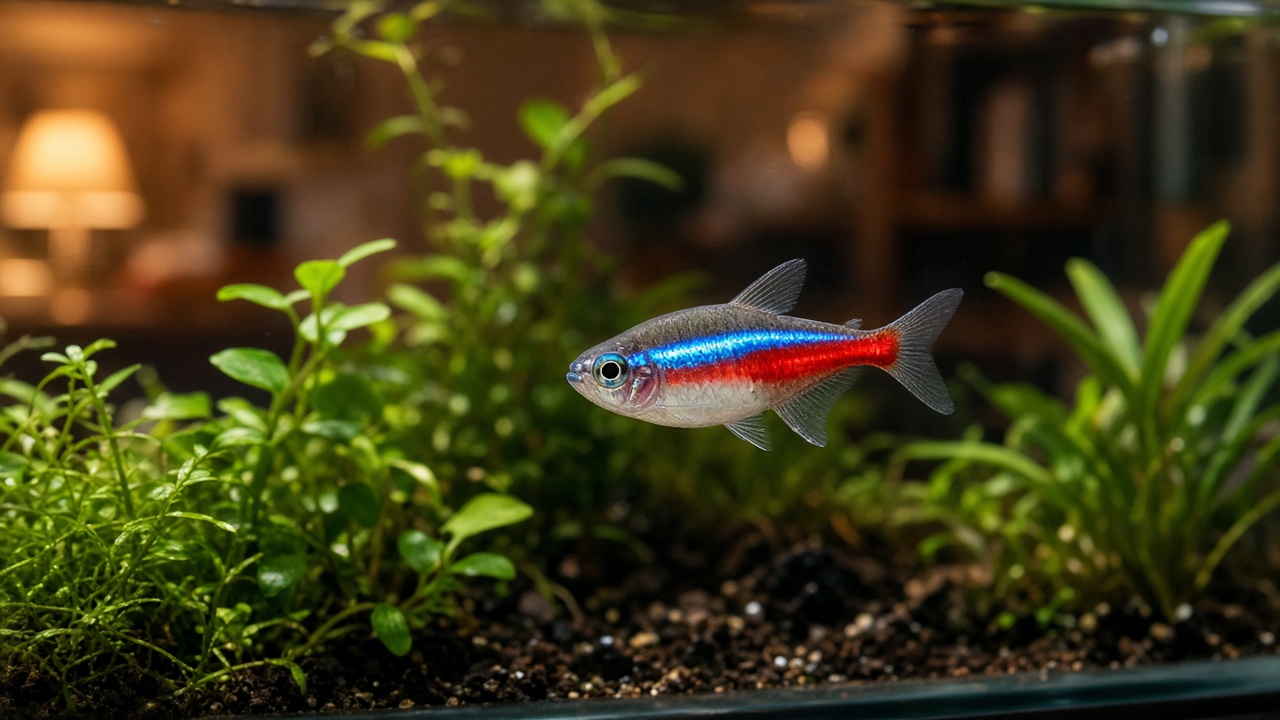
This fish is a midwater South American tetra that stays near 6 cm as an adult.
FishBase lists the accepted name as Megalamphodus erythrostigma, while shops still print Hyphessobrycon erythrostigma on bags.
FishBase records a maximum length of 6.1 cm standard length, or about 2.4 inches not counting the tail.
The IUCN Red List assessed the species on 4 March 2021 and listed it as Least Concern. The IUCN page names Brazil, Colombia, and Peru as the native range.
The IUCN account says most market fish are probably captive-bred. It also notes the species occurs in at least one protected area, the Amanã Sustainable Development Reserve in Amazonas, Brazil.
FishBase gives a trophic level of 2.8 based on food items, which sits between a plant eater and a strict predator.
Males often show longer, more pointed dorsal and anal fins. Females look fuller in the belly when they are carrying eggs. Color is not a safe sexing method on its own.
Tank size and the 80-cm School Rule
The tank must be long enough for a school to turn together.
FishBase’s aquarium-keeping note lists a minimum aquarium size of 80 cm, or about 31.5 inches of swimming length.
Our research team uses one in-house rule for this species and calls it the Waterpuppy 80-cm School Rule.
- Use a tank at least 80 cm long.
- Stock five or more of this species.
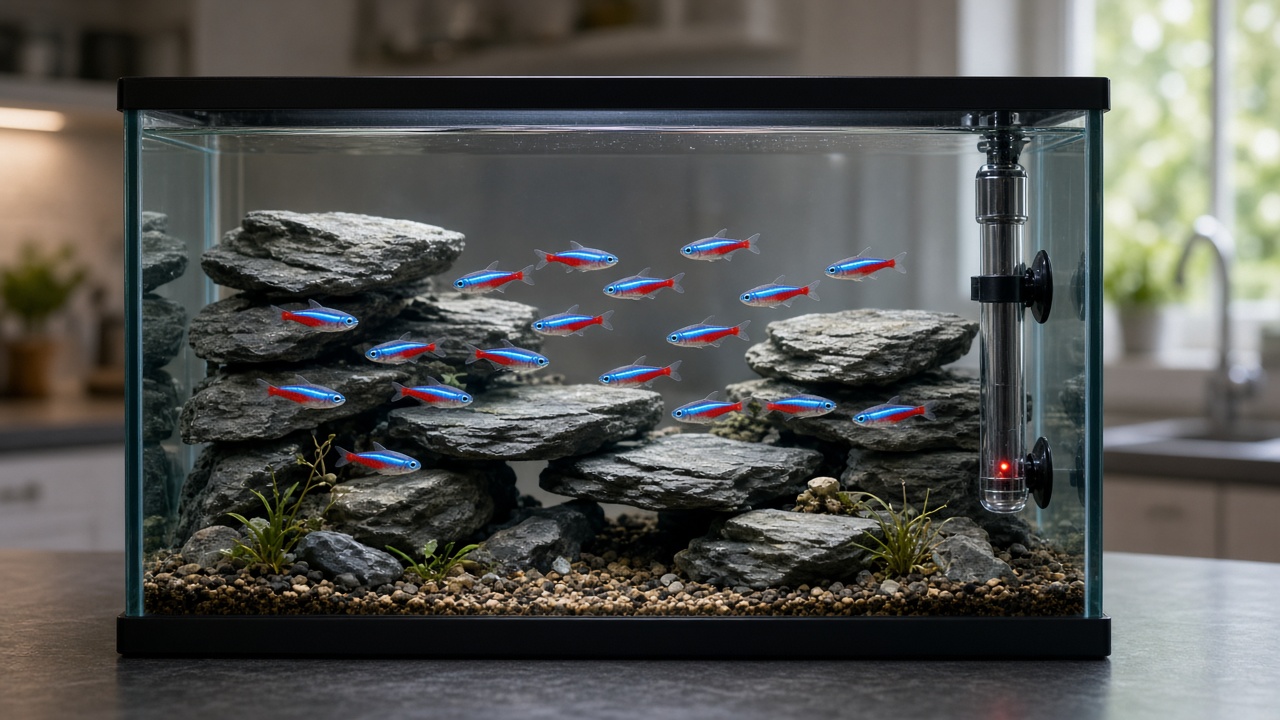
- Keep open midwater lanes, not a solid wall of hardscape.
Aqueon’s Rectangle LED Kits page lists four kit sizes: 10, 20 High, 29, and 55. We drop the 10 because it fails the length rule for a full school.
Between the 20 High and the 29, we treat the 29 as the closer match. A “High” 20-gallon box is taller, not longer.
Aqueon’s kit page lists a preset heater at a constant 78 degrees, which sits inside the FishBase temperature band. That 78-degree setting is a kit default, not a species limit.
If you already own a 20-gallon long tank, keep the school at five. Do not add a second midwater school until you move up.
How many to keep in one school
Five fish is the published floor, not a ceiling.
FishBase’s aquarium-keeping note says to keep them in groups of 5 or more individuals. A pair or a trio often chases and nips.
A school of six to eight works well in a 29-gallon kit. Extra fish spread pecks and look like one moving group.
Do not mix one bleeding heart tetra into another tetra school and call it done, because this species still needs its own group.
Males may flare fins at each other in a display, but that is not a reason to keep only one male. A larger group lowers the pressure on any one fish.
Skip this species if you want a single “feature fish.” A lone tetra hides, fades, and may nip fins.
Water, heat, and weekly tests
Stable, slightly acidic water matters more than fancy gadgets.
FishBase lists these published ranges:
- Temperature: 23°C to 28°C (about 73°F to 82°F)
- pH: 5.6 to 7.2
- Hardness: up to 12 dH
Aqueon’s Rectangle LED Kits page lists a preset heater at 78°F, or about 25.6°C, near the middle of the FishBase band.
Do not chase the lowest pH on the chart. Stay inside 5.6 to 7.2 and keep swings small.
API’s product page for the Freshwater Master Test Kit lists the checks that matter here. The kit measures pH, high-range pH, ammonia, nitrite, and nitrate.
API’s page says the kit comes with four test tubes, a holding tray, and a laminated color card. That same page tells you to test weekly.
Use this weekly loop:
- Test ammonia, nitrite, nitrate, and pH.
- If ammonia or nitrite reads above zero, skip feeding that day and plan a water change.
- Change about one-quarter of the water if nitrate climbs or the tank looks dull.
- Match the new water’s temperature to the tank before you pour.
API’s page states that a pH of 7.0 is neutral, while values below 7.0 are acidic and values above 7.0 are alkaline.
This species can live near either side of 7.0. Sudden jumps between those sides are the real problem.
Gentle filter flow is enough, and a hard spray bar that pins fish to the glass is not.
Diet and feeding
Offer a small flake or pellet that hits midwater.
FishBase says the species feeds on worms, crustaceans, and plants. In a home tank, that means a mixed tropical diet, not a single frozen food.
Tetra’s page for TetraMin Flakes lists crude protein at 46%, crude fat at 11%, crude fiber at 2%, and moisture at 7%. The same page lists Vitamin D3 at 1848 IU/kg and citric acid at 293 mg/kg.
Tetra lists these pack sizes for TetraMin Flakes:
- 100 ml / 20 g
- 250 ml / 52 g
- 500 ml / 100 g
- 1 L / 200 g
- 10 L / 2.1 kg
For a single 29-gallon school, the 1 L / 200 g tub is the size we compare. Larger tubs go stale if you keep few fish.
Hikari’s Micro Pellets page says the food is a daily diet for smaller-mouth fishes. It lists three pack sizes: 0.77 oz (22 g), 1.58 oz (45 g), and 2.2 lb (1 kg).
Hikari’s page also calls the pellets semi-floating, which matches a midwater tetra better than a wafer that sits on sand.
Use this feeding pattern:
- Offer a pinch of flake or micro pellet once or twice a day.
- Stop when the school finishes in about two minutes.
- Add a frozen or live item a few times a week if you keep it.
Skip garlic soaks, “color boost” claims, and any dose we cannot read on a maker page. Skip goldfish flakes, which are not built for this fish.
Gear we compared by listed size
Compare maker-listed sizes and pack weights, not ads.
The table below is an attribute sheet with no rank column and no prices. Our research team compared only what each maker page lists.
| Product | Maker-listed size | Listed spec | Role in a school tank |
|---|---|---|---|
| Aqueon Rectangle LED Kit | 20 High | Preset heater at 78°F; five-stage filter | Smallest kit we still discuss |
| Aqueon Rectangle LED Kit | 29 | Same kit line; next listed size up | Better length for the 80-cm rule |
| TetraMin Flakes | 1 L / 200 g | Crude protein 46%; Vitamin D3 1848 IU/kg | Daily midwater flake |
| Hikari Micro Pellets | 1.58 oz (45 g) | Also listed at 0.77 oz and 2.2 lb | Small-mouth pellet |
| API Freshwater Master Test Kit | 4-tube kit | pH, high-range pH, ammonia, nitrite, nitrate | Weekly water checks |
Aqueon’s kit page says each box includes a glass tank, LED hood, QuietFlow power filter, cartridge, and preset heater. It also lists a food sample, water conditioner sample, net, thermometer, and setup guide. Fish, gravel, and decor are sold separately.
Aqueon also lists five-stage filtration and an ammonia specialty filter pad, which is a kit claim and does not replace the API weekly tests.
If you already own a bare 29-gallon tank, you do not need the full Aqueon kit. You still need heat, a gentle filter, and a test kit.
Tank mates that fit this fish
Match tank mates by size and speed, not color.
A bleeding heart tetra occupies the middle of the tank. Bottom fish and surface fish can share the box if they stay calm.
Good matches are other peaceful tetras of similar size, small rasboras, corydoras, and a single peaceful dwarf gourami. Keep each schooling species in its own group of five or more.
Skip this list:
- Bettas with long fins
- Tiger barbs and other known nippers
- Large cichlids
- Fancy goldfish
- Baby shrimp you hope to breed
Adult Amano shrimp may hold up, but cherry shrimp often become snacks.
If you want a smaller red tetra for a tighter tank, read our Ember tetra care brief. Ember tetras stay smaller and do not replace a bleeding heart school in a long tank.
Do not stock by “inches of fish per gallon.” Stock by swimming length, school count, and waste load.
A 29-gallon kit can hold one bleeding heart school plus a small bottom group. It cannot hold three midwater schools.
Setup steps for a first school
Set the tank and cycle it before you buy any fish.
- Place an Aqueon 29 Rectangle LED Kit, or a similar long 29-gallon tank, on a stand that can hold a full tank.
- Add a dark sand or fine gravel bed and a few wood pieces.
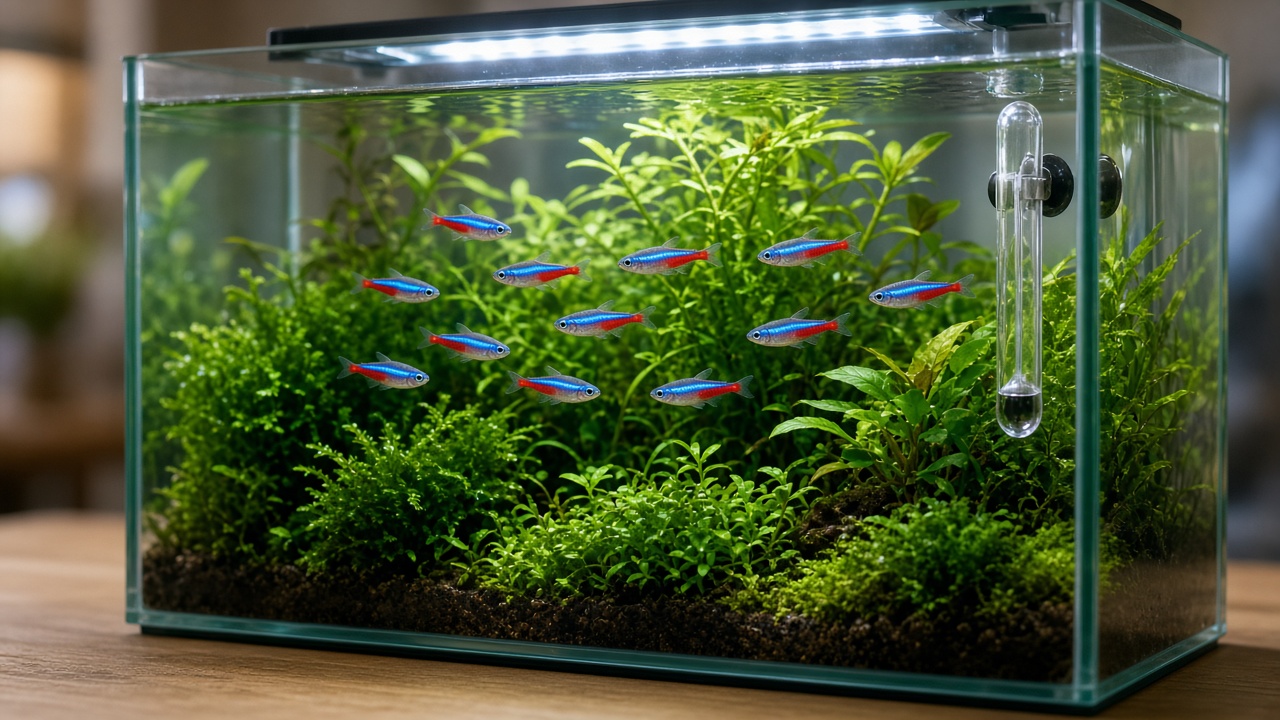
- Plant the back and sides. Leave a clear midwater lane.
- Run the filter and the 78°F preset heater.
- Cycle the tank. Use the API Freshwater Master Test Kit each week.
- Add five or more bleeding heart tetras only after ammonia and nitrite read zero.
Keep lights moderate, because bright sand and bare glass wash out the red shoulder spot.
Do a small water change after you add the school, then return to the weekly test loop.
If a fish hangs at the surface or clamps its fins, test the water before you add medicine.
FAQ
How big do bleeding heart tetras get?
FishBase lists a maximum of 6.1 cm standard length for males and unsexed fish, or about 2.4 inches without the tail. Most shop fish are smaller than that record, so plan tank length for the adult.
What size tank do bleeding heart tetras need?
FishBase lists a minimum aquarium size of 80 cm, or about 31.5 inches of swimming length. Our research team treats Aqueon’s 29 Rectangle LED Kit as the closer match versus the 20 High. A tall 20-gallon box is not the same as a long one.
How many bleeding heart tetras should I keep together?
FishBase says to keep them in groups of 5 or more, so five is the floor. Six to eight looks better in a 29-gallon kit, while one or two fish often hide and may nip fins.
What do bleeding heart tetras eat?
FishBase lists worms, crustaceans, and plants as foods, so use a small tropical flake or a micro pellet. Tetra’s TetraMin Flakes page lists 46% crude protein, and Hikari’s Micro Pellets page lists a small-mouth, semi-floating daily diet.
Can bleeding heart tetras live with shrimp or bettas?
Skip bettas with long fins, because this tetra may nip slow tails. Adult Amano shrimp can share a planted tank, but fancy dwarf shrimp are a risk when young.
What water temperature and pH do they need?
FishBase lists 23°C to 28°C, pH 5.6 to 7.2, and hardness up to 12 dH. Aqueon’s kit heater is listed at 78°F, which sits inside that temperature band. API’s page tells you to test pH and nitrogen waste weekly.
Are wild bleeding heart tetras at risk?
The IUCN Red List assessed the species as Least Concern on 4 March 2021. The IUCN account says harvest is probably not high and that much of the market is captive-bred. Ask your shop how the batch was produced.
<script type="application/ld+json"> { "@context": "https://schema.org", "@graph": { "@type": "Article", "headline": "Bleeding Heart Tetra Care: Tank [Size, School, Diet, Tank Mates", "description": "Keep bleeding heart tetras in a tank at least 80 cm long, in a school of five or more.", "author": { "@type": "Organization", "name": "waterpuppy.net", "url": "https://www.waterpuppy.net" }, "publisher": { "@type": "Organization", "name": "waterpuppy.net", "url": "https://www.waterpuppy.net" }, "mainEntityOfPage": "https://www.waterpuppy.net/articles/bleeding-heart-tetra-care/", "about": { "@type": "Thing", "name": "Megalamphodus erythrostigma", "alternateName": ["Hyphessobrycon erythrostigma", "bleeding heart tetra"] } }, { "@type": "FAQPage", "mainEntity": [ { "@type": "Question", "name": "How big do bleeding heart tetras get?", "acceptedAnswer": { "@type": "Answer", "text": "FishBase lists a maximum of 6.1 cm standard length for males and unsexed fish, or about 2.4 inches without the tail. Most shop fish are smaller than that record, so plan tank length for the adult." } }, { "@type": "Question", "name": "What size tank do bleeding heart tetras need?", "acceptedAnswer": { "@type": "Answer", "text": "FishBase lists a minimum aquarium size of 80 cm, or about 31.5 inches of swimming length. Our research team treats Aqueon’s 29 Rectangle LED Kit as the closer match versus the 20 High. A tall 20-gallon box is not the same as a long one." } }, { "@type": "Question", "name": "How many bleeding heart tetras should I keep together?", "acceptedAnswer": { "@type": "Answer", "text": "FishBase says to keep them in groups of 5 or more, so five is the floor. Six to eight looks better in a 29-gallon kit, while one or two fish often hide and may nip fins." } }, { "@type": "Question", "name": "What do bleeding heart tetras eat?", "acceptedAnswer": { "@type": "Answer", "text": "FishBase lists worms, crustaceans, and plants as foods, so use a small tropical flake or a micro pellet. Tetra’s TetraMin Flakes page lists 46% crude protein, and Hikari’s Micro Pellets page lists a small-mouth, semi-floating daily diet." } }, { "@type": "Question", "name": "Can bleeding heart tetras live with shrimp or bettas?", "acceptedAnswer": { "@type": "Answer", "text": "Skip bettas with long fins, because this tetra may nip slow tails. Adult Amano shrimp can share a planted tank, but fancy dwarf shrimp are a risk when young." } }, { "@type": "Question", "name": "What water temperature and pH do they need?", "acceptedAnswer": { "@type": "Answer", "text": "FishBase lists 23°C to 28°C, pH 5.6 to 7.2, and hardness up to 12 dH. Aqueon’s kit heater is listed at 78°F, which sits inside that temperature band. API’s page tells you to test pH and nitrogen waste weekly." } }, { "@type": "Question", "name": "Are wild bleeding heart tetras at risk?", "acceptedAnswer": { "@type": "Answer", "text": "The IUCN Red List assessed the species as Least Concern on 4 March 2021. The IUCN account says harvest is probably not high and that much of the market is captive-bred. Ask your shop how the batch was produced." } } ] } ] } </script>