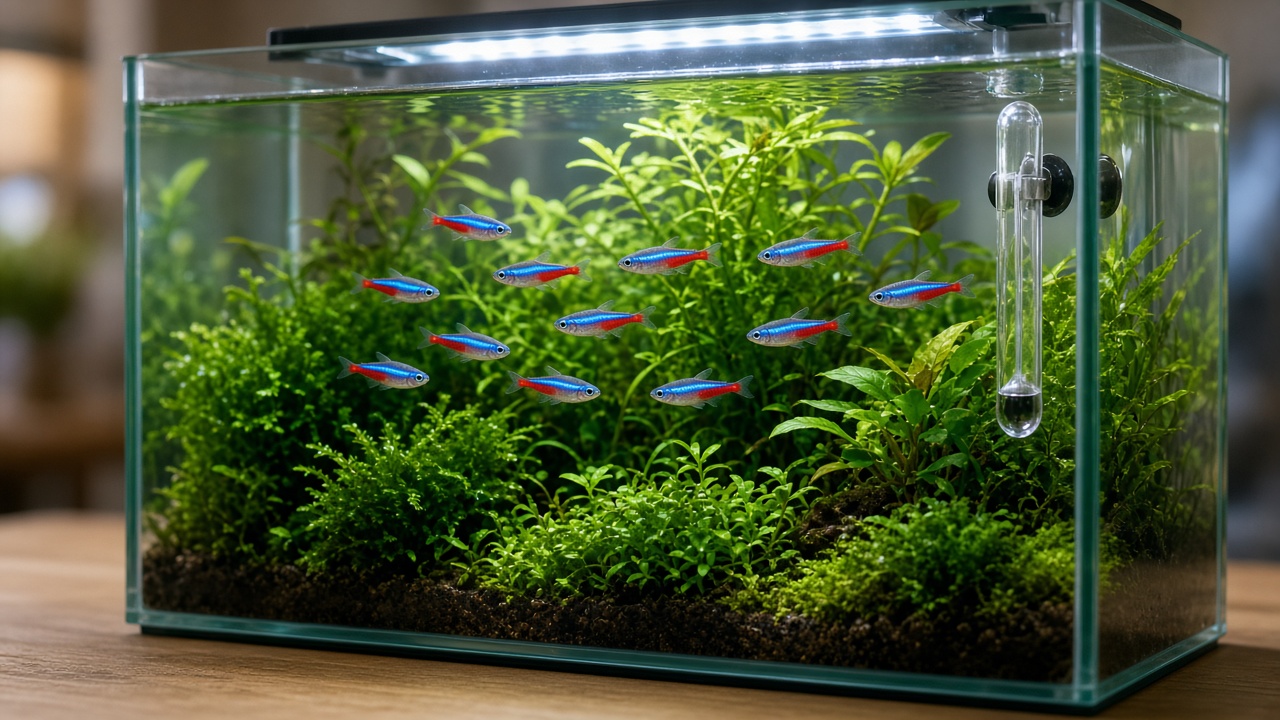
Quick answer: Plan on at least five years for neon tetras in a cycled, stable tank. Early deaths usually come from ammonia, excess heat, or a school that is too small. Match published cool, soft-water ranges before you add fish.
Aqueon states tetras should live at least 5 years, if not longer. This page is a published-spec review of neon tetra lifespan. We did not breed fish, run disease trials, or visit farms.
Our selection rule is narrow: we cover only Paracheirodon innesi in indoor freshwater community tanks. We do not cover cardinal tetras, green neons, pond culture, or drug-treatment plans.
Our research team compared published species records with maker labels and used those numbers, not store lore.
How long neon tetras live
Aqueon’s fishkeeping guide says small tetras should live at least 5 years.
That figure is a planning floor, not a measured tank average. FishBase’s neon tetra page lists size, water, and hatch time, but it does not list a captive lifespan.
Treat five years as the target if the tank stays cycled and cool. Shorter lives usually mean a husbandry miss, not a fragile species.
Aqueon also groups goldfish at 10 to 15 years and says koi live even longer. Neon tetras are small Amazon schoolers, so they need a shorter plan than those fish.
Use the five-year mark when you pick a tank, a school, and a heater, and do not buy them as a one-season decoration.
What published records list, and what they omit
FishBase is the record we used for species facts, and its neon tetra page is silent on years of life.
Here is what FishBase does list for Paracheirodon innesi:
- Maximum length: 2.5 cm standard length
- Temperature: 20–26°C (about 68–79°F)
- pH range: 5.0–7.0
- Hardness: 1–2 dH
- School: groups of 5 or more
- Minimum tank length: 60 cm (about 24 inches)
- Eggs in a tank hatch in about 24 hours
- IUCN Red List status: Least Concern, assessed 4 March 2021
- Population doubling time: less than 15 months
FishBase also says adults eat worms, small insects, crustaceans, and plant matter. That listed menu is omnivore fare, not a flake-only diet.
Our research team found a gap between maker copy and the species database. Maker care copy gives a year count, while the species database does not. We report both and do not invent a wild-age figure.
Water and heat mistakes that cut years
Unstable water and excess heat are the usual mistakes that cut years off a school.
Aqueon states that ammonia is more toxic at higher temperatures and at pH above 7.0. FishBase’s pH ceiling is also 7.0, so warm alkaline water stacks both risks.
Aqueon tells keepers to set an adjustable heater at 75–80°F for tropical fish. FishBase’s range tops out near 79°F, so the 80°F end of that dial sits above the FishBase ceiling.
Keep the box in the cooler half of the published FishBase range, and do not run the tank hotter than your room requires.
Aqueon’s Preset Heater is fixed at 78°F, which sits inside FishBase’s 68–79°F window. It is not a cool blackwater setting, so watch the actual water, not only the dial.
Aqueon also says sudden temperature swings stress fish and can trigger ich. Match new water to tank water before you pour it in.
Do this on a weekly rhythm:
- Test ammonia, nitrite, nitrate, and pH
- Change a portion of the water
- Match temperature by thermometer
- Dose conditioner for the new volume only
Aqueon says let a new tank settle at least 48 hours before the first fish. Neon tetras need more than a two-day wait, so wait until ammonia and nitrite read zero on a liquid kit.
API’s Freshwater Master Test Kit page says test weekly and that a pH of 7.0 is neutral. FishBase’s range ends at 7.0, so stay at or below that mark.
Do not chase pH with chemicals each week, because stability beats a perfect number on a chart.
School size, tank length, and tank mates
A short tank and a tiny school shorten life through constant stress.
FishBase’s aquarium note is a group of 5 or more in a tank at least 60 cm long. Aqueon says schooling fish such as tetras do best in groups of 6 or more.
Use the stricter pair:
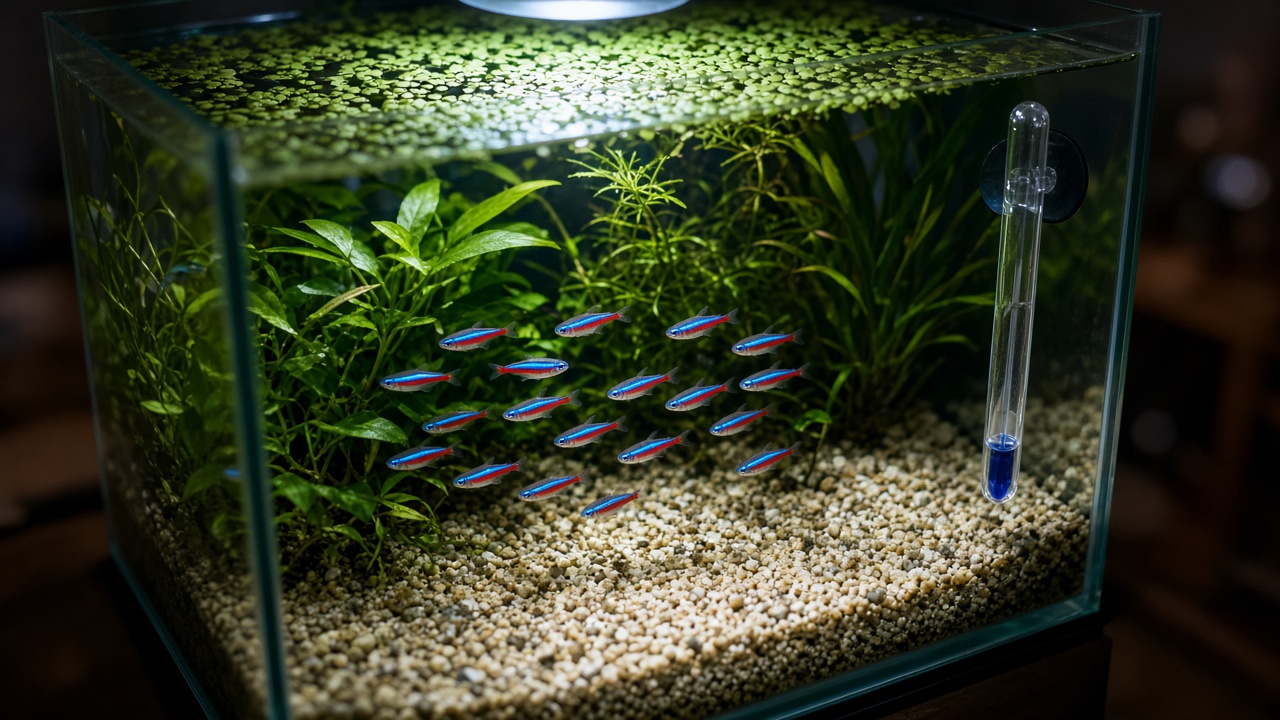
- At least 6 neon tetras
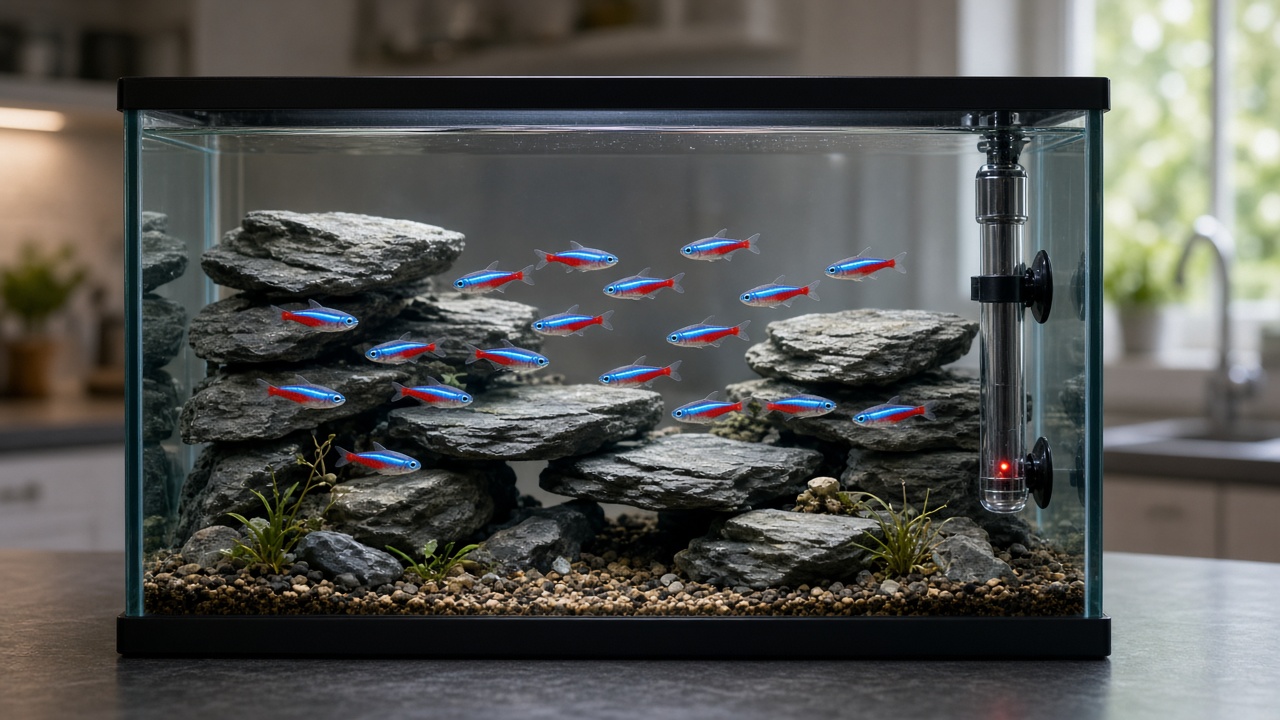
- A tank at least 24 inches long
- Gentle flow and cover, not a bare box
Length matters more than a tall hex shape, so measure the front glass before you trust a gallon sticker.
Do not house them with large cichlids, because an oscar will eat a neon tetra.
Do not mix them with cool-water goldfish. A fantail goldfish wants different heat and makes more waste.
Outdoor koi are a different project. Aqueon notes koi live even longer than the 10 to 15 years it gives goldfish, and a neon tetra does not belong in that pond.
Keep tank mates small and calm, and choose other small community fish that share the same water. Buy the full school on one day if you can, because adding extra fish later often means adding disease later.
Foods that fit a small mouth
A 2.5 cm fish needs food it can swallow on the first pass.
FishBase lists worms, insects, crustaceans, and plant matter as adult foods. A dry staple should be small and complete, and frozen crustaceans can fill part of that wild menu.
Our research team compared two maker labels sold for small freshwater fish. We did not score flavor or growth from a tank trial.
Hikari Sales USA’s Micro Pellets page lists these minima and maxima:
- Crude protein: 43.0% minimum
- Crude fat: 7.0% minimum
- Crude fiber: 7.0% maximum
- Moisture: 10.0% maximum
- Ash: 17.0% maximum
- Phosphorus: 1.1% minimum
- Vitamin A: 16,000 IU/kg minimum
- Vitamin D3: 2,400 IU/kg minimum
- Vitamin E: 960 IU/kg minimum
- Ascorbic acid: 360 mg/kg minimum
Hikari lists pack sizes of 0.77 oz, 1.58 oz, and 2.2 lb, and the pellets are made for small-mouth fishes.
Omega One’s Freshwater Flakes page lists a different label:
- Crude protein: 39% minimum
- Crude fat: 11% minimum
- Crude fiber: 2% maximum
- Moisture: 8.5% maximum
- Ash: 8% maximum
Omega One lists sizes from 0.42 oz to 5 lb. The first ingredients on that page are salmon and whole herring.
The protein gap on those two labels is 4 points: Hikari lists 43.0% minimum, and Omega One lists 39% minimum. That spread is a label gap, not a feeding trial.
Aqueon says feed most fish once or twice a day and that tetras are more carnivorous than livebearers. Rotate a small pellet or flake with a frozen invertebrate.
Skip leftover piles on the sand, because uneaten food becomes ammonia and ammonia cuts years. Feed only what the school clears, then lift the extra with a net.
Tests and conditioners that prevent early death
You cannot see ammonia in clear water, but you can measure it with a liquid kit.
API’s Freshwater Master Test Kit page says the kit checks ammonia, pH, high-range pH, nitrite, and nitrate. It ships with four test tubes and a laminated color card, and API says to test weekly.
API also says it has made aquarium products for almost 60 years, so use the booklet’s drop counts instead of guessing the color.
Seachem’s Prime page is the conditioner spec we used for tap water. The listed dose is 1 capful (5 mL) for each 50 US gallons of new water, and each cap thread is about 1 mL.
That works out to 0.1 mL per gallon at the standard dose, so a 10-gallon change needs 1 mL.
Seachem also states:
- Prime can be dosed every 24–48 hours
- It binds ammonia, nitrite, and nitrate for up to 48 hours
- A double dose is allowed for high chloramine
- Up to 5 times the normal dose may be used if ammonia or nitrite is above 2 ppm
- Use a half dose if temperature is above 86°F and chlorine or ammonia is low
Dose the new water, not a random splash, and Seachem says the sulfur smell is normal.
Aqueon sells boxed kits from 10 to 55 gallons, but a 10-gallon box is often shorter than FishBase’s 60 cm rule. Measure the glass, and do not trust the gallon number alone.
Aqueon’s Preset Heater line is built for 10- to 75-gallon tanks and is set at 78°F. Confirm the water with a thermometer Aqueon says to place away from the heater.
| Product | Category | Maker-listed number | Other listed attribute |
|---|---|---|---|
| Hikari Tropical Micro Pellets | Daily food | 43.0% min crude protein | 16,000 IU/kg min vitamin A |
| Omega One Freshwater Flakes | Daily food | 39% min crude protein | 8.5% max moisture |
| Seachem Prime | Water conditioner | 5 mL per 50 US gallons | Binds ammonia up to 48 hours |
| API Freshwater Master Test Kit | Liquid test kit | 4 glass test tubes | Weekly testing; pH 7.0 is neutral |
| Aqueon Preset Heater | Submersible heater | Preset to 78°F | Sizes listed for 10–75 gallon tanks |
Use the table to match a job, not to pick a winner, because food, conditioner, tests, and heat are different jobs.
A simple five-year setup checklist
Lock length, school, heat, and tests before you bring the first bag home.
Work in this order:
- Buy a tank at least 60 cm long.
- Cycle until ammonia and nitrite read zero.
- Set heat inside FishBase’s 68–79°F range.
- Add at least 6 neon tetras at once.
- Feed a small staple once or twice a day.
- Test weekly with a liquid kit.
- Condition every new drop of tap water.
Aqueon says acclimate new fish for at least 30 minutes. Float the bag, then mix tank water in slowly, and keep the lights off during that wait.
Aqueon notes tropical rooms get about 12 hours of light, while unplanted tanks do better with 8 to 10 hours, so use a timer.
If a fish hangs apart from the school or stops eating, isolate it. We do not publish drug doses, so ask a fish-experienced clinic if the school keeps fading.
Do not restock the same week; test first, then fix the water before you add more fish.
FAQ
How long do neon tetras live?
Aqueon says tetras should live at least 5 years, if not longer, and FishBase does not publish a neon tetra lifespan number. Plan on five years in a cycled, cool, soft-water tank, because early losses usually point to water, heat, or school size.
Do neon tetras live longer in cooler water?
FishBase lists 20–26°C, about 68–79°F, and Aqueon says ammonia is more toxic at higher temperatures. Cooler water inside that range lowers metabolic demand, but do not drop below 68°F to stretch life.
How many neon tetras should I keep?
FishBase says groups of 5 or more, and Aqueon says tetras do best in groups of 6 or more. Buy six as the floor, because a larger school looks calmer in a 24-inch tank.
What tank size do neon tetras need?
FishBase lists a minimum aquarium length of 60 cm, about 24 inches, and that is a length rule, not a gallon slogan. A short, tall tank fails the rule even when the sticker shows a large volume.
What most often shortens neon tetra life?
Ammonia, nitrite, heat above the FishBase range, and a school that is too small are the usual cuts, and untreated tap water is next. Seachem’s Prime page exists because chlorine and chloramine are routine tap problems.
Can neon tetras live with goldfish, oscars, or koi?
No. Oscars eat them, and fantail goldfish want different heat and make more waste. Koi are outdoor fish with a much longer Aqueon lifespan note, so keep neon tetras with small, calm community fish.
How often should I test the water?
API’s kit page says test weekly, and you should test more often in a tank that is still cycling. Record ammonia, nitrite, nitrate, and pH, then act on any ammonia or nitrite above zero.