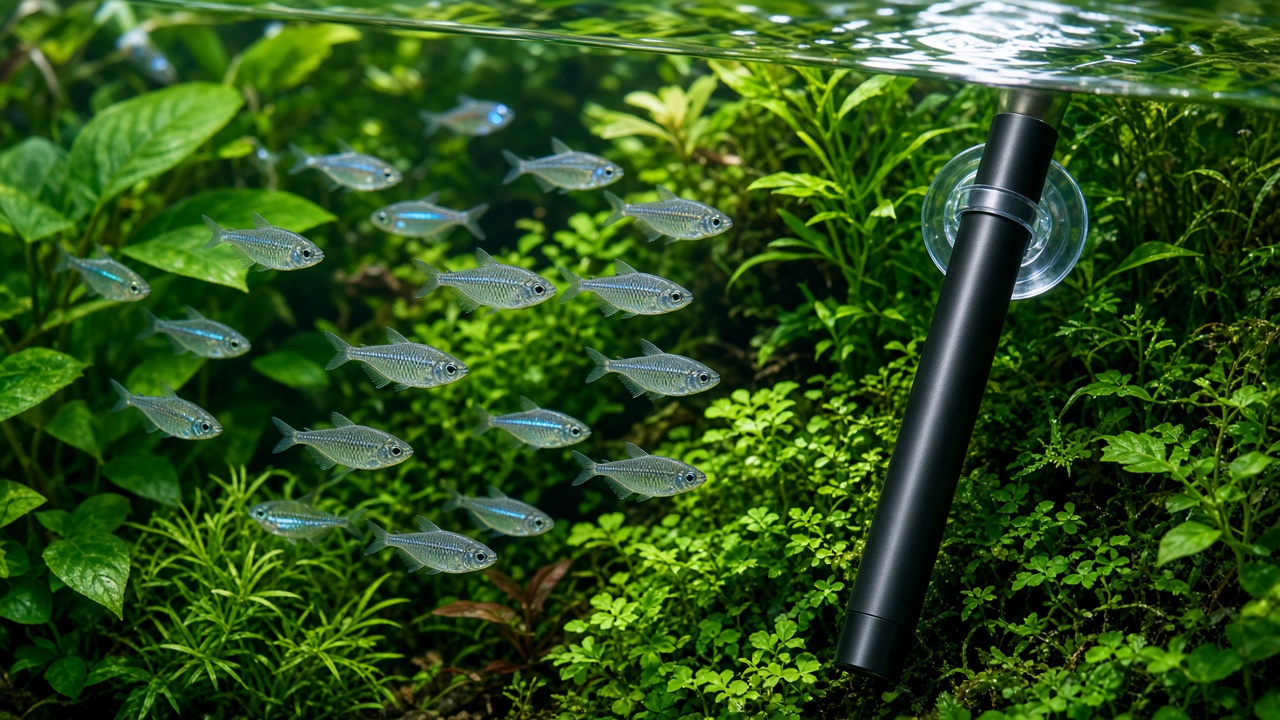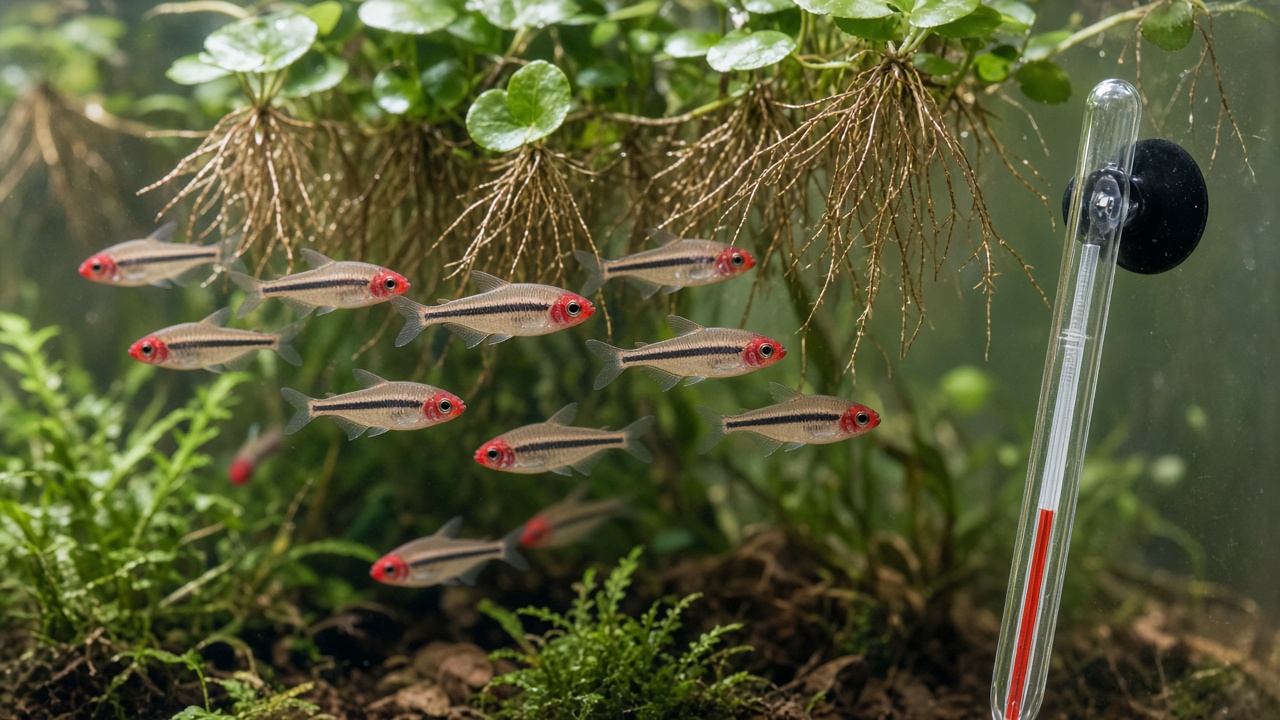
Quick answer: Buy a school of at least five rummynose tetras. House them in a tank at least 80 cm long. Feed a small tropical staple and keep water in a stable tropical range.
FishBase lists rummynose tetra (Petitella rhodostoma) at 5.0 cm total length and a school of 5 or more.
This page is a Waterpuppy research-desk comparison of FishBase records and maker labels. We did not run aquarium trials, collect wild fish, or rank brands.
Our School-Length Rule decides what belongs here. We cover only tanks that meet FishBase’s 80 cm length and a school of five or more. We skip 10-gallon boxes, lone fish, and foods with no listed protein or timed feed note.
What a rummynose tetra is
FishBase treats the rummynose tetra as Petitella rhodostoma, a tropical freshwater fish from South America.
Ernst Ahl named the species in 1924, and FishBase now places it in Acestrorhamphidae, the American tetras. The same summary lists the range as the lower Amazon River basin and the Orinoco River basin.
FishBase marks the fish as freshwater and benthopelagic, so it uses mid-water and near-bottom space. It lists a maximum total length of 5.0 cm for males and unsexed fish. That 5.0 cm figure is the only adult size we use for tank math.
FishBase also gives a trophic level of 3.1, plus or minus 0.4, which sits in the mid-consumer range. That matches a mixed diet of small prey and prepared food, not a plant-only menu.
FishBase notes commercial aquarium use. It does not list a numeric wild pH on that summary page, so we do not invent one.
The School-Length Rule for housing
FishBase’s aquarium note is the housing floor we use: a group of 5 or more in a tank at least 80 cm long.
Eighty centimeters is about 31.5 inches, which is longer than a common 10-gallon box. Our research team divided FishBase’s 80 cm tank by the 5.0 cm adult length and got 16 body lengths of open run. If the tank is shorter than 80 cm, this article does not treat the setup as a rummynose tank.
Aqueon’s tetras care guide speaks to tetras as a group and says most can live in 10 to 20 gallon tanks. It also says they do best in schools of 6 or more. We do not apply Aqueon’s 10-gallon line to rummynose tetra, because FishBase’s 80 cm length is longer than a typical 10-gallon tank.
We keep Aqueon’s school-of-6 line as a stricter group size if you want extra cover. Put the housing rule in this order:
- Start with five or more rummynose tetras, per FishBase.
- Prefer six or more if you follow Aqueon’s tetra school note.
- Use a tank at least 80 cm long, per FishBase.
- Leave a mid-water lane so a 5.0 cm fish can turn as a group.
- Use a tight lid, because Aqueon’s tetras care guide says tetras may jump when scared.
Aqueon also asks for a mild, steady current, which fits a long tank better than a cube. We do not cover breeding tanks here, because FishBase’s summary page does not give a spawn recipe. Aqueon calls tetra breeding difficult and notes that adults may eat eggs.
Water: tropical, stable, and tested
Aqueon’s tetras care guide is the numeric water band we cite for community tetras.
Aqueon lists these targets for most tetras:
- pH 6.8 to 7.8
- Alkalinity 3° to 8° dKH (50 ppm to 140 ppm)
- Temperature 75°F to 80°F
- A heater if the room stays below 75°F
- A 10% water change every week, or 25% every 2 weeks
FishBase only marks the climate as tropical and does not print a pH or temperature band on the Petitella rhodostoma summary. We do not fill that gap with an unsourced range.
Aqueon also notes that most shop tetras are farm-raised in harder, less acidic water than wild Amazon water. The 6.8 to 7.8 pH band reflects that farmed stock, not a blackwater copy.
Treat new tap water before it hits the tank. Seachem’s page for Prime states a dose of 1 capful (5 mL) for each 200 L (50 US gallons) of new water. Each cap thread is about 1 mL.
Scale the dose from that ratio:
- 10 US gallons of new water: 1 mL
- 20 US gallons of new water: 2 mL
- 50 US gallons of new water: 5 mL
Seachem says Prime can go in the tank, but new water first is better, and a sulfur smell is normal. If temperature is above 30°C (86°F) and chlorine or ammonia is low, Seachem says to use a half dose.
Seachem says Prime binds ammonia, nitrite, and nitrate for up to 48 hours. You may use up to 5 times the normal dose if ammonia or nitrite is above 2 ppm. You may dose again every 24 to 48 hours.
Those are emergency label rules, not a weekly habit. The weekly habit is Aqueon’s 10% change or the 25% change every 2 weeks. Test on a set day and log pH, ammonia, nitrite, and nitrate.
Diet: small staples with listed numbers
Rummynose tetras need a small tropical staple they can finish before it fouls the water.
Aqueon’s tetras care guide says most tetras are omnivores. Feed only what they can finish in under 2 minutes, once or twice a day. It also allows frozen or live foods as treats.
Hikari’s page for Tropical Micro Pellets says to feed two to three times daily, and only what fish will finish in a few minutes. API’s page for TROPICAL FLAKES says to feed twice a day, only what fish eat within 3 minutes.
Our research team compared those three timed-feed notes and calls the spread the Timed-Feed Window:
- Aqueon: under 2 minutes, once or twice a day
- API TROPICAL FLAKES: twice a day, 3-minute cap
- Hikari Tropical Micro Pellets: two to three times a day, a few minutes each
Stay inside the shortest window if the notes disagree, which means a 2-minute cap and one or two meals on quiet days. Add a third small meal only if the first two vanish.
We compared published labels for four currently sold products. A food had to list a protein percent or a timed feed note. We included Seachem Prime because untreated new water breaks this setup.
| Product | Form | Maker-listed protein or dose | Other listed spec |
|---|---|---|---|
| Hikari Tropical Micro Pellets | Semi-floating pellet | min. 43% crude protein | min. 7% crude fat; min. 1.1% phosphorus |
| TetraMin Flakes | Flake | 46% crude protein | 11% crude fat; Vitamin D3 1848 IU/kg |
| API TROPICAL FLAKES | Flake | Protein % not listed on the maker page | Feed twice daily in 3 minutes; up to 30% less ammonia |
| Seachem Prime | Water conditioner | 5 mL per 50 US gallons of new water | Binds ammonia, nitrite, and nitrate up to 48 hours |
Hikari’s page also lists maximum 7% crude fiber, maximum 10% moisture, and maximum 17% ash. It names tetras as a target fish.
Tetra’s page for TetraMin Flakes lists 2% crude fiber and 7% moisture. It also lists citric acid at 293 mg/kg.
API’s page for TROPICAL FLAKES names tetras among the target fish and lists menhaden and squid. It also claims the food can produce up to 30% less ammonia, which is API’s own page claim.
Our research team lined up the two protein percents that makers did print. TetraMin Flakes lists 46%, Hikari Tropical Micro Pellets lists a 43% minimum, and the gap is 3 percentage points.
A simple daily plan that stays inside those labels:
- Morning: a pinch of Hikari Tropical Micro Pellets or TetraMin Flakes.
- Evening: a second pinch, still inside a 2-minute eat window.
- Optional third micro-feed only if the school clears the first two.
- Treats: a frozen or live item on some days, per Aqueon’s tetra note.
- New water: dose Seachem Prime at 5 mL per 50 US gallons before it enters the tank.
Skip large wafers and foods the maker does not size for small mouths. Those fail the food filter in our rule.
Tank mates that still leave room for the school
Tank mates must leave the 80 cm run free and must not break the school of five.
Aqueon’s tetras care guide lists these mates for tetras as a group:
- Other tetra species
- Rasboras
- Small danios
- Peaceful barbs
- Appropriately sized rainbowfish
- Livebearers
A school of ember tetras can sit on that “other tetra” line if each species still has its own group. Do not mix two lonely pairs and call it a school.
Aqueon also names two problem types. Serpae tetras can nip when kept in low numbers, and Buenos Aires tetras grow large and may scare smaller fish. We exclude both from rummynose tanks under this rule.
Aqueon sets 75°F to 80°F for most tetras and calls Buenos Aires tetras a cooler exception. Do not add a cool-water exception to a 75°F to 80°F rummynose tank.
Keep the mate list short:
- Yes: other small tetras in their own school, rasboras, small danios, peaceful barbs.
- Yes: livebearers and mid-size rainbowfish if they share the 75°F to 80°F band.
- No: serpae tetras in a small group, Buenos Aires tetras, and cool-water species.
- No: fish large enough to eat a 5.0 cm tetra.
Three look-alikes shops sell as rummynose
FishBase splits three look-alikes, and this article writes care only for Petitella rhodostoma.
Use this checklist at the shop:
- Petitella rhodostoma: head red stops before the humeral region; one black spot on the lower rear caudal peduncle; dentary with 5–6 teeth that have 5 cuspids.
- Petitella georgiae: head red also stops short of the shoulder; one black caudal-peduncle spot; dentary with 9–11 teeth that have 5 cuspids.
- Petitella bleheri: head red reaches the humeral region; two black caudal-peduncle spots; dentary with 6 teeth that have 6–7 cuspids.
If the bag says “rummynose” and the red runs onto the shoulder, you may have bleheri. Care overlap is likely, but this article still keys numbers to rhodostoma because that is the FishBase page we read.
Ask the shop for five or more of one look. A mixed trio of look-alikes is not a school under our rule.
FAQ
How many rummynose tetras should I keep?
FishBase says to keep them in groups of 5 or more. Aqueon’s tetras care guide says tetras do best in schools of 6 or more. Start at five, then add a sixth if you want extra cover.
What tank length do rummynose tetras need?
FishBase lists a minimum aquarium size of 80 cm, which is about 31.5 inches. Our School-Length Rule rejects tanks shorter than that, including typical 10-gallon boxes. Length matters more than extra height.
What temperature and pH should I use?
FishBase only labels the species as tropical on its summary page. Aqueon’s tetras care guide lists 75°F to 80°F and pH 6.8 to 7.8 for most tetras. Use those numbers unless your farmed stock comes with a different written range from the seller.
How often should I change the water?
Aqueon’s tetras care guide gives two options: change 10% every week, or change 25% every 2 weeks. Treat the new water first. Seachem’s Prime page sets 5 mL per 50 US gallons of new water.
What should I feed rummynose tetras?
Use a small tropical staple such as Hikari Tropical Micro Pellets or TetraMin Flakes. Hikari lists a 43% minimum crude protein, and Tetra lists 46% crude protein. Feed inside a 2-minute window, once or twice a day.
Can rummynose tetras live with ember tetras?
Aqueon’s tetras care guide lists other tetra species as mates. A second school of ember tetras can work if each species still has its own group. Keep the tank at least 80 cm long so both schools can move.
How do I tell true rummynose from look-alikes?
FishBase separates three species by head red and tail spots. Petitella rhodostoma has red that stops before the shoulder and one black peduncle spot. Bleheri has red that reaches the shoulder and two black spots.