Quick answer: Yes. A home betta needs a gentle filter so ammonia stays at 0 mg/L. Skip a filter only if weekly tests stay at zero.
Yes: a home betta tank needs a filter unless weekly tests stay at 0 mg/L ammonia. This page is a desk review of published water manuals and one maker spec sheet.
We covered single-betta tanks from 5 to 10 gallons and left out cups, vases, community tanks, and ponds.
What a filter removes from a betta tank
A filter is a wet surface for bacteria that turn fish waste into less toxic nitrate.
Bettas eat and excrete in the same small volume of water, and leftover food on the floor adds still more waste. A working filter handles three jobs at once, and you still have to siphon and test.
Those jobs are:
- Mechanical: foam or floss traps flakes and debris
- Biological: bacteria convert ammonia to nitrite, then nitrate
- Chemical: carbon or resin binds some dissolved compounds
The University of Florida IFAS ammonia circular states that a tank biofilter must give those bacteria a place to live. Without that surface, ammonia stays dissolved even when the water looks clear.
The Merck Veterinary Manual names low dissolved oxygen and high ammonia as the two values most likely to kill fish. A running filter moves water across gills and media, and it keeps the bacterial bed wet. A filter isn’t a cure for overfeeding, and you still siphon solids between water changes.
Surface breathing is not a filter
A betta can gulp air at the surface, but that habit does not remove ammonia.
Bettas have a labyrinth organ, so they can take surface air when dissolved oxygen drops. That trait helped them survive warm, still water in the wild, and it does not process waste in a glass box.
The Merck Veterinary Manual sets a freshwater dissolved-oxygen target above 5 mg/L and calls values under 5 mg/L dangerous. Mortality may appear at 4 mg/L or below. Surface gulps can delay a low-oxygen crash, but they do nothing for ammonia.
The University of Florida IFAS circular states that un-ionized ammonia is about 100 times more toxic than ionized ammonium. Heat and high pH shift more of the total toward that toxic form, and a heated betta tank sits in that zone.
So the air-breathing argument fails on chemistry, because the fish can breathe while the water still burns the gills. The University of Florida IFAS circular says colorless ammonia has no smell at harmful levels. A test kit is the only way to know.
The ammonia numbers that decide the question
Any ammonia above 0 mg/L means the tank is out of balance.
That is the Waterpuppy Filter Rule: keep a filter until tests stay at zero. The figures below come from manuals our research team read in full.
The Merck Veterinary Manual freshwater table lists these targets:
- Total ammonia nitrogen: 0 mg/L
- Un-ionized ammonia: 0 mg/L
- Nitrite: 0 mg/L
- Nitrate: under 20 mg/L
- Dissolved oxygen: above 5 mg/L
- pH: 6.5 to 9.0
- Total alkalinity: above 100 mg/L as calcium carbonate
- Total hardness: above 20 mg/L as calcium carbonate
- Total chlorine: 0 mg/L
The University of Florida IFAS circular adds injury thresholds. Tissue damage can start when un-ionized ammonia rises above 0.05 mg/L. Sensitive fish typically die at 2.0 mg/L, and nitrite can harm fish at 0.10 mg/L.
The Merck Veterinary Manual footnote says un-ionized ammonia under 0.05 mg/L is not considered harmful in most cases. The target for a healthy tank is still zero, because any ammonia means the system failed.
A new filter isn’t instant. The University of Florida IFAS circular states a new biofilter needs six to eight weeks to cut ammonia and nitrite. The MSD Veterinary Manual also cites up to eight weeks for a tropical biofilter.
Fishless cycling uses a known ammonia dose. The MSD Veterinary Manual describes adding ammonia to reach at least 1 to 5 mg/L, then waiting until both ammonia and nitrite read zero.
Alkalinity keeps those bacteria working, and the University of Florida IFAS circular says common nitrifying bacteria fail below 20 mg/L alkalinity. The MSD Veterinary Manual says alkalinity of 50 mg/L or less will inhibit the biofilter. That same manual tells keepers to buffer to at least 100 mg/L.
Those figures are why a bowl without media fails so fast. There is almost no bacterial surface and almost no buffer volume, so ammonia appears within days.
Tank size, substrate, and waste load
A larger water volume slows the rise of ammonia, but it does not replace a filter.
Waste still lands on the bottom, and gravel beds hide uneaten food. Our guide to betta tank size covers footprint and depth, and this page uses size only to judge filter load.
Our research team used 5 to 10 gallons as the working range. That is the band where a small pump can turn the volume without a blast of current.
Substrate choice changes how often you vacuum, because sand shows debris while coarse gravel hides it. See our betta substrate guide for bed types, then siphon whatever you pick.
The University of Florida IFAS circular says to test ammonia once a week in a production system. Test at once if the fish stops eating. In a 5 to 10 gallon home tank, weekly tests are the floor.
If ammonia appears, that circular says to cut or stop feeding for one to three days. Then change 25 to 50 percent of the water if the source water is clean. The Merck Veterinary Manual says a change of 50 percent or more as soon as high ammonia is found.
Match temperature and remove chlorine first, because municipal water isn’t empty. The Merck Veterinary Manual reports harm at chlorine of 0.02 mg/L and mortality at 0.04 mg/L. Treat every new gallon, then test free and total chlorine if the water came from a city tap.
Published flow rates on a betta-sized kit
A betta needs turnover, but it does not need a jet that pins the fins.
Long fins stall in strong current, and the fish hangs at the glass and burns energy. The honest fix is a low, adjustable pump, not a tank with no pump.
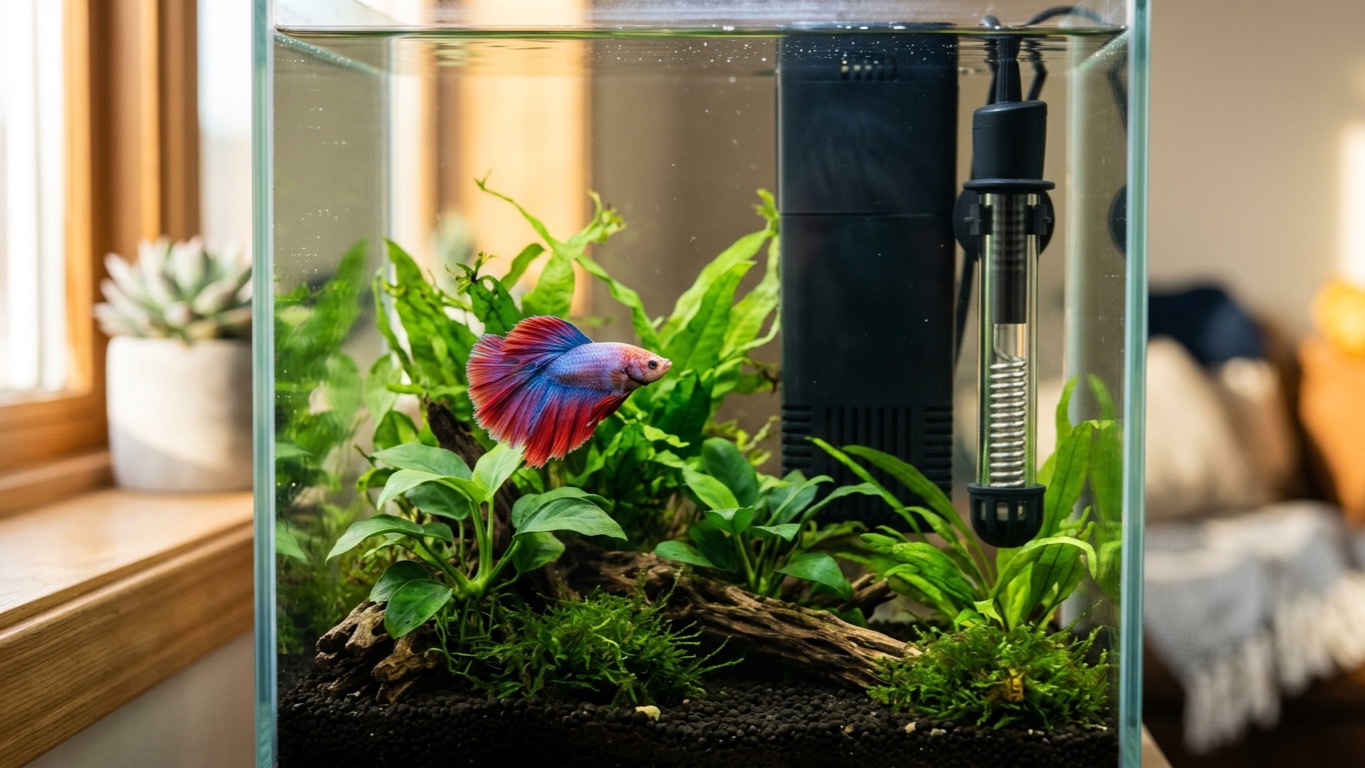
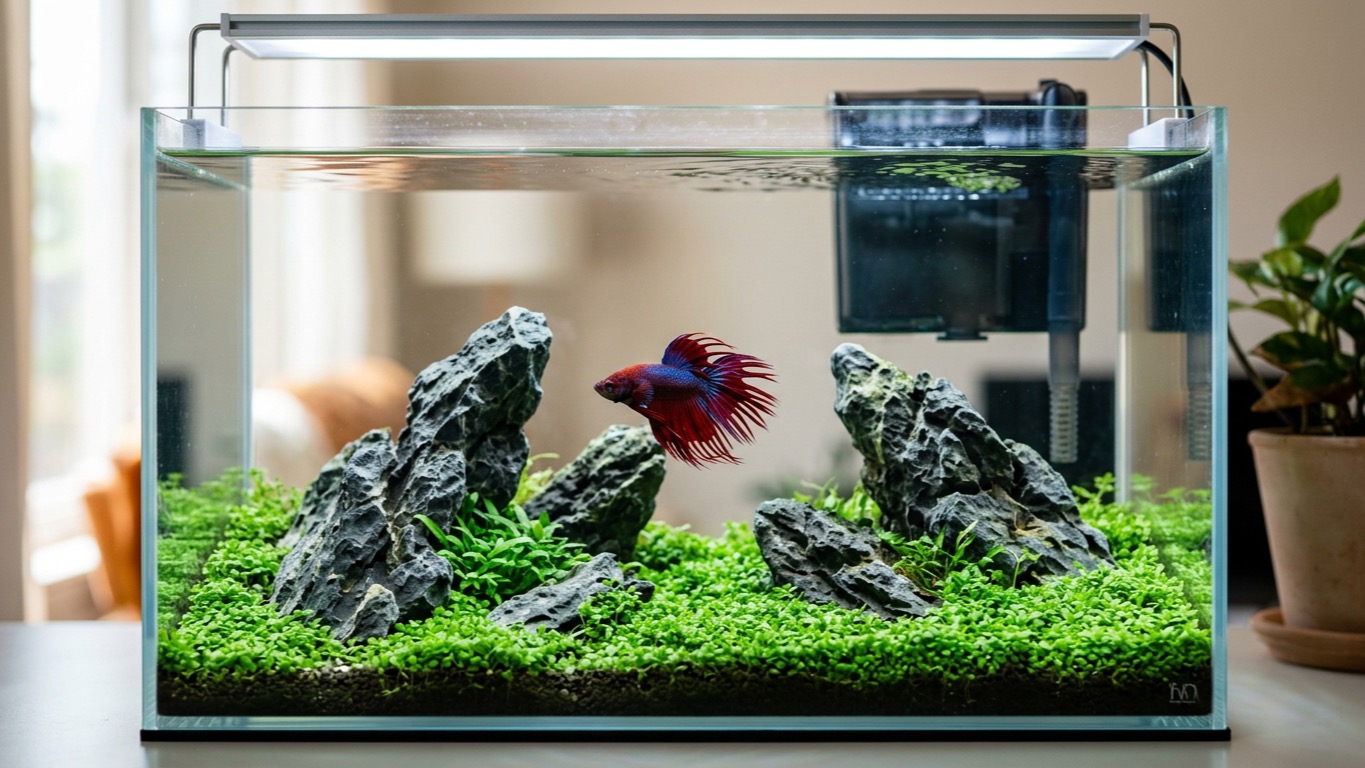
Fluval’s page for the Betta 6 Premium Aquarium Kit lists a 6 US gallon, 22.7 liter tank. The glass measures 12 inches long, 11 inches wide, and 17 inches high. The 120 volt pump is rated 26 to 92 US gallons per hour, and the preset heater holds 78°F, or 26°C.
Our research team compared that published pump range with the 6 gallon capacity.
- At 26 GPH, the volume turns over about 4.3 times per hour
- At 92 GPH, the volume turns over about 15.3 times per hour
That spread is the point. The maker built in a low setting, so start there and baffle the outflow if the fish still fights the current.
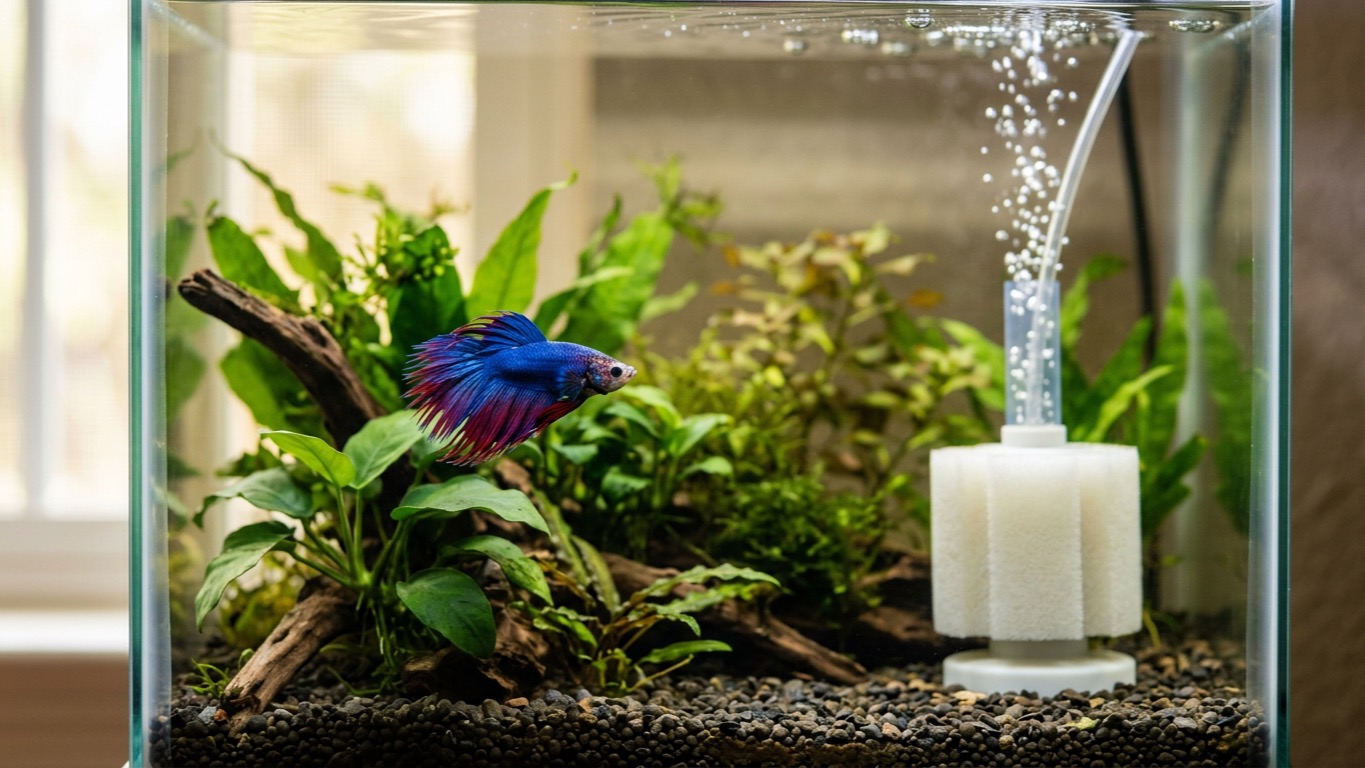
Sponge filters are another low-current option, because air lifts water through foam that holds the bacterial bed. Our sponge filter guide covers that style, and this page does not rank brands.
The MSD Veterinary Manual even names a sponge filter for a cheap 10 gallon quarantine tank. If you buy a hang-on-back filter sized for a larger tank, choke the flow. Aim the spout at the glass and add a sponge on the intake so fins do not get pinned.
How to set up and keep a filter
Start the filter before the fish, then leave the media wet for the life of the tank.
Use this order:
- Set the tank, heater, and filter on a level stand.
- Fill with dechlorinated water and start the pump.
- Dose ammonia for a fishless cycle at 1 to 5 mg/L, per the MSD Veterinary Manual.
- Test ammonia, nitrite, and nitrate on a fixed weekly plan.
- Add the betta only after ammonia and nitrite read 0 mg/L.
- Keep weekly tests after the fish is in.
Rinse foam in a bucket of tank water, not tap water. Tap chlorine kills the bed, and the Merck Veterinary Manual warns that chlorine and chloramine are common in city water.
Stagger pads so some old surface remains, and pull spent carbon while the foam stays.
If the betta clamps fins or sits in a corner, lower the flow.
The University of Florida IFAS circular says nitrifying bacteria also need oxygen, and the bed slows if dissolved oxygen falls below 5 mg/L.
Never dose antibiotics into a display tank to “help the filter.” The University of Florida IFAS circular notes that some disease drugs harm nitrifying bacteria.
Running a tank with no filter
An unfiltered tank is a water-change machine, not a low-work setup.
Some keepers skip hardware and can meet the 0 mg/L ammonia target only with huge, frequent changes. That is the exception in the opening claim, and it isn’t the easy path.
If you run no filter, use this list:
- Test ammonia and nitrite every day for the first month
- Keep the reading at 0 mg/L, the Merck Veterinary Manual target
- Change 25 to 50 percent of the water when any ammonia appears, per the University of Florida IFAS circular
- Siphon the substrate each change
- Stock one fish only
- Feed a pinch, then remove leftovers
Miss a day and the numbers climb, because there is no bacterial reserve.
The MSD Veterinary Manual describes old-tank syndrome when keepers only top off evaporated water. Alkalinity falls, pH crashes, and a big sudden change can release the toxic form of ammonia.
A filter doesn’t excuse skipped water changes, because nitrate still builds. The Merck Veterinary Manual freshwater target is under 20 mg/L nitrate. The University of Florida IFAS circular says closed systems can pass 250 mg/L if no water leaves, so partial changes are the export.
Buy a gentle filter, cycle it, test weekly, and change water on a calendar.
FAQ
Do betta fish need a filter in a 5 gallon tank?
Yes. Five gallons still collect ammonia from one fish and leftover food. Weekly tests should stay at 0 mg/L ammonia and 0 mg/L nitrite, the Merck Veterinary Manual targets.
Can a betta live in a bowl with no filter?
A bowl can hold a fish for a short time, but it will not hold the 0 mg/L ammonia target without constant water changes. Plan a filtered tank instead of a vase.
How long must I run a new filter before adding a betta?
The University of Florida IFAS circular says a new biofilter needs six to eight weeks. The MSD Veterinary Manual cites the same window and describes fishless cycling at 1 to 5 mg/L ammonia until both toxins read zero.
Is a bubbler enough instead of a filter?
A bubbler raises gas exchange, but it does not grow a full bacterial bed unless it drives water through foam. The Merck Veterinary Manual oxygen target is above 5 mg/L, and meeting that number still leaves ammonia in the water.
What temperature should a filtered betta tank hold?
Fluval’s page for the Betta 6 Premium Aquarium Kit says its preset heater holds 78°F, or 26°C. The Merck Veterinary Manual notes freshwater oxygen saturation of 8.27 mg/L at 77°F and sea level, so keep the filter moving warm water.
How often should I change water if I have a filter?
Keep a weekly partial change even with a working filter. The University of Florida IFAS circular calls for a 25 to 50 percent change if ammonia appears. The Merck Veterinary Manual calls for 50 percent or more when ammonia is high.
Can I turn the filter off at night to give the fish rest?
No. The bacterial bed needs flow and oxygen around the clock, so lower the flow instead of killing the pump.