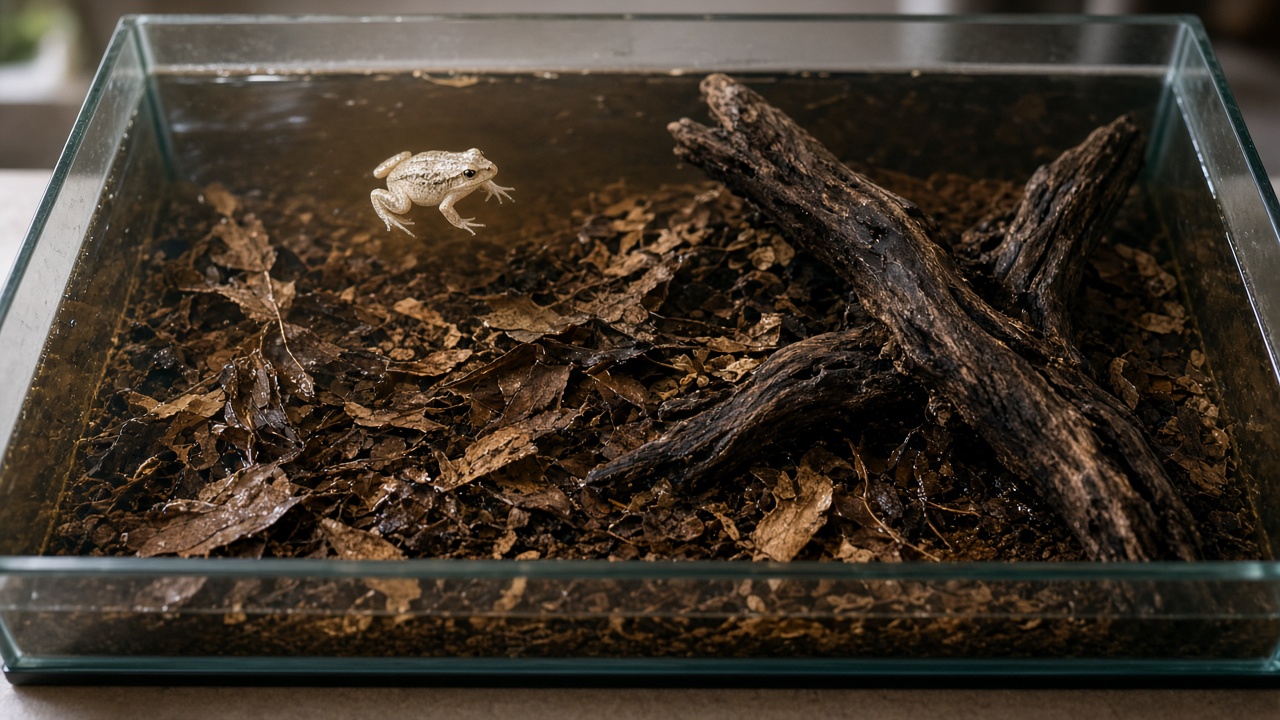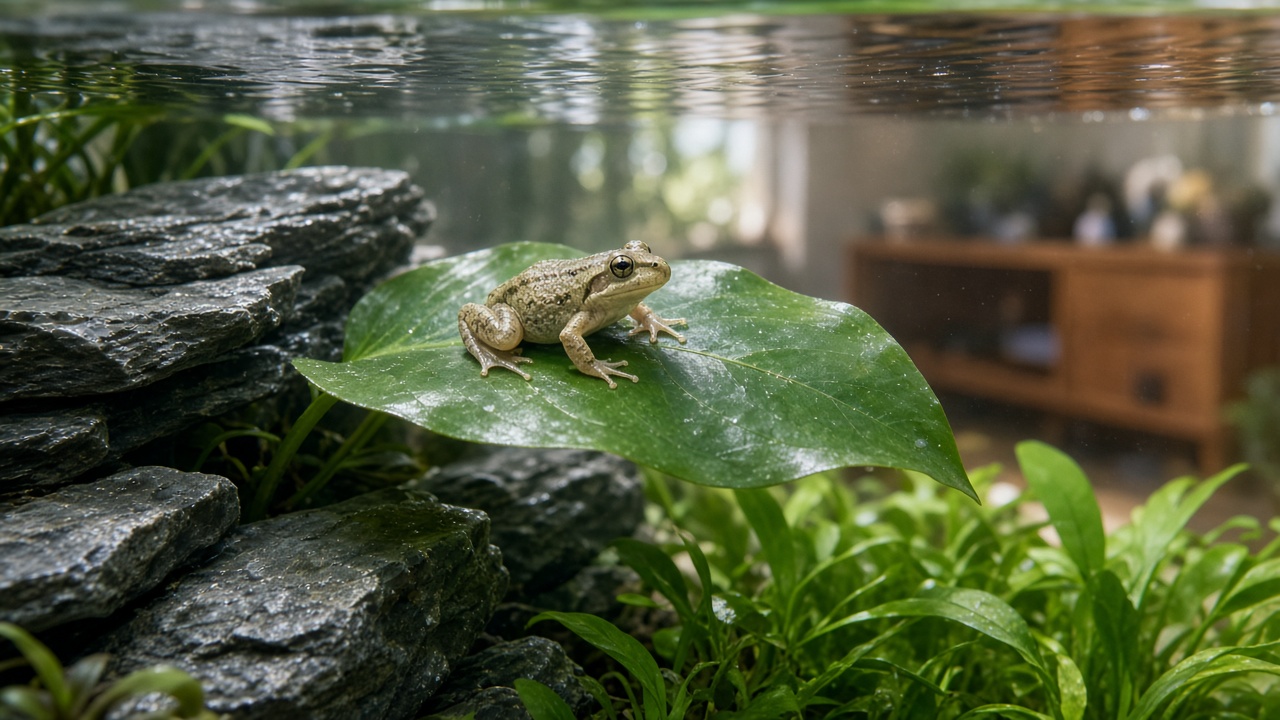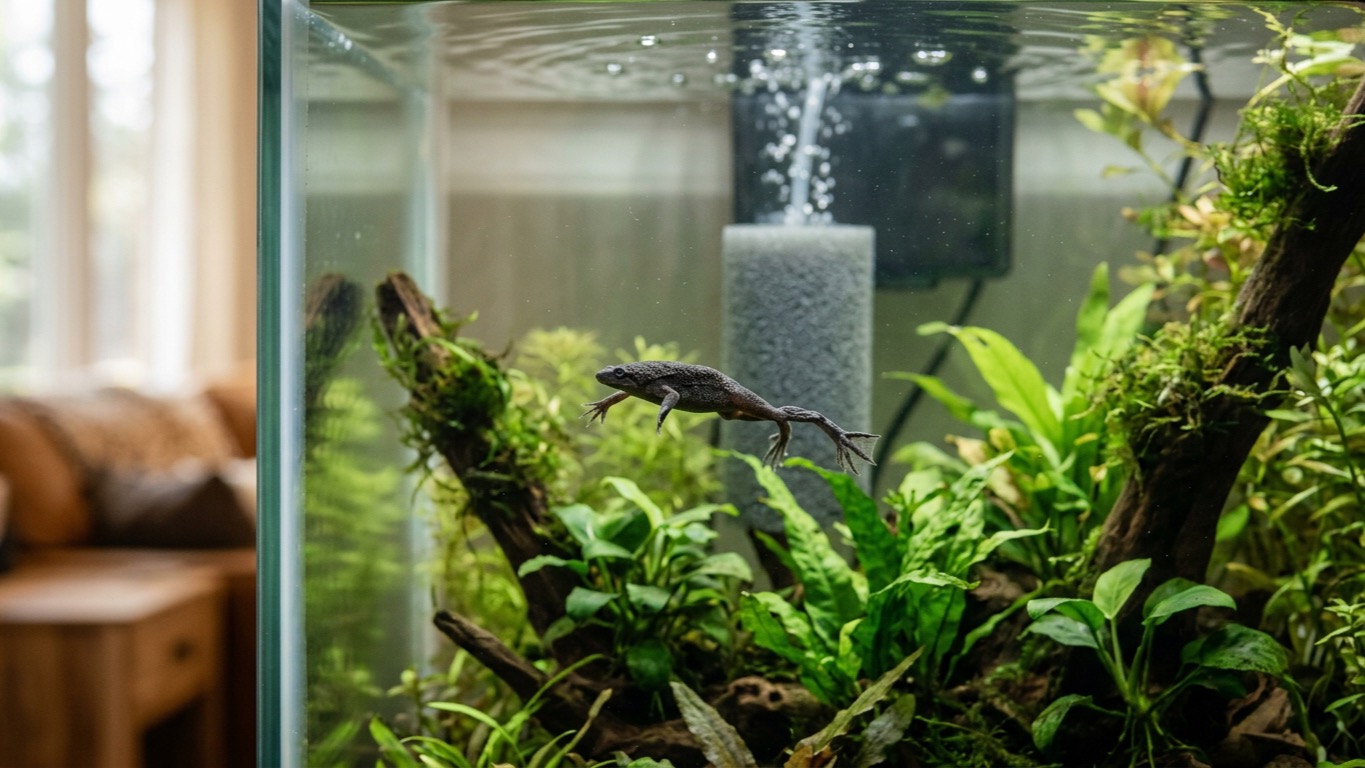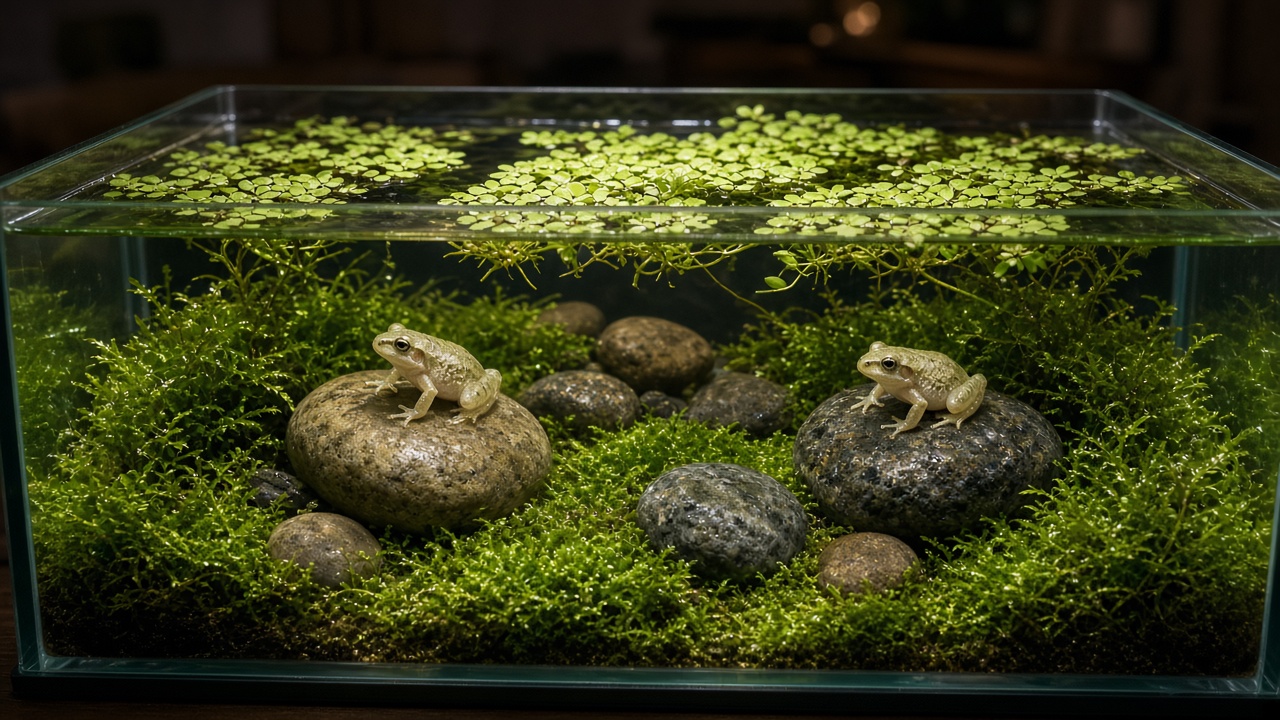
Quick answer: Use a long freshwater tank of about 10 gallons or more for a small group. Give each frog real lane space and a short climb to air. Soft flow, steady heat, and a tight lid complete the setup.
African dwarf frogs need a long tank of about 10 gallons or more, not a one-gallon cup per frog.
This page is a home-aquarium sizing and setup guide for Hymenochirus frogs. Our research team compared published lab housing numbers and maker tank sheets. We did not stock a frog room for this article. We did not load-test stands. We did not measure retail nano kits on a store shelf.
Selection rule: We include published Hymenochirus boettgeri housing densities and standard glass sizes with maker exterior dimensions. We exclude bowl charts, unbranded “nano” claims with no measurements, and tall column tanks sold for height alone.
Why “gallons per frog” is the wrong first question
Shape and depth matter as much as the gallon sticker.
African dwarf frogs gulp air at the surface. A tall, narrow tank turns every breath into a long swim. A long, shallow rectangle keeps that climb short and leaves room for target feeding.
Aqueon’s Critical Dimensions sheet lists the 10 Leader aquarium at 20¼ × 10½ × 12 9/16 inches. Empty weight is listed at 11 pounds. Filled weight is listed at 111 pounds.
The same sheet lists the 20 Long at 30¼ × 12½ × 12¾ inches. Empty weight is 25 pounds. Filled weight is 225 pounds. That extra length adds swimming lanes without a much deeper climb to air.
Rabb and Rabb’s 1963 breeding colony used aquaria measuring 24 × 24 × 44 centimeters. They filled those tanks to a depth of about 10 centimeters. Shallow water made surface access easy for air-breathing frogs.
Home keepers should read gallon labels through that lens. More length helps. Extra height rarely helps these frogs.
Published density numbers you can cite
Lab groups publish liters per frog, not slogan math.
An open protocols.io housing protocol for H. boettgeri sets group density at least 1.5 liters of water per frog. Those groups sit in 38-liter glass tanks. The tank exterior listed there is 25 × 30 × 50 centimeters.
A University of Michigan Virulence (2023) husbandry report also used 38-liter standard tanks for mixed groups. In a Tecniplast recirculation system, the same paper describes housing at about 0.8 liters per frog in smaller plastic tanks. That denser lab floor is not a home target.
Rabb and Rabb reported females from their Congo stock reaching about 35 millimeters in snout-vent length. Males were smaller. Small bodies still need stable water and open sand for feeding.
Practical reading of those numbers:
- Treat 1.5 liters per frog as a lab minimum inside a known 38-liter box
- Prefer more volume when meals are messy and water changes are weekly
- Plan for adult length near the mid-30-millimeter range, not hatchling size
- Leave open floor for tongs and leftover cleanup
How many frogs fit 10- and 20-gallon footprints
Start with the wall run, then count frogs.
A 10-gallon tank near Aqueon’s 10 Leader footprint can hold a small group when flow is soft and meals are controlled. A 20 Long near Aqueon’s listed dimensions gives clearer lanes for a larger group without stacking depth.
Compare height on the same maker sheet. Aqueon’s 20 High is 16¾ inches tall. The 20 Long is 12¾ inches tall. The long shape keeps the air path shorter.
Use this planning list before you buy:
- Measure the cabinet or stand for a 20-inch or 30-inch tank
- Confirm filled weight against the stand rating
- Pick a frog count that still leaves open sand
- Add plants and caves without blocking the surface path
- Recheck space after frogs grow and after you add tank mates
Do not borrow stocking charts written for oscars or large plecos. Those fish need different footprints and diets.
Setup pieces that make size work
A big tank still fails if flow, heat, and lids fight the frogs.
Soft filtration keeps weak swimmers from fighting a jet. A heater holds tropical warmth. A lid stops escapes while leaving an air gap for gulps.
The Virulence housing notes keep at least 1 centimeter between the lid and the water surface. Lid holes stay smaller than 1 centimeter so frogs cannot squeeze out.
Protocols.io calls for gravel with diameter greater than 1 centimeter so frogs cannot swallow stones. Fine sand is another safe floor choice. Skip medium gravel that matches mouth size.
Core setup checklist:
- Long tank on a level stand rated for filled weight
- Gentle sponge filter or a baffled hang-on return
- Adjustable heater plus a separate thermometer
- Secure lid with a small air gap and sealed cord notches
- Midwater rests near the surface for easy breathing stops
Cycle the tank before frogs arrive. Messy protein foods raise waste fast in small boxes.
If you use a hang-on filter, point the return along the glass. A jet aimed across the midwater lane knocks frogs off course on the way to air. Sponge filters driven by air pumps are easier to keep soft, as long as the bubbles do not blast one corner.
Heaters should sit where water moves gently past the tube. Dead corners create hot and cold pockets. A second thermometer at the far end proves the mix.
What not to use for size math
Skip bowls, vases, and unfiltered desktop cups.
Those vessels heat and foul too quickly. They also lack swimming lanes and safe heater placement.
Skip tall hex and column tanks sold for vertical aquascapes. The climb to air wastes energy and raises stress when current is strong.
Skip “one gallon per frog” memes copied from fish charts. Protocols.io’s 1.5 liters per frog already sits near 0.4 gallons per frog as a lab floor in a managed system. Home tanks still need spare volume for waste and maintenance gaps.
Skip cohabitation with large predators. A frog-sized meal in a big predator tank is not a size solution.
Footprint comparison table
Compare published attributes, then choose a count that matches your maintenance habits.
| Tank cue | Published exterior | Filled weight or density cue | Home note |
|---|---|---|---|
| Aqueon 10 Leader | 20¼ × 10½ × 12 9/16 in | 111 lb filled | Small-group starter footprint |
| Aqueon 20 Long | 30¼ × 12½ × 12¾ in | 225 lb filled | More lanes at similar height |
| Aqueon 20 High | 24¼ × 12½ × 16¾ in | 225 lb filled | Taller climb; weaker frog fit |
| Lab 38 L glass | 25 × 30 × 50 cm | ≥1.5 L per frog | protocols.io group floor |
| Rabb study fill | 24 × 24 × 44 cm aquaria | ~10 cm water depth | Short surface path |
Stocking and maintenance habits that protect the gallons you bought
Target-feed so fish do not steal every pellet.
Keep one clear feeding zone on the sand. Dense carpets hide food and let frogs miss meals.
Change water on a schedule that holds ammonia and nitrite near zero. Small tanks punish skipped weeks.
Watch surfacing effort after you add décor. If frogs struggle upward, lower the water line a little or add midwater rests. If they pin against a filter jet, baffle the outflow.
Revisit frog count when you add snails, shrimp, or fish. Every mouth shares the same nitrogen budget.
Weekly habits protect the gallons you paid for. Siphon leftovers after target feeding. Wipe the lid so condensation does not drip into salt-crusted gaps. Rinse filter sponges in old tank water, not hot tap water, so bacteria survive.
If frogs spend all day in one corner, check flow and temperature before you add more décor. Crowding the footprint with ornaments can shrink usable space below what the gallon label suggests. Open lanes are part of tank size.
Room, stand, and delivery checks before the glass arrives
Measure twice so the tank is not trapped in a hallway.
Aqueon’s filled weights show why this matters. The 10 Leader is listed at 111 pounds filled. The 20 Long is listed at 225 pounds filled. Soft furniture and narrow shelves are poor matches.
Check doorway width and stair turns for a 30-inch box. Confirm the stand is level and rated for the full load. Place the empty tank, then level again before you add water.
Keep outlets above the rim with drip loops on every cord. Frogs need a lid, so plan cord notches you can seal. A gap that fits a power cord can also fit a frog.
After the first fill, mark the water line with a small piece of tape. Evaporation in heated rooms drops the line and lengthens the climb to air. Top off with conditioned water, not raw tap water.
FAQ
How many gallons does one African dwarf frog need?
There is no honest one-gallon rule. Protocols.io lists at least 1.5 liters per frog in 38-liter lab tanks. Home keepers usually start near a 10-gallon long footprint for a small group and add space before adding frogs.
Is a 5-gallon tank enough for African dwarf frogs?
It is tight for a social group and unstable if meals are messy. Aqueon’s 10 Leader already lists a 111-pound filled load and a longer footprint. That class is a safer starter for most homes.
Is a 20-gallon long better than a 20-gallon high?
Yes for these frogs. Aqueon lists the 20 Long at 12¾ inches tall and the 20 High at 16¾ inches tall. Extra height lengthens the air climb without helping much.
How many frogs can live in a 10-gallon tank?
Keep the group small and the flow soft. Use open sand for target feeding. If leftovers pile up or frogs compete hard, move up to a 20 Long rather than squeezing in more animals. Protocols.io’s 1.5 liters per frog in a 38-liter lab tank is a density floor, not a home crowding goal.
Do frogs need more space as they grow?
Yes. Plan for adult females near the 35-millimeter snout-vent size Rabb and Rabb reported, plus waste from protein foods. Hatchling math under-sizes adult tanks. Revisit stocking when you add fish or shrimp that share the same filter load.
What filled weight should my stand hold?
Use the maker sheet. Aqueon lists 111 pounds filled for the 10 Leader and 225 pounds filled for the 20 Long, before heavy rock and décor.
Can I keep African dwarf frogs in a bowl if I change water daily?
No. Bowls lack stable heat, safe filtration, and swimming lanes. Daily scooping does not fix the shape problem or escape risk without a lid.