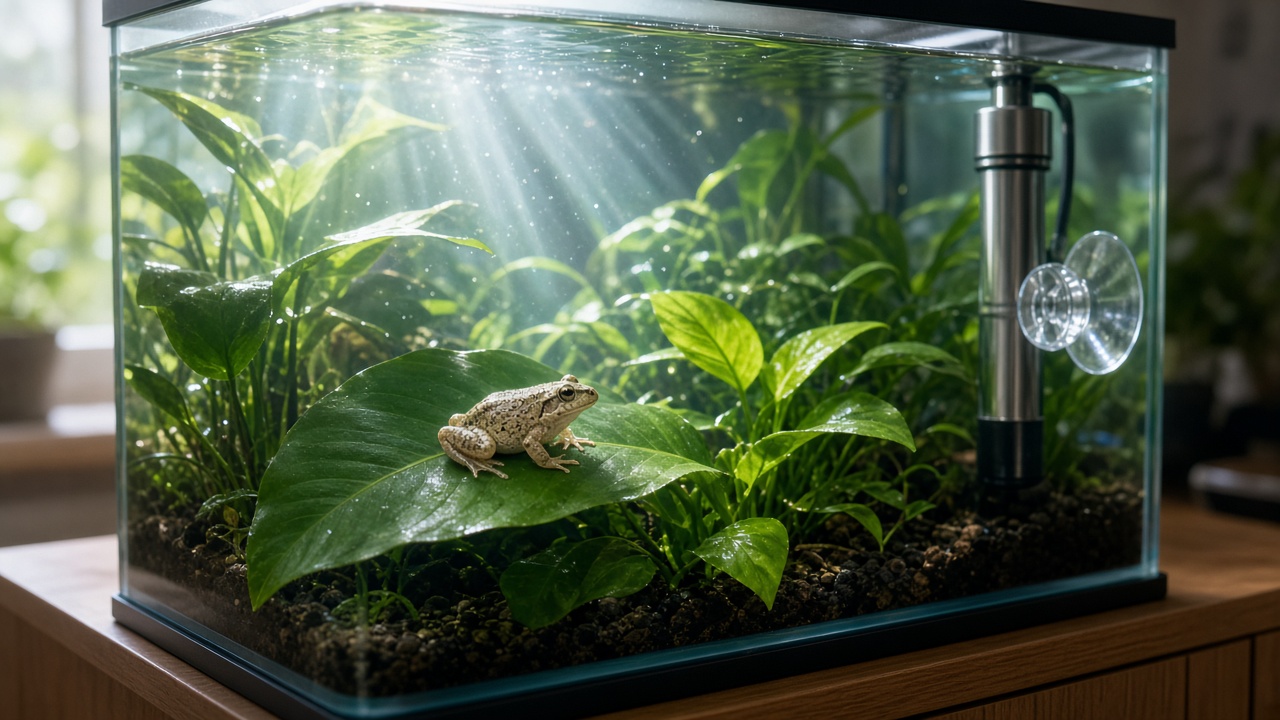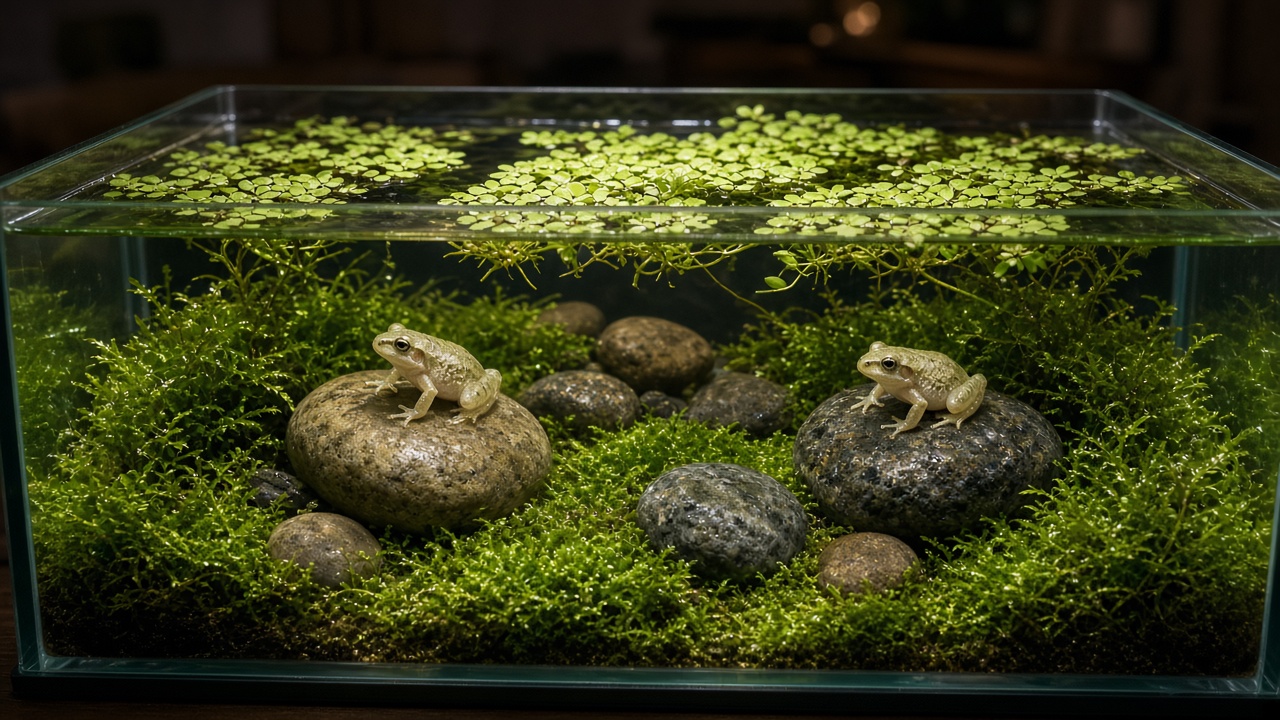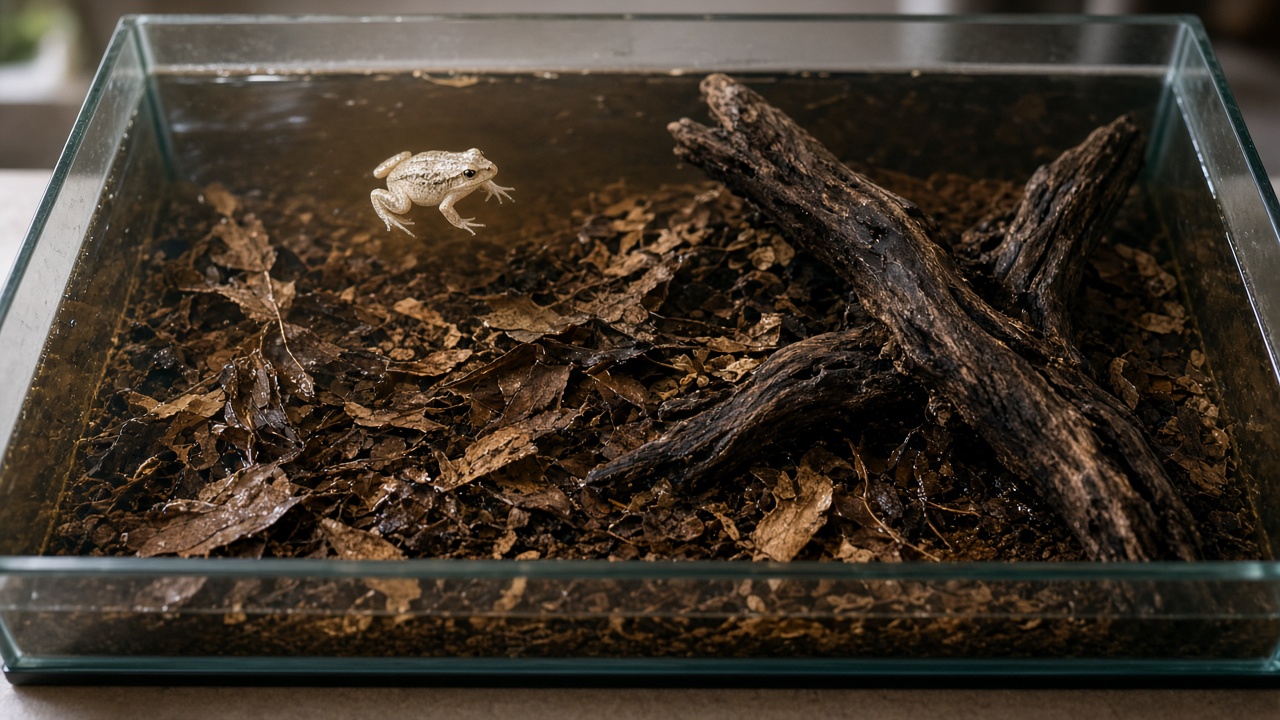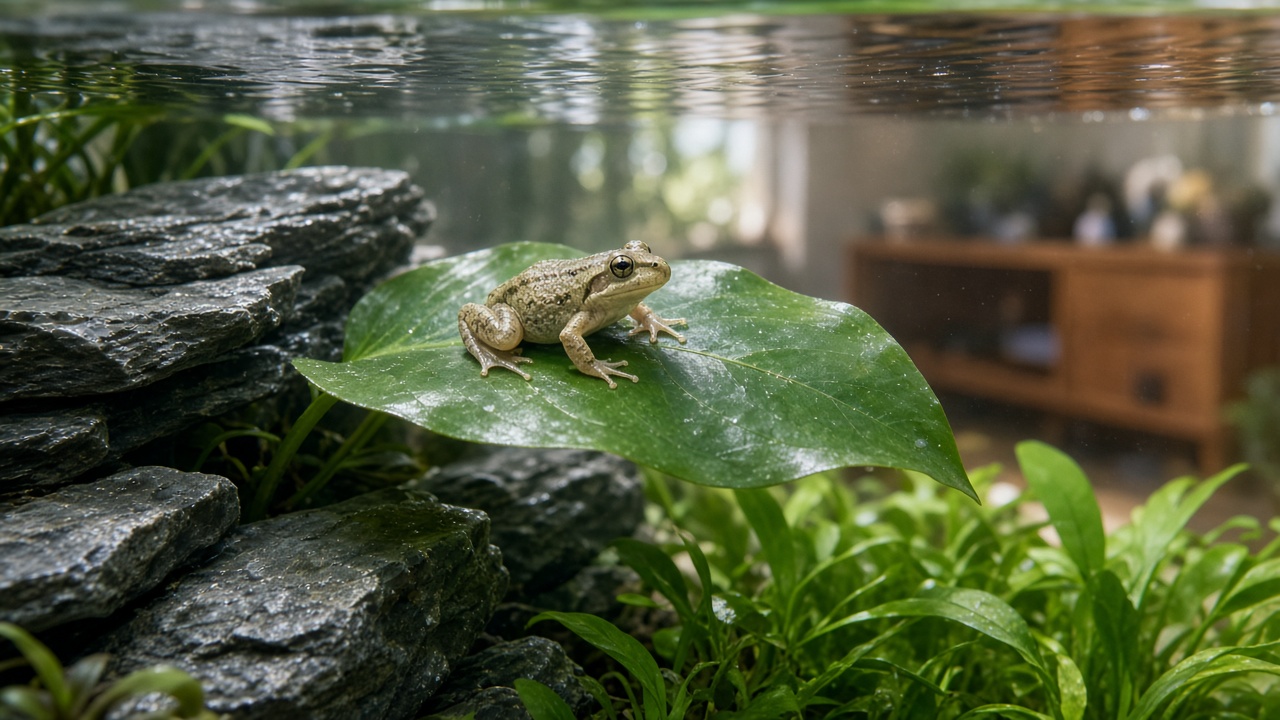
Quick answer: Give each African dwarf frog at least 2 gallons in a lidded freshwater tank. Hold water at 78–82°F with a gentle filter and rest spots near the surface. Skip vases, bowls, and tall column tanks.
A usable African dwarf frog habitat is a lidded freshwater tank of at least 2 gallons per frog, held at 78–82°F. This page is a habitat setup guide drawn from clinic care notes and maker spec sheets. Our research team did not house frogs for this article, did not measure tank current, and did not run water tests.
What this guide covers, and what it skips
We used one selection rule for every tank and kit on this page: the WaterPuppy 5–20 Lid Screen. A product is in only if its maker page lists a freshwater glass volume of 5 to 20 gallons and a lid, hood, or canopy.
That screen is why a 5-gallon desktop kit is here and a 1-gallon vase is not. It is also why a 20 High kit is in the table as a caution, not as a default pick.
We skipped bowls, outdoor ponds, paludariums, and any kit whose maker page does not publish a volume, plus cichlid rockwork and other high-flow decor.
Tank volume and footprint
Start with water volume per frog, then pick a short tank, not a tall one.
Colorado Exotic Animal Hospital’s care page states a minimum of 2 gallons of water per frog. That same page says a 1-gallon vase is not a usable home. Use that 2-gallon floor as a hard stop.
- A pair needs 4 gallons of water at the low end.
- A group of four needs 8 gallons.
- A 10-gallon kit still leaves room for hides and a heater.
Tetra’s Complete LED Aquarium Kit 10 Gal page lists that size as 20 inches by 10 inches by 12 inches. Twelve inches of listed height is short enough for a weak swimmer to reach air.
African dwarf frogs gulp air at the surface, so a tall column makes that trip longer.
Marineland’s Portrait Desktop Kit page lists a 5-gallon glass tank, and that volume fits two frogs at the clinic’s 2-gallon rule.
Aqueon’s Rectangle LED Kits page lists a 10 size and a 20 High size. Prefer the 10 over the 20 High, because the High label is a shape warning for frogs that must surface often.
Water temperature, changes, and conditioner
Hold a narrow, warm band and change a slice of water each week.
Colorado Exotic Animal Hospital’s care page sets water at 78–82°F, and it also says never go above 85°F or below 70°F.
AmphibiaWeb’s Hymenochirus boettgeri account lists 25°C as a published holding temperature. That is 77°F, one degree under the clinic’s low mark, so use the clinic band for a home tank.
Aqueon’s Rectangle LED Kits page states the included preset heater holds a constant 78°F, which sits at the bottom of the clinic band.
Change water on a fixed slice, not a full dump. Colorado Exotic Animal Hospital’s page calls for a 10 to 20% siphon once a week.
On a 10-gallon fill, that is 1 to 2 gallons of new water. Match the new water to the tank so you do not swing temperature.
Treat tap water before it touches the frogs. Seachem’s Prime page states a dose of 1 capful (5 mL) for each 50 US gallons of new water. Each cap thread is about 1 mL.
For 2 gallons of new water, that listed rate is 0.2 mL, so dose the new water instead of guessing into the tank.
Seachem’s page also says Prime can be redosed every 24–48 hours. An emergency nitrite dose may go up to 5 times the normal amount, but do not use that extra dose as weekly routine.
AmphibiaWeb lists a published pH band of 7.6 to 7.8 for this species. Keep pH stable first, and chase that narrow band only if your tap already sits near it.
Filters, lids, and flow
Use a filter you can baffle, and close every gap in the lid.
Colorado Exotic Animal Hospital’s page says the water should be filtered. It lists a sponge filter, an undergravel filter, or a canister filter as options.
African dwarf frogs are weak swimmers, and strong outflow pins them to decor and burns energy they need for air trips.
Marineland’s Portrait page lists 3-stage hidden filtration and an adjustable-flow pump, so turn that pump down until the surface barely ripples.
Aqueon’s Rectangle LED Kits page lists a QuietFlow LED PRO power filter and five-stage filtration. Hang-on-back returns are often too fast for frogs, so point the outflow at the glass and add a sponge prefilter on the intake.
For model-by-model intake guards and flow notes, use our aquarium filter guide for African dwarf frogs.
A lid is not optional trim, because frogs climb and a gap at a filter cutout is an exit.
Marineland’s Portrait page lists a sliding canopy, and Tetra’s 10-gallon kit page lists a hinged hood. Aqueon’s kit page lists a low-profile hood with a feeding door.
Pick the cover that closes around your heater cord, then foam the leftover slot.
Substrate, hides, and plants
Cover the floor with gravel frogs cannot swallow, then add shade and a near-surface perch.
Colorado Exotic Animal Hospital’s page says to use gravel too large for the frogs to eat while they forage. Skip fine sand if you cannot keep it out of their mouths.
That same page names 1-inch PVC pipe as a simple cave, and it also allows submerged logs, stone caves, or aquarium-safe decor.
Give at least one hide per frog, and leave open floor so they can walk, not only climb.
They need dim zones, and the clinic page says they should not sit in bright light all day.
Live plants help if you can keep them. The clinic page names Elodea and other tropical aquarium plants, and it sets a typical 12-hour photoperiod so the plants hold up.
That light clock matches the planted layout in our planted betta tank setup guide. Use the plants for shade and perches, and do not copy a betta’s flow or stocking.
Add a rock or branch that ends near the surface, because the clinic page says frogs rest there and gulp air without a long swim.
Do not build a rock pile meant for rift-lake fish. African cichlid types need harder water and rougher space, and they are not frog tankmates.
Leave copper decor and copper treatments out of the water. If a fish in the same house needs copper, move the frogs first.
Habitat kits compared by published specs
Our research team compared four still-sold kits whose maker pages met the 5–20 Lid Screen.
Only the two Aqueon Rectangle LED Kits list a heater, and that heater is preset to 78°F on Aqueon’s kit page.
Tetra is the only kit in this set whose maker page publishes a tank size in inches. Marineland’s Portrait page does not list length, width, or height.
| Kit | Volume on maker page | Size listed | Cover listed | Filter listed | Heater listed |
|---|---|---|---|---|---|
| Marineland Portrait Desktop Kit | 5 gallons | Not listed | Sliding canopy | 3-stage hidden filter; Rite-Size Z Cartridge; Bio-Foam; adjustable-flow pump | None listed |
| Tetra Complete LED Aquarium Kit 10 Gal | 10 gallons | 20 in × 10 in × 12 in | Hinged hood with white LED | Whisper PF 10; Medium Bio-Bag | None listed |
| Aqueon Rectangle LED Kit (10) | 10 gallons | 22.88 in × 12.75 in × 13.88 in on the kit page | Low-profile LED hood with feeding door | QuietFlow LED PRO; five-stage; Medium cartridge | Preset 78°F |
| Aqueon Rectangle LED Kit (20 High) | 20 gallons | Not listed as a separate size | Low-profile LED hood with feeding door | QuietFlow LED PRO; five-stage | Preset 78°F |
Read the Aqueon 10 row with care. Those three dimensions sit on the kit page as a single spec block, and they may describe the boxed kit, not the water column.
The 20 High kit passes the volume screen. The High name still makes it the last pick in this set for frogs that must surface.
Add a heater to the Marineland Portrait Desktop Kit or the Tetra 10-gallon kit. Neither maker page lists one in the box.
If you add a heater, stay inside the clinic’s 78–82°F band and confirm it with a separate thermometer, not the heater dial alone.
A setup sequence that matches the spec sheets
Build the tank, cycle it, then add frogs, and do not reverse that order.
- Place the empty tank on a stand that can hold the filled weight.
- Rinse large gravel until the water runs clear.
- Set the heater and filter before you fill.
- Fill with tap water treated at Seachem’s listed Prime rate.
- Set the heater to 78–82°F and wait until the reading holds.
- Run the filter and cycle the tank until ammonia and nitrite read zero.
- Add hides, a surface perch, and plants.
- Float the frogs in bags only long enough to match temperature.
- Net them in. Do not pour store water into the tank.
Colorado Exotic Animal Hospital’s page says to pull uneaten food after about 30 minutes. Use a turkey baster or a net, because leftover worms crash a small tank fast.
That same page gives a lifespan of 2 to 5 years with appropriate care. Habitat mistakes show up as short lives, not as a quick “it looks fine” week.
Do not release extra frogs, because the clinic page warns they can carry disease that harms native frogs.
AmphibiaWeb lists this species as Least Concern and notes no CITES listing. That status is not a permit to dump pets. Keep used water and decor out of local creeks.
FAQ
How many African dwarf frogs can live in a 10-gallon tank?
Use the clinic’s 2-gallon-per-frog floor. A 10-gallon tank can hold up to five frogs by that math. Four is a cleaner working number once you add a heater, hides, and plants.
Can African dwarf frogs live in a vase or bowl?
No. Colorado Exotic Animal Hospital’s page says they need more space than a 1-gallon vase. Move a frog sold in a globe into a lidded tank the same day.
Do African dwarf frogs need a heater?
Yes, in a normal American home. The clinic page sets 78–82°F and forbids drops below 70°F. Aqueon’s 10-gallon Rectangle LED Kit lists a preset 78°F heater.
How deep should the water be?
Keep the climb to air short. Tetra lists a 12-inch height on its 10-gallon kit, which is a practical ceiling for a starter tank. If you use a deeper box, add a perch that ends near the surface.
What tank mates belong in this habitat?
Other African dwarf frogs are the safe default. Skip African cichlids, which are faster, rougher, and built for different water. A planted betta setup can share plant ideas, not a shared tank.
What gravel size should I use?
Use gravel too large to swallow, which is the rule on the clinic care page. The same page names 1-inch PVC for caves, not as a gravel size. Avoid dyed gravel that sheds pigment.
How often should I change the water?
Siphon 10 to 20% once a week, per Colorado Exotic Animal Hospital. Treat the new water with Seachem Prime at 5 mL per 50 US gallons. Pull leftover food at 30 minutes so the weekly change is not a rescue.