Quick answer: Yes, goldfish lack jaw teeth and crush food with eight throat teeth. Pick a goldfish-labeled flake or pellet the fish can swallow whole. Match floating or sinking form to how your fish feeds.
Yes. A goldfish has zero jaw teeth and a 4/4 set of eight throat teeth. This page is a desk review of published goldfish anatomy and maker-listed diets.
PLOS One’s 24 June 2010 survey of 34 adult Cypriniformes lists the goldfish formula as 4/4. That means one row of four teeth on each side. Our research team analyzed those published counts next to maker pages for five goldfish-labeled complete diets.
Goldfish teeth sit in the throat, not the jaws
Goldfish never grow teeth on the lips or jaws, and the working teeth sit on the last gill arch, far back in the throat.
PLOS One states that all known Cypriniformes lack oral teeth, and goldfish belong to that freshwater order. The same paper places their teeth on the fifth ceratobranchial, which is the last gill arch.
Food enters a toothless mouth first, then meets the throat teeth before it reaches the gut. If you open a goldfish mouth, you will not see a bite.
PLOS One gives the goldfish dental formula as 4/4, which is four teeth on the left bone and four on the right. The paper calls those crowns compressed, meaning broad rather than needle-sharp.
The same survey imaged 31 species with X-ray microtomography and dissected three more. Across that Cyprinoidea sample, goldfish sat at the low end for tooth count, with one row of four teeth per side.
Zebrafish in that paper carry 11 spoon-shaped teeth per side in three rows, listed as 2,4,5-5,4,2. Common carp in the same plates show a 1,1,3 molariform set instead.
PLOS One also notes the order holds more than 3,000 recognized species, all of them freshwater. None of those species, the authors write, develop oral teeth.
The short rule is simple.
- Jaws: no teeth.
- Throat: eight working teeth in a 4/4 pattern.
- Crown shape in goldfish: compressed, built to crush.
What this article covers and what it leaves out
We used one selection rule for both anatomy and products.
For anatomy, we used counts and shapes published for Carassius auratus in the PLOS One survey. Other species appear only when that paper named them for contrast.
For products, we included only currently sold complete diets that meet all three checks below.
- The maker page labels the SKU for goldfish.
- The same page lists a physical form, such as flake or a pellet size.
- The same page lists a crude-protein figure.
We left out tropical-only diets, treats, frozen foods, and live foods. We also left out any goldfish snack that lacks a published protein number, which dropped many mixed community flakes.
Comparing published specs is not the same as ranking foods. The table later on this page is an attribute grid with no rank column and no price column.
How the crushing mill works
A goldfish does not chew with its lips; it packs food into the throat and grinds it there.
PLOS One shows replacement teeth next to the working row. Those spare crowns are not yet bound to the pharyngeal bone, while the working row is bound.
PLOS One defines compressed goldfish teeth as very broad, with front margins that are straight or convex and rear margins that are concave. That shape fits crushing, not tearing flesh.
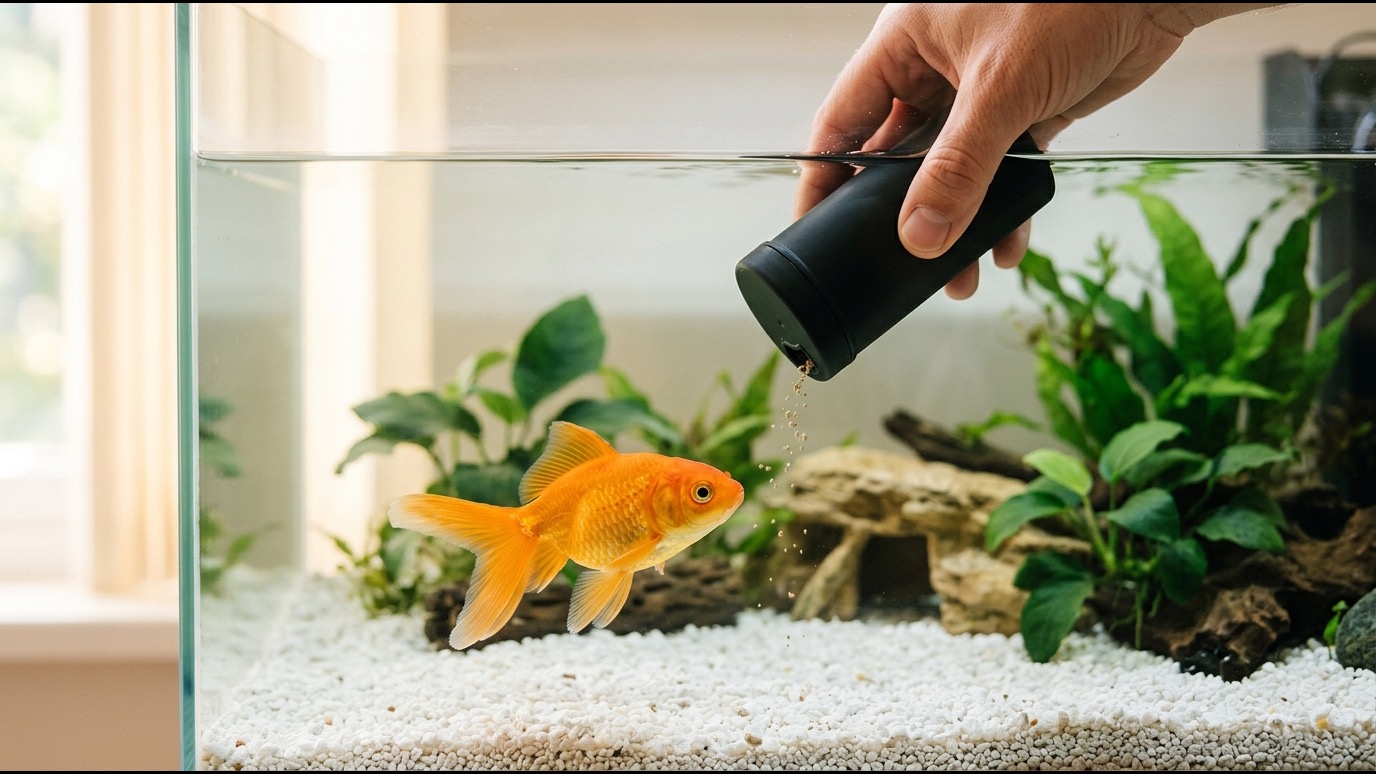
Watch a goldfish eat and you will see a pause after the gulp. The fish grabs a pellet, the jaws close, and then the throat works. Bits that come back out are sorted waste, not a failed bite.
Hard pieces get crushed, and soft flakes get mashed, so shell bits and grit can come back out of the mouth. Pellet size matters because a piece that fits the mouth still has to fit the throat mill.
Use this feeding check.
- Offer a piece the fish can take in one gulp.
- Watch for a second or two of throat motion.
- Remove leftovers after the maker’s stated eat-by window.
Teeth wear out and grow back
Goldfish replace throat teeth through life. PLOS One calls this trait polyphyodonty, meaning teeth are replaced for the animal’s whole life, not once.
The 2010 plates show spare teeth that are not yet attached. When a working tooth drops, a replacement can take its place, and you may find a tiny hard shard on the glass or gravel.
That shard is a shed pharyngeal crown, not a jaw tooth. Leave it if you like, or siphon it if you want a cleaner floor.
Do not try to pull a tooth from a living fish. The mill sits behind the gills, and home tools cannot reach it safely.
A missing tooth is not, by itself, a color problem. If a fish darkens, read our page on why a goldfish turns black. If a fish pales, read our page on why goldfish turn white.
Match food form to a crushing throat
The mill can crush flakes and pellets. Form still changes how much air the fish swallows and how much waste you siphon.
Our research team analyzed maker pages for five goldfish-labeled complete diets. Listed minimum crude protein ranged from 32.0% on Hikari Goldfish Gold to 46% on Hikari Lionhead.
Listed fat moved just as widely across those same pages.
- Hikari Goldfish Gold lists 4.0% minimum crude fat.
- Hikari Oranda Gold lists 6.0% minimum crude fat.
- Tetra Goldfish Flakes list 11% crude fat.
- Fluval Bug Bites Goldfish Pellets list 12.5% minimum crude fat.
Pellet diameter, where the maker printed it, ran from about 1.7 mm to 7 mm.
- Hikari Sales USA lists Hikari Goldfish Gold as an approximate 1.7–2.0 mm baby pellet.
- Fluval’s Bug Bites Goldfish Pellets page lists a slow-sinking pellet of 5–7 mm.
- Hikari’s Lionhead page lists a mini sinking pellet and does not print a millimeter size.
A 5–7 mm pellet is a large bite for a small fancy. A 1.7–2.0 mm pellet fits a young common more easily.
Buoyancy is the other published trait that changes how a goldfish reaches the mill.
- Hikari Goldfish Gold and Hikari Oranda Gold are floating pellets.
- Hikari Lionhead is a sinking daily diet.
- Tetra Goldfish Flakes float for a long time and then sink slowly.
- Fluval Bug Bites Goldfish Pellets are a slow-sinking pellet.
Commons that hunt the surface can use a floater, while deep-bodied fancies that gulp air at the top often do better with a sinker.
A few label numbers help you read the bag without treating it as a score. Hikari Goldfish Gold lists vitamin A at a minimum of 20,000 IU/kg and ascorbic acid at a minimum of 440 mg/kg.
Hikari Oranda Gold and Hikari Lionhead both list phosphorus at a minimum of 1.2%. Tetra Goldfish Flakes list vitamin D3 at 2,114 IU/kg, and Fluval’s pellet page lists up to 40% black soldier fly larvae.
None of these labels replace the 4/4 mill; they only change what the mill has to crush.
Goldfish diets compared by listed attributes
This grid uses only attributes printed on the maker pages named above. It is not a ranking.
| Product | Form and listed size | Buoyancy | Crude protein (min.) | Crude fat (min.) | Notes from the maker page |
|---|---|---|---|---|---|
| Hikari Goldfish Gold | Baby pellet, about 1.7–2.0 mm | Floating | 32.0% | 4.0% | Color-enhancing daily diet; vitamin A min. 20,000 IU/kg |
| Hikari Oranda Gold | Mini floating pellet | Floating | 45.0% | 6.0% | Aimed at Oranda, Lionhead, Azuma Nishiki, and Ranchu |
| Hikari Lionhead | Mini sinking pellet | Sinking | 46% | 6% | Daily diet; phosphorus min. 1.2%; feed within a few minutes |
| Tetra Goldfish Flakes | Flake | Floats, then sinks slowly | 42% | 11% | Complete food; moisture 6.5%; vitamin D3 2,114 IU/kg |
| Fluval Bug Bites Goldfish Pellets | Pellet, 5–7 mm | Slow sinking | 40.0% | 12.5% | Up to 40% black soldier fly larvae; 3.5 oz / 100 g pack |
How to use the grid:
- Pick a form the fish can swallow in one gulp.
- Pick floating or sinking to match body shape and swim style.
- Read the protein and fat lines as label facts, not as a score.
A high protein line does not mean sharper teeth. It means the bag lists more protein, and the throat mill still has to crush the piece.
Color shifts and tankmates are separate questions
Carotene and color claims on a food bag do not change the 4/4 formula. They may change how orange a fish looks, but they do not add jaw teeth.
If pigment shifts after a diet change, check water and health first, then use the color pages linked above. A black patch or a white fade is not proof that a tooth fell out.
Tankmates matter because they steal food the mill never sees. Fast surface fish can empty a flake cloud before a goldfish finishes the gulp-and-grind cycle.
If you keep mixed stock, read our page on what fish can live with goldfish. Match mouths and water needs, not just tank size.
PLOS One’s carp plates show a 1,1,3 molariform set, not the goldfish 4/4 pattern. Both crush, and neither nips like a fish with oral teeth.
FAQ
Can a goldfish bite a person?
No. PLOS One records no oral teeth in goldfish, and the eight working teeth sit on the last gill arch. A curious nibble on a finger is lips and a toothless mouth, not a bite from the mill.
Why does my goldfish spit food back out?
The throat mill crushes and sorts. Soft flakes mash, and hard pellets may come back out in pieces. If the piece is larger than the gulp, use Hikari Goldfish Gold’s 1.7–2.0 mm pellet.
Do baby goldfish have the same 4/4 set?
PLOS One’s goldfish plate is an adult Carassius auratus. The paper states that teeth are replaced through life, but it does not print a separate fry formula. Use the smallest goldfish-labeled pellet the maker lists, such as Hikari Goldfish Gold’s 1.7–2.0 mm baby pellet.
Should I pull a shed tooth from the tank?
You can siphon a shed crown with other debris, and you do not need to hunt for every shard. Do not reach into the throat of a living fish, because the working row is not on the jaws.
Are flakes worse than pellets for throat teeth?
No published count in our sources says flakes wear teeth faster. Tetra Goldfish Flakes list 42% crude protein and 11% crude fat, while Hikari Goldfish Gold lists 32.0% protein and 4.0% fat. Those are label gaps, not tooth-wear scores.
Do fancy goldfish chew the same way as commons?
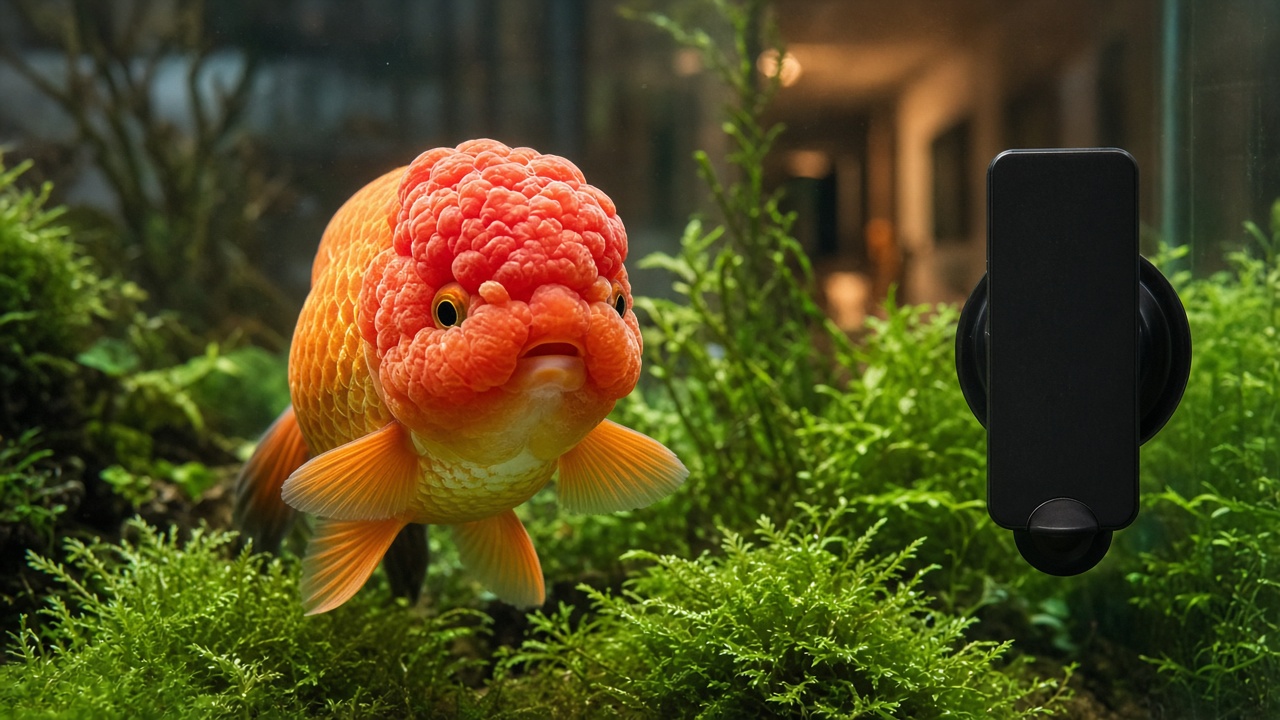
Yes. Fancy and common goldfish are the same species, and PLOS One’s 4/4 formula is for Carassius auratus, not one body type. Fancy fish may need a sinking pellet, which is why Hikari Lionhead and Fluval Bug Bites Goldfish Pellets sit in our grid.
Can goldfish crush snails or hard pellets?
The compressed 4/4 mill is a crusher, but that is not a guarantee that a large snail will be eaten. Offer food the fish can gulp. Fluval’s 5–7 mm pellet is already a large piece for a small fancy.