Quick answer: Keep one Centropyge in a mature saltwater tank of 29 gallons or more with live rock. Treat mixed reefs as a risk. Feed a marine pellet plus algae, and test the water every week.
FishBase lists 36 Centropyge species; those are the dwarf angelfish sold to home aquarists. This page is a Waterpuppy home-aquarium research brief. We did not house these fish, run feeding trials, or score live coral tanks.
Dwarf angelfish are small marine angels in one genus, not the freshwater angels from South America. They are also not the large angels sold as emperors or queens. Our research team counted every Centropyge row on FishBase’s genus list, and that count plus maker labels is the evidence here.
What dwarf angelfish are
FishBase treats dwarf angelfish as the genus Centropyge, and it currently lists 36 species.
Aquarium of the Pacific says Centropyge makes up over 35% of the angelfish family Pomacanthidae. That share is why shops can stock several dwarf angels that still look different from each other.
We compared published adult sizes for the species U.S. shops sell most often:
- Cherubfish, Centropyge argi: FishBase lists 8 cm total length.
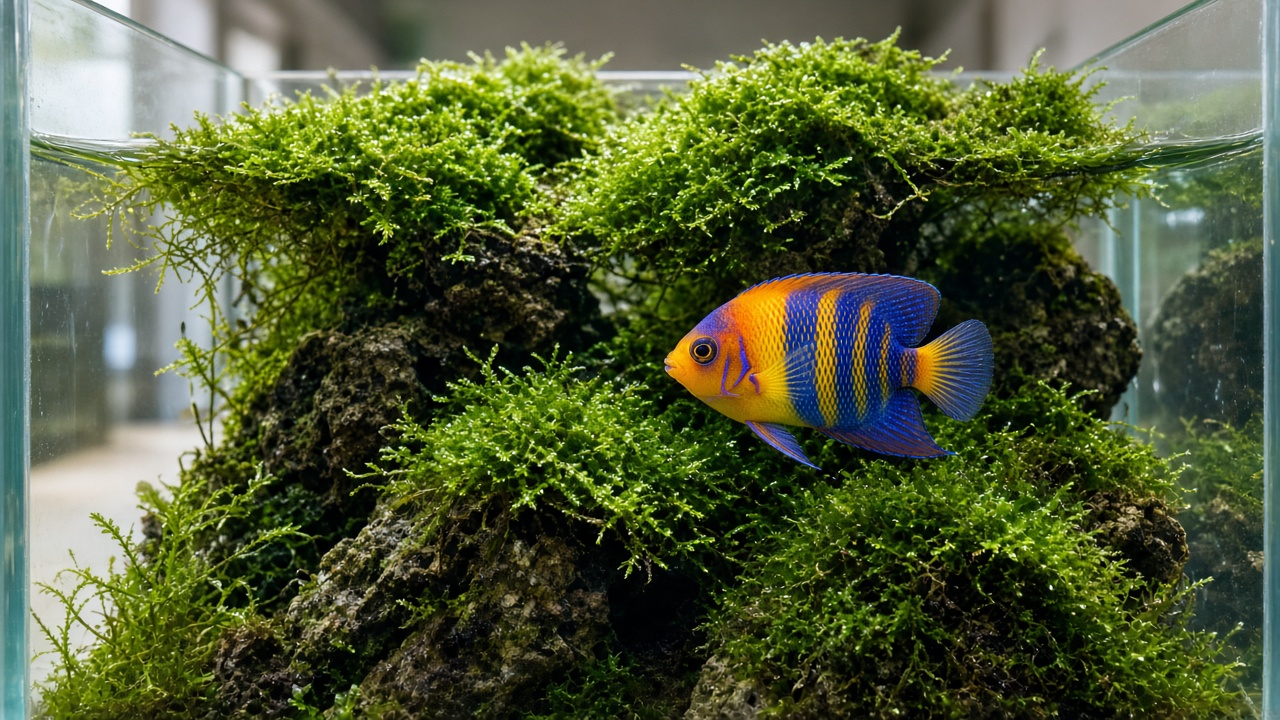
- Coral beauty, Centropyge bispinosa: FishBase lists 11.5 cm total length.
- Flame angel, Centropyge loriculus: FishBase lists 15 cm total length.
- Lemonpeel, Centropyge flavissima: FishBase lists 14 cm total length.
- Bicolor, Centropyge bicolor: FishBase lists 15 cm total length.
- Potter’s, Centropyge potteri: FishBase lists 12.5 cm total length.
Aquarium of the Pacific lists coral beauty adults at 10 cm, or 4 inches. That figure is 1.5 cm shorter than FishBase’s 11.5 cm number. Shop tags that say a coral beauty stays 3 inches match neither source.
FishBase also lists the keyhole angelfish, Centropyge tibicen, at 19 cm total length. That is the longest Centropyge on the list, so we do not treat it as a typical home dwarf.
Aquarium of the Pacific describes coral beauties as omnivores whose main wild food is algae on rock and coral. They also take plankton, and they may eat worms or small crustaceans when food is short.
The same page says they live in harems and are born female, with a dominant fish able to change to male. That is social biology, not a pair-bond guarantee inside a glass box.
Aquarium of the Pacific lists a life span of 12 to 23 years. Plan the tank as a long project rather than a short display.
Our selection rule
We used one rule, the 29-Gallon Cutoff, to decide what entered this brief.
A species is in if all four points are true:
- FishBase places it in Centropyge.
- FishBase lists a maximum of 15 cm total length or less.
- U.S. shops commonly sell it.
- We discuss it as a single fish, not a pair or harem.
A setup is in if the tank’s maker-listed volume is 29 U.S. gallons or more. Live rock must fill a large share of the footprint so the fish can graze.
We left these items out on purpose:
- Large angels in Pomacanthus or Holacanthus.
- Swallowtail angels in Genicanthus.
- Keyhole angels at FishBase’s 19 cm mark.
- Nano kits under 29 gallons as adult homes.
- Pair or harem stocking plans.
- Ranked “best fish” lists.
Our research team counted FishBase’s length column for this rule. Thirty-five of the 36 species have a published max length, and 21 of those 35 list 10 cm or less. The common shop fish above still sit at 8 to 15 cm, so a small genus does not mean a tiny adult.
Tank size under the 29-Gallon Cutoff
A single adult Centropyge belongs in 29 gallons or more, not in a desktop cube.
That number is our cutoff, not a museum tank recipe. We set it after lining up FishBase lengths, because an 8 cm cherub and a 15 cm flame are not the same fish. Both still patrol rock all day and need room to turn.
Use this layout:
- One fish per tank unless you later move to a much larger system we do not cover here.
- Rock piled into caves, ledges, and open swim lanes.
- A mature film of algae on that rock before the fish goes in.
- A lid, because these fish can jump.
Aquarium of the Pacific records coral beauties on reefs from 5 to 50 meters, or 16 to 164 feet. Home tanks cannot copy that depth, but they can copy the cover if you give the fish places to duck out of sight.
Skip the 10- to 20-gallon nano pitch for an adult. FishBase’s shop species already reach 8 to 15 cm, and a short tank leaves little rock for grazing.
Households that also keep African dwarf frogs should not copy that freshwater filter plan. Marine angels need saltwater volume and rock, not a small amphibian pad. See our guide to the best aquarium filter for African dwarf frogs for that separate system.
Reef tanks and coral nipping
A mixed reef is a risk with Centropyge, not a safe default.
Aquarium of the Pacific says coral beauties scrape algae off coral and rock. They have a beak-like mouth, sharp teeth, and strong jaw pressure, and that feeding mode is the nipping problem.
We did not watch home reefs, and we did not grade corals as safe or unsafe. Comparing that published diet with a tank full of fleshy corals is enough to flag the risk.
If you still want corals, use this desk rule:
- Put the fish in only after the rock is mature and the fish is eating prepared food.
- Watch LPS corals, zoanthids, and clam mantles first.
- Remove the fish if tissue recedes after other water tests stay stable.
- Prefer a fish-only tank with live rock if corals matter more than the angel.
Aquarium of the Pacific reports successful commercial captive breeding of coral beauties first in 2016. A captive-bred fish can still scrape coral, because breeding status does not cancel the mouth shape.
Food, salt, and test kits we compared
We compared maker pages for four products a home tank actually uses, and we did not rank them.
Hikari’s page for Marine-S lists a minimum of 48% crude protein and 8% crude fat. The same page says to feed two to three times a day, with each feeding no more than two minutes. Remove leftovers after that window, and note the listed pack is 1.76 oz, or 50 g.
New Life Spectrum’s Marine Fish page lists a minimum of 36% crude protein and 7% crude fat. Pellets are 1 to 1.5 mm and sink, 12 points below Hikari’s protein label. Our research team only compared those two printed analyses.
Instant Ocean’s sea-salt page gives a small-batch mix of 1/2 cup per U.S. gallon. It also states that 1.5 lb of mix is made to create 5 gallons at a specific gravity of 1.022. The listed target range is 1.020 to 1.024 at 77°F.
The same Instant Ocean page tells users to change 20% of the water every two weeks. Never mix dry salt in a tank that already holds animals.
API’s Saltwater Master Test Kit page says the kit measures four values: high-range pH, ammonia, nitrite, and nitrate. Each test starts with 5 ml of tank water, and API says to test weekly. The kit includes six reagent bottles and four tubes.
| Product | Form | Maker-listed number | Other listed attribute |
|---|---|---|---|
| Instant Ocean Sea Salt | Dry mix | 1.5 lb makes 5 gal at SG 1.022 | Target SG 1.020–1.024 at 77°F |
| Hikari Marine-S | Slow-sinking pellet | Crude protein min. 48% | Feed 2–3 times daily, under 2 minutes |
| New Life Spectrum Marine Fish | Sinking pellet | Crude protein min. 36% | Pellet size 1–1.5 mm |
| API Saltwater Master Test Kit | Liquid kit | 5 ml sample per test | Tests pH, ammonia, nitrite, nitrate |
Use both a pellet and an algae source, because Aquarium of the Pacific puts algae first in the wild diet. A high-protein pellet alone does not replace rock grazing.
Water targets from maker pages
Match the salt mix to a weekly test instead of guessing from water color.
From the Instant Ocean page, keep these mix steps:
- Mix the salt in a clean vessel, not in the display.
- Use 1/2 cup of Instant Ocean per U.S. gallon for small batches.
- Aim for specific gravity 1.020 to 1.024 at 77°F.
- Confirm 1.5 lb of mix against a 5-gallon batch at 1.022 if you weigh instead of scoop.
- Change 20% of the water every two weeks.
From the API page, keep these test steps:
- Draw 5 ml of tank water for each test.
- Check high-range pH, ammonia, nitrite, and nitrate.
- Repeat every week.
- Act on the booklet if a color falls outside the safe band.
Aquarium of the Pacific notes that warmer water may shorten life and gives a 12- to 23-year span. The page does not print a home heater setting, so hold temperature steady and avoid big swings after water changes.
Spawning notes on that page are wild-season facts, not a home-breeding plan. Eggs can float up to 18 hours, and larvae take about 15 days to reach the juvenile stage, which home tanks almost never raise.
FAQ
These answers repeat the same size, reef, and food rules used in the sections above.
What is a dwarf angelfish?
A dwarf angelfish is a marine angel in the genus Centropyge, and FishBase lists 36 species in that genus. They are smaller than emperor or queen angels and are not the freshwater angels sold for tropical community tanks.
How big of a tank does one dwarf angelfish need?
Our 29-Gallon Cutoff is the smallest adult home we will discuss. FishBase lists common shop species from 8 cm to 15 cm, and that size still needs rock to graze and room to patrol. We do not treat nano kits under 29 gallons as adult housing.
Are dwarf angelfish reef safe?
No, treat a mixed reef as a risk. Aquarium of the Pacific says coral beauties scrape algae off coral with a beak-like mouth and sharp teeth. We did not score corals, but that published feeding mode is enough to warn you.
Can I keep two dwarf angelfish together?
We do not cover pairs or harems, because a second Centropyge is outside this brief. Aquarium of the Pacific describes wild groups with one male and several females, and those groups also split when aggression rises.
What should I feed a dwarf angelfish?
Offer a marine pellet plus algae on rock or a seaweed sheet. Hikari’s Marine-S page sets a two- to three-times-daily schedule, with each feeding under two minutes. New Life Spectrum’s Marine Fish page lists 36% minimum protein in a 1 to 1.5 mm sinking pellet. Keep live rock coated with algae.
How long can a coral beauty live?
Aquarium of the Pacific lists 12 to 23 years, which is a long commitment. Plan filtration, salt mix, and weekly tests for more than a decade.
Do I need a captive-bred fish?
Captive-bred coral beauties help wild stocks, and Aquarium of the Pacific says commercial captive breeding was first reported in 2016. A captive-bred fish can still nip coral, because breeding status does not change tank size or diet.