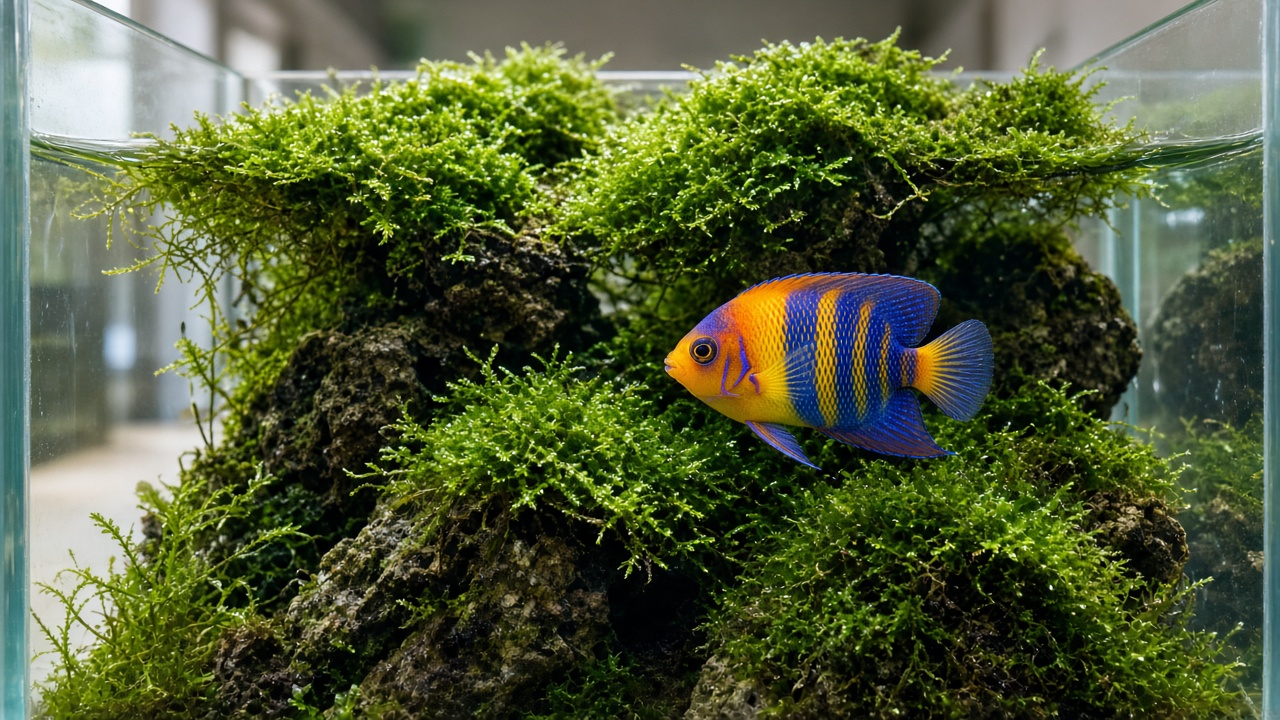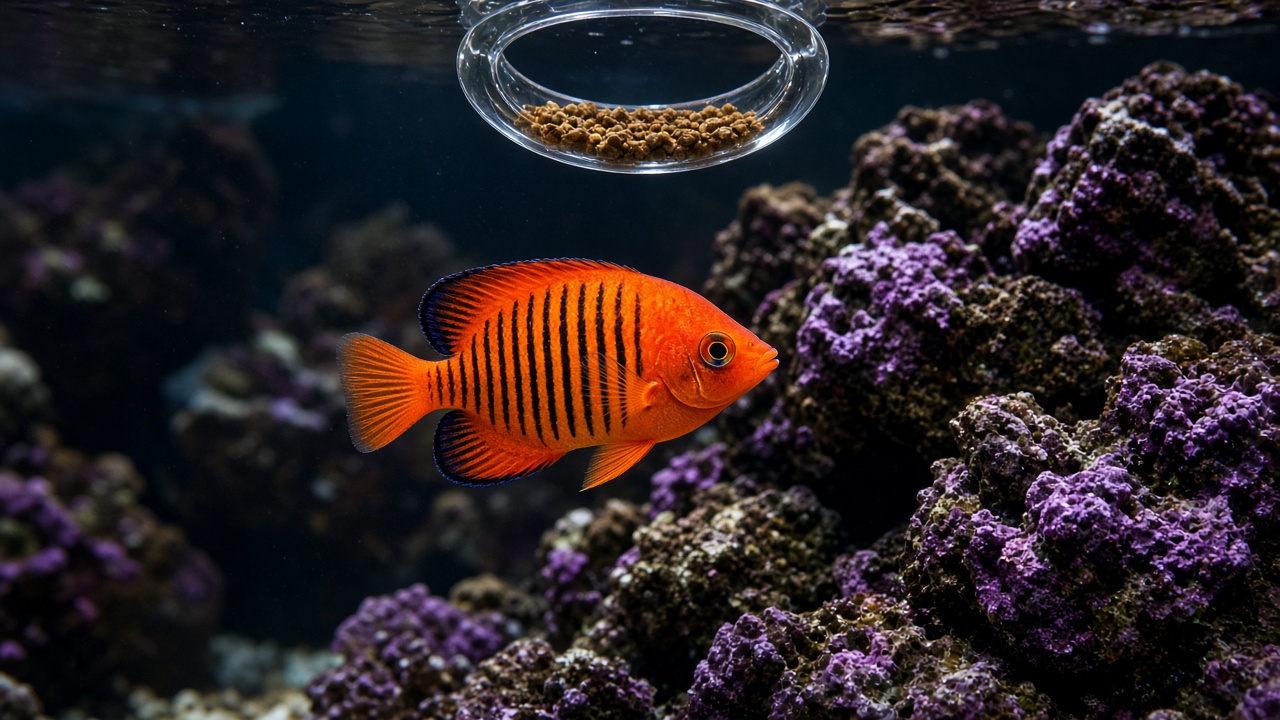
Quick answer: Keep one flame angelfish in a mature 70-gallon saltwater tank with live rock. Feed an omnivore mix of marine pellets, algae, and frozen foods. Treat it as reef-safe with caution because it may nip corals.
One flame angelfish needs at least 70 gallons, per LiveAquaria’s current product listing. This page is a Waterpuppy research-desk care brief.
Our research team compared published fish-biology records and maker food labels for the Waterpuppy Flame Angel Spec Compare.
Selection rule: This brief covers one adult flame angelfish in a fish-only-with-live-rock or mixed reef tank. We included only currently sold marine foods with a maker-page guaranteed analysis that names marine fish or saltwater angelfish. We left out freshwater foods, medications, copper products, and livestock.
What a flame angelfish is
FishBase treats this fish as a small Pacific dwarf angel that grazes algae on reefs.
FishBase lists the species as Centropyge loriculus (Günther, 1874), while sellers often print Centropyge loricula. Both names point to the same flame angel in Pomacanthidae, the family LiveAquaria also uses.
FishBase records these body counts.
- 14 dorsal spines
- 16 to 18 dorsal soft rays
- 3 anal spines
- 17 to 18 anal soft rays.
FishBase calls the body short and deep, with a compressed cross section that fits tight rock cracks.
FishBase lists a maximum length of 15.0 cm total length, while LiveAquaria lists a 4-inch aquarium maximum. Four inches is about 10.2 cm, so the Spec Compare notes a 4.8 cm gap between those published maxima.
LiveAquaria sells three size classes.
- Small: 1 inch to 1-3/4 inches
- Medium: 1-3/4 inches to 2-1/2 inches
- Large: 2-1/2 inches to 3-1/2 inches.
FishBase says the species is marine and reef-associated across 28°N to 25°S, at depths from 0 to 60 m.
FishBase says the species feeds on algae and assigns a trophic level of 2.8, plus or minus 0.31. That number sits between a pure plant eater and a meat eater.
FishBase says flame angels form harems of 3 to 7 fish, yet LiveAquaria still lists a 70-gallon minimum for one fish. Do not copy a wild harem into a home tank of that size.
FishBase reports the IUCN Red List status as Least Concern, with an assessment date of 09 October 2009. LiveAquaria says the fish is hermaphroditic and that aquarium breeding is very difficult, so this brief skips breeding setups.
Tank size and rockwork
Plan for 70 gallons and heavy live rock, not a nano cube.
LiveAquaria’s product page states a 70-gallon minimum and asks for lots of hiding places plus live rock for grazing. Use that 70-gallon figure as a floor for one adult. A longer tank helps more than a tall, skinny one because this fish stays near rock.
Build the rock with both cover and graze area.
- Stack rock so the fish can duck out of sight in seconds
- Leave open swim lanes along the front glass
- Keep some rock faces free of coral so algae can grow
- Avoid a bare, freshly cycled box with no film yet.
LiveAquaria says the fish should go into an established system, so a new tank with unstable nitrogen is a poor first home. It also says to house the fish with dissimilar genera, which means skip a second dwarf angel in the same 70-gallon box.
FishBase says wild fish stay secretive and near shelter, so copy that with caves, overhangs, and rubble gaps. Do not treat a 20-gallon or 40-gallon tank as a starter home, because this brief follows LiveAquaria’s 70-gallon listing.
If you later want two dwarf angels, you need a much larger footprint than that 70-gallon listing.
Water numbers to match
Match LiveAquaria’s published ranges and stay far below its copper limit.
LiveAquaria lists these targets on the flame angelfish product page.
- Temperature: 72 to 78°F
- pH: 8.1 to 8.4
- Specific gravity: 1.020 to 1.025
- dKH: 8 to 12.
Hold those ranges steady, because fast swings stress a grazing fish that lives in the rock all day.
LiveAquaria also states a hard copper rule: the flame angel is very sensitive to elevated copper. It says the fish should never be exposed to levels near or above 0.15 ppm. That 0.15 ppm figure is a stop line, not a treatment dose.
This brief does not cover copper medications, and we excluded those products under the selection rule. If a hospital tank used copper, retest before the fish goes back and keep it out while copper sits near 0.15 ppm.
Keep salinity inside LiveAquaria’s 1.020 to 1.025 band, and pick one number in that band. Keep alkalinity inside the 8 to 12 dKH band LiveAquaria prints, because large dKH jumps can stress fish and coral.
Diet and food attributes
Use a three-lane diet: a small marine pellet, plant matter, and an angel-labeled frozen food.
FishBase says wild fish feed on algae. LiveAquaria’s diet line adds spirulina, marine algae, angelfish preparations, mysis or frozen shrimp, and other meaty items. That mix matches the 2.8 trophic level FishBase publishes, so the fish is not a pellet-only carnivore.
The Waterpuppy Flame Angel Spec Compare reviewed four currently sold foods using only maker-page numbers.
| Product | Form and listed size | Crude protein (min.) | Crude fat (min.) | Moisture (max.) | Maker-stated use |
|---|---|---|---|---|---|
| Hikari Marine-S | Slow-sinking pellet, 1.6 to 1.8 mm; 1.76 oz (50 g) | 48.0% | 8.0% | 10.0% | Smaller marine carnivores or omnivores |
| Hikari Marine-A | Sinking pellet, 2.7 to 3.0 mm; 3.87 oz (110 g) | 47.0% | 5.0% | 10.0% | Daily marine diet; larger pellet |
| New Life Spectrum Marine Fish | Sinking pellet, 1 mm to 1.5 mm | 36% | 7% | 10% | Marine omnivores, herbivores, and carnivores |
| Hikari Bio-Pure Frozen Mega-Marine Angel | Frozen cubes, 3.5 oz (100 g) | 2.1% | 1.5% | 96% | Saltwater angelfishes |
Three dry foods in that table list 10% maximum moisture, with crude protein from 36% to 48.0%. That 12-point spread is a label fact, not a feeding rank.
Pellet diameter on those maker pages runs from 1 mm to 3.0 mm. A 3-inch fish takes the 1.6 to 1.8 mm Marine-S pellet more easily. The 2.7 to 3.0 mm Marine-A pellet is a bigger bite.
New Life Spectrum’s Marine Fish page lists a 1 mm to 1.5 mm pellet and 36% minimum crude protein. Hikari’s Marine-S page lists 48.0% minimum crude protein and 8.0% minimum crude fat.
Hikari’s Mega-Marine Angel page lists 96% maximum moisture, so its 2.1% protein is not a fair match for a 10% moisture pellet. Compare dry foods only with other dry foods.
Hikari’s Marine-S page tells keepers to feed two to three times each day. Offer only what the fish will eat in about one minute, and remove leftovers after that window.
A simple daily plan that stays inside those labels.
- Morning: a pinch of Hikari Marine-S or New Life Spectrum Marine Fish
- Midday: a small piece of marine algae, as LiveAquaria’s diet line asks
- Evening: a thawed piece of Hikari Bio-Pure Frozen Mega-Marine Angel
- Remove leftovers after the short feeding window Hikari prints.
Soak Marine-S in purified water for a few minutes if you follow Hikari’s own feeding note. Hikari says that soak makes the pellet sponge-like.
This table is an attribute sheet, not a ranked best-food list. Pick the pellet size that matches the fish in front of you, and skip medicated or copper-laced products that fail the selection rule.
Reef safety
Reef use is caution-only because this species may nip corals and clams.
LiveAquaria marks the fish “Reef Compatible: With Caution,” which is a warning rather than a green light.
LiveAquaria says the flame angelfish is prone to nip at these groups.
- Stony corals
- Soft corals
- Sessile invertebrates
- Clam mantles.
Some fish barely touch coral, while others pick polyps every day. You cannot know which one you have from a photo.
A fish-only-with-live-rock tank removes that coral risk, though the fish still needs rock to graze. LiveAquaria’s overview still asks for live rock in either layout.
If you keep coral in the same tank, watch the groups LiveAquaria names. Check stony coral, soft coral, sessile invertebrates, and clam mantles after each feeding week.
A well-fed fish still may nip, because extra food lowers hunger but does not rewrite LiveAquaria’s caution line. Do not add this fish to a tank built around one show clam, since LiveAquaria names clam mantles as a nip target.
FishBase says wild fish feed on algae, so algae on rock is a safer graze target than coral tissue. Leave some rock bare so film algae can grow.
This brief does not promise a reef-safe outcome, because the published label is caution.
Tankmates and adding the fish
Add this fish last, and skip other dwarf angels in a 70-gallon tank.
LiveAquaria lists temperament as semi-aggressive and says that in a peaceful community, this fish should be the last one added. It also says to house it with dissimilar genera, so two flame angels or a second Centropyge in 70 gallons break that line.
Safer tankmate ideas follow those LiveAquaria notes.
- Fish that do not share the same dwarf-angel genus
- Fish already settled before the angel arrives
- Fish large enough that a 4-inch angel cannot pin them in a corner.
Riskier pairings follow those same notes.
- Another dwarf angelfish in a 70-gallon tank
- A very shy goby that needs the same cave.
FishBase says wild groups run 3 to 7 fish, which is a reef fact rather than a stocking permit.
LiveAquaria says the species adapts well to aquarium life if the system is established. Move slowly when you add the fish.
- Confirm the display already matches LiveAquaria’s 72 to 78°F range
- Confirm pH 8.1 to 8.4 and specific gravity 1.020 to 1.025
- Confirm copper is not near 0.15 ppm
- Give the fish rock cover on day one
- Start the three-lane diet the same day, in small amounts
- Watch coral and clam tissue for nips during the first weeks.
If nipping starts, a fish-only-with-live-rock move is the clean option. Rearranging rock after the fact rarely changes a determined nipper.
This page does not cover disease treatment or quarantine drug lists.
FAQ
How big do flame angelfish get?
FishBase lists a 15.0 cm maximum total length, while LiveAquaria lists a 4-inch aquarium maximum and sells fish up to 3-1/2 inches. Plan rock gaps for a deep-bodied adult, not a slim 1-inch juvenile.
Are flame angelfish reef safe?
LiveAquaria prints “Reef Compatible: With Caution.” It says the fish may nip stony corals, soft corals, and clam mantles. A fish-only-with-live-rock tank avoids that coral risk.
What do flame angelfish eat?
FishBase says they feed on algae, and LiveAquaria adds spirulina, marine algae, angelfish preparations, and mysis or frozen shrimp. Hikari Marine-S or New Life Spectrum Marine Fish can cover the pellet lane. Hikari Bio-Pure Frozen Mega-Marine Angel covers the frozen lane.
Can two flame angelfish live in one tank?
FishBase reports wild harems of 3 to 7 fish. LiveAquaria’s 70-gallon minimum is for one fish, and it says to house the species with dissimilar genera. Two flame angels in 70 gallons sit outside that listing.
What water temperature do they need?
LiveAquaria lists 72 to 78°F, so stay inside that band and avoid fast swings. Pair it with LiveAquaria’s pH of 8.1 to 8.4 and specific gravity of 1.020 to 1.025.
Why does copper matter for this species?
LiveAquaria says the flame angel is very sensitive to elevated copper. It says the fish should never see levels near or above 0.15 ppm. That figure is a published stop line, not a treatment plan.
How often should I feed a flame angelfish?
Hikari’s Marine-S page says to feed two to three times each day. It says to offer only what the fish eats in about one minute and to remove leftovers. Split those feedings across a pellet, an algae item, and a thawed angel food.