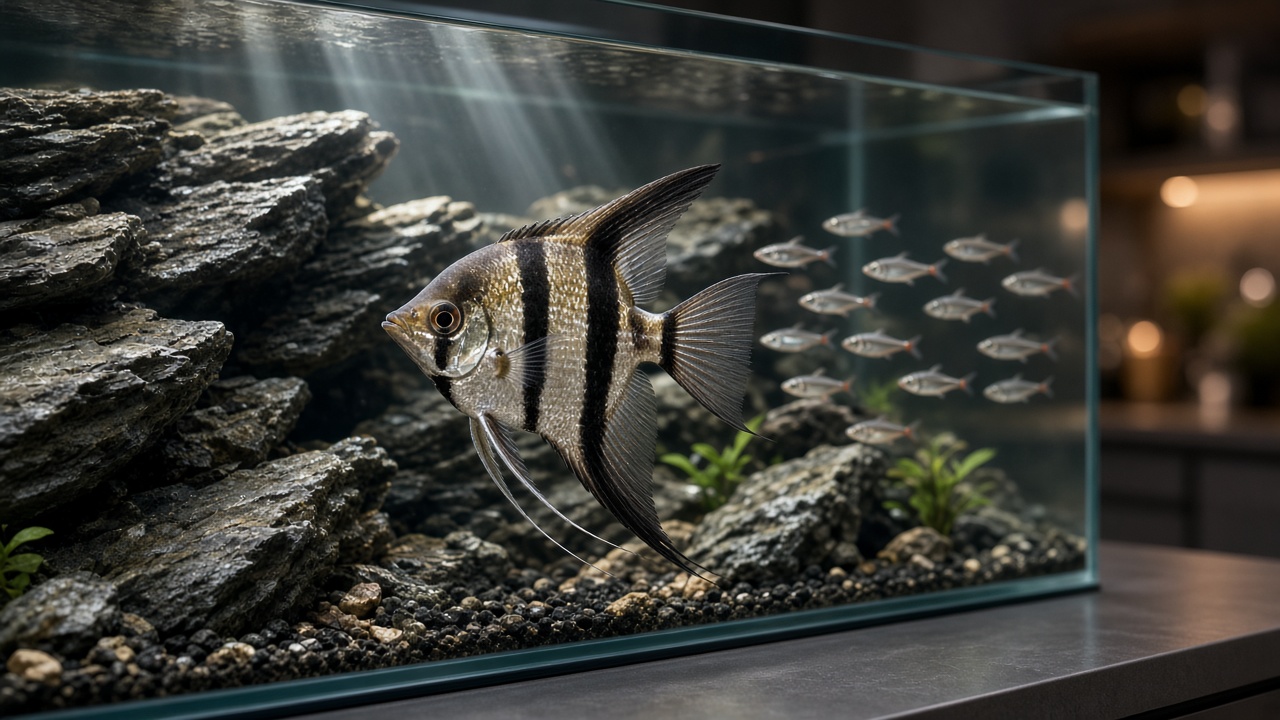
Quick answer: Pair angelfish with mid-size tetras, rasboras, rainbowfish, gouramis, swordtails, corydoras, and bristlenose catfish. Skip tiny tetras, guppies, shrimp, and fin-nippers. Plan a tall tank of 50 US gallons or more so the group can spread out.
Keep angelfish with 12 mid-size community fish; do not keep them with neon tetras, guppies, tiger barbs, bettas, or shrimp.
This page is a desk comparison of University of Florida farm lists and maker labels. We did not run tank trials, did not visit Florida farms, and did not rank species by store sales.
Our research team used one selection rule: a fish is in only if UF/IFAS names its Florida culture group. The adult also has to be too large or too armored for an angelfish to swallow.
We left out neon tetras, fancy guppies, tiger barbs, bettas, and dwarf shrimp because they fail that rule.
Three words to learn before you buy a second fish
Learn what a tank mate, a cycle, and ammonia mean before you add any companion.
A tank mate is another animal that can live in the same box of water. It is not a decoration, and it still eats, wastes, and needs space.
A cycle is the wait while helpful bacteria grow in the filter and turn toxic waste into a safer form. The University of Florida/IFAS ammonia circular says a new biofilter needs six to eight weeks before it can handle the load.
Ammonia is invisible fish waste, and you cannot smell it at levels that harm fish. UF/IFAS says the only way to know it is there is to test the water, and a healthy tank should read zero.
Gallons measure how much water the tank holds, and a 10-gallon starter box is too short for adult angelfish plus a school. Our research team set a 50 US gallon floor for this community list, which is our desk cutoff. That floor also matches Seachem’s published 5 mL dose for 50 US gallons of new water.
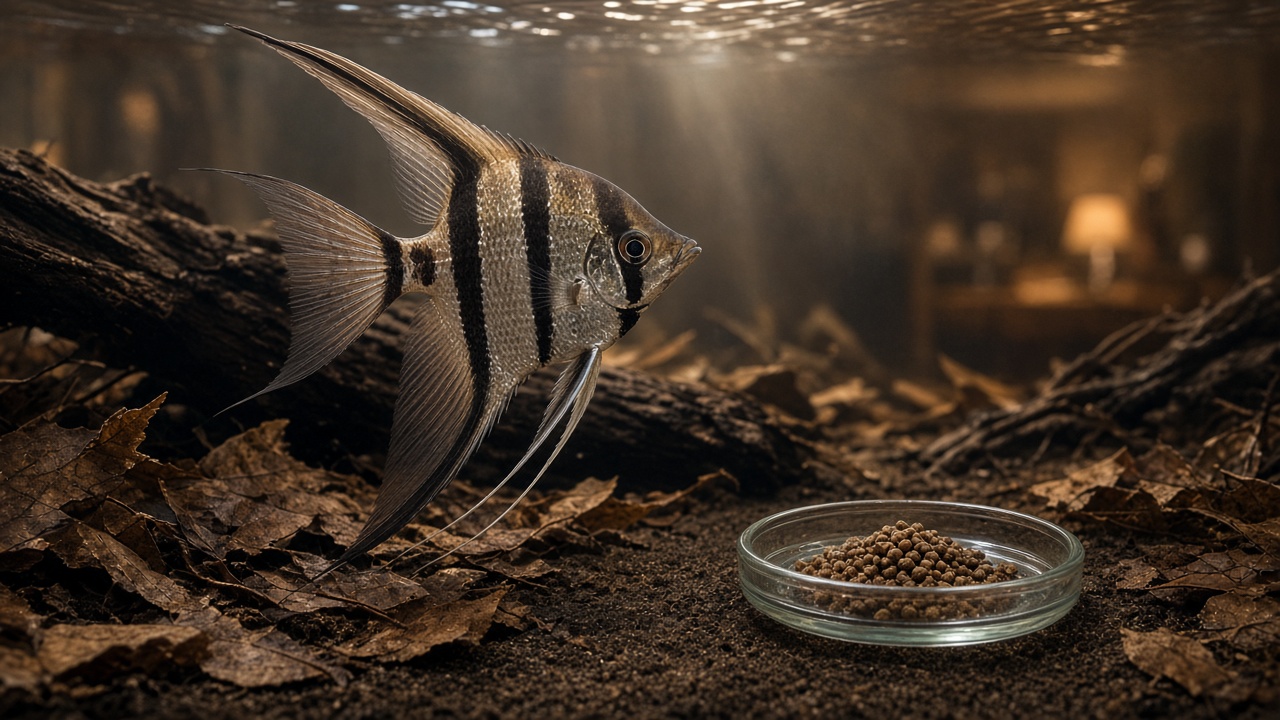
Angelfish are tall South American cichlids, and the University of Florida/IFAS Florida culture circular names Pterophyllum scalare as a commonly farmed cichlid. Cichlids care for their eggs, and many also guard a nest and chase neighbors.
That chase is why tank mates need room and hiding spots, so tall plants and vertical wood should break the view. For plant ideas, see our live plants for betta fish guide and pick the tall species.
The Florida-farm rule we used
A fish made this list only if UF/IFAS names its group and it is too large or too armored to eat.
UF/IFAS reports that about 200 Florida producers raise over 800 varieties of freshwater fish. A 2021 Tropical Aquaculture Laboratory survey put Florida tropical fish sales at $172,075,095. The same circular says Florida accounts for about 95% of U.S. ornamental production.
Our research team mapped 12 sold species onto those named groups and did not add a ninth group from hobby blogs.
We also used IFAS adult-size caps as a swallow-size screen:
- Most Florida-cultured tetras stay under 100 mm, or 4 inches
- Corydoras catfish stay under 100 mm, or 4 inches
- Bushy-nose plecos reach about 130 mm, or 5 inches
- Rainbowfishes stay under 125 mm, or 5 inches
- Swordtails and other livebearers stay under 140 mm, or 5.5 inches
- Most gouramis stay under 150 mm, or 6 inches
Common plecos can reach about 450 mm, or 18 inches, which is why we list the smaller bushy-nose instead.
Neon tetras sit on the IFAS “bread-and-butter” tetra list, but we still dropped them. Adult angels eat fish that fit in the mouth, and neons are the usual victim of that rule.
Twelve safe tank mates by swimming zone
These 12 species share a tropical community tank and stay in different water layers.
Angelfish hold the middle of a tall tank, so mates that stay high, low, or in a tight school reduce crowding. Keep schools as real groups, because two fish do not count as a school.
Bottom layer
Peppered corydoras and bronze corydoras fill the armored-catfish group and stay on the sand to eat leftover bits. UF/IFAS names Corydoras as a popular Florida culture genus and shows Corydoras paleatus.
Keep corydoras in a group of six or more, because a single cory hides and misses food.
Bristlenose plecos (bushy-nose, Ancistrus) graze wood and glass and are too armored to look like food. UF/IFAS lists them at about 5 inches, so they pass the swallow-size screen.
Mid-water schools
Lemon tetras, black tetras, and head-and-tail-light tetras are the mid-size tetra picks. UF/IFAS names Hyphessobrycon lemon tetras, Gymnocorymbus black tetras, and Hemigrammus head-and-tail-light tetras.
Buy a school of six or more so they move as one unit.
Harlequin rasboras cover the rasbora group and still school tightly. UF/IFAS shows Trigonostigma heteromorpha in its minnow chapter.
Upper water
Boeseman’s rainbowfish, turquoise rainbowfish, and New Guinea red rainbowfish cover the rainbowfish group. UF/IFAS names Melanotaenia boesemani, Melanotaenia lacustris, and Glossolepis incisa.
Opaline gouramis cover the labyrinth-fish group and use a still corner. UF/IFAS shows Trichopodus trichopterus and notes most gouramis stay under 6 inches.
Swordtails are the mid-size livebearer pick, and fancy guppies stay off this list because they are smaller and slower. UF/IFAS lists Xiphophorus hellerii at under 5.5 inches.
Silk leaves and caves can still help shy fish. See our betta decorations notes, then scale the wood up.
Five tank mates to skip
These five fail a mouth-size screen or a fin-safety screen and should stay out.
- Neon tetras: UF/IFAS names Paracheirodon innesi as a small staple tetra. Adult angelfish eat fish that fit in the mouth, so neons fail the swallow-size screen.
- Guppies: Fancy guppies are small, slow livebearers with long tails, so they fail the mid-size screen that swordtails pass.
- Tiger barbs: UF/IFAS names barbs as a Florida culture group, but tiger barbs nip long fins and fail our peaceful-school screen.
- Bettas: Bettas are not on this mixed-cichlid list, and both fish flare with trailing fins. Use our betta tank mates guide instead, and do not merge those two lists.
- Dwarf shrimp: Shrimp are prey, so they fail the same mouth-size screen as neon tetras.
Water numbers that keep a mixed tank alive
Shared water chemistry, not a pretty stocking list, decides whether the mix lasts long.
UF/IFAS puts ammonia just behind oxygen as the water factor that matters most. The circular publishes these checkpoints:
- Healthy tanks should read zero ammonia
- Un-ionized ammonia can damage tissue above 0.05 mg/L
- Sensitive fish often die at 2.0 mg/L
- Un-ionized ammonia is about 100 times more toxic than ammonium
- Nitrite can harm fish at 0.10 mg/L
- Nitrifying bacteria work poorly when alkalinity falls below 20 mg/L
- Test ammonia about once a week, and test at once if fish stop eating
API’s Freshwater Master Test Kit page says a pH of 7.0 is neutral. UF/IFAS says higher pH and higher temperature raise the toxic share of ammonia, so stay near neutral and keep ammonia at zero.
Do not chase a shop-card “perfect” number, because stability matters more than a single target.
If ammonia is present, UF/IFAS says to cut or stop feeding for one to three days. In a tank, it also lists a 25% to 50% water change if the new water has no ammonia.
Seachem’s Prime page says use 1 capful (5 mL) per 50 US gallons of new water, and each cap thread is about 1 mL. Treat the new water first, then add it to the tank.
Prime lists an emergency dose of up to 5 times normal if ammonia or nitrite is above 2 ppm. It says the binder lasts up to 48 hours, so wait before you dose again.
How to feed both layers and check the water
Feed top and bottom fish on a short clock, then test the water every week.
Angelfish eat in mid-water, while corydoras eat on the sand, so surface-only flakes leave the bottom fish hungry. Extra food also raises waste for every species, so feed only what the group can finish.
Tetra’s TetraMin Tropical Flakes page says feed two to three times daily, only what fish finish in three minutes. The same page lists U.S. sizes from 0.42 oz (12 g) to 4.25 lb (2.05 kg).
TetraMin is a staple for top- and mid-feeding tropical fish, which covers angels and the mid-water school.
Hikari’s Cichlid Gold page calls the food a daily diet for cichlids and larger tropical fish. Feed two to three times daily, and only what they finish in a few minutes. Listed floating bags include 2 oz (57 g) and 8.8 oz (250 g).
Use flakes for the school, then add a cichlid pellet when adult angels ignore the flake. Drop a few sinking bites for the corydoras after the surface feeding ends.
API’s Freshwater Master Test Kit page says the kit measures six aquarium levels, including ammonia, pH, high-range pH, nitrite, and nitrate. It ships with four test tubes, and API tells keepers to test weekly.
That weekly test matches the UF/IFAS weekly ammonia check, so run the test and the water change on the same day.
| Product | Maker-listed role | Key published number | Use in a mixed angel tank |
|---|---|---|---|
| TetraMin Tropical Flakes | Staple for top- and mid-feeding tropical fish | Finish food in 3 minutes, 2–3 times daily | Daily food for angels and the mid-water school |
| Hikari Cichlid Gold | Daily diet for cichlids and larger tropical fish | 2 oz (57 g) and 8.8 oz (250 g) floating bags | Pellet option when adult angels ignore flakes |
| Seachem Prime | Fresh and saltwater conditioner | 5 mL treats 50 US gallons | Treat every bucket of new tap water |
| API Freshwater Master Test Kit | Liquid tests for six freshwater levels | Four test tubes; weekly use | Confirms ammonia is zero before you add mates |
How to add companions without a clash
Add fish only after a finished cycle, and watch pairs that start to spawn.
A finished cycle means the API kit reads zero ammonia and zero nitrite. UF/IFAS says any ammonia means the system is out of balance, so do not add tank mates during that wait.
Use this order:
- Cycle the tank for six to eight weeks, or until ammonia and nitrite stay at zero.
- Add the school first, or add juvenile angels first. Do not drop one adult angel into a finished school and hope.
- Treat all new tap water. Seachem’s Prime page says dose for the volume of new water, not a guess.
- Feed on the three-minute Tetra clock, or the “few minutes” Hikari clock.
- Watch spawning. UF/IFAS says cichlids guard nests. Move the school if a pair claims the glass.
If you raise several young angels, they can pair off and fight, so plan a second tank for extra adults.
FAQ
Can angelfish live with neon tetras?
No, because adult angelfish eat fish that fit in the mouth, and UF/IFAS names neon tetras as a small staple tetra. Shop for lemon, black, or head-and-tail-light tetras instead of neons.
What size tank do angelfish and tank mates need?
Our research team only covers mixed tanks of 50 US gallons or larger, and that is our desk cutoff, not a farm-trial result. A short 10-gallon box cannot hold a tall cichlid plus a school and bottom fish.
Can angelfish live with bettas?
Do not mix them, because both fish flare with trailing fins and bettas are not on this list. Use a betta-specific list for betta tanks, and keep angels on the 50-gallon list above.
Do angelfish eat shrimp?
Yes, dwarf shrimp fail the same mouth-size screen as neon tetras. Snails are a separate question this page does not cover.
How do I know the tank is ready for tank mates?
Wait until the API kit reads zero ammonia and zero nitrite. UF/IFAS says a new biofilter often needs six to eight weeks, and any ammonia means the system is not ready.
How often should I test water after adding tank mates?
API’s Freshwater Master Test Kit page says to test weekly, and UF/IFAS also says to test ammonia weekly. Test at once if fish gasp or stop eating.
Can I keep a common pleco with angelfish?
No, because UF/IFAS lists common and sailfin plecos at up to about 18 inches. Use one bristlenose, which the same circular lists at about 5 inches.