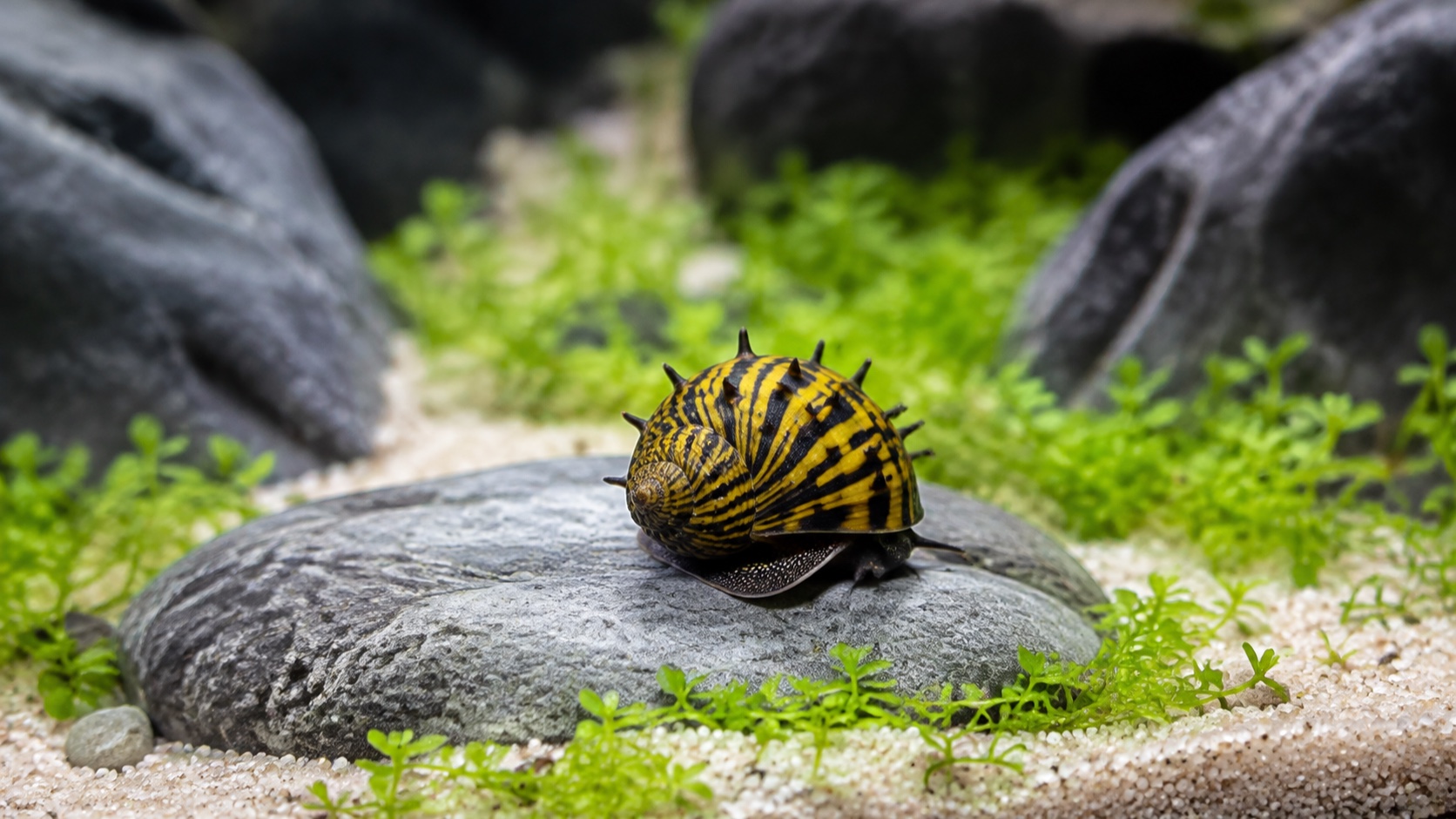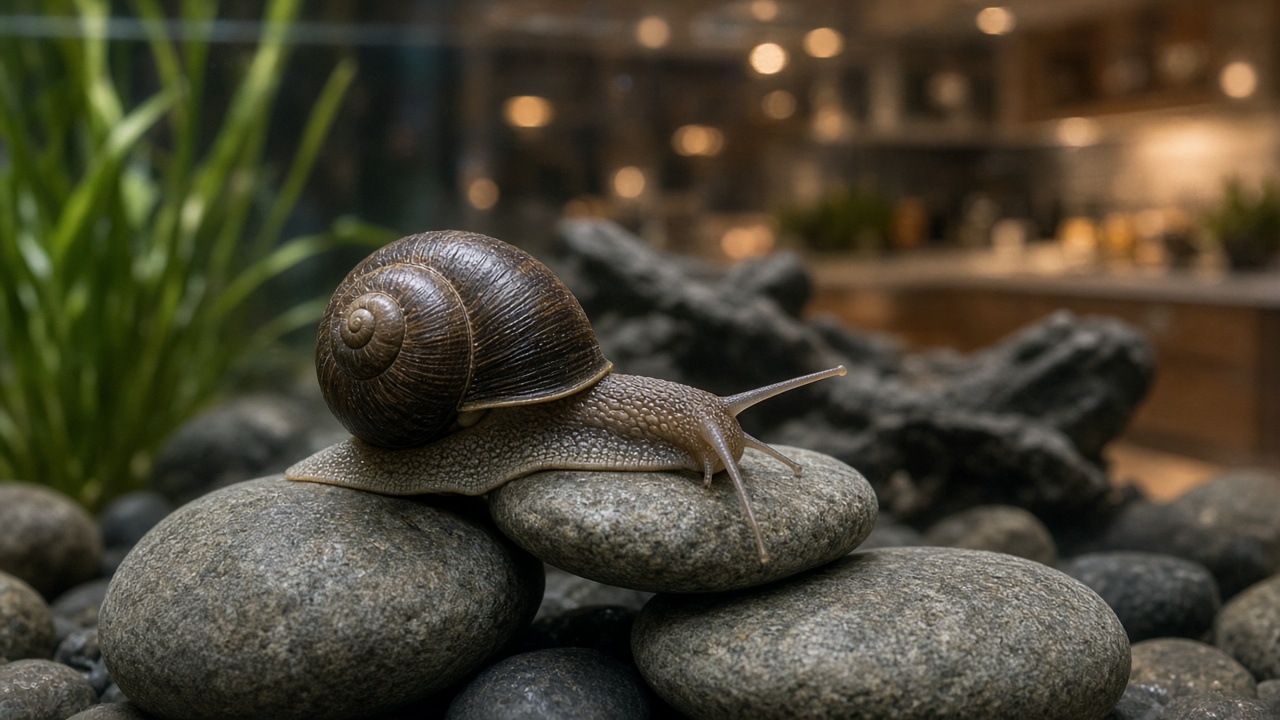
Quick answer: Keep Japanese trapdoor snails in closed freshwater tanks or lined ponds. Feed biofilm plus a sinking wafer when the tank is clean. Never release them; USGS lists the species as established across much of the eastern United States.
The Japanese trapdoor snail is a livebearing freshwater snail that USGS records at 50 mm with 10–120 young. This page is a desk comparison of USGS field records and current maker specs.
Our research team analyzed those published numbers and five product pages sold now, and the Closed-Water Rule below decides what made this article.
What this snail is
USGS treats the Japanese trapdoor snail as a large livebearing freshwater snail from East Asia.
Shops sell it as a Japanese trapdoor snail or Japanese mystery snail. USGS lists the scientific name as Cipangopaludina japonica.
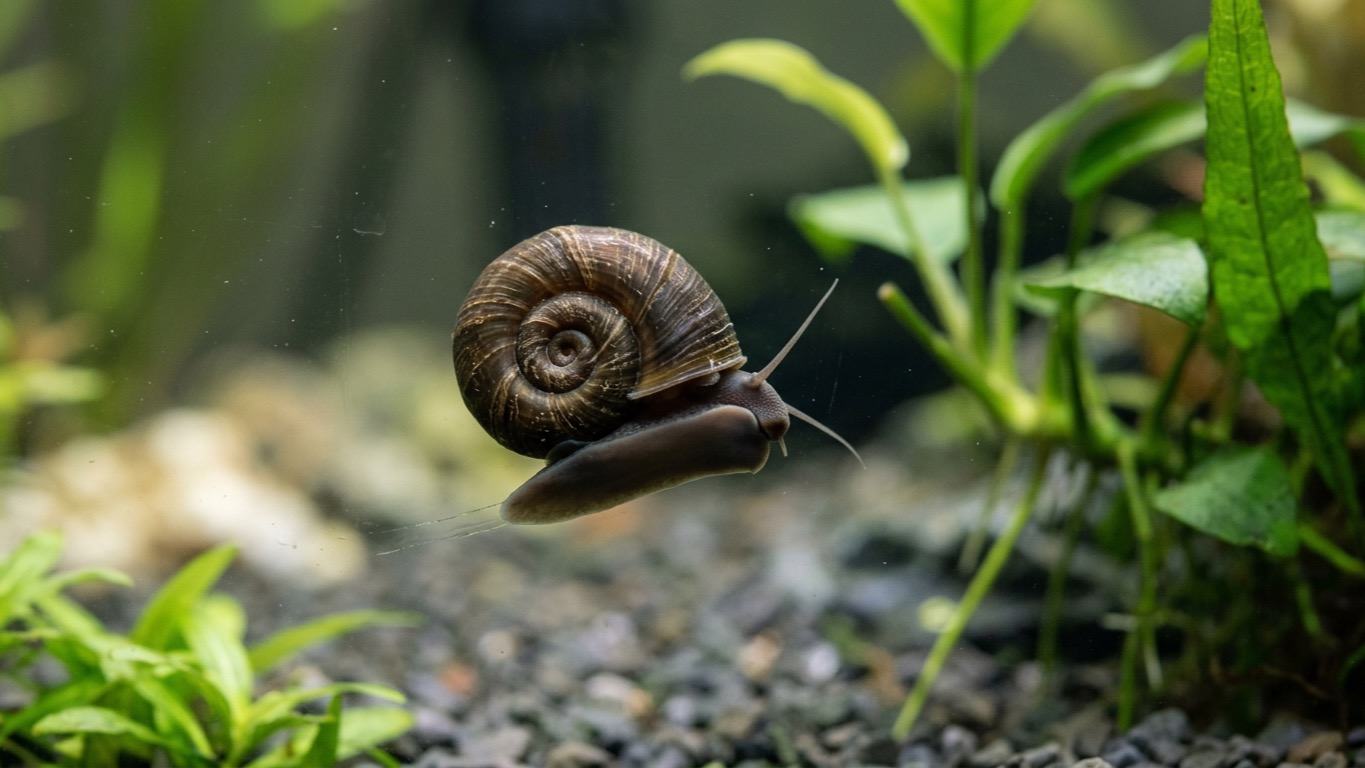
The “trapdoor” is an operculum, and USGS describes that plate as a concentrically marked lid on a large rounded shell.
USGS identification notes you can check without a lab are short:
- Adult shells show 7–8 whorls.
- The spire angle is 50–55 degrees.
- Juveniles start light, and adults turn dark brown.
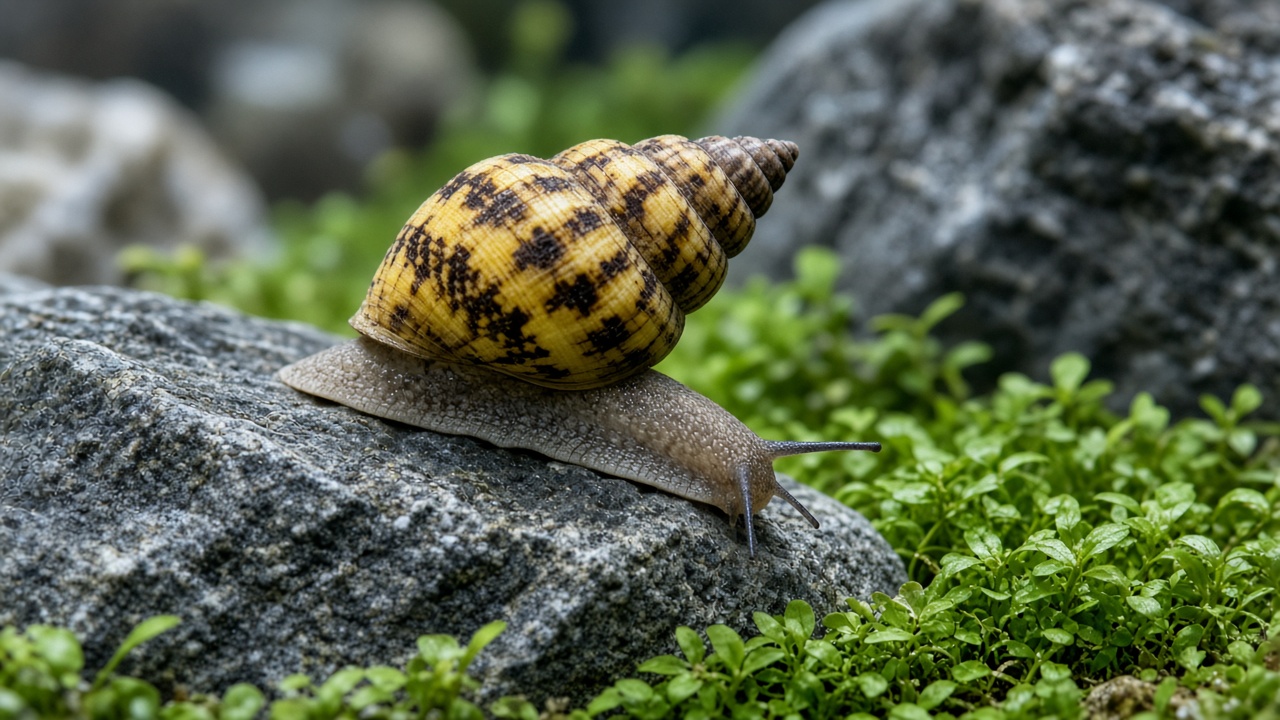
USGS says the shell can reach 50 mm. In Lake Erie, adults ran 30–65 mm high and 22–46 mm wide, and mature females were a bit larger than males.
USGS also says the two common Asian mystery snails look alike. A 2019 genetic paper cited there found them distinct but hard to tell by shell, so treat the animal you bought as a large livebearer.
We only cover closed tanks and lined ponds that stay wet and cannot spill into wild water.
That is our selection rule, and it follows the habitat USGS actually recorded. USGS places this snail in lakes, rivers, and rice paddies, and it also records die-offs when marshes around Sandusky Bay dry in hot weather.
We include a scenario only if it meets all four points:
- Freshwater only, with no marine or brackish mix.
- The water body is closed, with no overflow to a creek, drain, or lake.
- The floor is soft enough for a heavy snail that USGS found on mud.
- You can condition new water and test it on a weekly cycle.
We skip open-water stocking, copper algae treatments, and nano cubes with no floor for a 30–65 mm adult. We also skip claims we could not trace to USGS or a maker page.
If you want a smaller egg-layer for a planted tank, use our ramshorn snail care guide instead.
Tank setup for one adult
Give one adult a wide, cycled tank with a soft floor and treated tap water.
Those Lake Erie adults were 30–65 mm high and 22–46 mm wide. Our desk rule is one adult per 10 gallons, in a tank that is longer than it is tall.
Set the tank up in this order:
- Cycle the filter until ammonia and nitrite read zero on a liquid kit.
- Use sand or smooth gravel, and leave open floor instead of sharp rock piles.
- Add wood or stone that can grow a thin film, but do not pack the floor.
- Treat every new water dose before it touches the snail.
- Float the bag, then drip tank water in for 30–45 minutes.
Seachem’s page for Prime states a standard dose of 1 capful (5 mL) for each 200 L (50 US gallons) of new water. Each cap thread is about 1 mL, and Seachem says to add it to the new water first when you can.
Seachem also says Prime will not change pH, which helps because USGS field water sat at pH 6.3–7.3.
Keep flow gentle, because USGS found this snail in water 4 m deep or less in Sandusky Bay. That bay water was turbid, with sparse plants, so skip a strong powerhead that rolls the snail.
Tank mates should be peaceful and too small to crush a 30 mm shell, so skip loaches, large cichlids, and assassin snails.
Pond setup that stays closed
Lined ponds can work if they stay wet and have no path into wild water.
USGS lists the snail as native to lakes in Japan, Taiwan, and Korea, and it is now established across much of the eastern United States. USGS records an 1892 San Francisco food-market import and 1940s Lake Erie stocking as catfish food.
A backyard liner with no overflow is in scope, and a farm pond that floods a ditch is not.
Use this pond checklist:
- A liner or sealed tub with no earthen bank that overflows in rain.
- Water that remains after a dry week, because USGS records mortality when shallows dry.
- Soft mud or sand on the floor, not bare liner alone.
- Shade so surface water does not sit at the 30°C Sandusky Bay peak all day.
USGS recorded two-ton seine hauls in Sandusky Bay, so we treat release as a hard fail.
We do not have a freeze-survival number on the pages we compared, so keep snails indoors if the pond may freeze to the mud.
Koi and large goldfish will eat small snails, so wait until a snail is near the USGS adult range.
Water, minerals, and weekly tests
Match the soft-to-moderate field water USGS recorded, then test on a weekly schedule.
USGS lists North American finds in water of pH 6.3–7.3. The same note lists calcium at 11 ppm and sodium at 16 ppm. Conductivity in those waters ran 62–194 μmhos/cm, which is on the soft side.
API’s page for the Freshwater Master Test Kit says to test weekly. The kit’s listed checks are pH, high-range pH, ammonia, nitrite, and nitrate, and API states that a pH of 7.0 is neutral.
Use these targets from the pages we compared:
- pH near the USGS band of 6.3–7.3.
- Ammonia and nitrite at zero on the API kit.
- Nitrate held down by water changes, not by dumping snails outside.
- GH measured before you add any mineral mix.
Seachem’s page for Equilibrium is written for RO, DI, or mineral-poor water, and it tells you to measure GH first on other water.
Seachem’s listed dose is 16 g (1 tablespoon) for every 80 L (20 US gallons). That raise is 1 meq/L, which Seachem also writes as 3 dH. Mix the powder in 1 L of water first, and Seachem says the haze should clear in 15–30 minutes.
Seachem’s planted-tank guide on that page is 1–2 meq/L (3–6 dH). Equilibrium’s listed analysis per 1 g includes 8.06% calcium and 2.41% magnesium.
Do not chase a high GH just because other guides say so. USGS already found this snail at 11 ppm calcium, so use Equilibrium when your tap or RO water is poorer than that.
Seachem’s Prime page says the binder can hold ammonia, nitrite, and nitrate for up to 48 hours. You may re-dose every 24–48 hours, and Seachem allows up to 5 times the normal dose when nitrite or ammonia is above 2 ppm.
Food, algae, and five current products
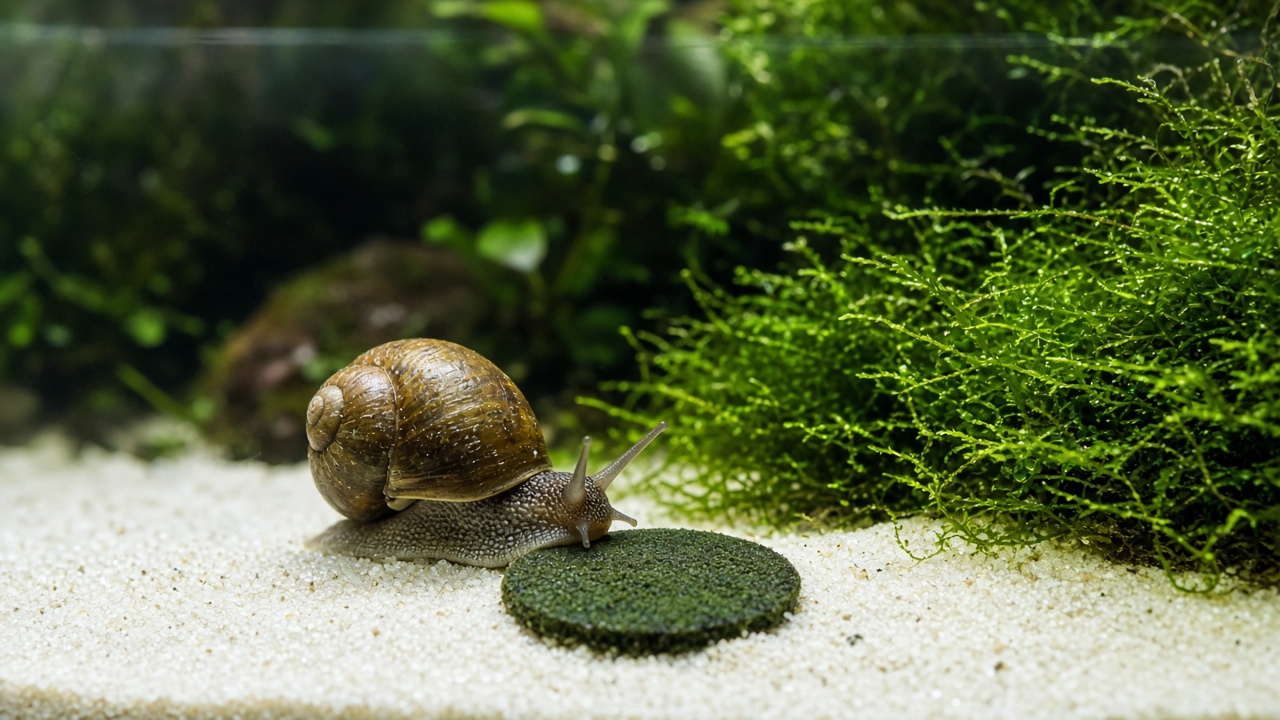
This snail eats detritus first, and wafers fill gaps when the tank is too clean.
USGS says the Japanese mysterysnail feeds on detritus and sludge that hold many kinds of bacteria. In Japan it is common in rice paddies on soil among plants, which is a scavenger diet, not a promise to clear green glass.
Soft algae and leftover film are part of that mix, but hard green spot algae and healthy plant leaves are not a food plan. If you want a smaller dedicated grazer, see our horned nerite snail care page.
Feed in this order:
- Let a cycled tank grow a thin film on wood and glass.
- Offer one sinking wafer or a pinch of granules after lights out.
- Remove uneaten food when the maker’s window ends.
- Skip extra food if waste piles up or nitrate climbs.
Hikari’s page for Tropical Algae Wafers lists a 2-hour feed window. Fluval’s page for Bug Bites Bottom Feeder Granules lists a 2-minute feed window, two or three times daily. Those are different clocks, so follow the page that matches the food in your hand.
Across the two sinking foods our research team compared, listed minimum crude protein sat at 32.0% and 33%.
| Product | Format on the maker page | Listed numeric spec | Maker-stated job |
|---|---|---|---|
| Hikari Tropical Algae Wafers | Sinking disc; 20 g to 250 g packs | Min. 33% crude protein; min. 0.8% phosphorus; 2-hour feed window | Daily diet for plecos and other algae eaters |
| Fluval Bug Bites Bottom Feeder Granules | 1.4–2.0 mm sinking granules; 45 g (1.6 oz) | Min. 32.0% crude protein; up to 40% black soldier fly larvae; min. 1.50% calcium | Mix for plecos and other bottom feeders |
| Seachem Prime | Liquid; 50 mL through 4 L | 5 mL per 50 US gallons; binds up to 48 hours | Removes chlorine and chloramine |
| Seachem Equilibrium | Powder; 300 g, 600 g, 4 kg | 16 g per 20 US gallons raises GH by 3 dH; 8.06% calcium | Restores GH in RO, DI, or mineral-poor water |
| API Freshwater Master Test Kit | Four tubes, tray, and color card | Weekly testing; pH 7.0 listed as neutral | Measures pH, high-range pH, ammonia, nitrite, and nitrate |
Break a Hikari wafer if one disc is larger than the snail’s mouth. Fluval’s granules are already 1.4–2.0 mm, so a small pinch is enough.
Breeding, lifespan, and why you must not release them
Females can carry 10–120 young and live 8 years, so a pair is a long project.
USGS states the species is viviparous and gives birth to crawling young. It does not glue egg clutches to your glass the way a ramshorn snail does.
USGS says young are generally born after water rises to 15°C (59°F) or more. Females live up to 8 years, and a female can carry 10–120 young.
You do not need a special breeding tank, but you do need a plan for the babies. A clean tank with extra wafers will feed more young than a lean tank.
Sexing is not reliable from a top-down photo, though USGS notes females run slightly larger when mature. Keep one snail if you want zero young.
Do not release extras. USGS lists the snail as established in many eastern US waters and calls high densities a nuisance to anglers.
Check your state and city rules before you buy, because some places restrict live mystery snails. If you already have too many, rehome them to other closed tanks.
FAQ
How big do Japanese trapdoor snails get?
USGS says the species can reach 50 mm. Lake Erie adults in that profile were 30–65 mm high and 22–46 mm wide, so plan floor space for a 2-inch-class snail.
Do Japanese trapdoor snails eat algae and live plants?
USGS describes a diet of detritus and sludge, not a plant-only menu. They will rasp soft film and leftover food, but they will not clear every algae spot. They are a poor stand-in for a horned nerite snail.
How many babies can one female have?
USGS says a female can carry 10–120 young and live up to 8 years. Births tend to follow a rise past 15°C, so one pair can fill a tank over a few warm seasons.
Can they live in an outdoor pond all year?
Only in a closed, lined pond that never dries and never overflows. USGS records die-offs when shallows dry, and we found no freeze-to-mud survival number on the pages we compared.
What should I feed if the glass looks clean?
Use Hikari Tropical Algae Wafers and follow the 2-hour window on Hikari’s page. Or use a pinch of Fluval Bug Bites Bottom Feeder Granules and follow Fluval’s 2-minute, two-to-three-times-daily window.
Are Japanese trapdoor snails the same as Chinese mystery snails?
USGS treats Cipangopaludina japonica and Cipangopaludina chinensis as separate species. The same profile says shells often look the same, so care for the livebearer you have.
What water tests matter each week?
API’s Freshwater Master Test Kit page says to test weekly for pH, high-range pH, ammonia, nitrite, and nitrate. Measure GH before you dose Seachem Equilibrium, and dose Seachem Prime at 5 mL per 50 US gallons of new water.