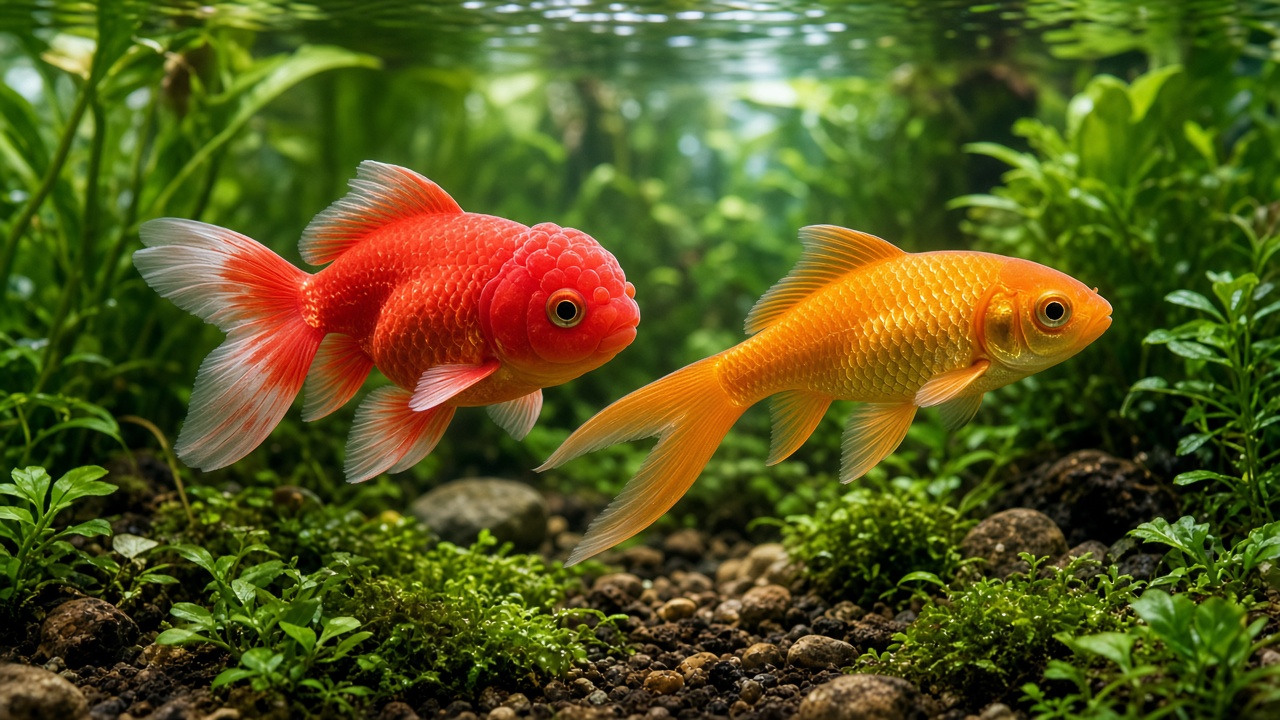
Quick answer: Sort the swell before you change food. Smooth scales and a slow, even round-out usually mean extra meals or eggs. Raised scales and a tight, even swell mean fluid, not fat.
A fat home-tank goldfish is overfed, carrying eggs, or holding fluid.
This page is a research-desk sort of those three looks.
Selection rule: we cover only those three outside-visible causes. We also cover only goldfish-labeled foods whose maker pages list protein, fat, and form. We leave out pond stocking plans, drug protocols, and tropical-only diets.
Our research team analyzed four current maker pages. Listed crude fat ran from 4.0% on Hikari Goldfish Gold to 12.5% on Fluval Bug Bites Goldfish Pellets.
How to tell fat, eggs, and fluid apart
Use the Three-Look Check on scales, swell shape, and swim to sort food weight from eggs or fluid.
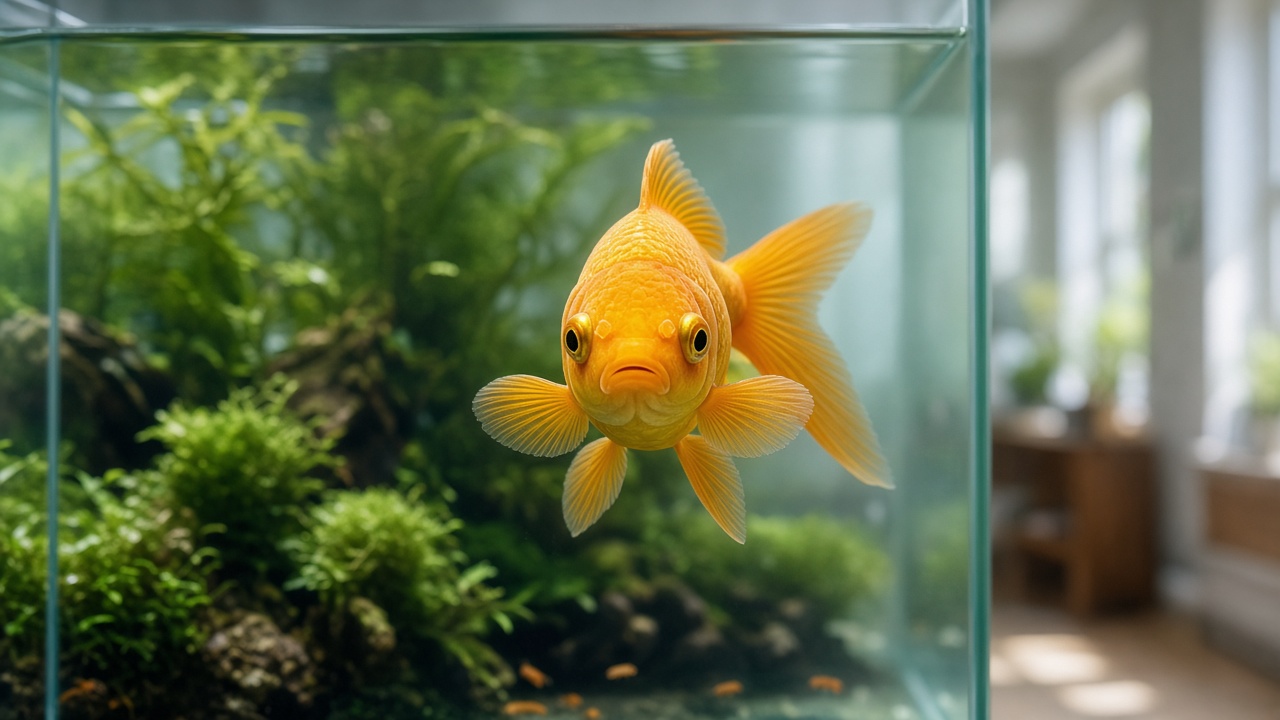
A slow, even belly with flat scales is usually food weight or eggs. A hard, even swell with lifted scales is fluid.
The Three-Look Check
Stand above the tank and record these three things:
- Scales: flat and smooth, or lifted like a pinecone
- Swell: slow and even, one-sided, or tight all the way around
- Swim: level and active, or listing, hanging, or sitting still
Aqueon’s goldfish care guide states that goldfish can live over 20 years in captivity. A weeks-long round-out is not the same problem as a sudden tight swell.
Poor water can also shift color while the belly grows. See our notes on why a goldfish turns black. Fade and pale patches are covered in why a goldfish turns white.
What overfeeding looks like on a goldfish
Overfeeding adds weight slowly, and leftover food also fouls the water.
The fish still eats, the scales stay flat, and the belly thickens over days rather than hours.
Watch for these signs:
- A soft, even belly that grew after extra snacks
- Long strings of waste after large flake meals
- Food left on the surface or the gravel
- More algae after a week of heavy feeding
Hikari’s page for Goldfish Gold states that this growth formula supports rapid weight gain while avoiding buildup of internal fat deposits. That claim is about the recipe, not about unlimited meals.
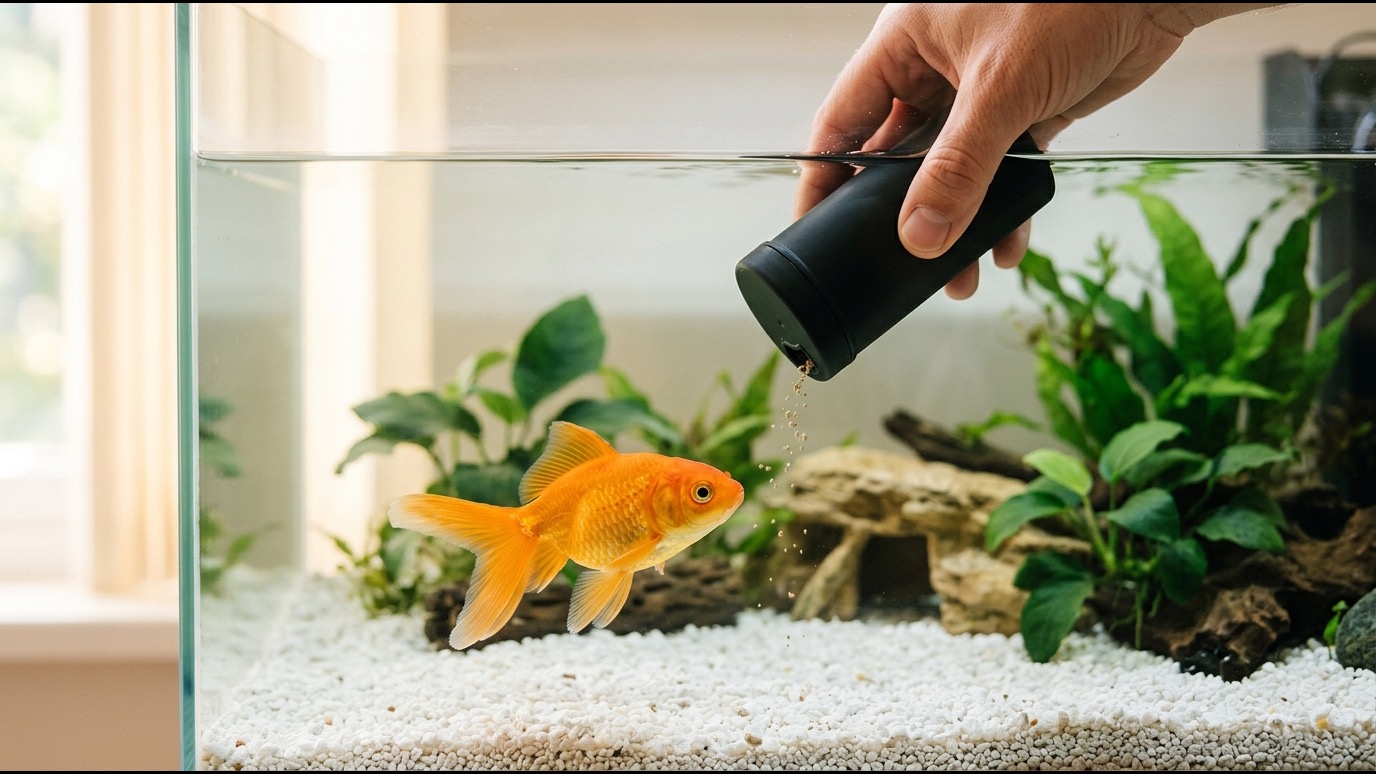
The same Hikari page says to feed two to four times daily. Offer only what the fish will eat within a few minutes, then remove uneaten food.
Hikari also flags two temperature bands, and it tells keepers to take extra care below 50°F (10°C) or above 86°F (30°C).
Aqueon’s goldfish care guide gives a tighter home-tank window. Feed only what the fish finish in two to three minutes, once or twice a day.
Fluval’s page for Bug Bites Goldfish Pellets says to feed as much as the fish can eat in two minutes, two or three times daily.
Maker feeding windows
Put those maker windows side by side:
- Hikari Goldfish Gold: two to four times a day, a few minutes each
- Aqueon care guide: one or two times a day, two to three minutes
- Fluval Bug Bites Goldfish Pellets: two or three times a day, two minutes
If your fish still looks round after you match those windows, the cause may not be extra food.
When a round belly is eggs, not weight
Egg-fill is usually even, and the female still swims and eats.
Aqueon’s goldfish care guide states that all fancy and common types are the same species. Females can fill with eggs in a home tank, and males do not.
Aqueon also states that goldfish are egg scatterers. Adults give no care after the eggs are laid, and the eggs stick to plants and decor.
Aqueon states those eggs hatch in 48 to 72 hours if you move them to a separate tank.
Egg-fill usually looks like this:
- The fish is female, or you are not sure of the sex
- The swell is even, not one hard lump
- Scales stay flat
- The fish still eats and holds a level swim
- Other goldfish may chase or nudge the vent
A one-sided lump that keeps growing sits outside this page’s rule. We do not cover tumors or organ masses.
Extra tankmates raise the food race and the chase. See what fish can live with goldfish before you add more mouths.
What pinecone scales actually mean
Lifted scales plus a tight, even swell mean fluid, not stored food.
The Merck Veterinary Manual lists fluid in the abdomen as “dropsy” and “pinecone disease.” It ties that look to Aeromonas and related bacteria in freshwater aquarium fish.
Merck also lists other Aeromonas signs you can see from outside:
- Bloody spots or ulcers on the body
- Ragged fins
- Enlarged eyes
Merck states that koi and goldfish are especially open to Aeromonas salmonicida. That strain can cause deep ulcers and death.
Merck names a rare goldfish parasite, Sphaerospora auratus, that causes renal dropsy in pond-raised goldfish. Merck says there is no practical treatment and calls the infection extremely rare.
Do not treat pinecone scales as a food problem. Stop extra snacks, test the water, and call a fish-experienced clinic if scales lift.
This desk does not name drugs or salt baths, because those steps sit outside our selection rule.
How much to feed, and which foods list what
Match the meal to a listed two-to-three-minute window, then compare protein and fat on the label.
Our research team analyzed the four maker pages below for listed protein, fat, fiber, and form.
| Product | Form | Crude protein (min) | Crude fat (min) | Crude fiber (max) | How it sits |
|---|---|---|---|---|---|
| Hikari Goldfish Gold | Baby pellet | 32% | 4.0% | 3.0% | Floating |
| Tetra Goldfish Flakes | Flake | 42% | 11% | 2% | Long-floating, then slow sink |
| Fluval Bug Bites Goldfish Pellets | 5–7 mm pellet | 40.0% | 12.5% | 5.0% | Slow sinking |
| New Life Spectrum Goldfish Regular | 1–1.5 mm pellet | 34% | 8% | 8% | Sinking |
Label spreads from four maker pages
Three spreads stand out when those four labels sit in one table:
- Fat: 4.0% on Hikari Goldfish Gold versus 12.5% on Fluval Bug Bites Goldfish Pellets
- Protein: 32% on Hikari Goldfish Gold versus 42% on Tetra Goldfish Flakes
- Fiber: 2% max on Tetra Goldfish Flakes versus 8% max on New Life Spectrum Goldfish Regular
Hikari’s page lists Goldfish Gold at a minimum of 32% crude protein and 4% crude fat. Fiber is listed at a maximum of 3%, moisture at a maximum of 10%, and phosphorus at a minimum of 0.7%.
Tetra’s page for Goldfish Flakes lists 42% crude protein, 11% crude fat, 2% crude fiber, and 6.5% moisture. It also lists vitamin D3 at 2114 IU/kg.
Fluval’s United States page for Bug Bites Goldfish Pellets lists a minimum of 40% crude protein and 12.5% crude fat. Fiber is listed at a maximum of 5%, and the pellet is listed as 5–7 mm and slow sinking. Fluval states the formula contains up to 40% black soldier fly larvae as the first ingredient.
New Life Spectrum’s page for Goldfish Regular lists a minimum of 34% crude protein and 8% crude fat. Fiber and moisture are listed at a maximum of 8% and 10%. The regular sinking pellet is listed at 1 mm to 1.5 mm in a 150 g jar.
Aqueon’s goldfish care guide says goldfish may gulp air at the surface. That gulp can make them lose balance and float upside down. Aqueon says to soak flake foods briefly and to avoid floating pellets.
Use that Aqueon note when you pick a form:
- Fancy, egg-shaped bodies: start with a sinking pellet from the table
- Surface gulp after flakes: soak the flake, or switch form
- Leftover floating food: you fed past the two-to-three-minute window
Merck states that dry fish food should be kept cool and dry and used or replaced every two months.
What to do in the first 48 hours
Test the water, cut leftover food, and watch the scales before you switch brands.
Do these steps in order:
- Photograph the fish from above and from the side.
- Check scales, swell, and swim using the Three-Look Check.
- Remove leftover food.
- Test ammonia, nitrite, nitrate, and pH.
- Feed one short meal in a two-to-three-minute window, or skip a meal if waste is still present.
- Hold the next meal to the same window.
Water numbers from Merck and Aqueon
Merck describes new tank syndrome as ammonia buildup in the first one to three weeks. That happens when the biofilter is not yet working.
Merck says that when total ammonia is high (2 mg/L or higher), change at least 50% of the water. That intense care should last only one to two weeks unless another problem remains.
Merck also describes old tank syndrome, where a pH drop below 6.0 can kill filter bacteria. Ammonia then climbs, often higher than 10 mg/L. Merck says simple water changes are not the plan in that case, because a pH rise can make the ammonia more toxic.
Aqueon’s goldfish care guide gives a routine once the tank is stable:
- Change 10% of the water weekly, or 25% every two weeks
- Treat tap water with conditioner before you refill
- Keep fancy goldfish at 68° to 74°F
- Keep comets and shubunkins at 60° to 70°F
- Aim for pH between 7.0 and 8.4
- Give adult common goldfish, comets, and shubunkins at least 20 gallons per fish
- Give adult fancy goldfish at least 10 gallons per adult fish
Aqueon also lists one tablespoon of aquarium or sea salt per five gallons as an optional health aid, not as a dropsy protocol.
Merck states that carbon dioxide can be toxic above 12 mg/L. Fish then look dull and unresponsive, and strong aeration is the listed fix on that page.
If scales lift during these 48 hours, stop shopping for a richer food and call a fish-experienced clinic.
FAQ
These short answers repeat the Three-Look Check and the maker feeding windows.
How do I know if my goldfish is carrying eggs or just fat?
Egg-fill is usually even, and the fish still eats and swims level. Aqueon’s care guide states that goldfish scatter adhesive eggs, give no parental care, and that those eggs hatch in 48 to 72 hours if moved. A one-sided lump, lifted scales, or a fish that stops eating is not egg-fill on this page.
Is a bloated goldfish the same as dropsy?
No. Bloat is only a look, while dropsy is Merck’s name for fluid in the abdomen, often with pinecone scales. Merck ties that look to Aeromonas and related bacteria. Food weight and eggs do not lift scales.
Should I stop feeding a fat goldfish?
Skip leftover food, and do not starve a fish for days unless a clinic tells you to. Fluval’s Bug Bites Goldfish Pellets page sets a two-minute meal, two or three times daily. Aqueon sets two to three minutes, once or twice a day.
Do I need a high-protein goldfish food to slim a fat fish?
No. Slimming is about meal size and leftovers, not a higher protein number. Tetra Goldfish Flakes list 42% and Hikari Goldfish Gold lists 32%. Fluval Bug Bites Goldfish Pellets list 40% and New Life Spectrum Goldfish Regular lists 34%.
Can tankmates make a goldfish look fatter?
They can speed the food race, because extra mouths make you pour more food. Shy fish still gulp air at leftover flakes, and Aqueon warns that surface gulping can flip a goldfish. Check stocking against what fish can live with goldfish before you add another eater.
Why did my goldfish change color after I started feeding more?
Leftover food fouls water, and poor water can darken or fade a goldfish. Merck ties high ammonia to new tanks in the first one to three weeks and to old tanks when pH falls below 6.0. For color, see goldfish turning black and goldfish turning white.