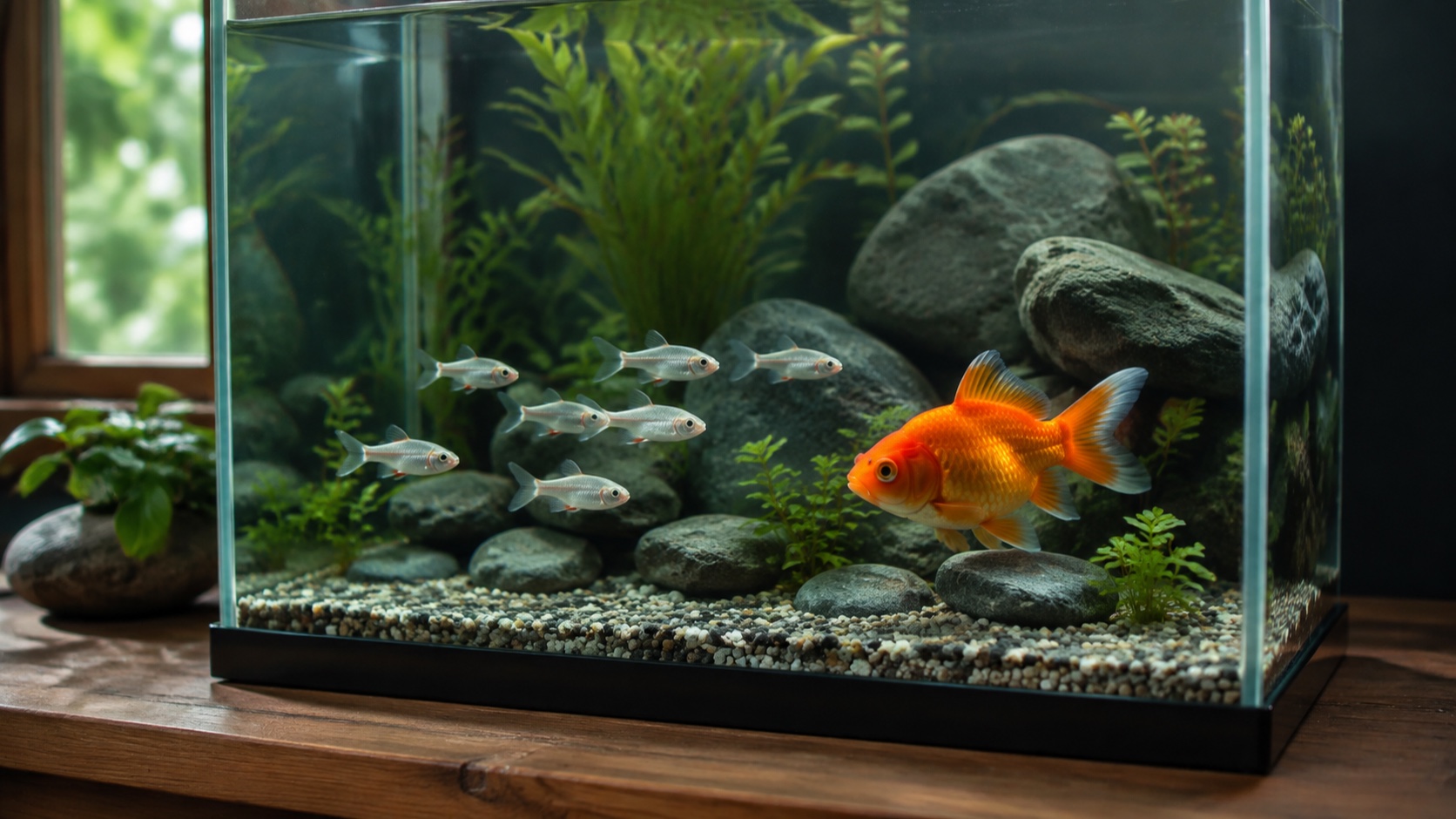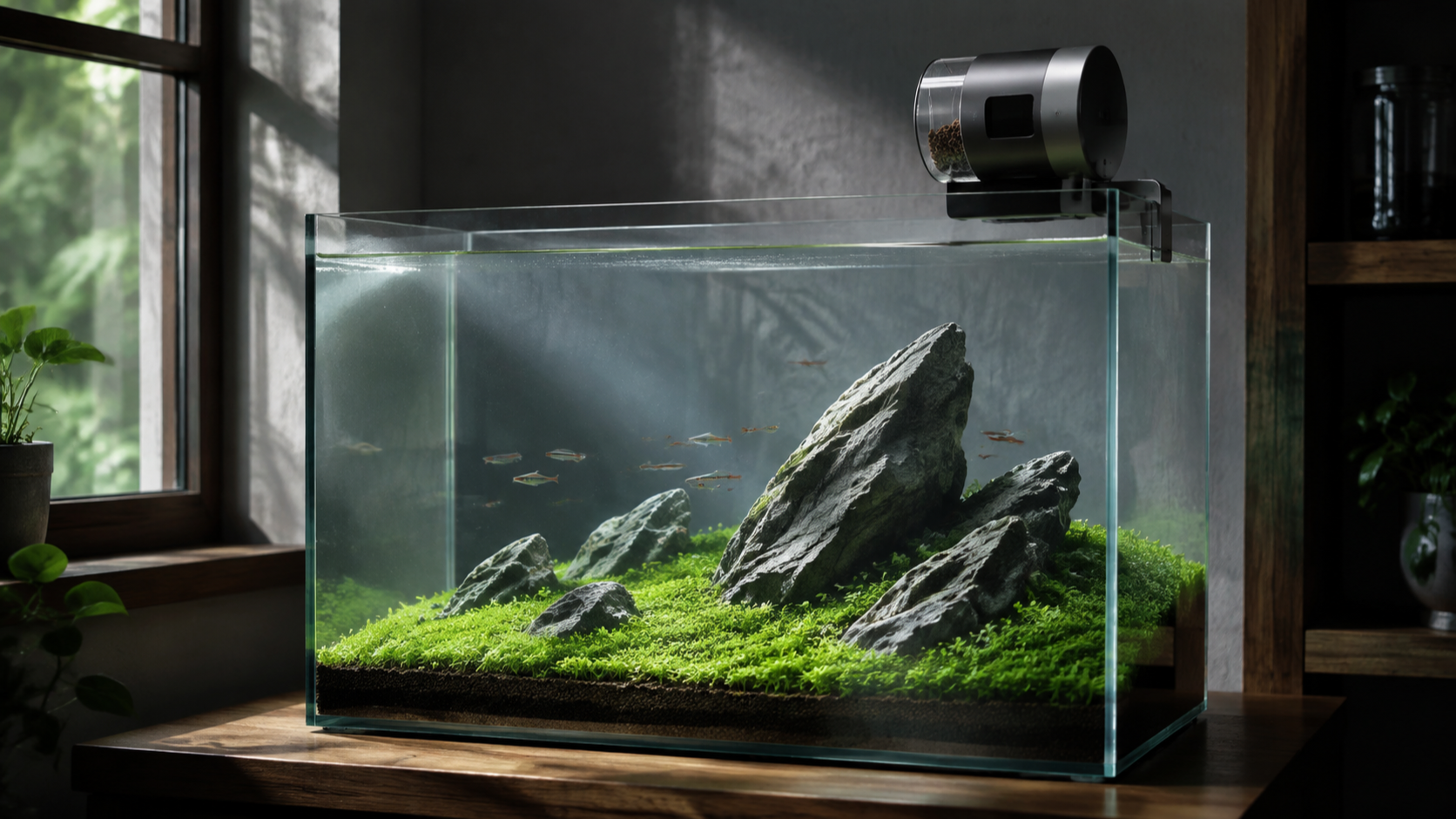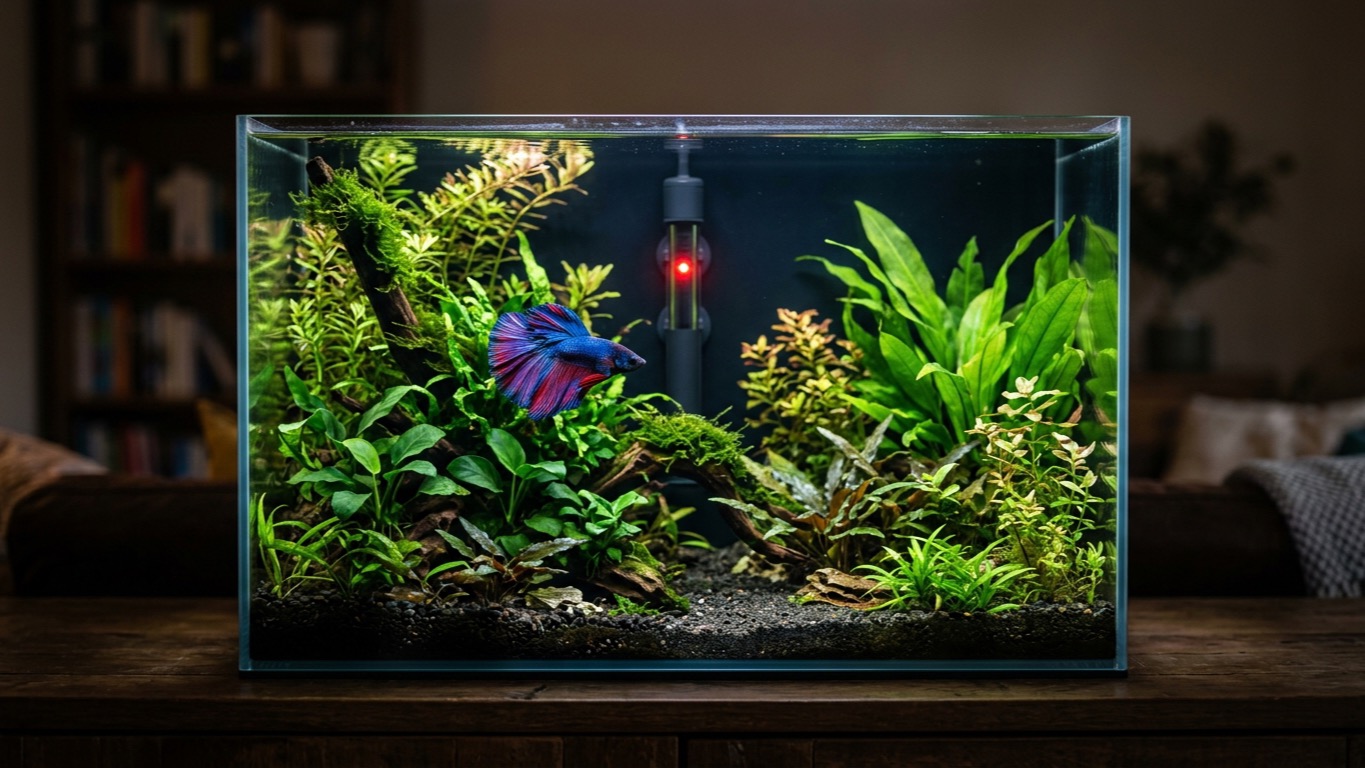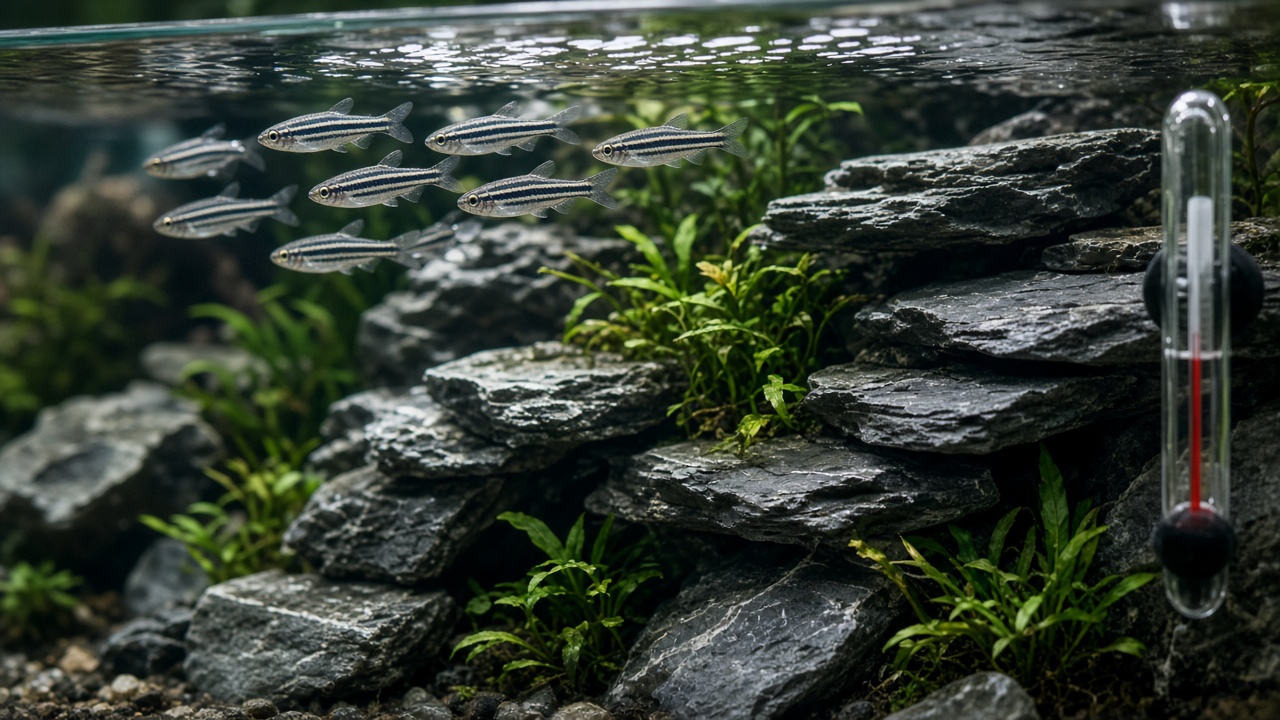
Quick answer: White cloud mountain minnows, zebra danios, and rosy barbs can live in an unheated indoor tank. Goldfish can too, but only in much larger water. Skip tropical fish such as bettas.
OATA names zebra danios, white cloud mountain minnows, and rosy barbs as fish that can live in unheated indoor tanks. This page is a desk comparison of published care sheets and product labels. We did not keep livestock, run unheated tanks, or log room temperatures in homes.
The OATA Indoor List Rule
A species is on this page only if the Ornamental Aquatic Trade Association names it for an unheated indoor aquarium.
Our research team analyzed OATA’s unheated-tank care sheet and its goldfish sheet. We then compared four current product labels. That method is the OATA Indoor List Rule.
A pick enters the list only when one of these is true:
- OATA names the animal on its unheated indoor sheet.
- OATA’s goldfish sheet says a heater is not required in a normal room.
A pick stays out if it needs a heater to hold 22°C, about 72°F. Outdoor-only pond stock stays out, and hobby-blog numbers stay out.
We left out neon tetras, most livebearers, and bettas that need 76–82°F. Those fish fail the rule even if a shop labels them hardy.
An unheated tank is not automatically cold, because a warm room can hold water near tropical heat, so read the thermometer, not the missing heater.
Fifteen unheated-tank picks
These 15 picks are the names OATA published for indoor tanks that skip a heater. OATA says its unheated list is not exhaustive, and we still stop at the names we read.
Small midwater schoolers
1. Zebra danio. OATA says zebra danios can live in unheated aquariums and stay about 5 cm, or 2 inches. Keep at least five in the 17–27°C band, about 63–81°F.
2. Leopard danio. OATA groups leopard danios with zebras on the same unheated list and uses the same 5 cm size, group of five, and 17–27°C band.
3. White cloud mountain minnow. OATA calls them a popular unheated-tank fish at about 5 cm and asks for a group of at least five. The tighter band is 17–23°C, about 63–73°F.
4. Variatus platy. OATA lists this platy at 6–8 cm, about 2.4–3.1 inches, in a 17–27°C band, with two females for each male or a single-sex group.
Barbs and bottom dwellers
5. Rosy barb. OATA says rosy barbs can grow to about 10 cm, or 4 inches, and should live in a group of at least five. The band is 17–27°C, and OATA warns some barbs nip long fins.
6. Golden barb. OATA pairs golden barbs with rosy barbs at the same 10 cm size and 17–27°C band, and they need open swim space plus plants.
7. Bronze corydoras. OATA says bronze corys can live unheated and grow to about 6 cm, or 2.4 inches. Keep at least five on sand or fine gravel.
8. Peppered corydoras. OATA lists peppered corys beside bronze corys and uses the same 6 cm size, group of five, and 17–27°C band.
9. Hillstream loach. OATA sets this fish at up to 6 cm with an 18–24°C band, about 64–75°F. Keep at least three or four in fast, well-oxygenated water with algae to graze.
Large-bodied fish and shrimp
10. Weather loach. OATA says weather loaches can reach 25 cm, about 10 inches, and should live in a group of at least three. The band is 17–24°C, about 63–75°F.
11. Comet goldfish. OATA’s goldfish sheet names the sarasa comet and says a heater is not required unless the room is very cold. Adults commonly reach 25 cm in tanks.
12. Shubunkin goldfish. OATA lists shubunkins on the same goldfish sheet and uses the same 4–25°C band and the same 100-litre start.
13. Fancy goldfish. OATA says not to house comet goldfish with fancy goldfish, because comets out-compete them. One adult still needs at least 100 litres, about 26 US gallons.
14. Amano shrimp. OATA places Amano shrimp on the unheated indoor list at about 3 cm, or 1.2 inches. Keep at least five in the 17–27°C band, and keep copper out of the water.
15. Cherry shrimp. OATA lists cherry shrimp with Amano shrimp at the same 3 cm size and 17–27°C band, and they are tank picks, not fish.
OATA wants live plants for cover on most of these sheets. Plant lists written for heated betta tanks, including our live-plant guide, are warm-water pages. Use them for plant names, not for temperature.
Temperature bands that decide yes or no
The yes-or-no number is OATA’s 22°C tropical floor, about 72°F, not a shop sticker that says hardy.
A species that needs a heater to hold 22°C or more is tropical on OATA’s rule and stays off this list.
Published bands from those two OATA sheets:
- White cloud mountain minnow: 17–23°C (63–73°F)
- Hillstream loach: 18–24°C (64–75°F)
- Weather loach: 17–24°C (63–75°F)
- Danios, barbs, platies, corys, and the two shrimp: 17–27°C (63–81°F)
- Goldfish: 4–25°C (39–77°F)
The overlap for a mixed unheated community is the shared window, not the widest window. White clouds top out at 23°C, and hillstream loaches start at 18°C.
A room that holds 70°F can work for the schoolers on this list, but that same room is too cool for a betta.
OATA also sets these water numbers on the unheated sheet:
- Ammonia: 0 mg per litre
- Nitrite: 0 mg per litre
- Nitrate: no more than 20 mg per litre above tap water
- Most species pH: about 6.0–8.0
- Most species general hardness: 4–12°dH
Place the tank away from drafts, heat vents, and direct sun. OATA repeats that placement rule because unheated water follows the room.
Tank size, filters, and test kits
Goldfish need a 100-litre start, while the smaller schoolers need a group and a filter, not a bowl.
OATA says buy as large a tank as you can, and it says a filter is always essential, even in subtropical water.
Goldfish numbers from OATA’s goldfish sheet:
- Common adult size in a tank: up to 25 cm
- First adult: at least 100 litres (about 26 US gallons)
- Each extra adult: another 50 litres (about 13 US gallons)
- Water test: once a week
- Partial water change: 25% at least once a week
OATA’s unheated sheet says goldfish are often sold for small unheated tanks, and that sale does not match the 100-litre line.
Comparing published specs, a 30-gallon tank is a better match for a white-cloud school than for two adult goldfish. Two adult goldfish need about 150 litres, or 40 US gallons.
| Product | Role on the maker page | Published number | Second published number |
|---|---|---|---|
| Fluval U2 Underwater Filter | Internal filter for tanks up to 30 US gal | 105 US gal/h pump output | 5 W at 120 V / 60 Hz |
| API Freshwater Master Test Kit | Freshwater ammonia, pH, nitrite, and nitrate kit | 4 test tubes plus a color card | Test weekly |
| Hikari Goldfish Wheat-Germ mini pellet | Daily diet for goldfish in cooler water | 32% minimum crude protein | Reduce feed below 50°F |
| Tetra Select Goldfish Flakes | Staple flake diet for goldfish | 42.0% minimum crude protein | 300 mg/kg minimum vitamin C |
Fluval’s U2 page lists item A470 for 12–30 US gallons at 105 US gallons per hour. That printed rate is about 3.5 turnovers in a 30-gallon tank. The same table lists the housing at 8 x 3.5 x 4 inches.
API’s kit page says the set measures ammonia, pH, high-range pH, nitrite, and nitrate. It ships with four test tubes and a laminated color card, and API says to test weekly. API’s FAQ states that pH 7.0 is neutral.
Feeding and weekly care
Feed what the fish finish in a few minutes, then test the water every week.
OATA’s unheated sheet says feed once a day, only what fish eat in a few minutes. Hikari’s Goldfish Wheat-Germ page says feed two to four times daily, still within a few minutes.
Those two lines do not match, so use the shorter meal and leave no leftover pellets.
Published feeding numbers:
- Hikari Goldfish Wheat-Germ: 32% min protein, 4% min fat, 4% max fiber, 10% max moisture
- Hikari sizes: 3.5 oz (100 g), item 06220; 7 oz (200 g), item 06226
- Hikari cutoff: reduce the ration when water stays below 50°F or above 86°F
- Tetra Select Goldfish Flakes: 42.0% min protein, 11.0% min fat, 2.0% max fiber, 6.5% max moisture
- Tetra sizes: 1 oz, 2.2 oz, and 7.06 oz
Hikari’s page is written for goldfish in cooler water, and Tetra Select’s page is a goldfish flake label. Neither page is a white-cloud diet trial.
OATA’s weekly care list:
- Test ammonia, nitrite, nitrate, pH, and hardness.
- Change 25% of the water.
- Treat new tap water with conditioner before it enters the tank.
- Rinse filter media in the removed tank water, not under the tap.
- Feed only what disappears in a few minutes.
To add new fish, OATA’s floating-bag steps are:
- Switch off the tank lights.
- Float the bag for 10 minutes.
- Add small amounts of tank water to the bag for up to 20 minutes.
- Release the fish and keep bag water out of the tank.
Watch the new fish for the first week, because OATA flags clamped fins, flashing, and shimmying as reasons to test the water again.
What this list leaves out
This list leaves out tropical fish, outdoor-only livestock, and any bowl sold as a goldfish home.
Bettas fail the OATA Indoor List Rule. Their published home band on our temperature brief is 76–82°F, which sits above OATA’s 22°C tropical floor.
OATA’s goldfish sheet reports many fish living 6–8 years, and some 20 years or more. That is a longer plan than the lifespan notes on our betta-age page. Buy the tank for the adult, not the two-inch juvenile.
We also left out:
- Tropical livestock above OATA’s 22°C heater floor
- Endlers, guppies, and neon tetras, which have no unheated line on the sheets we read
- Pond-only stocking plans and ranked “best fish” tables
- Any claim that a warm apartment stays at 63°F all year
The limit is honest: we compared published specs, and we did not measure your room.
FAQ
Can goldfish live in a small unheated bowl?
No. OATA’s goldfish sheet sets one adult at 100 litres, about 26 US gallons, plus 50 litres for each extra adult. A heater is not required in a normal room, but a filter is, and a bowl fails the volume line.
Can betta fish live in cold water?
No. Bettas are tropical on the published 76–82°F home band. OATA’s unheated sheet sets a 22°C floor, about 72°F, for tropical species that need a heater. Do not mix a betta with white clouds.
What temperature is too cold for white cloud mountain minnows?
OATA’s unheated sheet starts white clouds at 17°C, about 63°F. If the tank reads below that, the pick no longer matches the published band, so move the tank off the draft or add heat.
Do unheated tanks still need a filter?
Yes. OATA’s unheated sheet says a filter is still essential in subtropical water. The Fluval U2 page lists 105 US gallons per hour for tanks up to 30 US gallons. Match the filter to adult size, not to the missing heater.
Can I keep white clouds with goldfish?
No. OATA lists white clouds at about 5 cm and goldfish at up to 25 cm in tanks. That size gap is too wide for one community, so keep the schoolers in their own tank.
How often should I test the water?
OATA’s unheated sheet and API’s kit page both say test weekly. OATA wants ammonia and nitrite at 0 mg per litre and nitrate no more than 20 mg per litre above tap water. API’s kit uses four tubes and a color card for those readings.
Should I feed less when the room is cold?
Hikari’s Goldfish Wheat-Germ page says to reduce the ration when water stays below 50°F. OATA still wants meals finished in a few minutes, so feed less that day if fish leave food.