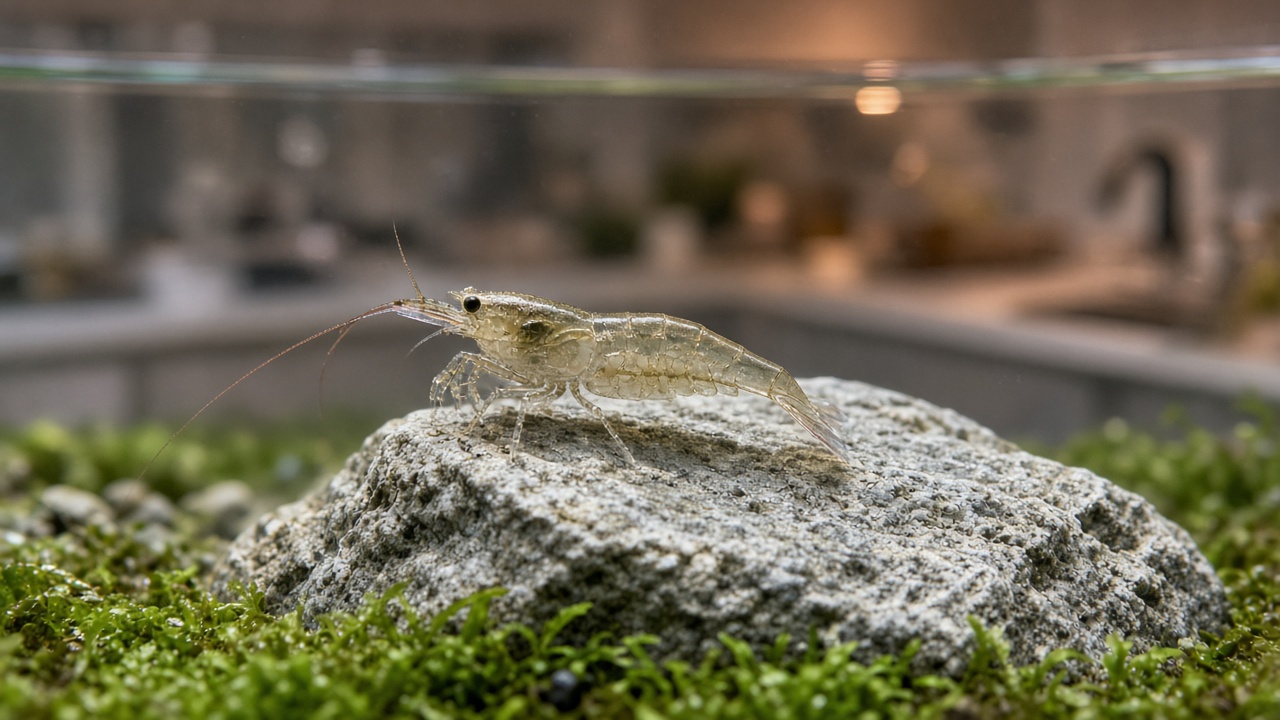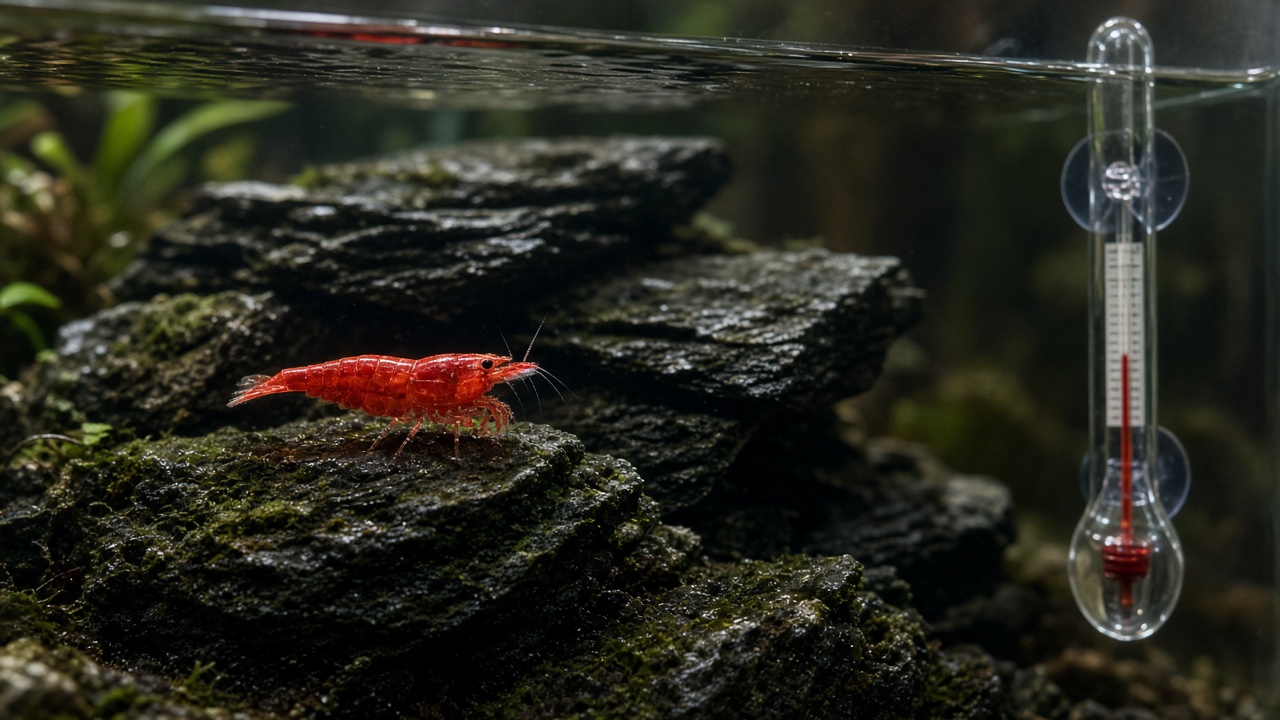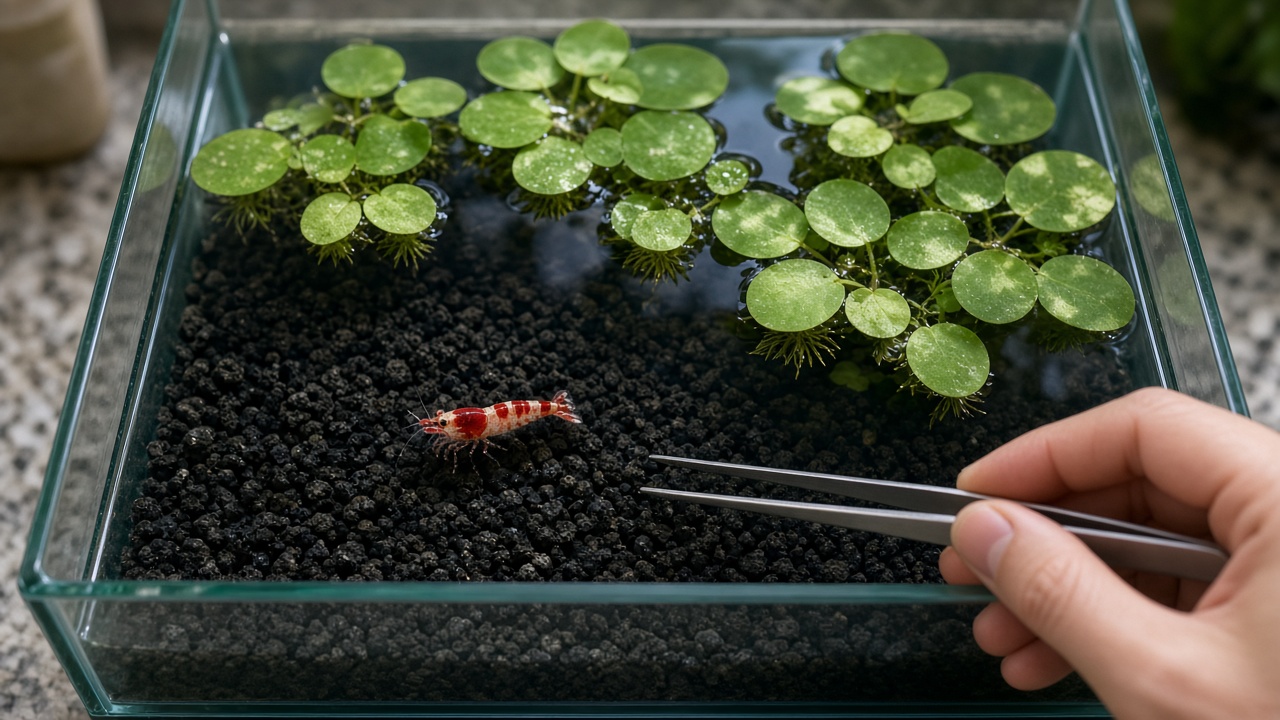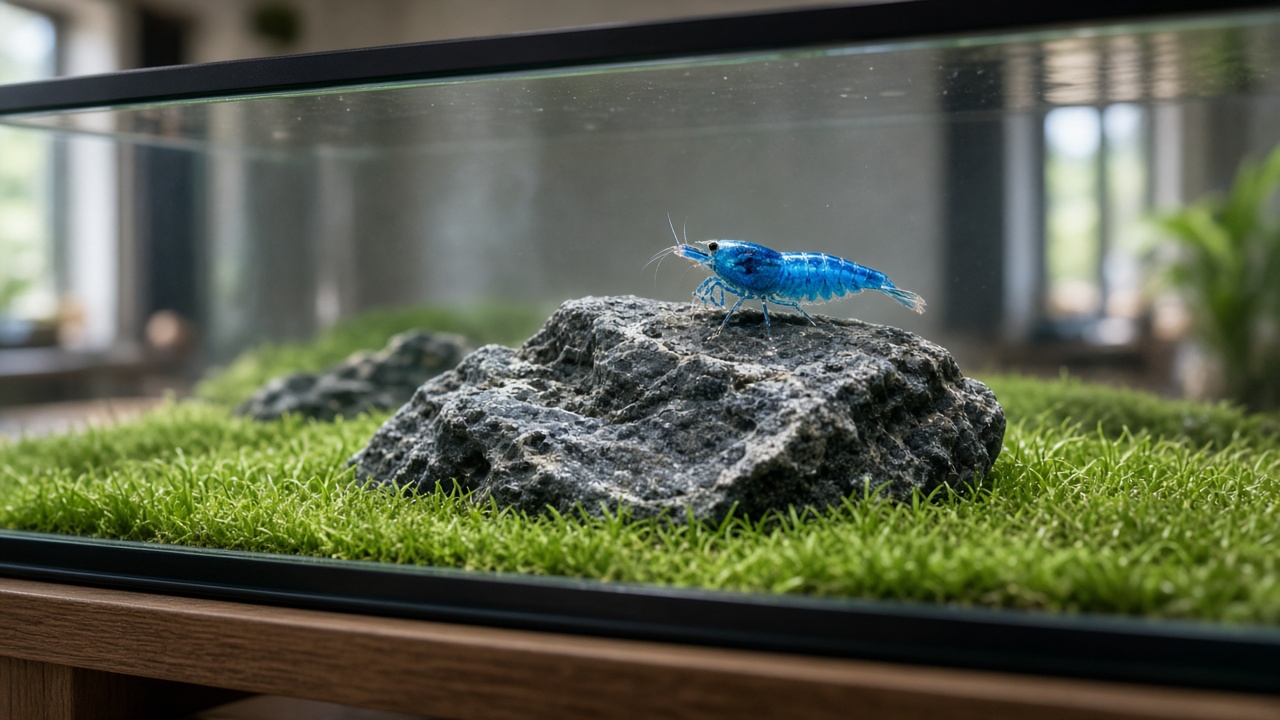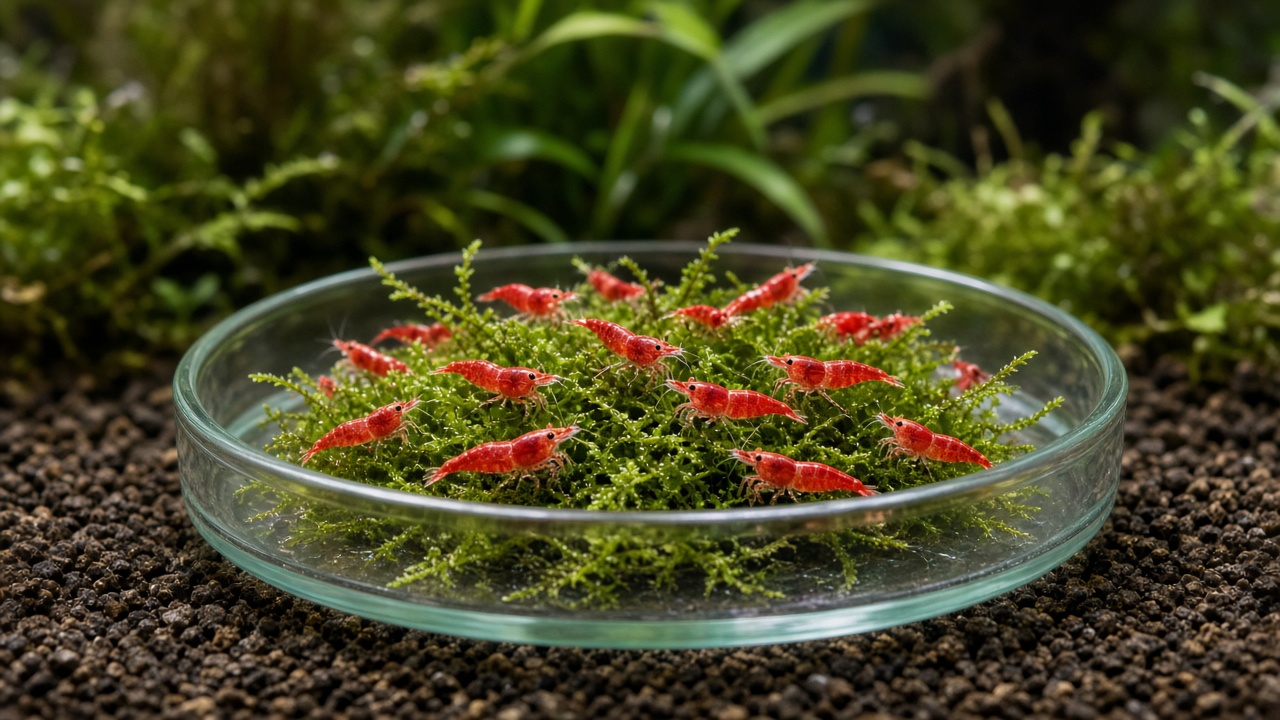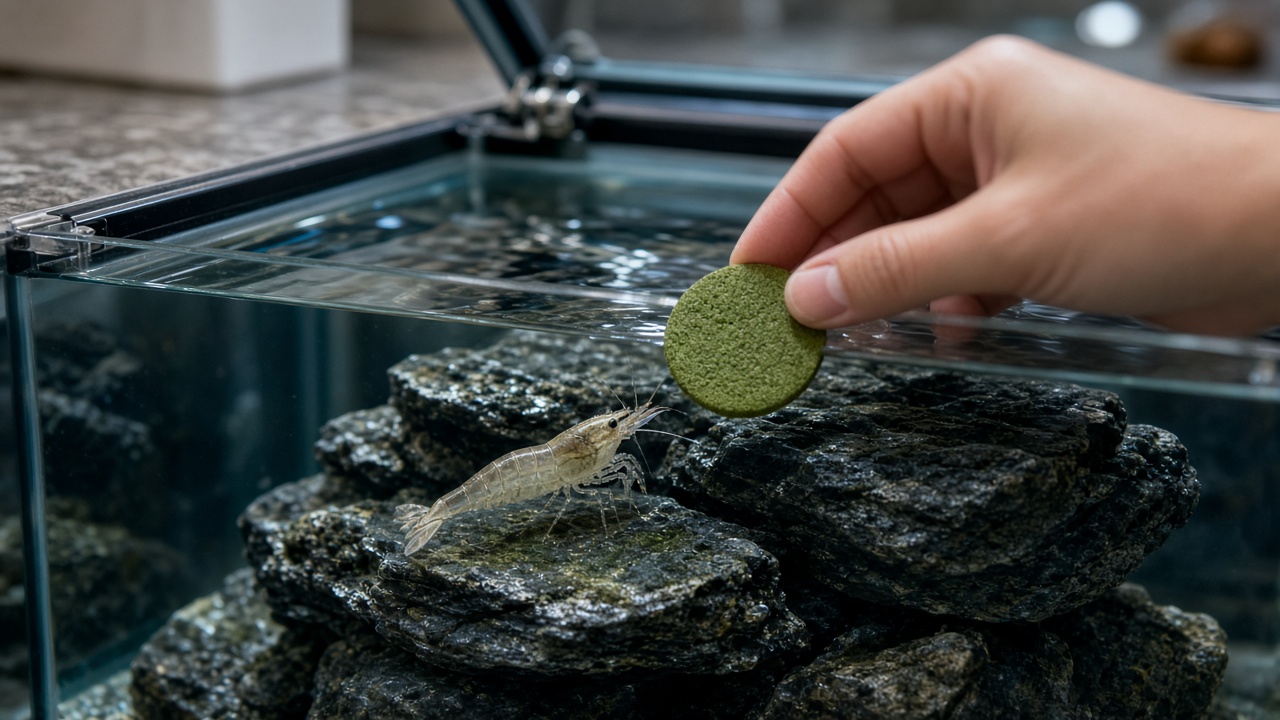
Quick answer: Keep Amano shrimp in a cycled, copper-free planted tank and feed algae plus a sinking shrimp diet. Do not expect a freshwater tank to raise the next generation. Treat them as a grazing crew, not a breeding colony.
Amano shrimp are Caridina multidentata, river grazers whose eggs measure 0.38–0.40 mm by 0.23–0.28 mm. This page is a home-tank care brief that compares published specs and does not include tank trials, a hatchery protocol, or sick-animal treatment.
What this page covers, and what it leaves out
The selection rule is simple: we cover freshwater home tanks that use Amano shrimp as algae grazers.
A product or setup enters this page only if the maker lists a shrimp use, or a named paper gives a species fact.
We left out four concrete scenes:
- Brackish larval rooms and salt-mix hatcheries
- Copper parasite baths for fish
- Wild collection and export advice
- Drug doses for sick shrimp
If your tank is a planted box with leftover algae, you are in scope. If you want a closed colony that makes juveniles, you are not.
What an Amano shrimp is
Amano shrimp are one valid freshwater species, not a color morph of cherry shrimp.
The 2006 paper in the Journal of Crustacean Biology by Cai, Ng, Shokita, and Satake treats Caridina multidentata as Stimpson’s 1860 name. That paper also treats Caridina japonica De Man, 1892 as the same species.
Their type specimen is an egg-carrying female with a 9.8 mm carapace length. Cai’s team collected it at Tenno-ura on Chichi-jima on 4 May 2000. The type they pick for C. japonica is a male with an 8.0 mm carapace length.
Carapace length is not total body length. Cai’s team measured from the post-orbital margin to the rear of the carapace.
Cai’s lots still show a wide adult range. One Haha-jima lot has males at 6.0–7.4 mm carapace length and 16 egg-carrying females at 7.5–9.1 mm.
Cai’s habitat line is short. Caridina multidentata lives in large rivers with big rocks on the substrate. That is why a planted tank with hard leaves and wood fits them better than bare glass.
Egg size is the breeding clue. Cai records 0.38–0.40 mm by 0.23–0.28 mm and contrasts that with Indonesian material near 1 mm. Small eggs point to a free-swimming larva, not a landlocked dwarf-shrimp brood.
Females can carry eggs in freshwater, and Cai’s type specimen was egg-carrying in a stream. A closed freshwater tank is still not a hatchery, and this page does not walk through larval salinity.
Algae eating, and the food that replaces it
Amano shrimp earn their keep as grazers, then they still need a sinking diet.
Cai’s river-and-rock habitat is the wild cue. In a tank they pick biofilm, soft green film, and leftover bits. They do not eat every algae type, and hard black beard tufts often stay.
A sparkling-clean tank starves a grazer, and that is the usual miss. Our research team compared two shrimp diets that makers still sell for this gap.
Hikari Sales USA’s page for Shrimp Cuisine lists a sinking daily pellet of about 1.2–1.4 mm. The listed pack is 0.35 oz (10 g), item 19404.
That same Hikari page lists these minimums and caps:
- Crude protein, 40.0% minimum
- Crude fat, 6.0% minimum
- Phosphorus, 1.0% minimum
- Copper, 29 mg/kg minimum
Hikari names seaweed, spirulina, and alfalfa as plant matter. The page says the diet supports ecdysis, which is the molt.
Fluval’s page for Bug Bites Shrimp Micro Granules lists a 1.05 oz / 30 g pack. Fluval says black soldier fly larvae are the first ingredient, up to 32%.
Fluval’s guaranteed analysis on that page lists:
- Crude protein, 32.0% minimum
- Crude fat, 12.0% minimum
- Calcium, 1.5% minimum
- Vitamin D3, 600 IU/kg minimum
Feed a pinch, then stop. Use this list:
- Offer a few pellets or granules after the lights have been on.
- Watch for a few minutes. Remove what sits.
- Skip a day if leftover film is still thick.
Do not treat the Hikari copper figure as a water dose. That number is dietary copper on a food label. Waterborne copper is a different risk.
Tank water, copper, and the box itself
Stable, copper-free water matters more than a rare shrimp gadget.
Build the box like any shrimp tank. Use the layout steps in our shrimp tank setup guide. Pick gentle flow from our nano aquarium filter for shrimp tanks page.
Condition new water before it hits the glass. Seachem’s page for Prime says to use 1 capful (5 mL) for each 200 L (50 US gallons) of new water. Each cap thread is about 1 mL.
Seachem also lists these Prime rules:
- A double dose is allowed for high chloramine.
- Up to 5 times the normal dose may be used to bind nitrite in an emergency.
- Use that 5× dose if ammonia or nitrite is above 2 ppm.
- Prime can be dosed every 24–48 hours.
- The bind lasts up to 48 hours.
Seachem says Prime removes chlorine and chloramine. It also binds ammonia, nitrite, and typical tap metals. It does not change pH.
Copper is the hard no. University of Florida IFAS page FA165 says most invertebrates will not survive a copper treatment.
IFAS tells keepers to move invertebrates out. Do not return them until free copper is 0.01 mg/L or less, and ideally zero. Therapeutic fish levels on that page are 0.15–0.20 mg/L, and 0.3 mg/L slows the bacteria that process ammonia and nitrite.
A fish hospital dose is not a shrimp-tank dose. Keep copper meds out of the display.
Test ammonia, nitrite, nitrate, and pH before you add shrimp. Wait for a zero ammonia and zero nitrite color.
For the floor, Fluval’s Stratum page lists 3–5 mm granules for the main Stratum line. Fluval says the grains come from the foothills of Mount Aso. The page lists item numbers 12693, 12694, and 12695.
Fluval says Stratum supports a neutral to slightly acidic pH. Use the 3–5 mm bed if you want rooted plants.
Rinse new hardscape and skip metal ornaments. Skip old tanks that held a copper bath unless you can show a near-zero copper read.
Gear our research team compared
We compared four in-scope products on listed attributes, not on rank or price.
A row is in this table only if the maker page states a shrimp use or a water-care dose we can quote.
| Product | Form | Listed size or dose | Crude protein (min.) | Maker-stated use |
|---|---|---|---|---|
| Hikari Shrimp Cuisine | Sinking pellet, 1.2–1.4 mm | 0.35 oz (10 g), item 19404 | 40.0% | Daily diet for freshwater ornamental shrimp |
| Fluval Bug Bites Shrimp Micro Granules | Micro granules | 1.05 oz / 30 g | 32.0% | Daily nutrition for freshwater shrimp |
| Seachem Prime | Liquid conditioner | 5 mL per 50 US gal (200 L) | — | Removes chlorine and chloramine; binds ammonia |
| Fluval Stratum | 3–5 mm granules | Items 12693, 12694, 12695 | — | Planted tanks and freshwater shrimp |
Hikari’s 40.0% protein minimum sits above Fluval’s 32.0% minimum, and Fluval lists more fat, at 12.0% against Hikari’s 6.0%. Those are label facts, not a taste test.
Prime is not food, and it is in the table because every water change needs a stated dose.
Tank mates that fit this rule
Tank mates stay in this article only if they leave the shrimp uneaten and the water copper-free. We do not publish a fish-by-fish scorecard.
Use this yes list:
- Peaceful small community fish that cannot swallow an adult Amano
- Other algae snails, if you want a second grazer
- Live plants with hard leaves the shrimp can pick
Use this no list:
- Cichlids, large gouramis, and other mouthy hunters
- Any tank still on a copper parasite course
- Crayfish and large predatory shrimp
- Fresh copper ornaments or untreated tap dumps
Amano shrimp are larger than cherry shrimp. Cai’s carapace lengths show why a small tetra is less of a threat to an adult than to a tiny dwarf shrimp. Juveniles you buy are still bite-size, so give them plants and rock gaps.
Do not mix them with a fish you plan to treat in place. IFAS is clear: invertebrates leave before copper goes in.
Amano shrimp will out-speed cherry shrimp at a food dish. Feed two spots so the larger shrimp do not take every pellet.
Lifespan, molts, and the year count we will not invent
Maker pages and Cai’s 2006 paper do not publish a home-tank year count, so this page does not invent one.
Shop blogs quote year counts, and those pages are not in our source list. We will not launder their number.
What we can track is molt health. Hikari’s Shrimp Cuisine page says the diet supports ecdysis. Fluval’s shrimp granules list 1.5% minimum calcium and 600 IU/kg minimum vitamin D3 for the shell.
A healthy molt looks like this:
- The shrimp hides, then leaves a clear shell on the wood or glass.
- It stays pale and still for a short time.
- It eats the shed or leaves it. Either is fine.
A bad molt looks like a stuck shell or a shrimp that never firms up. Sudden pH swings and metal spikes are the usual suspects, and IFAS notes that a pH drop can release bound copper from ornaments.
Seachem says Prime binds typical tap metals at the listed dose. It is not a copper-medication remover. If a tank had a 0.15–0.20 mg/L copper course, IFAS wants invertebrates out until the read is 0.01 mg/L or less.
Buy adults when you can. Cai’s egg-carrying females already sit at 7.5–9.1 mm carapace length in one Haha-jima lot. A larger body is harder for a small fish to eat, and it is not a promise of extra years.
FAQ
Do Amano shrimp breed in a normal freshwater tank?
Females can hold eggs in freshwater. Cai’s type specimen was egg-carrying in a stream. The eggs they measured are 0.38–0.40 mm by 0.23–0.28 mm, much smaller than the near-1 mm eggs they reject as a different group. A closed freshwater box is not a hatchery for those larvae.
How often should I feed if the glass still has algae?
Feed less than you think. Start with a few Hikari 1.2–1.4 mm pellets or a pinch of Fluval’s 30 g granules, then remove leftovers after a few minutes. Skip food on days when the film is still thick.
Is the copper in Hikari Shrimp Cuisine the same as a copper fish med?
No. Hikari’s page lists 29 mg/kg minimum copper inside the food, while IFAS FA165 is about copper dissolved in tank water at 0.15–0.20 mg/L for parasites. Dietary copper on a label is not a license to dose the water. Keep copper meds out of the shrimp tank.
What substrate should I use?
Fluval’s Stratum page lists 3–5 mm granules for the main line and names it for planted tanks and freshwater shrimp. Rinse gently, and do not stir the bed every week.
Can I keep Amano shrimp with cherry shrimp?
Yes, if you feed two spots so the larger Amano shrimp do not take every pellet. They are different genera, and Cai’s paper is about Caridina multidentata, not Neocaridina. Cherry shrimp will breed in the same freshwater box. Amano shrimp will not fill it with juveniles.
Why did my shrimp die after a water change?
The usual causes are chlorine, a metal spike, or a big parameter jump. Seachem’s Prime dose is 5 mL per 50 US gallons of new water. Match temperature and do not pour untreated tap. If the old tank ever had copper, IFAS wants a free-copper read at 0.01 mg/L or less before invertebrates go back.
Do I need a group, or will one shrimp work?
One adult will graze a small pane, and a group clears more film and looks less shy. This page does not set a shrimp-per-gallon number because none of our sources publish one. Stock for the algae load you actually have, then feed when that load drops.