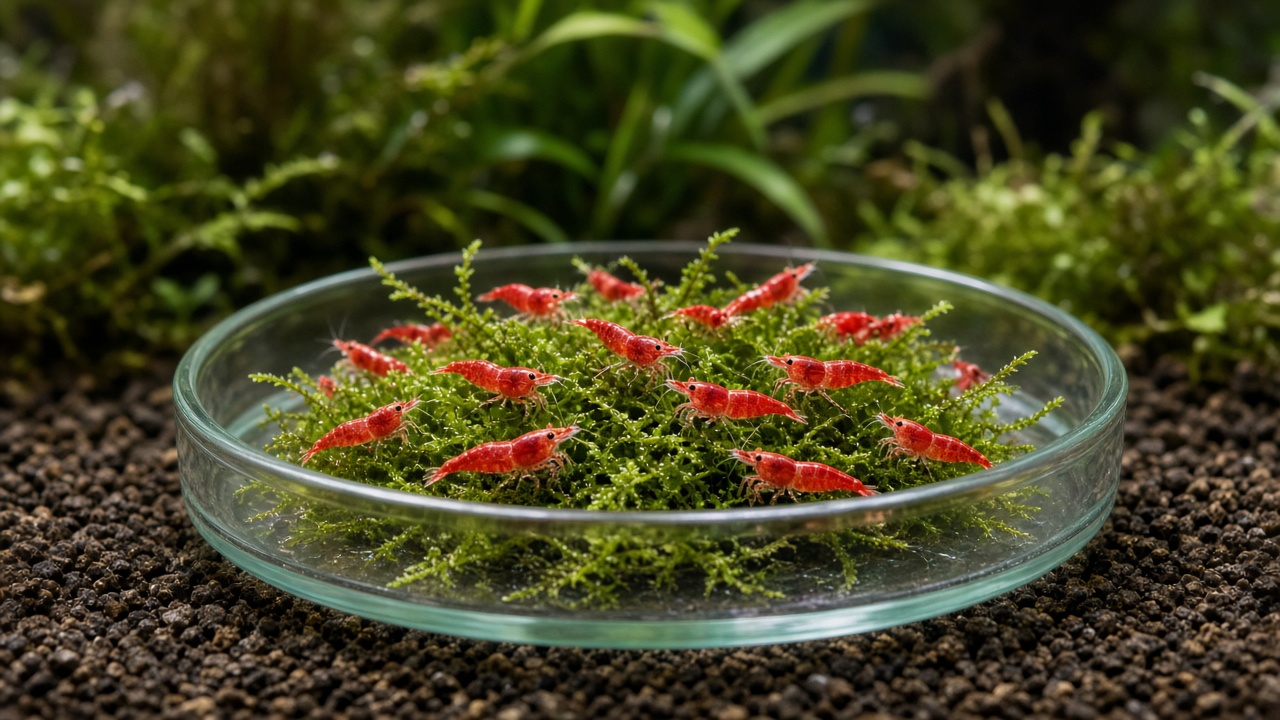
Quick answer: Keep cherry shrimp in a cycled, planted freshwater tank with stable minerals and a shrimp-safe filter. Feed a sinking shrimp diet and skip copper treatments. They breed on their own once water stays steady.
Cherry shrimp are Neocaridina davidi freshwater shrimp that reach 40 mm and hatch after 16 to 19 days. This page is a Waterpuppy research brief that compares published maker specs with the USGS species profile. We did not keep a colony for this draft, did not buy livestock, and did not open sealed product jars.
Selection rule: We cover only red-line Neocaridina davidi sold as cherry shrimp in freshwater planted tanks. We leave out Caridina crystal shrimp, marine shrimp, medications, and any price ranking.
Our research team also used a Four-Gate Colony Rule. A tank had to be cycled, mineral-stable, shrimp-safe on flow, and free of copper treatments. Anything that failed a gate stayed out.
Cherry shrimp are Neocaridina davidi, not a separate species
Cherry shrimp are one color line of a single freshwater species, not a unique genus.
The USGS species profile lists the scientific name as Neocaridina davidi (Bouvier, 1904). The same page lists older names, including Neocaridina heteropoda.
The USGS profile states that body size can reach 40 mm, citing Klotz and coauthors. Wild-type animals look transparent to greenish brown, and the red cherry look is a captive color morph.
The USGS page, revised in February 2026, lists a native range across parts of China, Vietnam, Taiwan, and Korea. That wide range helps explain ordinary tap-water tolerance.
Do not release extras outdoors. The USGS profile says aquarium release is the main path of introduction.
The same profile notes that a US Fish and Wildlife Service review in 2025 classed the species as high risk. Established populations have been on Oahu since the 1990s.
Water: test hardness, then add minerals only if the water is short
Stable minerals matter more than chasing a single perfect pH number.
The USGS profile calls cherry shrimp a habitat generalist and does not publish a hobby pH or GH target. This desk does not invent one.
We report maker doses you can check, then you test your own tap water.
API’s product page for the General and Carbonate Hardness Test Kit says hardness has two parts: general hardness (GH) and carbonate hardness (KH). The same page says low KH can allow rapid pH shifts.
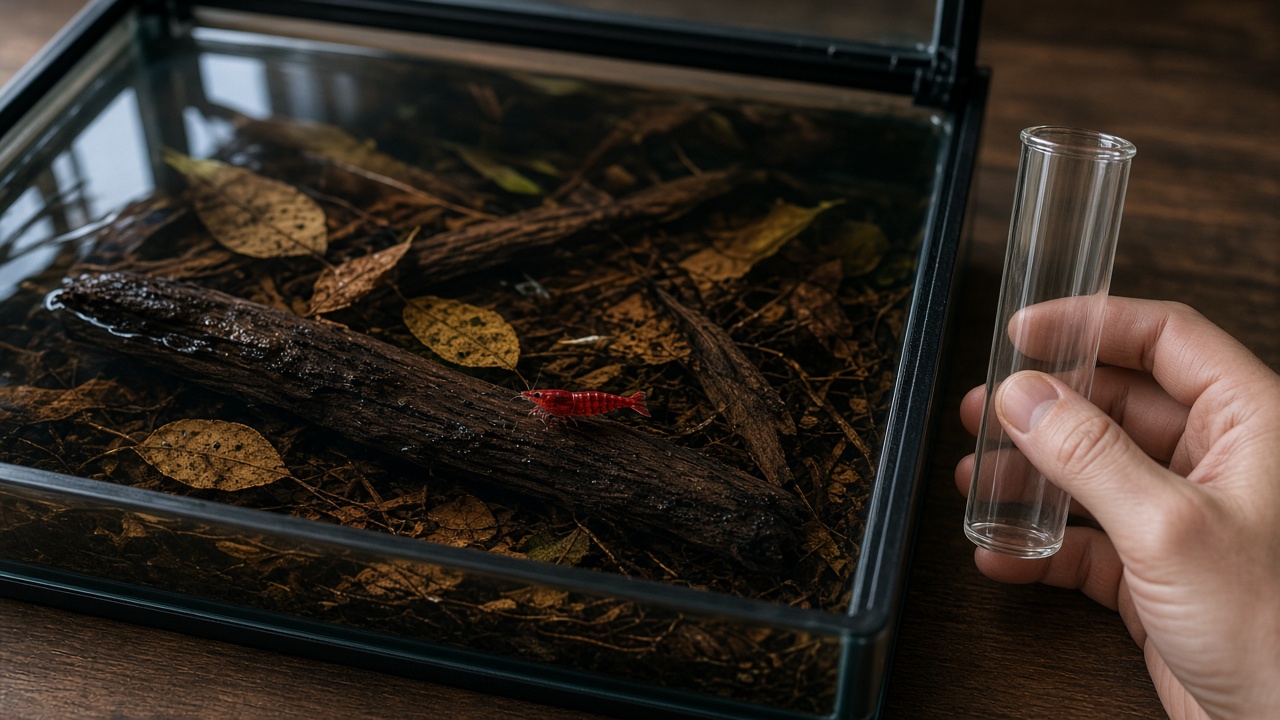
API’s page lists a KH bottle, a GH bottle, instructions, and two capped test tubes. The maker asks for weekly checks.
If tap water is already mineral-rich, do not stack extra GH powder. If you mix reverse-osmosis water, you need a mineral source, so test first and then dose.
Seachem’s Equilibrium page gives a clear dose. To raise GH by 1 meq/L (3 dH), add 16 g (1 tablespoon) for every 80 L (20 US gallons) of new water.
Mix that 16 g into 1 L (1 quart) of water first. Seachem says the tank may haze, then clear in 15 to 30 minutes.
The same page prints a planted-tank mineral guide of about 1–2 meq/L (3–6 dH). That is a maker plant range, not a USGS shrimp range.
Seachem’s guaranteed analysis per 1 g of Equilibrium lists these solids:
- Soluble potash (K2O): 23.0%
- Calcium (Ca): 8.06%
- Magnesium (Mg): 2.41%
Seachem lists bottle sizes of 300 g, 600 g, and 4 kg. Do not add Equilibrium when you only replace evaporated water. The maker says that dose is for RO or DI water.
Chlorine and chloramine still have to come out of tap water. Seachem’s Prime page says to use 1 capful (5 mL) for each 200 L (50 US gallons) of new water.
Prime’s page also states these emergency caps:
- A double dose is listed as safe for very high chloramine.
- If ammonia or nitrite is above 2 ppm, the maker allows up to 5 times the normal dose.
- If temperature is above 30 °C (86 °F) and chlorine is low, use a half dose.
- The binder is listed as holding those compounds for up to 48 hours.
Dose Prime on the new water volume during a change. Dose the full tank volume only if you add it straight to the aquarium.
A planted tank and a shrimp-safe filter matter more than gadgets
A mature, planted box with gentle flow is the real setup.
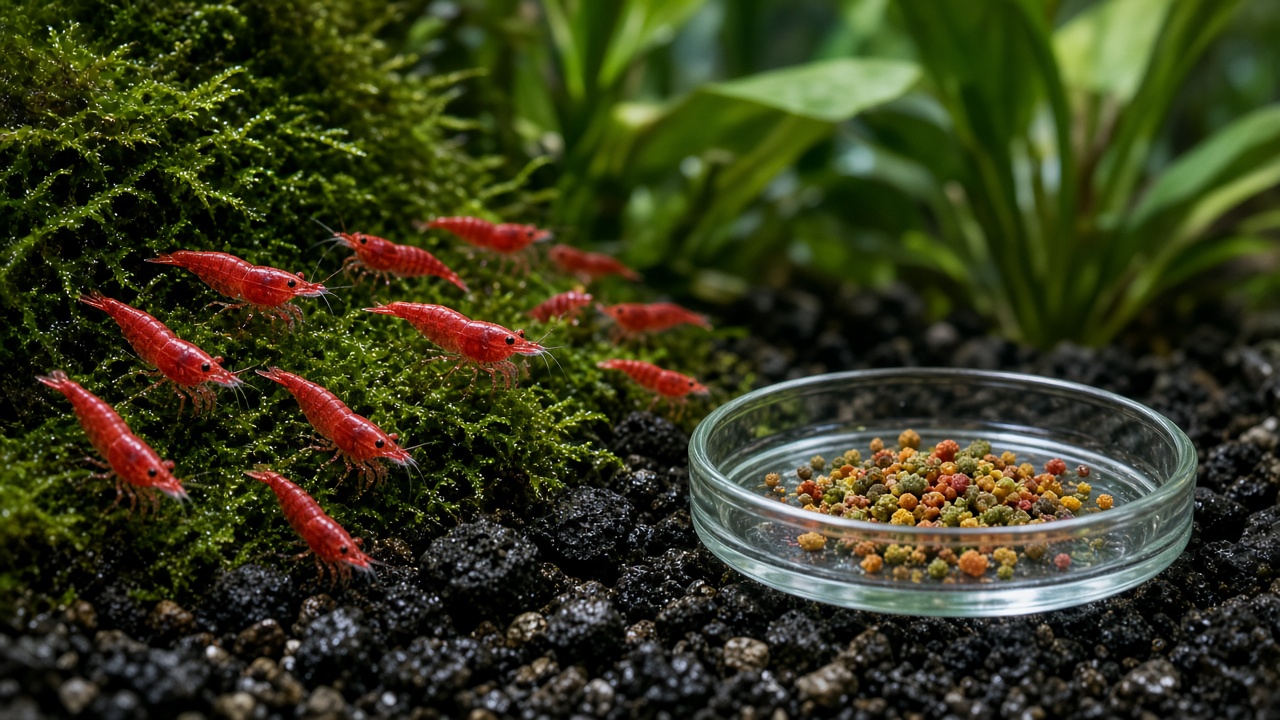
Cherry shrimp graze biofilm. The USGS profile calls the species an opportunistic omnivore that feeds on detritus, algae, and tiny animals.
Plants and leaf litter give that film a place to grow, and a bare tank does not. Start with a cycled tank, and do not add shrimp to cloudy new water.
Our shrimp tank setup guide walks through cycling, plants, and hardscape. This brief does not repeat that build list.
Filter choice is a safety issue because shrimp walk into intakes. Shrimplets are far smaller than the 40 mm adults listed by the USGS.
Use a sponge or a guarded intake. Our nano filter guide for shrimp tanks covers that intake problem.
Keep water changes small and matched. Large unmatched dumps swing GH and temperature, and molting shrimp take the hit.
Skip copper treatments and copper-heavy plant additives. Hikari’s Shrimp Cuisine page notes that the diet itself contains copper for blood function.
That is a food-level amount on a label. It is not a license for copper meds.
Feeding: match the label, then stop
Biofilm does most of the work. Prepared food only fills the gaps.
Hikari’s product page for Tropical Shrimp Cuisine names it a daily diet for Caridina and Neocaridina. The same page lists a 10 g (0.35 oz) pack with this guaranteed analysis:
- Crude protein: min. 35%
- Crude fat: min. 9.0%
- Crude fiber: max. 6.0%
- Moisture: max. 10%
- Ash: max. 14%
- Phosphorus: min. 0.8%
Hikari says to feed several times a day and give only what shrimp eat in a few minutes. Remove leftovers after that window.
Aquarium Co-Op’s product page for Xtreme Shrimpee Sinking Sticks lists another form with the same protein floor. That page says the jar holds 2.7 oz of 3 mm sinking sticks. The published analysis is:
- Crude protein: min. 35.0%
- Crude fat: min. 4.0%
- Crude fiber: max. 5.0%
- Moisture: max. 12.0%
- Phosphorus: min. 1.0%
- Ash: max. 12%
Our research team compared those two published labels, not open jars. Both foods list a 35% protein minimum, while Hikari lists more fat (9.0% versus 4.0%).
Xtreme lists a 2.7 oz jar and a 3 mm stick, and Hikari lists a 10 g disc pack. Pick one staple and do not stack both every day.
| Product | Maker page form | Protein min. | Fat min. | Phosphorus min. | Listed pack |
|---|---|---|---|---|---|
| Hikari Shrimp Cuisine | Sinking discs for Neocaridina | 35% | 9.0% | 0.8% | 10 g (0.35 oz) |
| Xtreme Shrimpee Sinking Sticks | Everyday 3 mm sticks | 35.0% | 4.0% | 1.0% | 2.7 oz |
| Seachem Equilibrium | GH mineral powder | Not a food | Not a food | None listed | 300 g, 600 g, 4 kg |
| Seachem Prime | Liquid conditioner | Not a food | Not a food | None listed | 50 mL to 4 L |
| API GH and KH Test Kit | Liquid GH and KH reagents | Not a food | Not a food | None listed | 2 bottles, 2 tubes |
Feed on a dish if you can, so leftovers are easy to see. Skip a food day each week if the tank is mature, because overfeeding raises waste faster than shrimp can eat.
Breeding happens without a special setup
Cherry shrimp breed in a stable tank. You do not need a separate breeding kit.
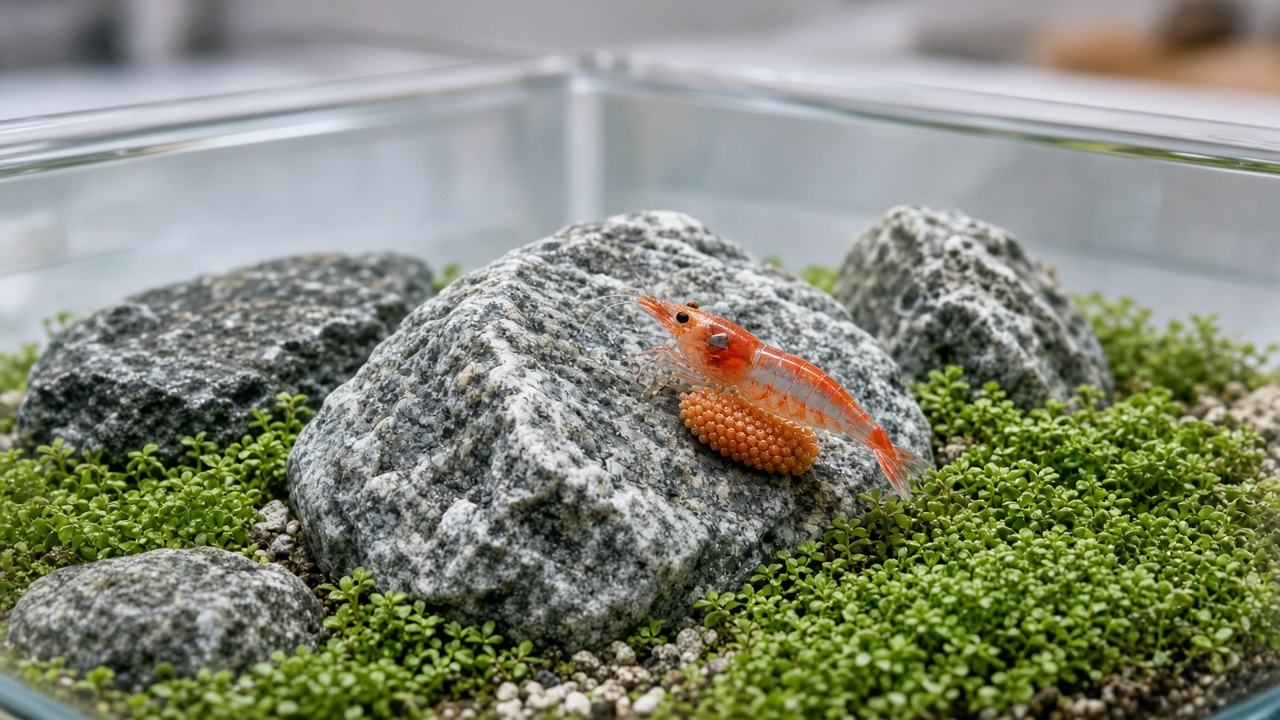
The USGS profile says cherry shrimp are highly fecund, with clutch size up to 60 eggs, citing Pantaleão and coauthors. We use that figure because that is the profile we read.
Females carry the eggs. The USGS page says Neocaridina species have no planktonic larval stage, so young hatch as tiny versions of the adults.
Incubation lasts 16 to 19 days, citing Mitsugi and Suen as listed on the USGS page. The same profile says animals become sexually mature at about 30 days.
A quiet colony can fill a tank fast. Shrimplets need moss and plants more than they need a special food.
Watch for dropped eggs after a hard water change. That is a stability problem, not a food problem, so match GH and temperature on the new water.
Do not mix red cherry lines with blue, yellow, or wild-type stock if you care about color. Mixed pairings produce mixed young, and that is a selection choice, not a health rule.
Tank mates: pick species that cannot eat a 40 mm shrimp
Our mate rule is size and hunting style, not a community-fish slogan.
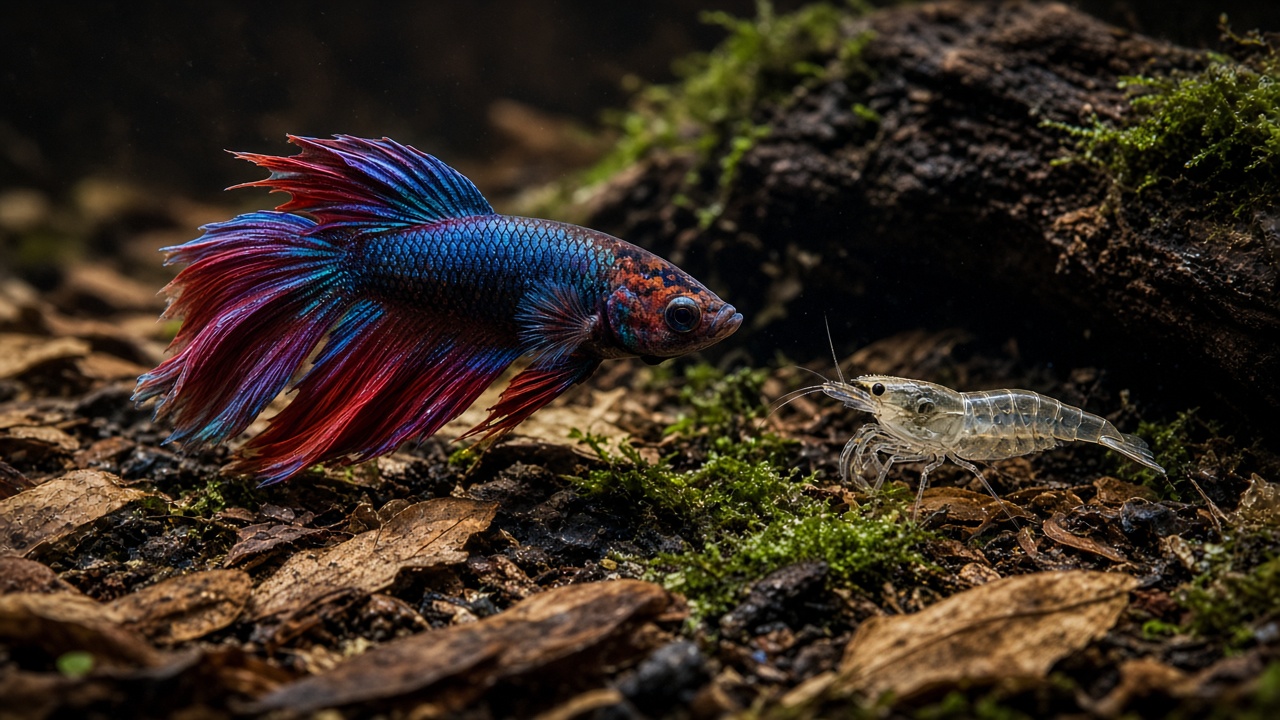
The USGS profile lists adults at up to 40 mm. Any fish that routinely eats prey that size is out, and so are fish that hunt tiny crustaceans all day.
We did not watch mixed display tanks for this brief, so we do not publish a safe-fish list. Other cherry shrimp of the same color line fit the rule.
Small snails that leave shrimplets alone also fit. Large crayfish and most cichlids do not.
If you already keep fish, add shrimp only after the tank is planted. Expect losses of babies.
Never add shrimp to a tank that just had copper-based treatment.
Grading is a seller label, not a scientific rank
Grading tells you how solid the red looks. It is not a USGS trait.
Sellers often use letters such as SSS, SS, S, and A. Those labels are trade shorthand, not a government grade, and our research team did not score live animals.
Use this home rule if you want a deeper red line:
- Keep only the most even, opaque red adults as breeders.
- Move pale or striped young to a separate tank.
- Do not mix other color morphs into the red tank.
- Add new stock from one source at a time so you can see what they throw.
High grades do not need different water. They need the same Four-Gate Colony Rule, and color still varies with diet, age, and background.
Hikari’s page mentions astaxanthin as a color pigment in Shrimp Cuisine. That is a label claim, not a grade certificate.
Pale young still graze algae. They should not stay in a red breeding box.
FAQ
How big do cherry shrimp get?
The USGS species profile lists body size up to 40 mm. Females often look thicker when they carry eggs. Size alone does not tell you the seller grade.
How many eggs does a female carry?
The USGS profile cites a clutch size of up to 60 eggs. Not every female hits that number, and stress or poor minerals can cut clutch size. Dropped eggs after a big water change are common when GH swings.
How long until eggs hatch?
The USGS page lists 16 to 19 days of incubation for Neocaridina. Young hatch as miniature adults and do not need saltwater or a larval tank. Cover the filter intake so they are not sucked in.
What water test should I buy first?
Start with GH and KH. API’s General and Carbonate Hardness Test Kit page lists a GH bottle, a KH bottle, and two tubes, and the maker asks for weekly tests. An ammonia kit matters if the tank is new.
How do I add minerals to reverse-osmosis water?
Seachem’s Equilibrium page says 16 g per 20 US gallons raises GH by 3 dH. Mix the powder in 1 quart of water first, then test GH after the haze clears. Do not dose it into top-off water that only replaces evaporation.
Can cherry shrimp live with fish?
Only if the fish cannot eat a 40 mm adult or hunt shrimplets. This desk did not run mixed-tank watches, so we will not publish a safe-fish chart. A species-only planted tank is the lower-risk path.
Why did my shrimp die after a water change?
The usual cause is a sudden GH or temperature swing, not hunger. Match the new water to the tank and use Seachem Prime at 5 mL per 50 gallons on the new water. Then retest GH with the API kit before you add a large volume.