Quick answer: Keep red rili shrimp in a cycled planted freshwater tank with locked hardness. Feed a shrimp-labeled sinking diet. Skip turtles, crabs, and fish that hunt fry.
Red rili shrimp are a freshwater Neocaridina davidi color form that breed in planted tanks.
This page is a care brief from published maker specs, and we did not keep a rili colony, mix color lines, or watch a hatch.
Our research team compared six maker pages. Hikari Sales USA’s Shrimp Cuisine page lists 40.0% minimum crude protein for a daily Neocaridina diet.
What this page covers, and what it leaves out
We only write red rili as a Neocaridina color form in a locked freshwater planted tank.
That selection rule is the filter for this page. A product stays only if its maker page lists a number we can quote.
We keep this path:
- Freshwater Neocaridina davidi sold as red rili
- Water mixed and tested before shrimp go in
- Sinking foods whose maker page names shrimp or crustaceans
- Tank mates that do not eat fry
We leave these out:
- Bee shrimp, Sulawesi shrimp, and other Caridina lines
- Color-mix colonies you want to stay rili
- Fish-only wafers that name catfish, not shrimp
- Turtle tanks, crab tanks, and hunting fish
- Any dose a maker page does not print
The shrimp tank setup page is the lock-first order, and this page is the rili care that follows that lock.
What a red rili shrimp is
A red rili shrimp is a cherry-shrimp color pattern, not a second species.
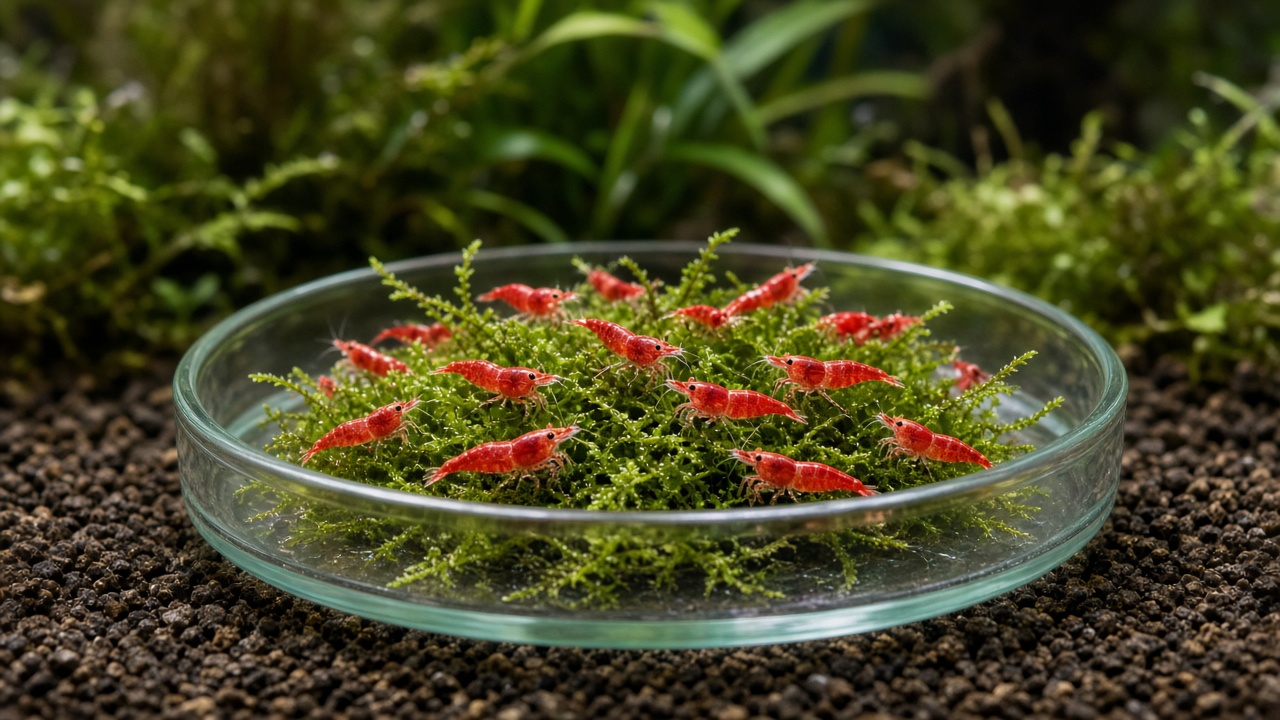
The body is clear through the middle, and the head and tail stay red. That gap is how shops tell rili from solid cherry stock.
It is still Neocaridina davidi, and it still lives in freshwater and molts a shell. It is not a marine shrimp or a crab.
Hikari Sales USA’s Shrimp Cuisine page names Caridina and Neocaridina as the animals that diet is for.
Do not buy a rili if you want a guaranteed solid-red line, because the clear band is the point of the form.
Water: condition first, then minerals
Treat new tap water, then add minerals only after you have a GH reading.
Seachem’s Prime page is the conditioner sheet we used, and Seachem’s Equilibrium page is the GH sheet we used.
Prime’s printed dose is easy to overshoot in a small shrimp tank:
- 1 capful (5 mL) per 200 L (50 US gallons) of new water
- Each cap thread is about 1 mL
- A double dose is listed for high chloramine
- Up to 5 times the normal dose if ammonia or nitrite is above 2 ppm
- A half dose if temperature is above 30 °C (86 °F) and chlorine or ammonia is low
- The bind lasts up to 48 hours, and a repeat dose may run every 24 to 48 hours
A 5 mL cap into a 10 gallon change is a large overdose, so use the 1 mL cap-thread step.
Equilibrium’s page is for planted tanks on RO or other mineral-poor water. The printed raise is:
- 16 g (1 tablespoon) per 80 L (20 US gallons)
- That dose raises GH by 1 meq/L (3 dH)
- Mix that 16 g into about 1 L (1 quart) of water first
- The haze should clear in 15 to 30 minutes
- Do not use it when you only replace evaporated water
- For tap water, measure GH first, then add only what you need
Seachem’s plant guide on that page is about 1 to 2 meq/L (3 to 6 dH). The same sheet says KH should also sit near 1 to 2 meq/L (3 to 6 dKH).
Per 1 g, Seachem’s Equilibrium page lists:
- 23.0% soluble potash (K2O)
- 8.06% calcium
- 2.41% magnesium
- 0.11% iron
- 0.06% manganese
- 19.5% elemental potassium (195,000 ppm)
If you still need the lock-first order, use the shrimp tank setup page. Do not add shrimp while ammonia or nitrite is still moving.
Tank, plants, and substrate
A rili tank is a planted freshwater box with a cover, gentle flow, and a soil choice you can measure.
Fluval India’s page for Plant and Shrimp Stratum is the soil sheet we compared. The maker says it supports a neutral to slightly acidic pH, and that newborns can hide in it until they come out.
The same Fluval page prints a depth and a bag map:
- Recommended depth: 1.18 to 1.57 in (3 to 4 cm)
- Bag size on that page: 8 kg / 17.6 lb
- 45 cm (17.72 in) tank: one 2 kg bag, or one 4 kg bag
- 60 cm (23.62 in) tank: one 8 kg bag
- 90 cm (35.43 in) tank: one 8 kg bag plus one 4 kg bag
That depth will change KH, so test KH the day you add it, the next day, and at one week.
Skip these in a rili tank:
- Copper treatments the label does not clear for invertebrates
- Bare suction that can pull fry
- Open rims, because shrimp climb
- Plant soil added before the water lock holds
Moss, floaters, and plants tied to wood give grazing film, but they do not replace a cycled filter.
A turtle tank setup is a different job that needs swim volume, a dry dock, and UVB.
Daily food, compared by the label
This page compares shrimp-labeled diets by the numbers on their maker pages.
Hikari Sales USA’s Shrimp Cuisine page lists a 0.35 oz (10 g) pack and a 1.2 to 1.4 mm sinking pellet. Fluval’s Bug Bites Shrimp Micro Granules page lists a 1.05 oz (30 g) pack. New Life Spectrum’s Invertebrate Crustacean page lists a 60 g jar of 0.5 to 0.7 mm pellets.
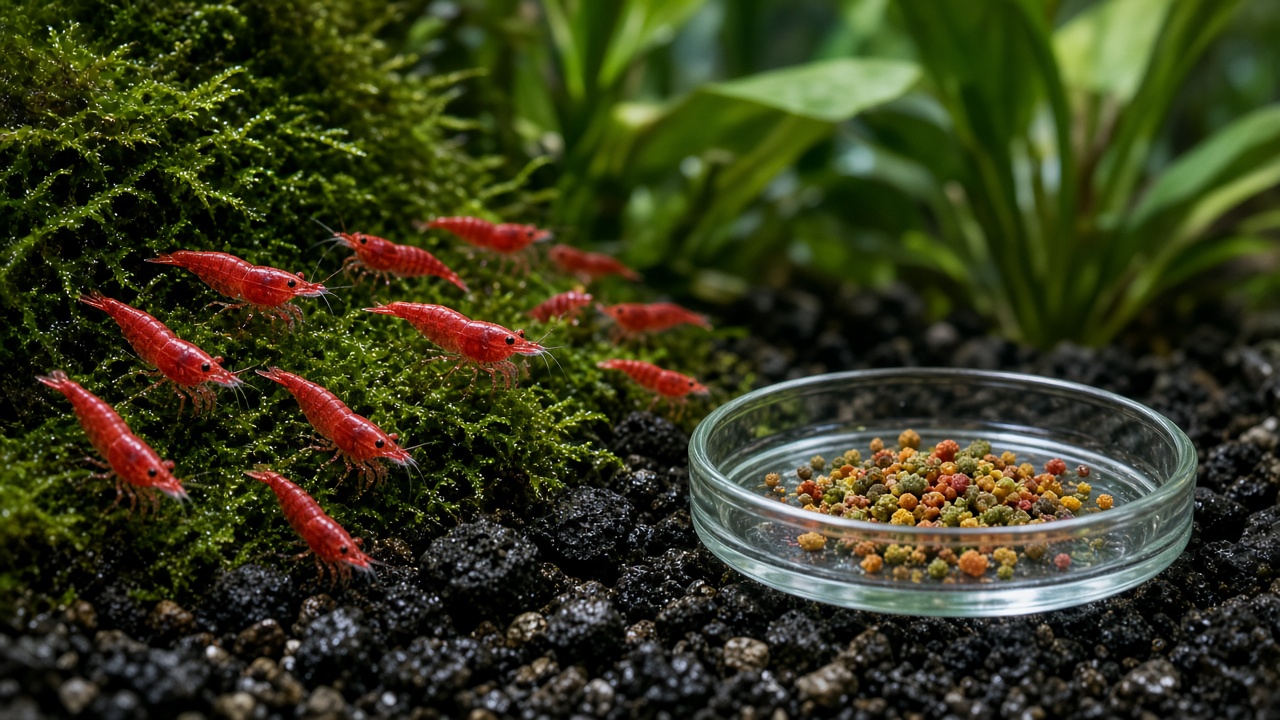
Hikari’s feeding line is “multiple times daily,” and only what shrimp eat in a few minutes. Remove leftovers after that window.
Our research team lined up the three food labels. Listed minimum crude protein runs from Fluval’s 32.0% to Hikari’s 40.0%, an 8.0-point spread on the printed guarantees.
| Product | Role on the maker page | Pack or form | Key published number | Second published number |
|---|---|---|---|---|
| Hikari Shrimp Cuisine | Daily diet for Caridina and Neocaridina | 0.35 oz (10 g), 1.2–1.4 mm sinking pellet | 40.0% min crude protein | 29 mg/kg min copper |
| Fluval Bug Bites Shrimp Micro Granules | Daily diet for freshwater shrimp | 1.05 oz (30 g) micro granules | 32.0% min crude protein | 1.5% min calcium |
| New Life Spectrum Invertebrate Crustacean | Calcium-fortified crustacean diet | 60 g jar, 0.5–0.7 mm sinking pellet | 36% min crude protein | 10,000 IU/kg min vitamin A |
| Fluval Plant and Shrimp Stratum | Planted shrimp substrate | 17.6 lb (8 kg) bag | 1.18–1.57 in (3–4 cm) depth | One 8 kg bag for a 60 cm tank |
| Seachem Prime | Fresh and saltwater conditioner | 5 mL capful | 5 mL per 50 US gallons | Bind up to 48 hours |
| Seachem Equilibrium | GH mineral for planted RO or soft water | 16 g tablespoon | 16 g per 20 US gallons raises 3 dH | 8.06% calcium |
Pick one shrimp-labeled daily food and stay with it, and do not stack three diets in one feeding.
Hikari’s page names a “safe form of copper” at that 29 mg/kg line. That is a food mineral, not a tank treatment.
Tank mates that do not hunt them
A rili colony stays a shrimp tank, and predators do not get a pass because they look small.
Keep these out:
- Turtles, which hunt in the water column
- Red claw crabs, which are brackish and territorial
- Large cichlids, shrimp-hunting loaches, and goldfish
- Any fish you have watched eat a shrimp
A turtle tank setup is built for a swimmer with a dry dock, and that animal will eat invertebrates. Do not use this page to stock a slider tank.
Red claw crab care is a brackish paludarium brief. Those crabs need salt and land, so they are not a freshwater rili tank mate.
Safe company, if you add any, is other Neocaridina you accept will mix. Snails that do not eat eggs can stay, and fish are optional.
If you want the red-and-clear pattern to hold, keep the tank rili-only. A cherry, yellow, or blue Neocaridina mate will blur the line in one generation.
Breeding and keeping the rili pattern
Red rili shrimp breed in a locked planted tank if you do not mix color lines.
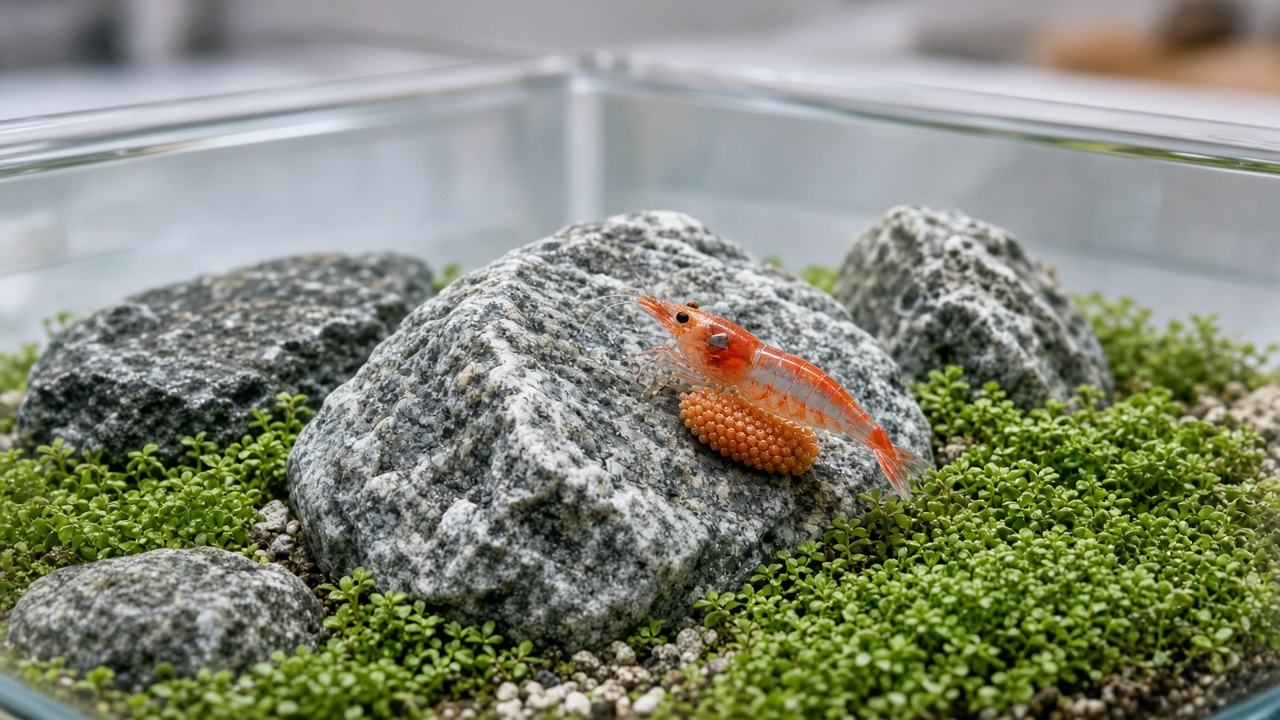
Females carry eggs under the tail until the young drop. We did not count clutches, and no maker page on our list prints an egg number.
What the pages do print is fry cover. Fluval India’s Stratum page says the soil gives newborns a refuge from predators until they emerge.
Use that as a cover rule, not a soil demand:
- Keep moss and leaf litter if you skip soil
- Keep fish out if you want the drop to survive
- Feed a sinking shrimp diet so adults do not strip the film
- Do not siphon the bed hard after a drop
If a female is berried, leave the water plan alone, because a big parameter swing during a hatch is how you lose the drop.
The clear mid-body can fade if you mix forms, and that is a genetics choice, not a water fault. If the pattern matters, start with one line and do not add a second color.
Seachem’s Equilibrium page says the 16 g dose is for new water, not top-offs, so keep that rule during breeding.
FAQ
Are red rili shrimp a separate species from cherry shrimp?
No, they are a Neocaridina davidi color form with a clear mid-body. Hikari Sales USA’s Shrimp Cuisine page groups Caridina and Neocaridina as the shrimp that diet is for. It does not split rili into a second species.
What water should I use for red rili shrimp?
Use conditioned freshwater, then set GH from a reading. Seachem’s Prime page sets 5 mL per 50 US gallons of new water, and 1 mL per cap thread for small fills.
Seachem’s Equilibrium page raises GH by 3 dH with 16 g per 20 US gallons, and its plant guide is 3 to 6 dH. Follow the shrimp tank setup lock before you add shrimp.
How often do I feed them?
Hikari’s Shrimp Cuisine page says to feed multiple times daily, only what they eat in a few minutes. Remove leftovers after that window. Fluval’s Bug Bites page and New Life Spectrum’s page are daily-diet labels, not a second feeding clock.
Can I keep red rili shrimp with a turtle or a red claw crab?
No, a turtle tank is a hunter tank with a dry dock and UVB. A red claw crab needs brackish water and land. Use the turtle tank setup page or the red claw crab care page instead.
Do I need Fluval Stratum to keep or breed them?
No, soil is optional. Fluval India’s Plant and Shrimp Stratum page lists a 3 to 4 cm depth and an 8 kg bag for a 60 cm tank. It also says the soil supports a slightly acidic pH and hides newborns, so test KH after you add it.
Will babies stay red rili if I add other cherry shrimp?
No, other Neocaridina color forms will mix the line. Keep a rili-only group if the clear mid-body is the look you want. Fluval’s Stratum page can hide fry from fish, but it cannot stop a mixed mating.
Why did shrimp die after I added new water?
The usual fault is a raw tap fill or a hard GH jump. Seachem’s Prime page says to treat new water, and the bind lasts up to 48 hours. Seachem’s Equilibrium page says to mix 16 g into about 1 L first, and not to dose evaporated top-offs.