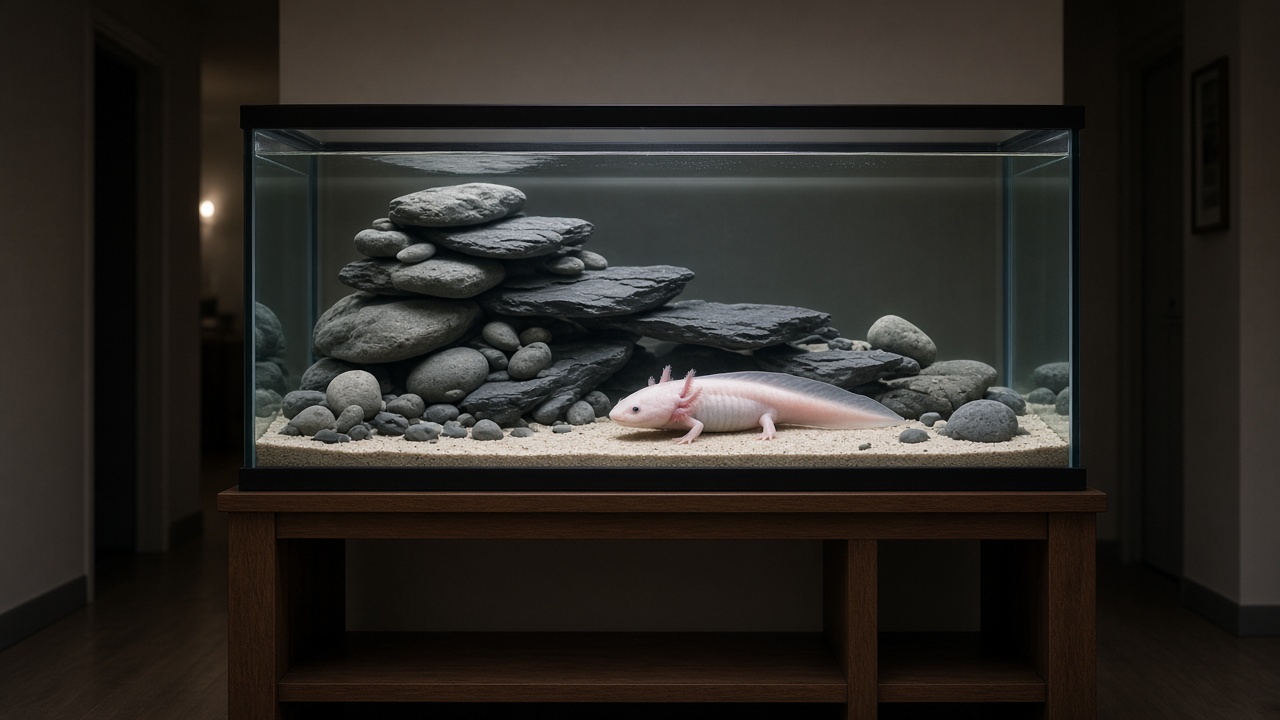
Quick answer: No. Do not pick up an axolotl to hold it. Move it only in water, and only when a tank job requires a move.
No. You should not hold an axolotl; keep the animal fully in water.
This page is a research brief that compares two published husbandry sheets and four current maker pages.
Our research team compared published specs and did not invent a “safe hold time.” This site’s guides may contain affiliate links.
What this page covers, and the selection rule
This article covers only wet moves and tools that leave the animal in the tank.
We used one rule for every scenario and product named here. If a task or tool lifts the body into air, it stayed out.
- In: water changes, tap-water treatment, water tests, and a wet move when a tank must be emptied.
- Out: play holds, photo lifts, kids’ “petting,” dry nets, heaters, gravel, and gloves sold as handling gear.
A cycled, cool display tank rarely needs a move at all. Build that box first with our axolotl tank setup guide for volume, sand, and flow.
Caudata Culture lists Ambystoma mexicanum as Critically Endangered in the IUCN Red Book, and that same entry lists CITES Appendix II.
Why a hand-hold is the wrong default
Published sheets treat water, not hands, as the place an axolotl lives.
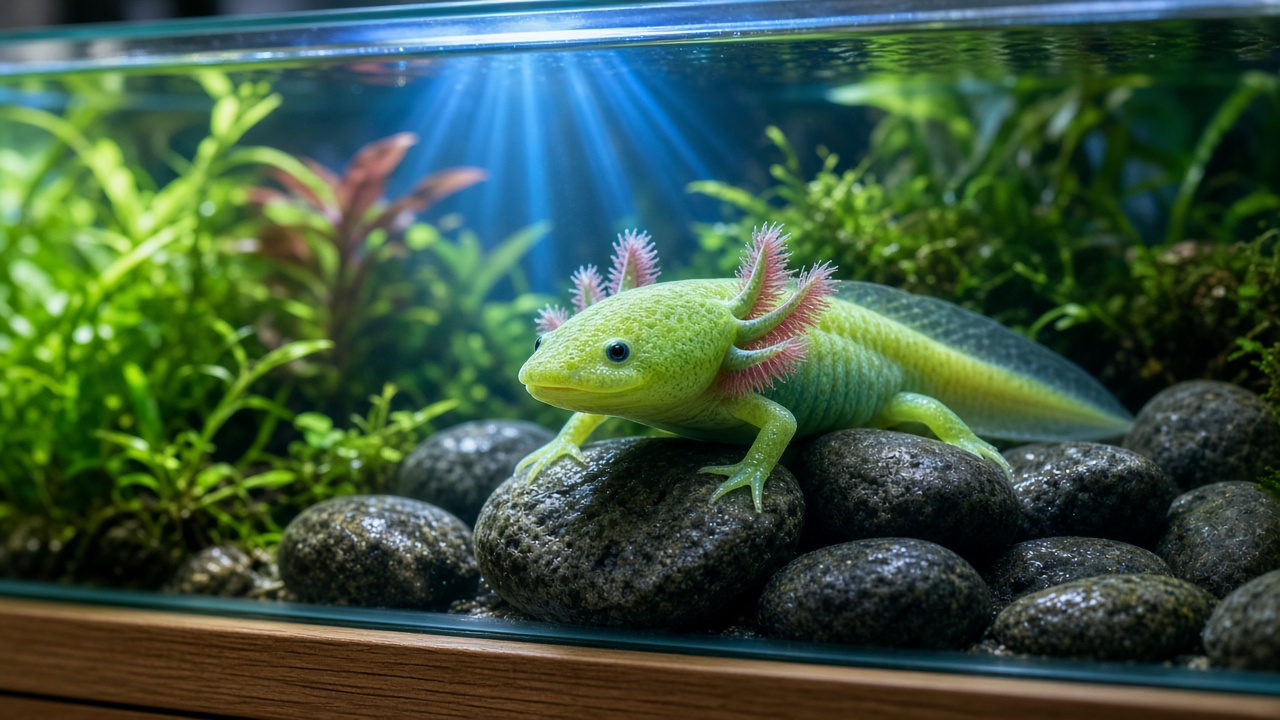
Caudata Culture describes a fully aquatic salamander. Typical adults are 20 to 28 cm (8 to 11 inches), and specimens over 43 cm (17 inches) are known.
The University of Kentucky Ambystoma Genetic Stock Center makes the skin point in plain words. Hard water helps them keep “the integrity of their skin, their most important defense against infection.”
A dry, warm hand wipes and heats that surface. The Kentucky guide is a research colony sheet, not a living-room pet manual.
Staff pour bowl animals into a plastic colander, clean the bowl, then return the animal. That is a wet, short move, not a hold for fun.
The same guide says axolotls “tolerate short periods of time out of the water very well,” then sets a hard stop. Never leave them out long enough for the skin to dry or become “tacky.”
Caudata Culture does not publish a play-handling method. Its housing section is water, sand or a bare floor, and a quiet tank.
Heat from a hand versus published water bands
A human hand is warmer than every published comfort band we compared.
We left the two sheets as a range.
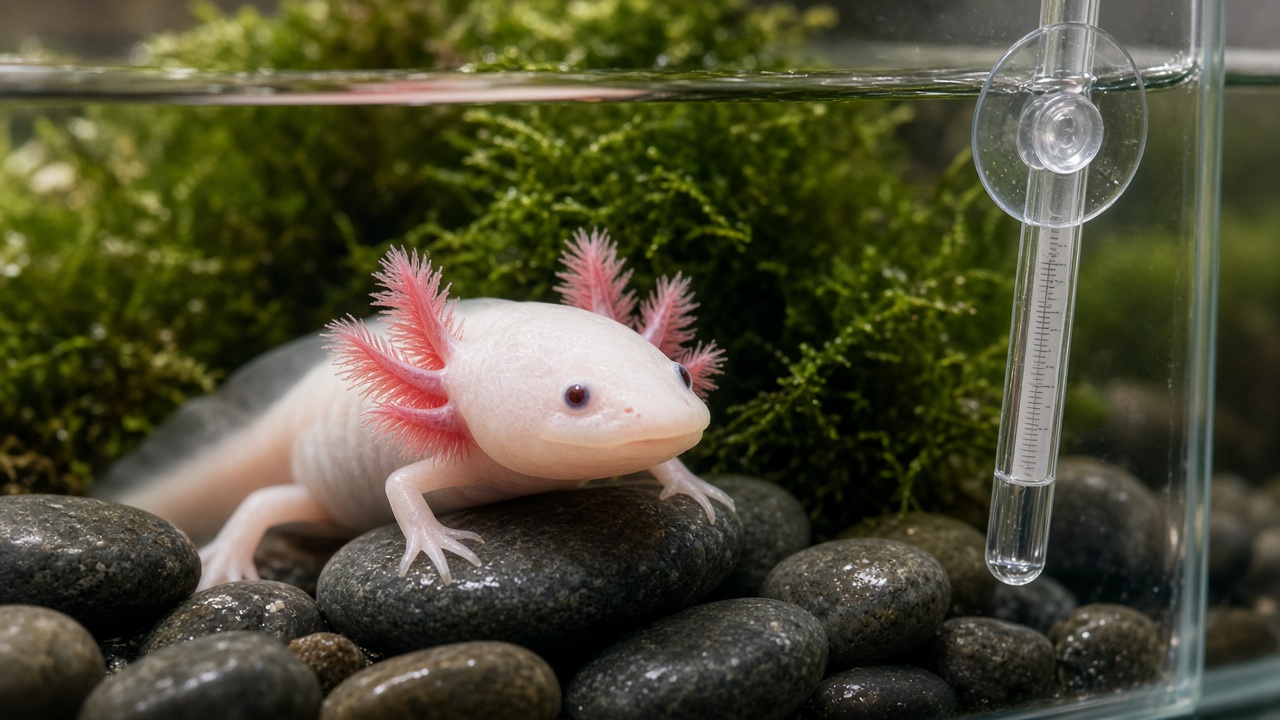
- Caudata Culture: 14 to 22°C (57 to 72°F) is reasonable for adults.
- Caudata Culture: over 25°C (77°F) is unsuitable for more than a few days.
- Caudata Culture: wild Xochimilco water rarely rises above 20°C (68°F). Winter water may fall to 6 or 7°C (43°F).
- University of Kentucky: the colony is kept at 15 to 18°C (60 to 65°F).
- University of Kentucky: they should never be kept above about 22°C (72°F).
Those bands sit far below human skin. A lift into air also ends the water bath that keeps gill filaments wet.
High heat is not a small stress. Caudata Culture ties high temperature to anorexia and to fungal or bacterial infection.
The Kentucky guide calls too-warm water dangerous and flags direct sun. A hand-hold adds a hot, dry surface on top of that risk.
If the tank runs hot, fix the room or the cooling plan. See the tank setup page for cool-water housing, and do not use a hold as a “check.”
The Stay-Wet Transfer Rule
When a move is required, keep the whole body in water, or keep the skin wet for only a short pour.
We named this the Stay-Wet Transfer Rule. It is our reading of the Kentucky skin line plus the Caudata housing line, not a brand claim.
Use it only when the tank must be emptied or the animal must change boxes.
- Skip the move if a siphon can do the job around the animal.
- If you must lift, fill a smooth container with tank water first.
- Guide the animal in, then lift the container, not the body.
- Keep the head and gills under water for the whole carry.
- Set the container in the new water and let the animal walk out.
That water-to-water carry is a move, not a hold.
The Kentucky colony pour is the other published path. Staff pour the animal and water into a colander, then return it to a clean bowl.
They say gas exchange continues if the skin stays moist, and they say never let the skin go tacky.
A home display tank is larger than a one-gallon bowl. The Kentucky guide houses some adults in one-gallon bowls. It also uses a tub about 10 by 18 by 6 inches (25 by 46 by 15 cm) for three to four animals.
A half gallon (2 liters) per animal is called adequate there only with frequent changes. That is a lab protocol, not a reason to keep a pet in a bowl.
Copy the wet-move idea, and do not copy the bowl.
Caudata Culture calls a 60 by 30 by 37 cm (24 by 12 by 15 inch) box adequate for two adults. Water depth of 15 cm (6 inches) or more is recommended.
You can change 20% of that water every two weeks without lifting anyone. Do not grab a tail, a gill, or a limb.
Hands-off tools our research team compared
The useful gear treats water or pulls waste, so the animal can stay on the floor.
The table is an attribute list from maker pages. It is not a ranked “top” list, and there is no price column.
| Product | Maker-listed size or dose | Job without a hand-lift | What the maker page states |
|---|---|---|---|
| Seachem Prime | 1 capful (5 mL) per 200 L (50 US gal) | Treats tap water before it goes in | Removes chlorine and chloramine; detoxifies ammonia, nitrite, and nitrate |
| Aqueon Siphon Vacuum Gravel Cleaner | 6 ft hose; sizes from Mini 5 in to Large 16 in | Pulls waste and water while the animal stays put | Five sizes; Mini listed for 1 to 5 gal; 90-day warranty on that spec block |
| Fluval GravelVAC Multi-Substrate Cleaner (S/M) | Up to 20 in / 50.8 cm; 8 in extension tube | Same water-change job in a deeper box | Freshwater and saltwater; sand, gravel, or rock |
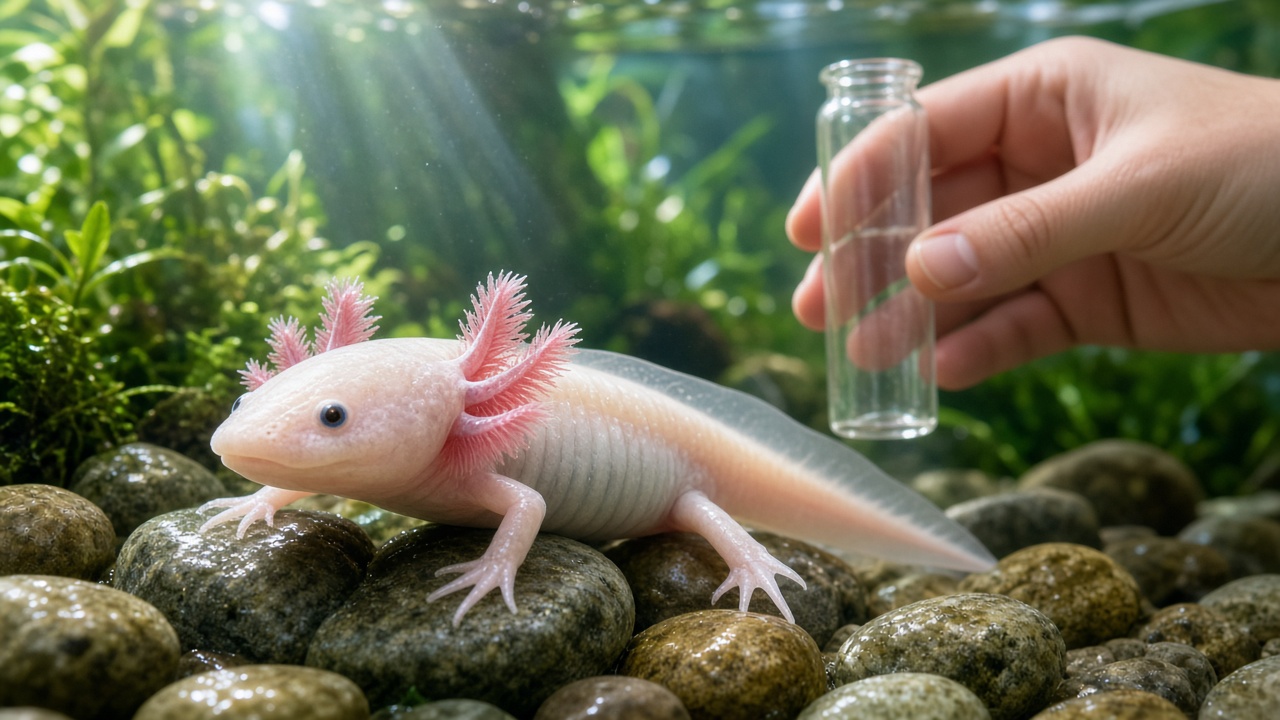
| API Freshwater Master Test Kit | Four test tubes; test weekly | Shows if water, not a pickup, is the problem | Lists ammonia, pH, high-range pH, nitrite, and nitrate |
Seachem’s page for Prime states a 5 mL capful treats 200 L (50 US gallons) of new water. Each cap thread is about 1 mL. For a 20% change, you dose the new water, not the whole box.
Seachem also states these dose rules:
- A double dose is safe for high chloramine.
- Dose every 24 to 48 hours.
- Use up to five times the normal dose to bind nitrite in an emergency.
- Use that five-times line if ammonia or nitrite is above 2 ppm.
- Bind time on that page is up to 48 hours.
Prime bottle sizes on the same page run from 50 mL to 4 L. Caudata Culture already says to treat tap water for chlorine, chloramine, and metals.
Aqueon’s siphon page lists five sizes, including Mini 5 inches, Medium 9 inches, and Large 16 inches. The spec block we read is 5.5 by 1.5 by 13.7 inches, with a 6-foot hose and a 90-day warranty.
That Mini row is listed as ideal for 1 to 5 gallon tanks. Caudata Culture’s two-adult box is 24 inches long, so pick the Large 16-inch tube for a deeper home tank.
Fluval’s page for the GravelVAC Multi-Substrate Cleaner (S/M) lists a reach up to 20 inches (50.8 cm). An 8 inch (20 cm) extension tube is included.
The page says it works on sand, gravel, or rock, in fresh or salt water. Caudata Culture already rejects small gravel, so use the siphon on sand or a bare floor.
API Fishcare’s page for the Freshwater Master Test Kit lists ammonia, pH, high-range pH, nitrite, and nitrate. The kit ships with four test tubes, a holding tray, and a laminated color card.
The page says to test weekly, and that weekly test decides the water change, not a hand-lift.
If a product’s job is to grip skin, it failed our rule.
We left out fine shrimp nets. A net smaller than a 20 to 28 cm adult still folds gills against mesh.
We left out heaters, because both sheets want cool water. We left out gravel, because Caudata Culture shows swallowed gravel in the gut and calls it unsuitable.
We left out reptile gloves and “handling” tongs. No maker page we compared lists those as axolotl care.
We left out feeder-fish advice as a handling workaround. The Kentucky guide warns against bait-shop minnows because of parasites, and Caudata Culture also flags feeder fish and tadpoles.
The Kentucky sheet uses 1/8 inch (3 mm) soft-moist salmon pellets, then 3/16 inch (5 mm) pellets as animals grow. Adults about one year old are fed three or four times per week, and no more than five pellets at a time. Drop the food instead of placing it by hand.
After a required move
The follow-up is water quality and a quiet tank, not another pickup.
Watch from outside the glass.
- Are the gills fanned or clamped?
- Is the animal eating at the next normal feeding?
- Are the toes and tail intact?
- Is the water still inside the published temperature bands?
The Kentucky guide lists loss of appetite and gill decline as early illness signs. Those signs need a clinician who treats amphibians. This desk does not diagnose.
Do a water test with the API kit if the tank looks off. Dose Seachem Prime only as that maker page states.
Caudata Culture’s usual home change is about 20% every two weeks, unless the tank is crowded or overfed.
If two adults start nipping, split them. The Kentucky guide says mixed sizes lead to missing toes, and Caudata Culture notes cannibalism in many bloodlines.
The Kentucky guide also keeps pH between about 6.5 and 8. Test that range in the water, not by grabbing the animal.
FAQ
Can you hold an axolotl at all?
No, not as a petting animal. The two sheets we compared keep the species in water. The Kentucky guide allows only a short, wet pour and forbids dry, tacky skin.
Can I touch my axolotl with wet hands?
Wet hands are still warmer than 14 to 22°C water, and they still rub mucus. Use a water-filled container if a move is required. Leave the animal in the tank for ordinary care.
How long can an axolotl stay out of water?
The Kentucky guide does not print a second count. It says short periods are tolerated if the skin stays moist, and it says never let the skin dry or turn tacky.
Do I need to net my axolotl for a water change?
Usually no. Caudata Culture’s 20% change every two weeks is done in place. Use an Aqueon or Fluval siphon around the animal, and net only if the tank must be emptied.
Can children hold an axolotl?
No. A child hold is still a dry, warm lift, and it also raises a drop risk for a 20 to 28 cm body. Let kids watch through glass.
Will one pickup kill my axolotl?
The sheets do not say one short wet pour is a death sentence. The Kentucky staff pour bowl animals into a colander as routine care. Repeated dry holds, high heat, and tacky skin are the harms those pages describe.
Is a ten-gallon tank a reason to handle them more?
No. The Kentucky guide offers “two adults in a ten-gallon aquarium” as a lab rule of thumb with heavy water changes. Caudata Culture’s home box for two adults is 60 by 30 by 37 cm.