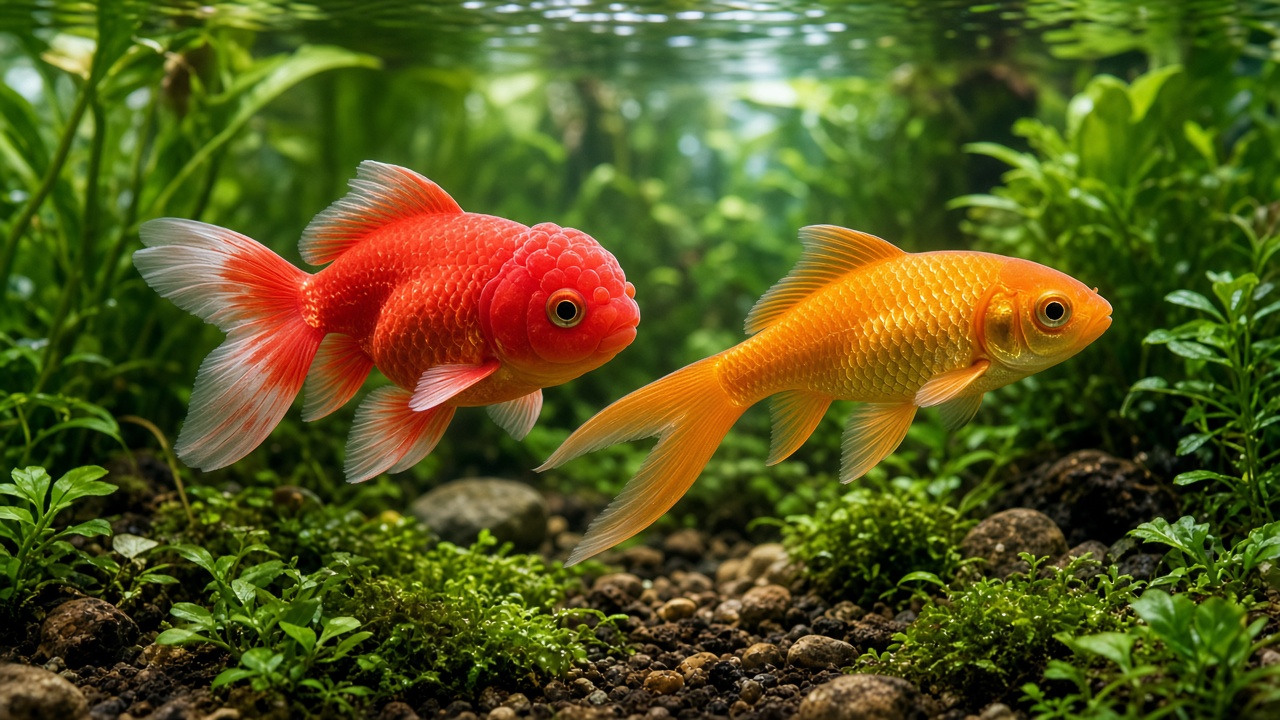
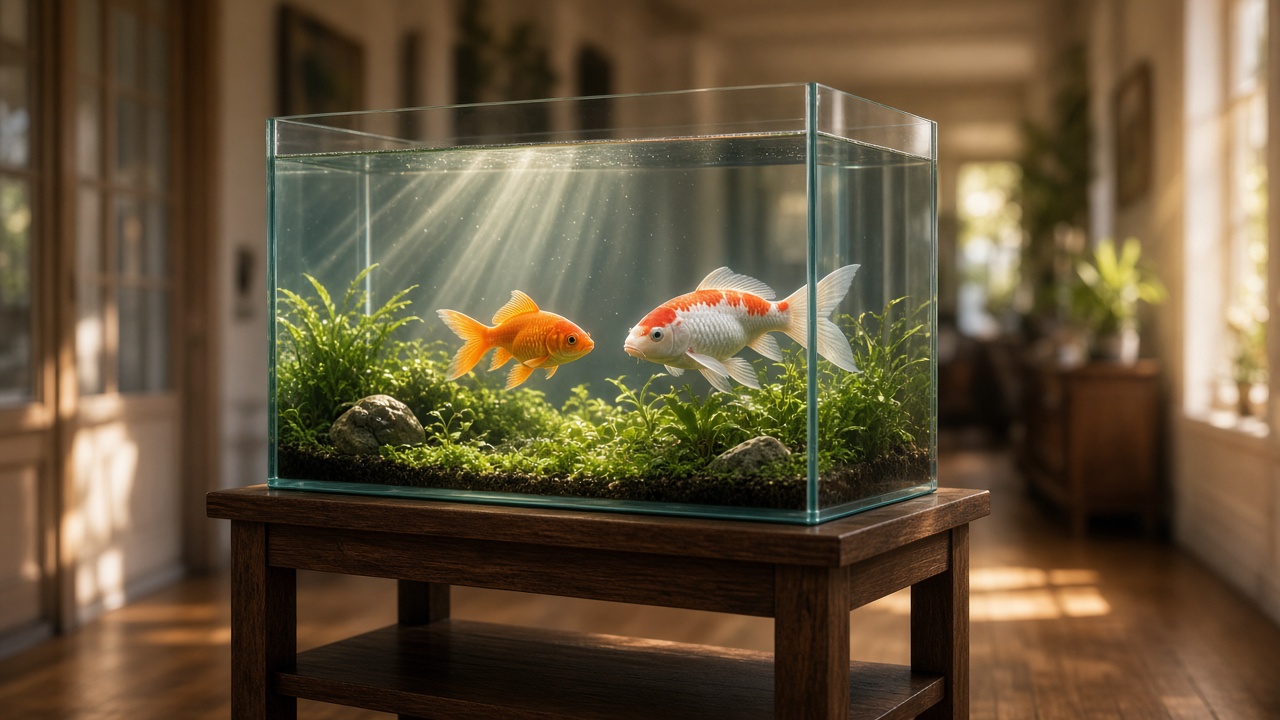
Quick answer: Keep one adult comet in a filtered tank of 20 gallons or more. An outdoor pond works if it stays safe through winter. Skip bowls.
Adult comet goldfish need at least 20 gallons of filtered water each.
This page is a research-desk brief on pond versus tank homes, adult size, and lifespan.
Takeaway: one rule decided what belongs on this page.
Our research team analyzed maker pages and the US Geological Survey (USGS) goldfish profile. We kept a product only if it is sold now and the maker lists a number.
The 20-Gallon Comet Rule:
- Housing advice had to name comets, or give a gallon, degree, or percent figure.
- Foods and filters had to show a published size, protein, flow, or watt number.
- Fancy-only gear, bowls, and items with no maker number stayed out.
We also left out ranked lists and price tiers, so the table compares attributes rather than a finish order.
Pond or tank: pick the home first
Takeaway: a pond fits a comet that can live outdoors through winter, and a tank fits a comet you can give 20 gallons each.
Aqueon’s goldfish care guide says common goldfish, comets, and shubunkins make excellent outdoor pond fish. The same page says those fish are known to survive relatively cold winters.
A tank is the better indoor choice when you can meet that 20-gallon-per-adult mark. Aqueon’s guide also says goldfish should never be kept in bowls, small aquariums, or any unfiltered container.
Use this split when you choose a home:
- Choose a pond if the fish can stay outside in winter and you can keep predators out.
- Choose a tank if you can give each adult comet at least 20 gallons and an oversized filter.
- Do not choose a bowl, because Aqueon’s guide rules bowls out in plain words.
Aqueon’s guide notes that fancy goldfish can live in ponds too. It also says fancies are more vulnerable to predators and must come inside in harsh winters.
Comets lack that winter-indoor warning, so keepers use ponds for them more often than for orandas.
The US Geological Survey goldfish profile says aquarium releases are one way this species enters US waters. Do not dump a comet into a creek, lake, or storm drain.
The same profile says the species is established or reported in all states except Alaska. Keep pond fish on your property with a liner and an overflow plan.
How large a comet goldfish gets
Takeaway: plan for a long, single-tail fish that commonly reaches 15 to 20 cm.
Aqueon’s care guide groups comets with common goldfish and shubunkins. It says those fish grow quite large and make a lot of waste.
The USGS goldfish profile gives the hard size numbers. It says goldfish generally reach only 15–20 cm in total length and weigh 100–300 g.
The same profile says goldfish may reach 59 cm in total length and up to 3.0 kg. It also lists a typical standard length of 120 to 220 mm, with a maximum of 410 mm.
In household units that is about 6 to 8 inches, and about 23 inches or 6.6 pounds at the top end.
A pet-store comet is often only a few inches long and is not done growing. The USGS profile says the long dorsal fin has 15 to 21 rays and the lateral line has 25–31 scales.
Aqueon’s guide says all goldfish varieties are the same species. USGS uses the name Carassius auratus. A comet is the single-tail, fast-swimming form, not a short-body fancy.
How long a comet goldfish lives
Takeaway: captivity can outlast the typical wild span if water and space stay stable.
Aqueon’s goldfish care guide says that, when properly cared for, goldfish can live over 20 years in captivity. That is the number we use for planning a home.
The USGS profile gives a different typical span. It says the usual life span is 6 to 7 years, with a maximum of 30 years recorded.
Those two figures can both be true because USGS covers wild reports and Aqueon covers kept fish.
See how long goldfish live for age notes across types.
A short life is often a water problem, not a “small fish” trait. Aqueon’s guide ties harm to waste that builds in small, unfiltered water.
If you want a comet for a child’s first tank, plan past the school year.
Water, filters, and a simple weekly routine
Takeaway: keep comet water cool, slightly alkaline, and on a small, steady change schedule.
Aqueon’s care guide sets comet and shubunkin water at 60° to 70°F. It sets fancy goldfish at 68° to 74°F. Do not mix those ranges if you also keep orandas.
The same page says pH is not critical, but ideally should be between 7.0 and 8.4. It warns that rapid changes in temperature or chemistry can be fatal.
USGS lists a much wider lab tolerance, from pH 4.5–10.5, with a preference of 5.5–7.0. That wild-fish range is not a tank target, so a home comet should stay in Aqueon’s 7.0 to 8.4 band.
Aqueon’s guide also publishes this salt dose: one tablespoon of aquarium or sea salt per 5 gallons. Use that only as the maker wrote it.
Water-change amounts from the same Aqueon page:
- Change 10% of the water weekly, or
- Change 25% every 2 weeks.
- Treat tap water with a conditioner before you refill.
Aqueon says the filter should be slightly over-sized because goldfish waste is high. Extra aeration is recommended when goldfish are kept at warmer temperatures.
Our research team compared two current Fluval canister models on Fluval’s 407 page, which also lists the 307.
| Product | Role | Maker-listed capacity | Maker-listed flow or power | Maker-listed size |
|---|---|---|---|---|
| Fluval 307 Canister Filter | External filter | 40–70 US gal | 303 US GPH pump; 206 US GPH circulation; 16W | 9.5 in × 7 in × 16.5 in; 7.3 L canister |
| Fluval 407 Canister Filter | External filter | 50–100 US gal | 383 US GPH pump; 245 US GPH circulation; 23W | 9.5 in × 7 in × 19.3 in; 9.2 L canister |
| Aqueon Goldfish Flakes | Daily flake food | Lists comets as a target fish | Floating flake; sizes include 1.02 oz to 5 lb | Package 2.95 × 2.95 × 6.13 in |
| Tetra Select Goldfish Flakes | Daily flake food | 42.0% min crude protein | 11.0% min crude fat; 300 mg/kg vitamin C | 1 oz, 2.2 oz, and 7.06 oz packs |
| Hikari Goldfish Gold | Daily pellet food | 32.0% min crude protein | 4.0% min crude fat; 440 mg/kg ascorbic acid | Baby pellets 3.5 oz (100 g) and 10.5 oz (300 g) |
Match the filter to Aqueon’s 20-gallon-per-adult rule:
- One adult comet: 20 gallons of water, and a filter rated above that volume.
- Two adult comets: 40 gallons, which sits at the bottom of the Fluval 307 range.
- Three adult comets: 60 gallons, still inside the Fluval 307 range.
- Four adult comets: 80 gallons, which fits the Fluval 407 range.
Fluval’s page lists pump output and a lower circulation rate. Use the circulation number to judge tank turnover.
What to feed a comet goldfish
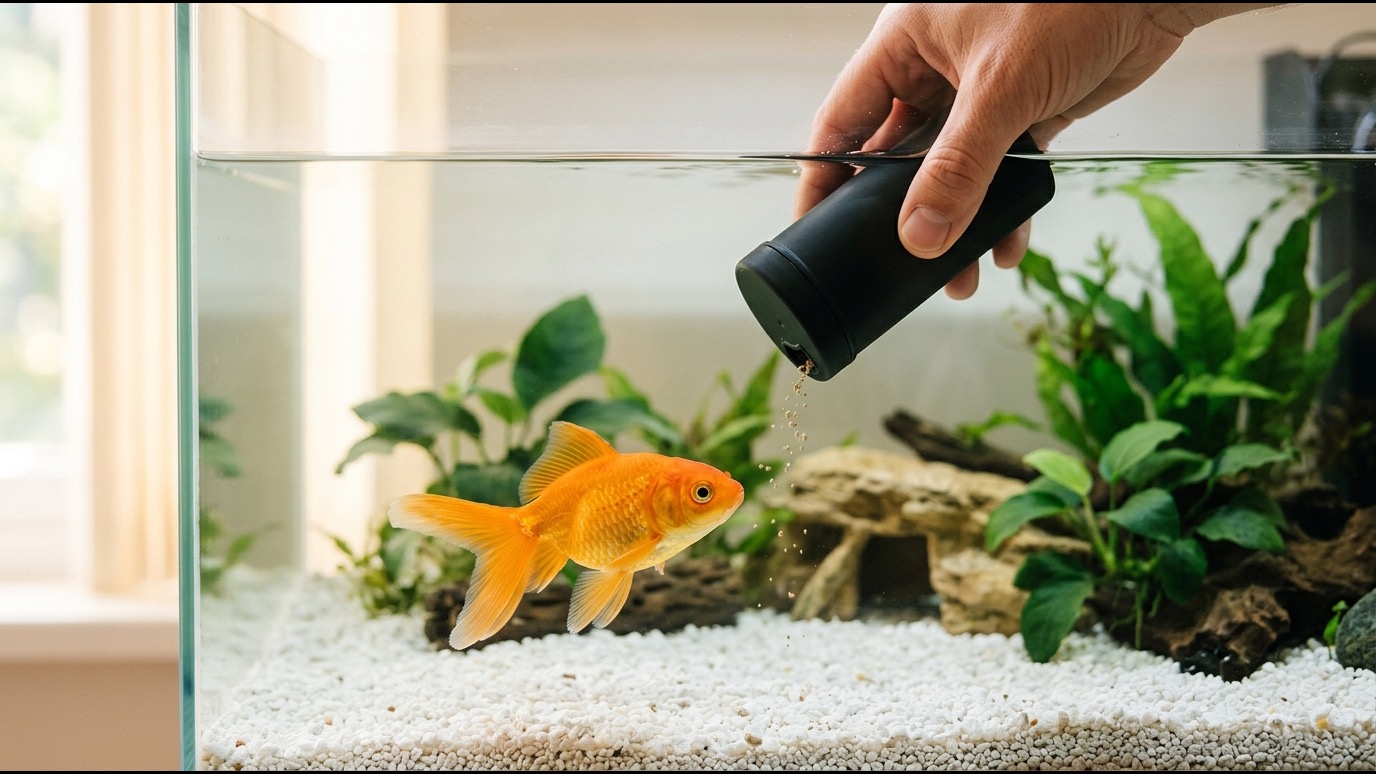
Takeaway: feed a goldfish diet in short sessions, and soak flakes so the fish swallow less air.
Aqueon’s care guide says goldfish are omnivores. In the wild they eat crustaceans, insects, and plant matter.
The same page says to rotate foods daily and feed only what they can consume in 2 to 3 minutes, once or twice a day.
Aqueon Goldfish Flakes are a current product that names comets on the maker page. That page says the flakes float and will not cloud water when fed as directed.
Aqueon’s care guide also says goldfish may gulp air at the surface and then float upside down. It tells keepers to soak flake foods briefly and to avoid floating pellets.
That last point matters if you also buy Hikari Goldfish Gold. Hikari Sales USA’s page lists Goldfish Gold as a floating pellet.
If you use that pellet, watch the first minute of the meal. Hikari’s page says to feed two or four times daily and keep each meal to about a minute.
It also says to reduce feeding below 10°C (50°F) or above 30°C (86°F). Extra food becomes ammonia, so leftover pellets are a water problem.
Protein numbers from the two flake and pellet maker pages:
Tetra’s page also lists 300 mg/kg vitamin C. Hikari’s page lists 440 mg/kg ascorbic acid.
Aqueon’s guide says larger goldfish will eat many live plants and may still uproot tough plants. Skip sharp décor. Aqueon says lava and tufa can tear fins.
Color fades, tankmates, and when to get help
Takeaway: color shift is common, and tankmates must tolerate cool water.
Aqueon’s guide says goldfish get along with most peaceful, similarly sized fish and to avoid fin nippers and boisterous fish.
If the tank has no heater, Aqueon says to keep only fish that tolerate cooler water. Commons, comets, and shubunkins may later be too rough for smaller fancies.
USGS notes that wild fish are often olive green or even creamy white, not bright gold, so a pale comet is not always sick. Pale color can also follow diet, light, or water stress.
If orange fades toward white, test the water, then read why goldfish turn white.
Aqueon’s guide says goldfish can be taught to hand-feed and can tell owners from other people. A fish that stops coming to food needs a water test the same day.
Do not add pond plants or wild snails from a ditch, because USGS describes goldfish as a widely introduced species.
FAQ
How many gallons does one comet goldfish need?
Aqueon’s goldfish care guide says adult comets should have at least 20 gallons of water per fish. That is a minimum, not a ceiling. Add 20 gallons for each extra adult comet, and size the filter above the tank volume.
Can a comet goldfish live in a bowl?
No. Aqueon’s care guide says goldfish should never be kept in bowls, small aquariums, or any unfiltered container. Bowls fail on waste, oxygen, and adult size.
Is a pond better than a tank for a comet?
A pond is better when the fish can stay out through winter and you can block herons and raccoons. Aqueon’s guide calls comets excellent outdoor pond fish and says they survive relatively cold winters. A tank is better when you can give 20 gallons per adult and keep the water at 60° to 70°F.
How big do comet goldfish get?
The USGS goldfish profile says they generally reach only 15–20 cm in total length. The same profile lists a maximum of 59 cm total length and 3.0 kg. Aqueon does not publish an inch length for comets, but it does say they grow quite large.
How long do comet goldfish live?
Aqueon’s care guide says goldfish can live over 20 years in captivity when properly cared for. USGS lists a typical span of 6 to 7 years and a recorded maximum of 30 years. Treat 20 years as the planning number for a kept comet.
What temperature should comet goldfish water be?
Aqueon’s guide says comets and shubunkins should be kept between 60° and 70°F. Fancy goldfish on that page prefer 68° to 74°F. USGS says the species can survive 0–41°C, which is 32° to 106°F, but survival is not a good tank range.
What should I feed a comet goldfish?
Use a goldfish food, not a tropical community flake. Aqueon Goldfish Flakes name comets on the maker page. Tetra Select Goldfish Flakes list 42.0% minimum protein, and Hikari Goldfish Gold lists 32.0%. Aqueon says to feed what they finish in 2 to 3 minutes.