Quick answer: Keep one female betta in a heated, filtered tank of 5.5 gallons or more, not a vase. Feed a labeled betta pellet in small meals. Add more females only in a 15-gallon tank with cover and a spare tank ready.
A female betta can live alone in a heated 5.5-gallon tank; a vase does not meet that size. This page is a care brief from our research team’s comparison of published maker specs. We did not run tank trials, keep a female group for this draft, or treat any fish.
How we chose what this page covers
We used one rule: cover female Betta splendens only in filtered, heated tanks of 5.5 gallons or more.
That 5.5-gallon floor is the size on Aqueon’s current 5.5 LED Aquarium Starter Kit page. We skip bowls, cups, and unheated desk vases, and we also skip mixed-sex pairs and breeding setups.
We cover a single female as the default home. Female-only groups stay in scope only at or above the 15-gallon community size on Aqueon’s Betta Care Guide. We do not cover two-fish or three-fish female tanks.
We compared published labels on foods sold for bettas and did not rank brands or sort them by price.
How to tell a female betta from a male
Aqueon’s care guide says pet-store fish are usually Betta splendens or B. imbellis. The same page says there are over 70 recognized Betta species.
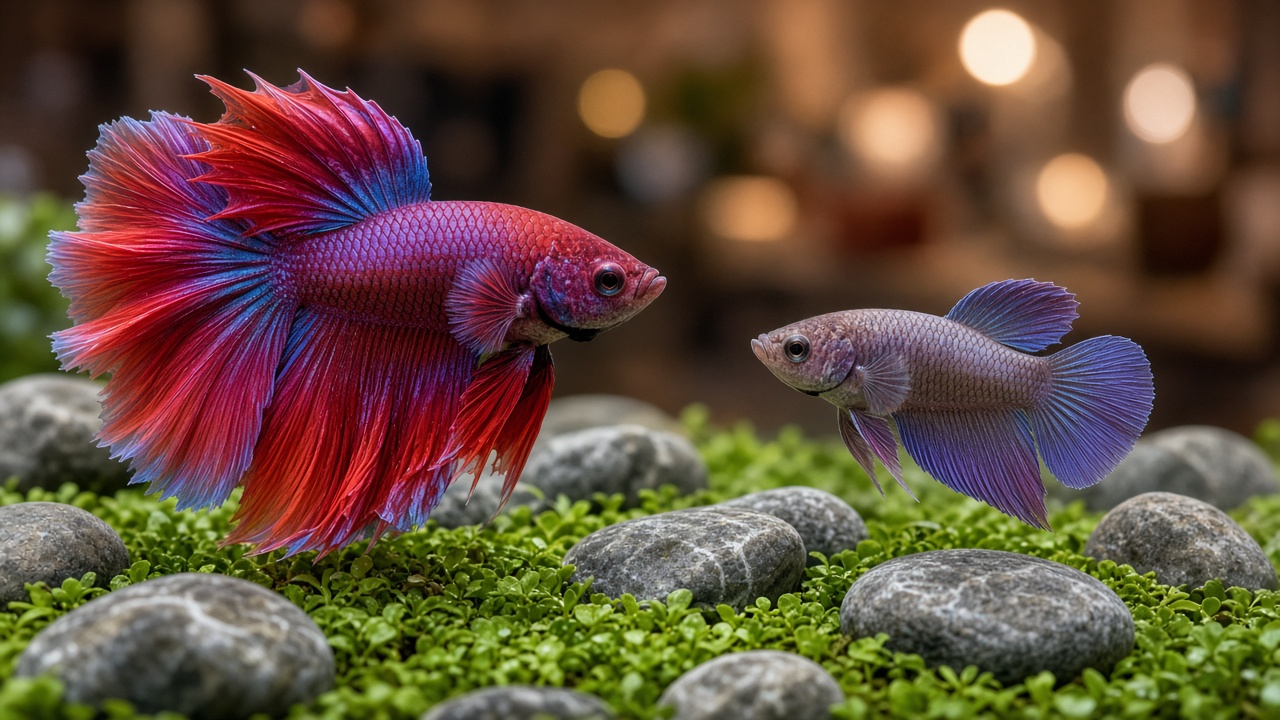
Females often have shorter fins and a rounder belly when they carry eggs. Many show a small pale egg spot near the vent, while males often have longer fins and brighter color.
Aqueon’s guide says there are hundreds of color and fin types, so fin length alone can fool you. Read the body shape and the vent, not just the tail.
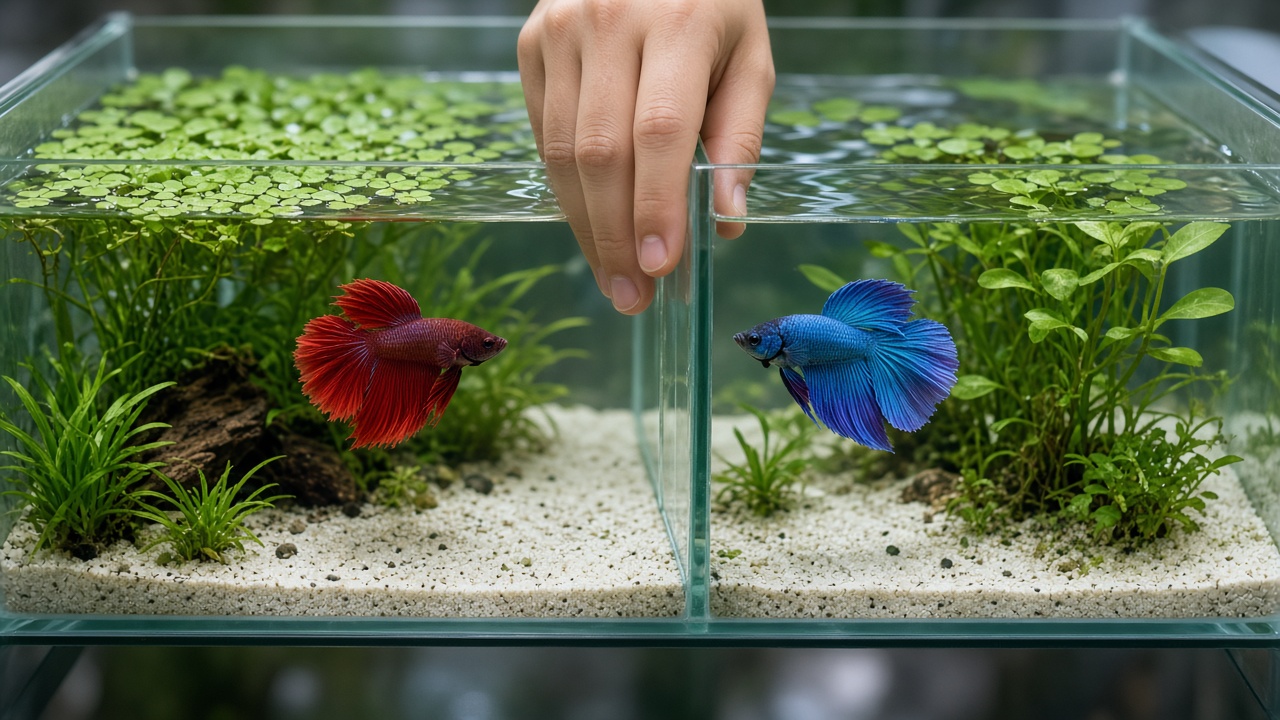
Aqueon’s guide is clear that male bettas are highly territorial toward each other and must be kept separately or in a partitioned container.
A female can live alone, and that is the setup this page treats as the default.
Tank size and water for a female betta
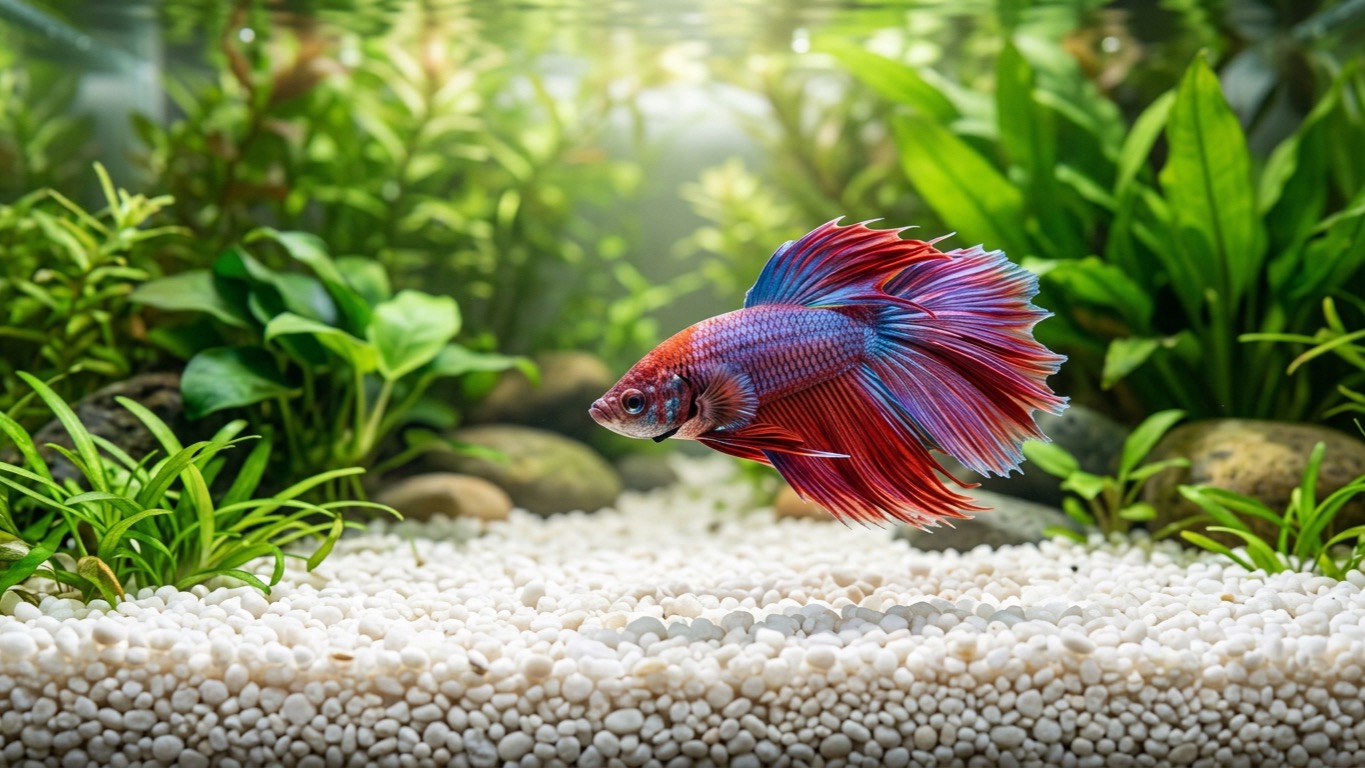
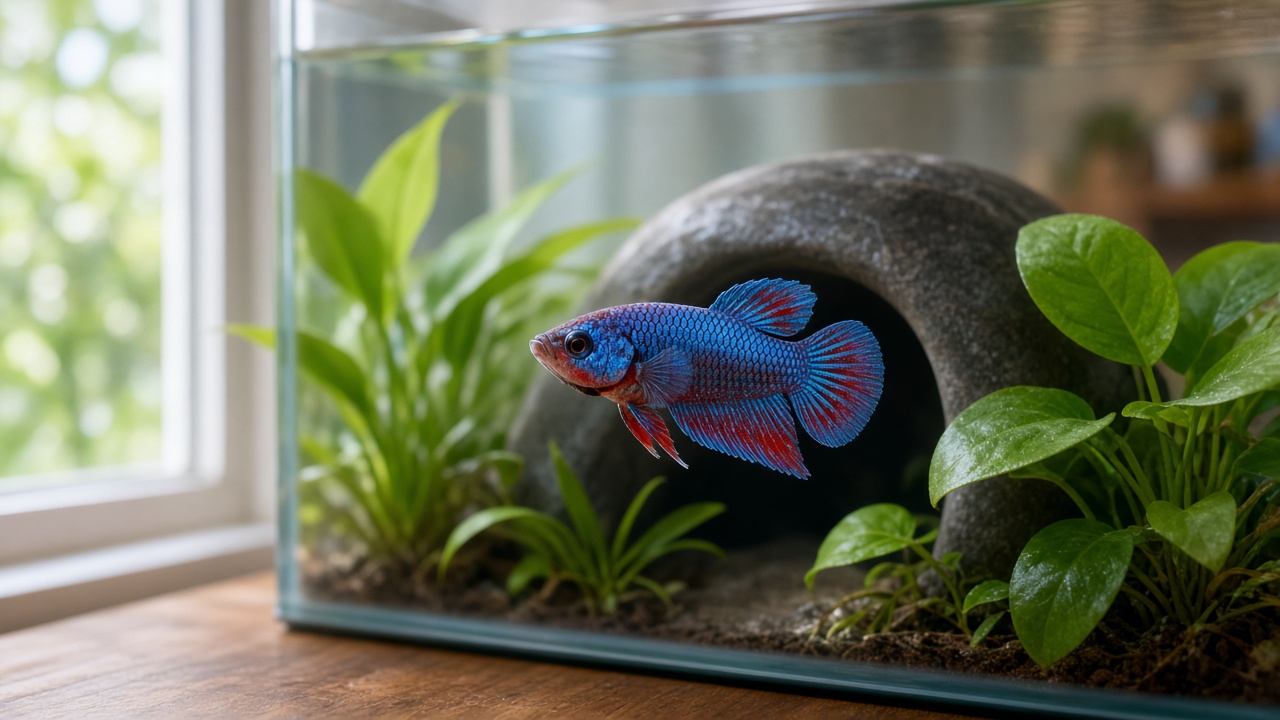
A single female needs a heated, filtered tank with a lid, not a cup.
Aqueon’s 5.5 LED Aquarium Starter Kit page lists the kit size as 5.5. The same page lists dimensions of 16.375 by 8.625 by 10.6875. The kit includes a glass tank, a low-profile LED hood, and QuietFlow filtration.
That kit is the smallest glass setup we used as a floor. For more volume and a calmer nitrogen cycle, see our guide on what size tank a betta needs.
Aqueon’s Betta Care Guide sets these water numbers:
- Temperature: 76°F to 85°F
- pH: 6.8 to 7.5
- Calm flow, not a strong current
The same guide says bettas may seem to tolerate cooler rooms, then go inactive and get sick more easily. If the room sits below 76°F, Aqueon says to use a heater.
For tanks 10 gallons and larger, Aqueon’s guide points to its own heater line. The 5.5-gallon kit page does not list a heater in the box, so plan to add one.
Aqueon’s guide says to set the container up at least 48 hours before you buy the fish. It also says bettas jump, so keep a secure lid on the tank.
Water-change amounts on that same Aqueon page:
- Unfiltered containers: change 1/3 of the water every 3 to 4 days
- Filtered tanks: change 10% every week, or 25% every 2 weeks
- Change the filter cartridge at least once per month
- Never change all of the water at one time
Treat tap water with a conditioner before it goes in, as Aqueon’s care guide says to treat tap water before you add it.
Aqueon’s guide lists an average lifespan of 3 to 4 years when care is steady.
Sorority rules we will and will not cover
A female-only group is optional, not the basic care plan.
Aqueon’s care guide says male bettas must be kept apart from other males. It does not bless a small female group in a bowl. The same page says a betta can live with other peaceful fish in a community tank of 15 gallons or larger.
Our desk uses that 15-gallon line as the smallest group tank we will discuss, and we still prefer one female in her own tank.
If you try a female-only group, use this list:
- Start with a cycled, planted 15-gallon tank or larger
- Add several females at once, not one new fish into an old group
- Give dense plants, caves, and line-of-sight breaks
- Keep a spare heated tank ready
- Watch for torn fins, hiding, or a fish pinned in a corner
- Pull the target fish the same day you see persistent chasing
We do not cover two-female or three-female tanks, because those setups often leave one fish as the only target.
We do not cover a male housed with females except for a planned spawn. Aqueon’s guide says spawning needs extra care and that pairs do not typically breed in a community tank.
If you cannot watch the tank every day, keep one female.
What to feed a female betta
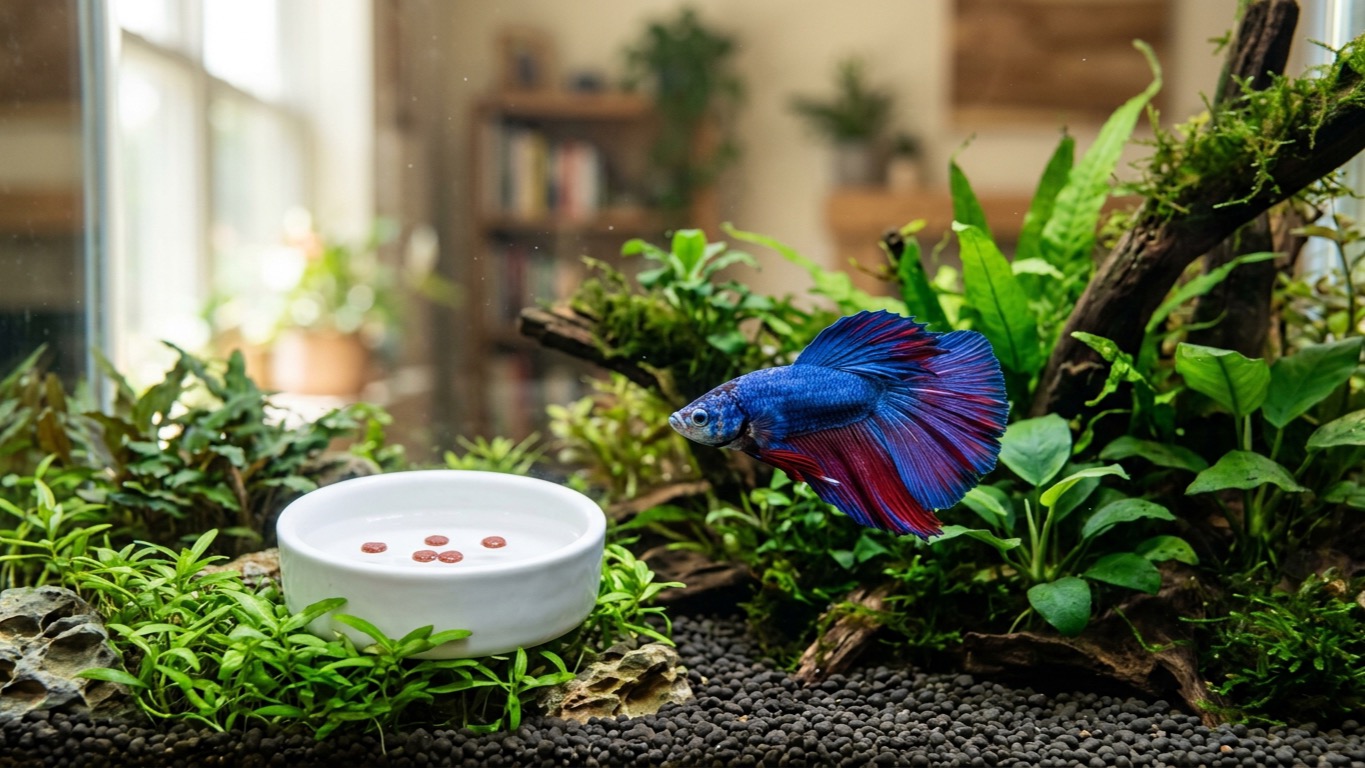
Feed a labeled betta pellet in tiny meals and remove leftovers.
Aqueon’s care guide says bettas eat insects and other invertebrates in the wild. In a filtered tank, that page says to feed once or twice a day, with all food gone in two minutes or less.
For meal counts by pellet size, see our guide on how often to feed a betta.
Hikari’s FAQ gives these counts for Betta Bio-Gold:
- Fish under 1.5 inches (nose to tail base, before the fins): use Micro Pellets, 6 pellets twice a day
- Fish 1.5 to 1.75 inches: 3 pellets of Betta Bio-Gold, up to 3 times daily
- Add 1 pellet per 1/4 inch of growth
- Never feed more than 5 pellets at one feeding
- Space extra feedings at least 3 hours apart
- Feed one pellet at a time and wait until she eats it
NorthFin’s Betta Bits page says 4 to 6 bits a day and lists 1 mm pellets. It lists a minimum of 45% crude protein, 5% crude fat, and a maximum of 5% crude fiber. Package sizes on that page are 20 g and 100 g.
Omega One’s Betta Buffet Pellet page lists this guaranteed analysis:
- Minimum crude protein: 42%
- Minimum crude fat: 8%
- Maximum crude fiber: 2.0%
- Maximum moisture: 8.5%
- Maximum ash: 8%
The first ingredients on that Omega One page are salmon, wheat flour, and whole herring.
Aqueon’s Nutrinsect Betta Pellets page says the formula is 100% fish-free. It names dried mealworms and dried black soldier fly larvae among the protein sources.
The listed size is 1.41 oz. Feeding on that page is 2 to 3 times a day, in amounts she finishes in two minutes. Remove leftovers about five minutes after feeding.
Our research team compared those published protein lines. Omega One lists 42% minimum and NorthFin lists 45% minimum, a 3-point spread on the labels, not a feeding trial.
| Product | Form on the maker page | Crude protein (min) | Crude fat (min) | Maker feeding note |
|---|---|---|---|---|
| Omega One Betta Buffet Pellet | Floating pellet | 42% | 8% | Salmon and whole herring on the ingredient list |
| NorthFin Betta Bits | 1 mm pellets | 45% | 5% | 4–6 bits a day |
| Hikari Betta Bio-Gold | Pellet diet named on Hikari’s FAQ | Not listed on the FAQ page | Not listed on the FAQ page | 3 pellets, up to 3 times daily, for a 1.5–1.75 in fish; max 5 per feeding |
| Aqueon Nutrinsect Betta Pellets | Pellets, 1.41 oz | Not listed on the product page | Not listed on the product page | 2–3 times a day; eat in 2 minutes; remove leftovers at 5 minutes |
Read the guaranteed analysis on the bag before you buy, and do not dump a large pinch, because uneaten pellets foul a small tank fast.
Tank mates that do not belong with a female betta
A female betta is a freshwater fish, not a brackish invertebrate.
Aqueon’s care guide lists peaceful community mates for a 15-gallon tank or larger. It names tetras, calm barbs, rasboras, livebearers, and Corydoras catfish. It says to avoid male gouramis, fin-nippers such as tiger barbs, and very active fish such as giant danios.
That list is about fish, not a license to add crabs.
Red claw crab care is a different habitat. Those crabs need brackish water and land, and a female betta does not, so one tank fails both animals.
Skip snails you cannot identify, anything that nips fins, and another male betta.
If you want a simple tank, keep the female alone with plants and a lid.
Daily care and warning signs
Stable warm water and small meals do more than extra decor.
Aqueon’s guide says to decorate with gravel, plants, and floating cover. Soft plants give females a place to rest, while sharp plastic edges tear fins.
A simple daily check:
- Confirm the heater still reads inside 76°F to 85°F
- Confirm she ate and leftovers are gone
- Confirm the lid is closed
- Confirm no fish is hiding with clamped fins
Aqueon’s average lifespan line is 3 to 4 years, and a cold cup cuts that short.
If she stops eating or shows torn fins, test the water and the temperature first. Then reduce feeding and add cover. If a group is the problem, split the tank.
FAQ
Can two female bettas live in the same tank?
Our desk does not cover two-female tanks. Aqueon’s care guide sets 15 gallons as the community size for a betta with other fish, and females can still chase. If you try a group, use that 15-gallon line, add several females at once, and keep a spare tank ready.
Do female bettas need a heater?
Aqueon’s care guide sets 76°F to 85°F as the healthy range. The same page says cooler water makes them inactive and more prone to disease. Use a heater and a thermometer if the room drops below 76°F.
How often should I feed a female betta?
Aqueon’s care guide says once or twice a day in a filtered tank, with food gone in two minutes. Hikari’s FAQ allows 3 Betta Bio-Gold pellets, up to 3 times daily, for a 1.5 to 1.75 inch fish. It caps one feeding at 5 pellets. NorthFin’s page says 4 to 6 Betta Bits a day.
What size tank does a female betta need?
Our floor is 5.5 gallons, the size on Aqueon’s 5.5 LED Aquarium Starter Kit page. That kit’s listed dimensions are 16.375 by 8.625 by 10.6875. Aqueon’s care guide uses 15 gallons or larger when other fish share the tank; see our betta tank size guide for the volume math.
Can a female betta live with a red claw crab?
No. A female betta is a freshwater fish. Red claw crabs need brackish water and land, as our red claw crab care page explains. One tank cannot meet both sets of rules.
How long do female bettas live?
Aqueon’s Betta Care Guide lists an average lifespan of 3 to 4 years. That assumes warm, clean water and a lid, and a vase with no heater or filter is not that setup.
Do I need a filter for one female?
Aqueon’s guide says bettas can live in small aquariums without circulation because they breathe air at the surface. The same page says a filter gives better water and less work, but our selection rule still requires a filter on every tank we cover.