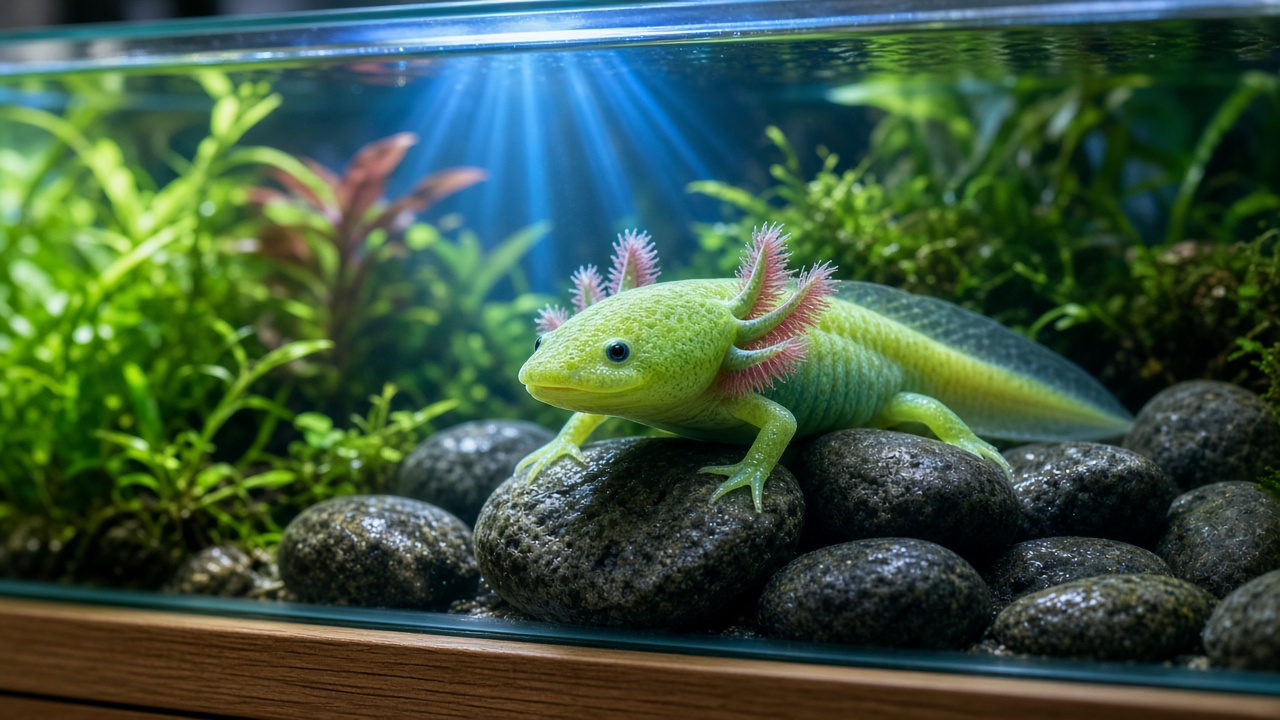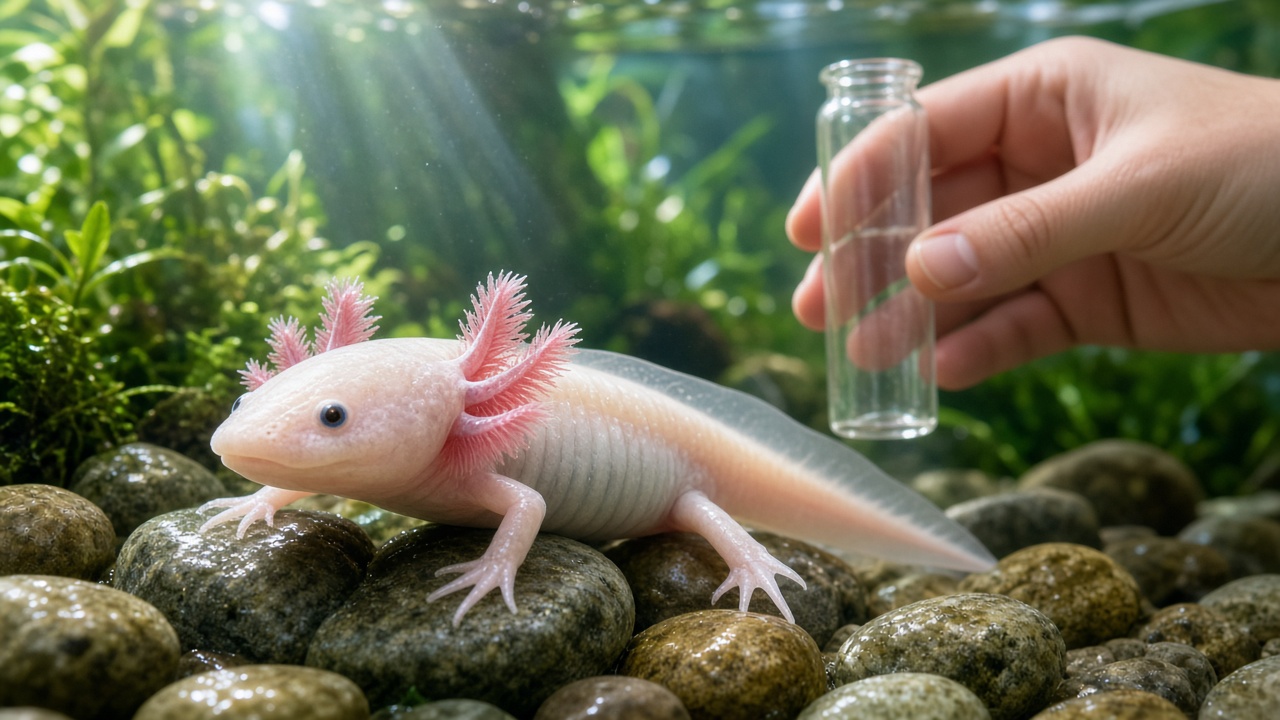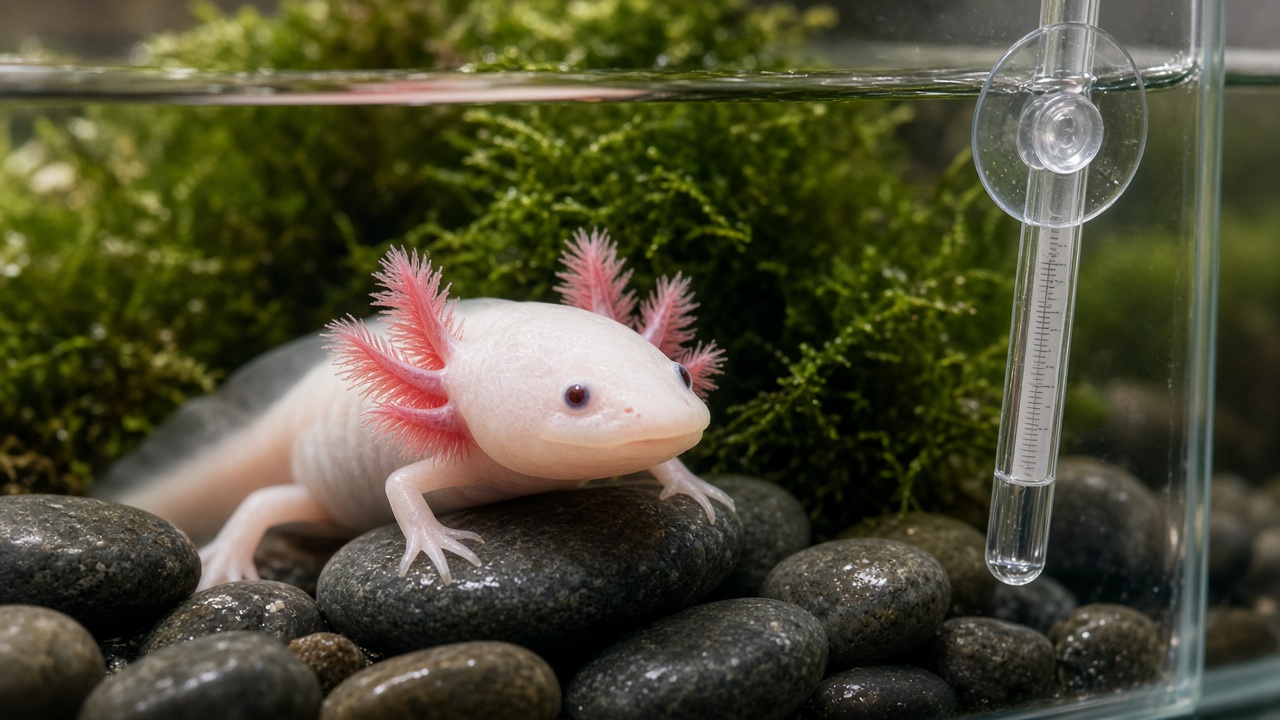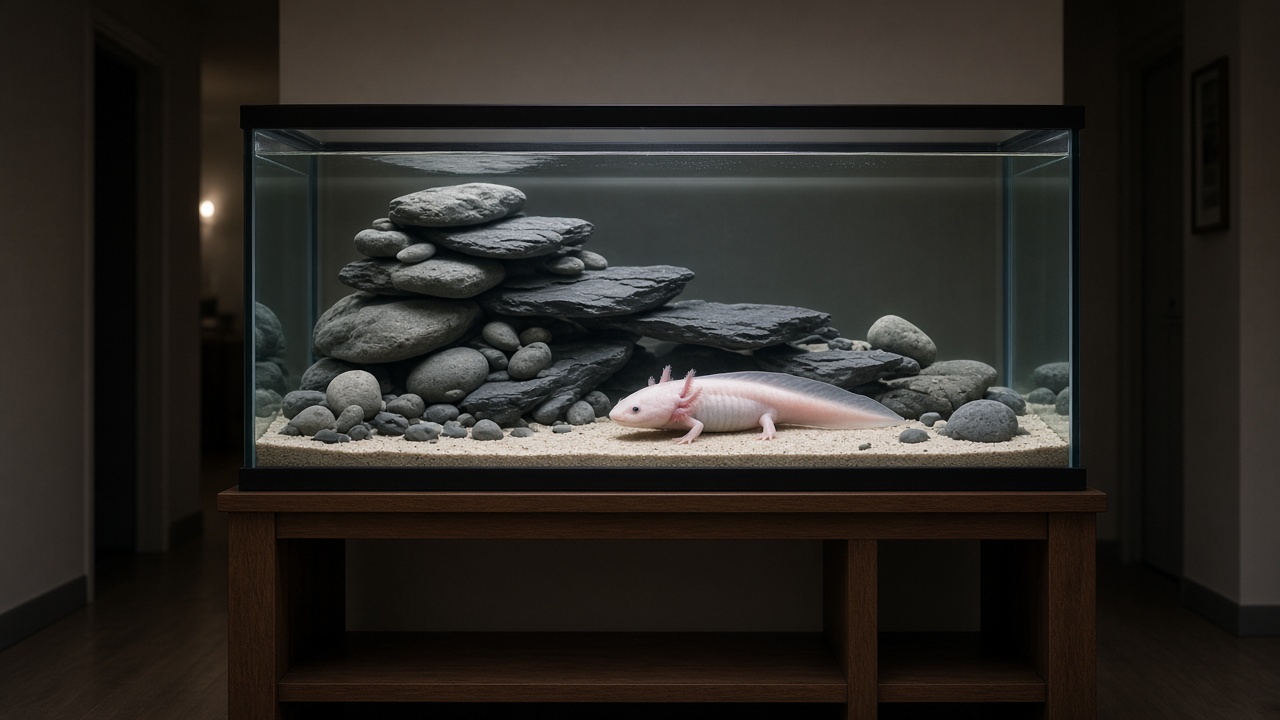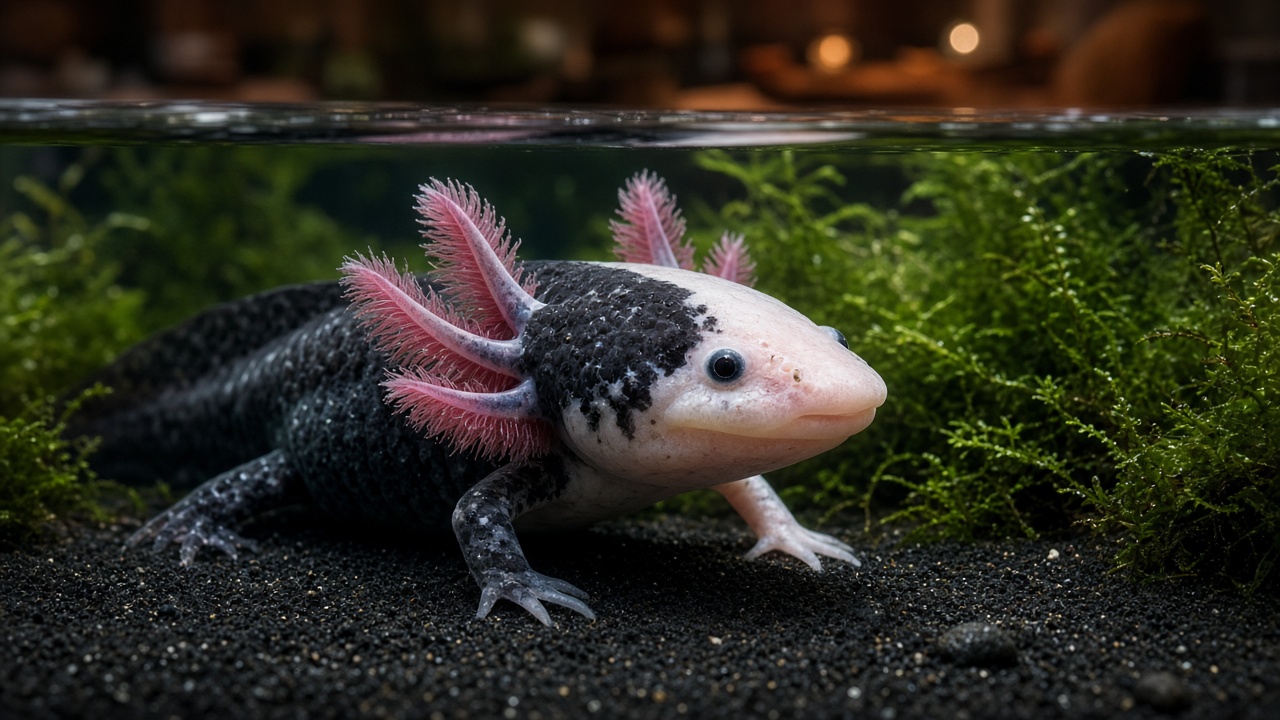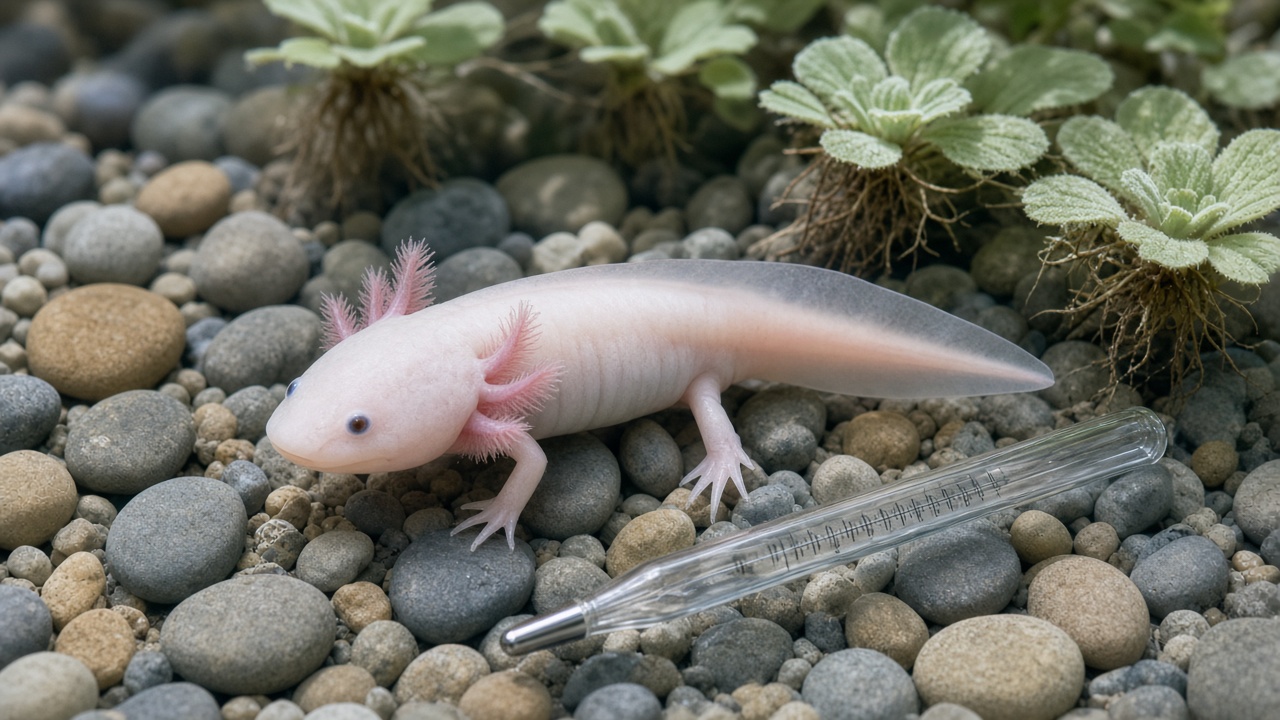
Quick answer: Plan for many years, not months. Animal Diversity Web lists a 5-to-6-year laboratory average. The Natural History Museum lists 10 to 15 years in the wild.
Published laboratory averages sit at 5 to 6 years, and wild estimates sit at 10 to 15 years.
This page is a research-desk comparison of those published figures and of maker specs for home tanks.
Selection rule: we included published lifespan numbers for Ambystoma mexicanum only. We also included currently sold gear whose maker pages list a numeric spec for heat, waste, or volume. We left out color morphs, breeding recipes, and wild-caught animals.
Published lifespan numbers in three settings
Home tanks, research labs, and Mexican canals are not one dataset.
Animal Diversity Web lists expected laboratory longevity at 5 to 6 years. The same page says some animals have lived as long as 10 to 15 years.
AmphibiaWeb reports that lab individuals can live over 10 years, while the Natural History Museum states that wild animals can live 10 to 15 years.
Our research team analyzed those three pages side by side and calls that split the Waterpuppy Three-Setting Desk.
- Laboratory expected average: 5 to 6 years (Animal Diversity Web)
- Laboratory records: over 10 years (AmphibiaWeb); some 10 to 15 years (Animal Diversity Web)
- Wild estimate: 10 to 15 years (Natural History Museum)
A home tank is closer to a lab than to a canal, so the cautious planning number is the 5-to-6-year laboratory average. Some published animals reach the upper teens, which is a record range, not a promise.
Why a home tank is not a lab and not a lake
A pet tank can beat a lab average if heat, waste, and crowding stay low.
Animal Diversity Web notes that most laboratory animals die shortly after metamorphosis. AmphibiaWeb reports that metamorphosis is rare in the lab, typically less than 1%.
Forced land forms are a short-life path, not a long-life path.
The Natural History Museum quotes Jeff Streicher, Senior Curator in Charge of Amphibians and Reptiles. He says too much iodine can kill an axolotl, and even a successful change leaves a weaker animal.
Labs also start from a tight founding stock. Animal Diversity Web traces nearly all modern laboratory axolotls to 33 animals shipped from Xochimilco to Paris in 1864.
Wild canals add different risks. The Natural History Museum says only 50 to 1,000 adults are thought to live in the wild. AmphibiaWeb reports a decline of 80% since 2003.
AmphibiaWeb also reports survey density as low as 0.001 individuals per square meter, with high first-year mortality in the wild.
So the wild 10-to-15-year figure is a potential span, not a typical year count for every hatchling. A home tank removes fish predators, but it does not remove heat, ammonia, or a hard filter blast.
Cool water is the first lifespan lever
Published wild temperatures sit in a narrow cool band, not a tropical band.
AmphibiaWeb reports wild water at 16 to 20°C (61 to 68°F) and pH of 7.4 to 8.2. It also lists an optimal temperature of 18 to 20°C (64 to 68°F).
That band is cooler than most tropical community tanks, which is why an oscar fish care heater plan does not transfer here.
INKBIRD’s page for the ITC-308 lists a control range of −50 to 120°C (−58 to 248°F). Accuracy is listed at ±1°C / ±2°F.
The Wi-Fi model on the same page lists −40 to 100°C (−40 to 212°F). Maximum output is listed at 1,200 W on 110 VAC.
Those ranges are far wider than an axolotl needs, so the useful fact is the dual heating and cooling relays. Use the controller to switch a chiller or fan on the cool side. Use a heater only if a room drops below the published 16°C (61°F) floor.
- Aim near AmphibiaWeb’s 18 to 20°C (64 to 68°F) optimal band
- Stay inside the 16 to 20°C (61 to 68°F) wild band
- Keep pH near the 7.4 to 8.2 band AmphibiaWeb reports
- Do not treat a tropical heater as default gear
Cool rooms can hold that band with little power, but warm rooms need active cooling.
Volume, flow, and chemistry gear
Stable water volume and low waste matter as much as the calendar.
Animal Diversity Web lists average length at 20 cm (9 inches), and some animals grow to more than 30 cm (12 inches).
The Natural History Museum lists a top length of 30 centimeters and a weight of about 50 to 200 grams. AmphibiaWeb reports some wild animals near 40 centimeters.
AmphibiaWeb also reports first-year growth to 20 cm, then about 10 cm more in year two. A small bowl is not sized for that curve.
Seachem’s page for the Tidal 75 lists a tank rating up to 75 US gallons (300 liters). Listed flow is 350 US GPH (1,500 L/H). Listed draw is 8 W at 120 V.
Our research team analyzed that maker page and divided listed flow by listed tank size.
- 350 GPH on a 75-gallon rating is about 4.7 turnovers per hour at full flow
- The same 350 GPH on a 20-gallon tank is about 17.5 turnovers per hour
- Seachem lists a front flow dial, so the published max is not the required setting
Axolotls have external gills, so a hard return current is a stressor, not a feature.
Seachem’s Prime page lists 1 capful (5 mL) for each 50 US gallons (200 L) of new water. Each cap thread is about 1 mL.
- A 20-gallon full-tank dose is 2 mL, or about two cap threads
- A 10-gallon change is 1 mL, or about one cap thread
- Prime may be dosed every 24 to 48 hours
- The binder is listed as holding ammonia, nitrite, and nitrate for up to 48 hours
- If ammonia or nitrite is above 2 ppm, Seachem lists up to 5 times the normal dose
Seachem also lists a half dose if temperature is above 30°C (86°F) and chlorine or ammonia is low. Treat that high-heat note as a warning, not a target.
Currently sold gear, compared by listed attributes
We compared four currently sold products by printed specs and did not rank them.
The table holds only attributes from the maker pages, not a buying order.
| Product | Job in a long-lived tank | Listed size or range | Listed output or dose | Listed power or warranty |
|---|---|---|---|---|
| Seachem Tidal 75 | Hang-on filter with flow dial | Up to 75 US gal (300 L); 10 1/8 × 7 × 9 1/2 in | 350 US GPH (1,500 L/H); 0.50 US gal media (1.9 L) | 8 W at 120 V; 3-year warranty, 5 if registered |
| Seachem Prime | Chlorine and nitrogen binder | Bottles 50 mL through 4 L | 5 mL per 50 US gal; up to 5× if ammonia or nitrite exceeds 2 ppm | Binds waste up to 48 hours |
| INKBIRD ITC-308 | Heat and cool switch | −50 to 120°C (−58 to 248°F) | ±1°C / ±2°F; 10 A | 1,200 W max at 120 VAC; 1-year warranty |
| INKBIRD ITC-308-WIFI | Heat and cool switch, Wi-Fi | −40 to 100°C (−40 to 212°F) | ±1°C / ±2°F | 1,200 W at 110 VAC; 2,200 W at 220 VAC; 1-year warranty |
Seachem lists the Tidal 75 filter volume at 0.50 US gallons (1.9 liters). That media volume is the biological side of the waste problem.
INKBIRD lists a 0.1° display resolution below 100°C or °F, which is fine enough to hold AmphibiaWeb’s 2°C optimal window. Match the filter to floor space first, then baffle the outflow.
What cuts years in tanks or in the wild
The same animal fails for different reasons in a canal and in a glass box.
The Natural History Museum states the International Union for Conservation of Nature lists the species as Critically Endangered. The museum cites a decreasing wild population of 50 to 1,000 adults.
AmphibiaWeb reports the estimated extent of occurrence at 468 km². That page also cites an estimate that the lakes’ area has fallen to 2.83% of historic area.
The Natural History Museum names tilapia and carp as competitors that also eat young.
In 2025, that museum reports scientists released 18 captive-bred axolotls into wetlands near Mexico City. That is a conservation trial, not a pet-trade supply.
Home tanks fail on a shorter list.
- Water held above the 20°C (68°F) top of AmphibiaWeb’s wild band
- Unbound ammonia or nitrite above the 2 ppm trigger on Seachem’s Prime page
- Full-flow returns near 350 GPH in a small tank
- Crowding after the 20 cm first-year growth AmphibiaWeb reports
- Induced metamorphosis, which Animal Diversity Web links to early death
AmphibiaWeb lists CITES Appendix II, which is a trade listing rather than a lifespan number. Legal origin papers still matter for any cross-border move.
How axolotl years compare with other aquarium animals
Axolotls are long-lived for a small aquatic pet and short-lived next to some pond fish.
A 5-to-6-year laboratory average already outlasts many tropical community fish. The 10-to-15-year published top end overlaps large goldfish.
Fantail goldfish care also hinges on cool, large, clean water. The thermal plan is closer than an oscar plan.
Koi fish care sits on the other side of the calendar. Koi are pond animals with a multi-decade span, not a 20-gallon indoor span.
Do not copy a koi pond build or an oscar heater into an axolotl tank.
Sexual timing is earlier than the full lifespan. The Natural History Museum says they reach sexual maturity after about a year.
AmphibiaWeb reports lab maturity between 8 and 15 months. Animal Diversity Web says eggs hatch in 10 to 14 days, with 100 to 300 eggs per spawn.
A breeding year is not a long-life year, because extra eggs raise waste and crowding.
FAQ
How long do axolotls live as pets?
Plan from Animal Diversity Web’s 5-to-6-year laboratory average. AmphibiaWeb reports lab animals can live over 10 years, and Animal Diversity Web records some at 10 to 15 years. A home tank is a captive setting, so those lab figures are the closest published match.
Do wild axolotls live longer than tank axolotls?
The Natural History Museum lists 10 to 15 years in the wild. That is higher than the laboratory average. It is not higher than the published captive maximum of 10 to 15 years. AmphibiaWeb reports high first-year wild mortality, so many hatchlings never reach that span.
How big do axolotls get as they age?
Animal Diversity Web lists an average of 20 cm (9 inches), with large animals over 30 cm (12 inches). The Natural History Museum lists up to 30 centimeters and 50 to 200 grams. AmphibiaWeb reports some animals near 40 centimeters, with about 20 cm in year one and 10 cm more in year two.
When is an axolotl an adult?
The Natural History Museum says sexual maturity comes after about a year, and AmphibiaWeb reports 8 to 15 months in the lab. Adult form still includes gills and a finned tail, so maturity is not the same as old age.
How many axolotls are left in the wild?
The Natural History Museum states that only 50 to 1,000 adults are thought to remain. AmphibiaWeb reports an 80% decline since 2003 and densities as low as 0.001 individuals per square meter. Those wild counts do not set a home-tank lifespan.
What temperature supports a long life?
AmphibiaWeb reports wild water at 16 to 20°C (61 to 68°F). The optimal band is 18 to 20°C (64 to 68°F). The INKBIRD ITC-308 can switch cooling gear across a far wider listed range. The animal still needs the cool slice of that range.
Can a filter be too strong?
Yes. Seachem lists 350 US GPH on the Tidal 75, or about 4.7 turnovers per hour on a 75-gallon tank. That rate is far higher in a smaller tank. Use the listed flow dial and point the return away from the gills.