Quick answer: A bubble nest is a male betta’s egg raft, not a happiness badge. Leave it if the water is warm and still. Do not add a female unless you can run a full breeding setup.
Male bettas blow saliva-coated air bubbles to hold eggs, even with no female present.
This page is a research-desk briefing on nest meaning and tank conditions. We did not breed fish, measure live nests, or run tank trials.
Our research team analyzed published nest-area papers and compared maker specs.
The Nest-Condition Rule we used
We only covered cases where a nest’s size or hold can be measured. We only named gear that changes the water a male uses to hold bubbles.
That rule let in two nest-area papers and four current products. It kept out foods, medicines, decor sold as “nest toys,” and breeding boxes.
It also kept out any claim we could not trace to a named paper or maker page.
What a bubble nest is
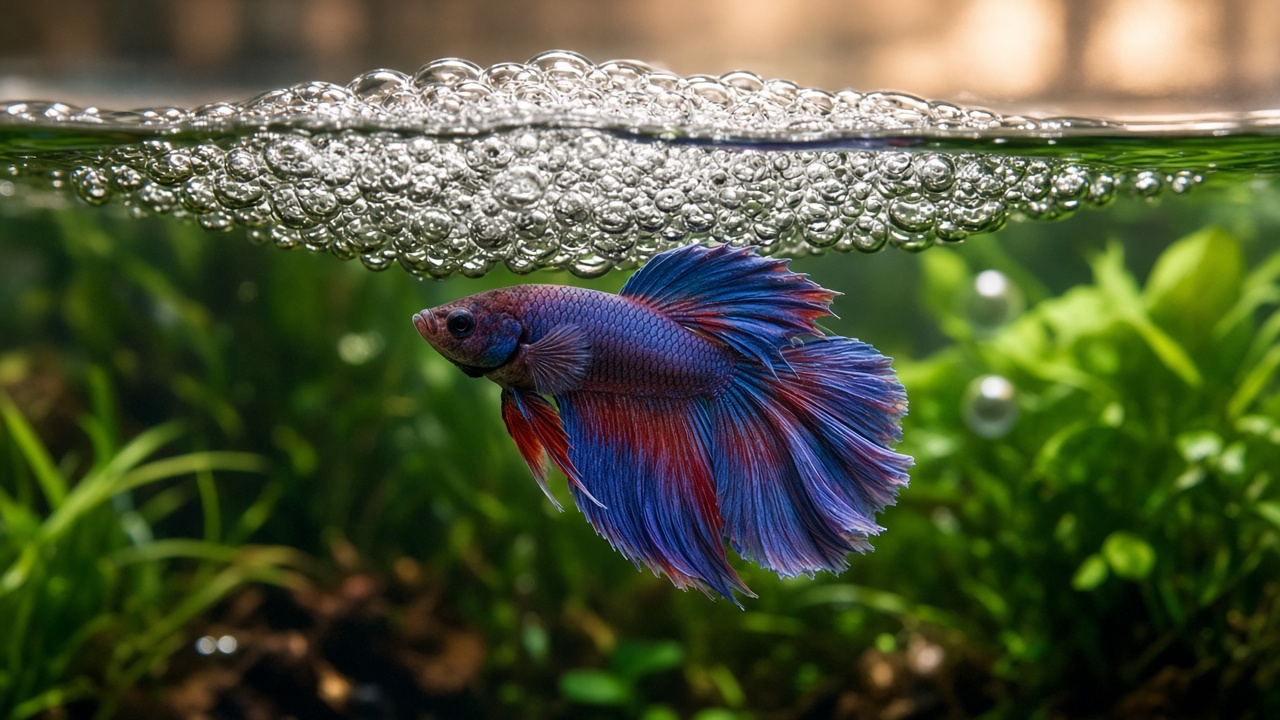
A nest is a floating patch of sticky bubbles at the surface. The male gulps air, coats it with mucus, and stacks the bubbles into one raft.
The nest is a place to park eggs after a spawn. It is not a toy, and it is not a health score.
The BMC Research Notes paper measured nest area in square centimeters. At 150 ppm hardness, mean nest area was 108.58 square centimeters.
That number is a surface patch, not a pile of random foam. A real nest holds shape and sits in one spot.
The same paper used breeding tanks of 60 × 30 × 30 cm with no air stone. A floating leaf sat on the surface so the male had an anchor.
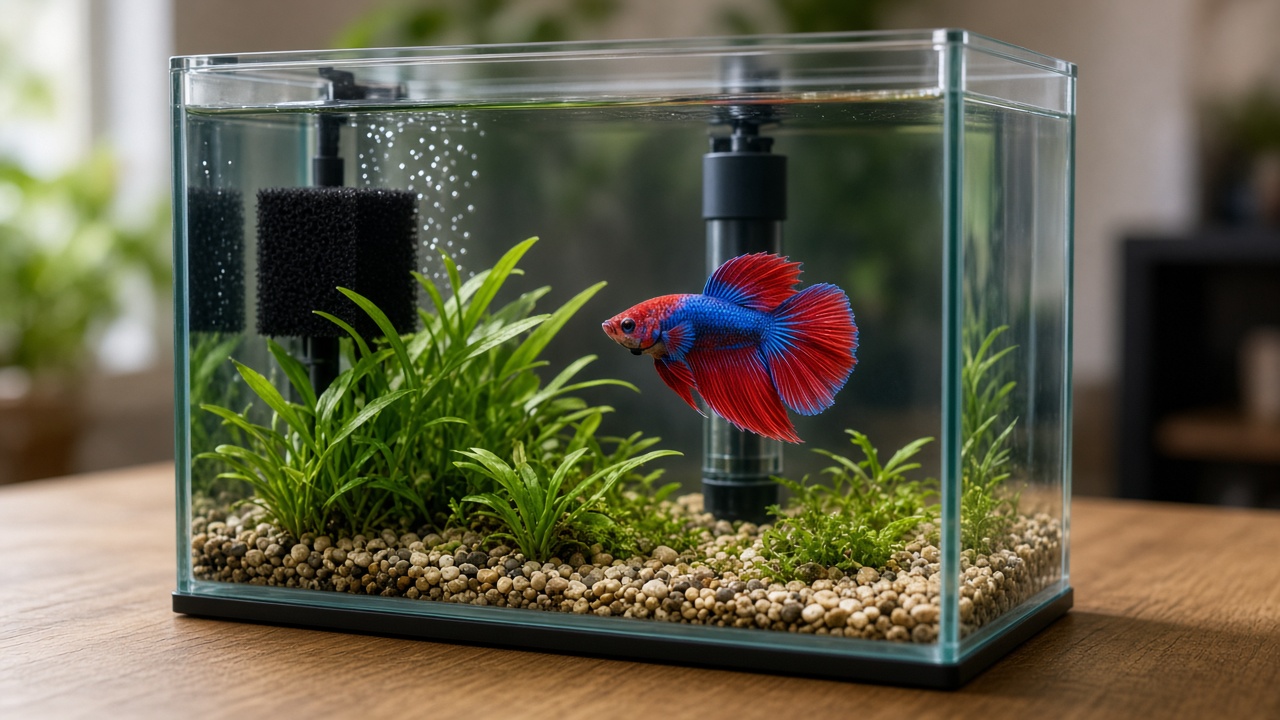
Those lab tanks were still-water boxes. A home filter that blasts the surface works against the same design.
Why males build nests with no female
Nest building is breeding work, and a male can start it before a female is in view.
The Fırat University thesis used 75 males and 15 females. Males still built nests in the temperature tanks.
The BMC Research Notes team used a female in a glass cube to cue nest work. The male still built the nest on his side of the glass.
A nest means the male is acting on a breeding script. It does not mean you should add a mate.
A nest also does not tell you how long do betta fish live.
Adult males nest. Lifespan still depends on water, food, and disease.
Water conditions that change nest size
Hardness and heat both change how large a nest gets. Those two factors are the ones the papers measured.
The BMC Research Notes paper held tanks at 25–27°C (77–81°F) and pH 6.5–7.5. Hardness was the variable.
Here is what that paper reported for Betta splendens:
- Largest mean nest area: 108.58 square centimeters at 150 ppm calcium carbonate
- Nest area fell 75 percent at 900 ppm calcium carbonate
- At 540 ppm and 900 ppm, bubbles burst and males could not rebuild
- Hatch success was 78 percent at 150 ppm and 25 percent at 900 ppm
- Control males held about 743 eggs
Soft water held the nest, and very hard water broke it.
The Fırat University thesis changed heat, not hardness. Males nested from 25–29°C (77–84°F).
Mean nest area by heat in that thesis:
- 25°C: 35.11 square centimeters
- 26°C: 35.83 square centimeters
- 27°C: 39.79 square centimeters
- 28°C: 43.15 square centimeters
- 29°C: 39.01 square centimeters
The peak mean was 43.15 square centimeters at 28°C (82°F). The thesis used nine nests at that step.
Males longer than 3 cm built nests. Length and nest area had only a weak link (r = 0.45).
The thesis also dropped 17 nests that were too small to count. Size varies a lot, even at the same body length.
Four males at 3.7 cm built nests of about 20, 30, 35, and 65 square centimeters. Same length produced very different rafts.
Stable heat near 82°F matches that peak. That is why many keepers ask do betta fish need a heater.
How to tell a nest from loose bubbles
A nest is a packed raft in one corner or under a leaf. Loose bubbles drift, pop, and do not get rebuilt.
Use this short check:
- Packed patch that stays put: treat it as a nest
- Male returns and adds bubbles: treat it as a nest
- Foam that trails from a filter: treat it as flow or soap
- Film that smears when touched by decor: often protein film, not a nest
The BMC Research Notes tanks used a floating leaf as an anchor. Cover helps a raft stay put.
The Fırat University thesis also changed decor, not just heat. In raffia-only tanks, 9 males (25 percent) used gray raffia.
Next came black raffia and open water, each with 8 males (21 percent). White raffia was last, with 2 males.
Habitat props helped more than a bare surface. The thesis used duckweed (Lemna) as one of those props.
A filter that rips the surface will shred a nest. That is flow, not a “failed” fish.
What to do when a nest appears
Leave the nest in place if you are not breeding. Do not scoop it out “to clean.”
Do this instead:
- Check heat against 25–29°C (77–84°F).
- Lower surface spray if bubbles blow apart.
- Condition new tap water before each change.
- Skip adding a female unless you have a spare tank and a plan.
- Watch eating and gill work. A nest does not replace that check.
Males still rest at night. A nest does not mean he skips rest.
See do betta fish sleep for rest signs.
If you are not breeding, a nest is a note about water and instinct. It is not a to-do list.
If you plan a spawn
This next part is only for planned spawns. Skip it if you have one male and no mate.
The BMC Research Notes team counted eggs, then left the male on the nest. They allowed 24–48 hours of pre-hatch care.
Then they counted hatched larvae. Hatch success fell from 78 percent at 150 ppm to 25 percent at 900 ppm.
Hard water hurt more than nest size. Eggs and larvae failed even when some foam remained.
If you do spawn, move the female out after the eggs are in the nest. The paper removed her so the male could guard.
Do not use the 12 × 12 × 12 cm cubes from that hardness trial as a home tank. Those were lab cages for single males.
A nest in smashed, hard water is a warning. The BMC Research Notes males could not rebuild once bubbles burst at 540 ppm and 900 ppm.
A nest in a cold tank is also a poor match. The Fırat University series started at 25°C (77°F), not room-cool bowls.
A nest next to a strong outflow is wasted work. The male will keep rebuilding and burning energy.
Watch the fish, not the foam. If he stops eating, clamps fins, or gasps, treat water quality first.
Gear that changes nest water
The four products below change heat or tap-water toxins. They do not “make” a nest.
We compared listed specs from each maker’s page. We did not rank them.
| Product | Maker-listed dose or power | Maker-listed volume | Maker-listed size | Maker-listed control note |
|---|---|---|---|---|
| Fluval M50 Submersible Heater | 50 W | Up to 15 US gal (50 L) | 11 × 1 × 1 in | Computer-calibrated thermostat |
| Aqueon Pro Adjustable Heater (50 W) | 50 W | Up to 20 gal | 1.5 × 1.75 × 9 in | 68–88°F, ±1° |
| Seachem Prime | 5 mL per 200 L (50 US gal) | Dose on new water | Cap thread about 1 mL | Binds ammonia up to 48 hours |
| API Betta Water Conditioner | 2.5 mL per 1 gal (3.8 L) | Dose on tank or change water | Liquid | Removes chlorine, chloramine, ammonia |
A 5–10 gallon tank sits inside both heater ranges. Fluval’s page lists the M50 for tanks up to 15 US gallons. Aqueon’s page lists the 50 W Pro for tanks up to 20 gallons.
Aqueon’s page sets the Pro from 68–88°F, accurate to ±1°. That band covers the 77–84°F nest window from the Fırat University thesis.
Seachem’s page for Prime states 5 mL per 200 L of new water. Each cap thread is about 1 mL.
Seachem also states these dose rules:
- May dose every 24–48 hours
- Use up to 5 times the normal dose if ammonia or nitrite is above 2 ppm
- Use a half dose if temperature is above 30°C (86°F) and chlorine is low
API’s page for Betta Water Conditioner states ½ teaspoon (2.5 mL) per gallon (3.8 L). Use that on new water, not as a nest tonic.
Pick one conditioner and one heater that match tank size. Do not stack two conditioners in the same change.
Seachem’s page lists Prime bottles from 50 mL through 4 L. The small bottle still uses the same 5 mL per 50 gallons rule.
API’s listed dose is much larger per gallon than Prime’s. Measure with a dropper or syringe in a small tank.
Fluval’s page gives the M50 a 3-year limited warranty. Aqueon’s page lists a limited lifetime warranty on the Pro heater.
FAQ
Does a bubble nest mean my betta is happy?
No. Neither nest-area paper scored “happiness.” The BMC Research Notes paper tracked nest area, eggs, and hatch rate.
A nest can show up in water that later fails those same measures.
Do female bettas make bubble nests?
The two papers we used measured male nests. The Fırat University thesis used 75 males.
The BMC Research Notes nest set used five males. We have no female nest-area number from those pages.
Should I remove a bubble nest?
No, if you are not breeding. Leave the raft and fix heat and flow instead. Scooping it out just makes the male rebuild.
Does a nest mean I should add a female?
No. A nest is the start of a breeding script, not a request for a roommate. Add a female only if you can split fish after the spawn.
Why did my betta stop making nests?
Hard water can burst bubbles. The BMC Research Notes paper saw that at 540 ppm and 900 ppm.
Strong surface flow and heat outside 25–29°C also work against a raft.
How large should a nest be?
There is no single home-tank target. The Fırat University thesis found a mean of 43.15 square centimeters at 28°C.
BMC Research Notes found a mean of 108.58 square centimeters at 150 ppm. Those tanks were not the same size.
Can I keep a nest if I do water changes?
Yes, if you pour slowly and treat the new water. Seachem’s page says to dose Prime on new water first.
API’s page says to add 2.5 mL per gallon of water you add.