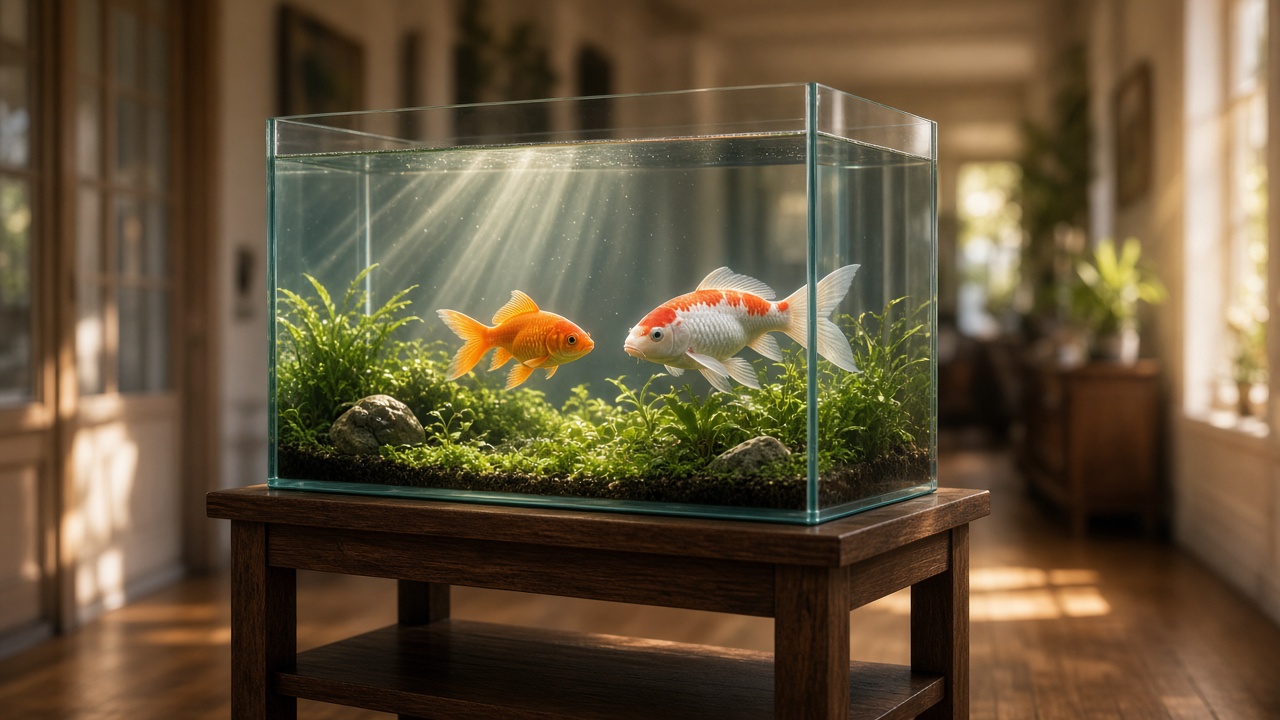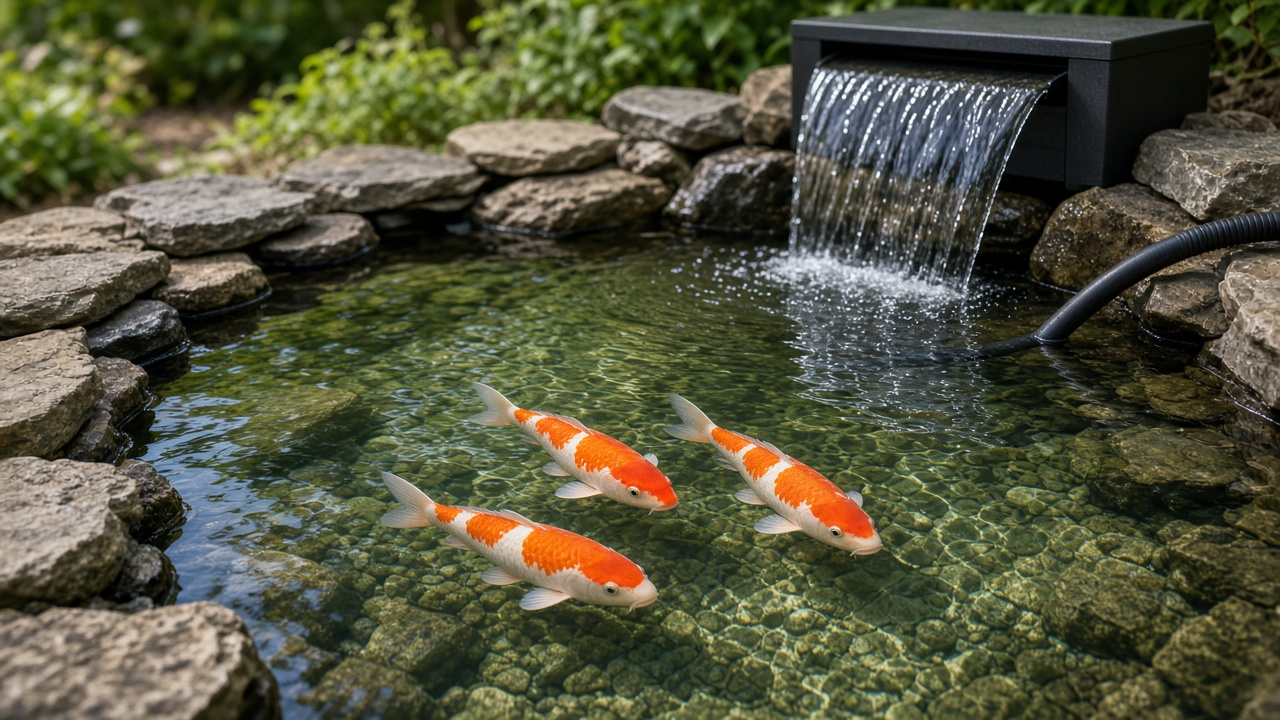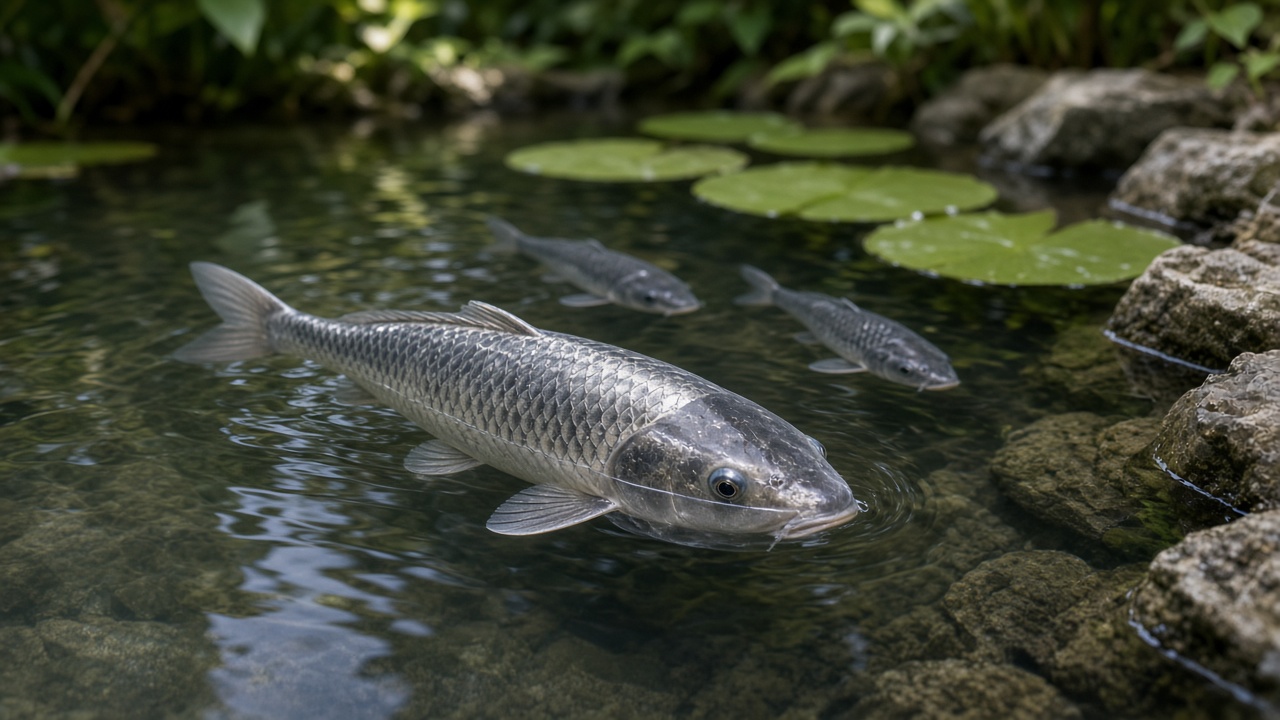
Quick answer: Keep ghost koi in a deep outdoor pond with other koi or hardy goldfish. Plan for a 3-foot adult and decades of care. Do not treat them as a small indoor community fish.
Ghost koi are pond carp that can reach 3 feet and average 40 years of life.
This page is a research-desk brief on published koi and pond-food specs. We did not run pond trials, open fish, or rank products.
What this page covers
A ghost koi is sold as ornamental carp, so we used published koi figures, not a separate zoo species sheet.
Selection rule: a product or pond scenario is in only if a maker page or named institution lists a quotable number. This page covers outdoor ponds, stocking math, and four current koi diets with listed crude protein. We left out forever indoor tanks, show judging, disease charts, and foods with no protein number on the maker page.
Our research team compared four maker labels side by side, and that label readout is the WaterPuppy Pond Spec Desk set for this page.
Smithsonian’s National Zoo files Japanese koi as Cyprinus carpio, and Oklahoma State University Extension traces koi carp to the same common-carp line.
How large ghost koi get
Plan the pond for a 3-foot carp, not for the 4-inch fish in the bag.
Smithsonian’s National Zoo states that koi can grow up to 3 feet (90 centimeters), and that is the adult size we use for pond planning.
Oklahoma State University Extension uses a smaller number for stocking math, and its worked example treats the average adult koi carp as 18 inches long.
One figure is a maximum and the other is a stocking average, so both can stand. Buy for the 3-foot adult, then count fish with the 18-inch unit until they grow.
Use this size checklist:
- Size the pond for the 3-foot adult on the Smithsonian page.
- Count stocking with the 18-inch unit in the Oklahoma State example.
- Recheck the count each year as fish add length.
Oklahoma State University Extension works a full surface-area example: a 9-by-15-foot water garden has 135 square feet of surface. At one 12-inch fish per 4.5 square feet, that pond holds 360 inches of fish, or 20 adult koi at 18 inches each.
The same page adds a tighter field rule from top exhibitors in Japan. They stock only 10 to 15 koi, even in large water gardens.
Unaerated gardens on that page take one 12-inch fish per 4.5 square feet. Fountains or waterfalls move the rate to one fish per 2 to 3 square feet.
Oklahoma State University Extension says many year-round outdoor gardens keep a section at least 3 or 4 feet deep. That zone should not freeze in winter and gives fish a cool retreat in heat.
In the deep south, the same page allows 18 to 24 inches if few fish are stocked and floating plants give shade. Ghost koi still do better with the 3- or 4-foot pocket.
How long ghost koi live
Treat a ghost koi as a multi-decade pond animal, not a two-season pet.
Smithsonian’s National Zoo lists an average koi lifespan of 40 years. The same page says the oldest-known koi lived nearly 230 years, aged from scale rings.
Oklahoma State University Extension says koi can grow quite large and sometimes live for 60 or 70 years. We report both ranges and did not age any fish.
Smithsonian’s National Zoo times first breeding at 4 to 6 years for females and 3 to 5 years for males.
Oklahoma State University Extension warns that even a few fry survivors can overfill a garden. One option on that page is a single sunfish, such as a bluegill, to eat eggs and fry.
Do not release extra carp into creeks or lakes, because Oklahoma State University Extension says goldfish and koi are non-native in many U.S. waters.
Water, depth, and daily checks
Ghost koi fail first on oxygen, waste, and sudden temperature swings, not on color.
Oklahoma State University Extension lists dissolved oxygen, ammonia, nitrite, pH, alkalinity, hardness, carbon dioxide, and contaminants such as pesticides.
Fish on that page become severely stressed below 3 ppm dissolved oxygen and die at about 1 ppm. Cool water holds more oxygen than warm water, so night and cloudy spells are the risk windows.
The same page says a pH swing from 6.5 to 9 will not harm the garden’s ecology. A pH far outside that band can stress or kill fish.
Alkalinity above 20 ppm is called adequate, and 50 ppm or more is called better. Bacterial bio-filters on that page work best at pH 7 to 8 and alkalinity above 50 ppm.
Put those quantities into a weekly habit:
- Test dissolved oxygen, ammonia, pH, and alkalinity after any weather swing.
- Watch for piping, which that page defines as sucking air at the surface.
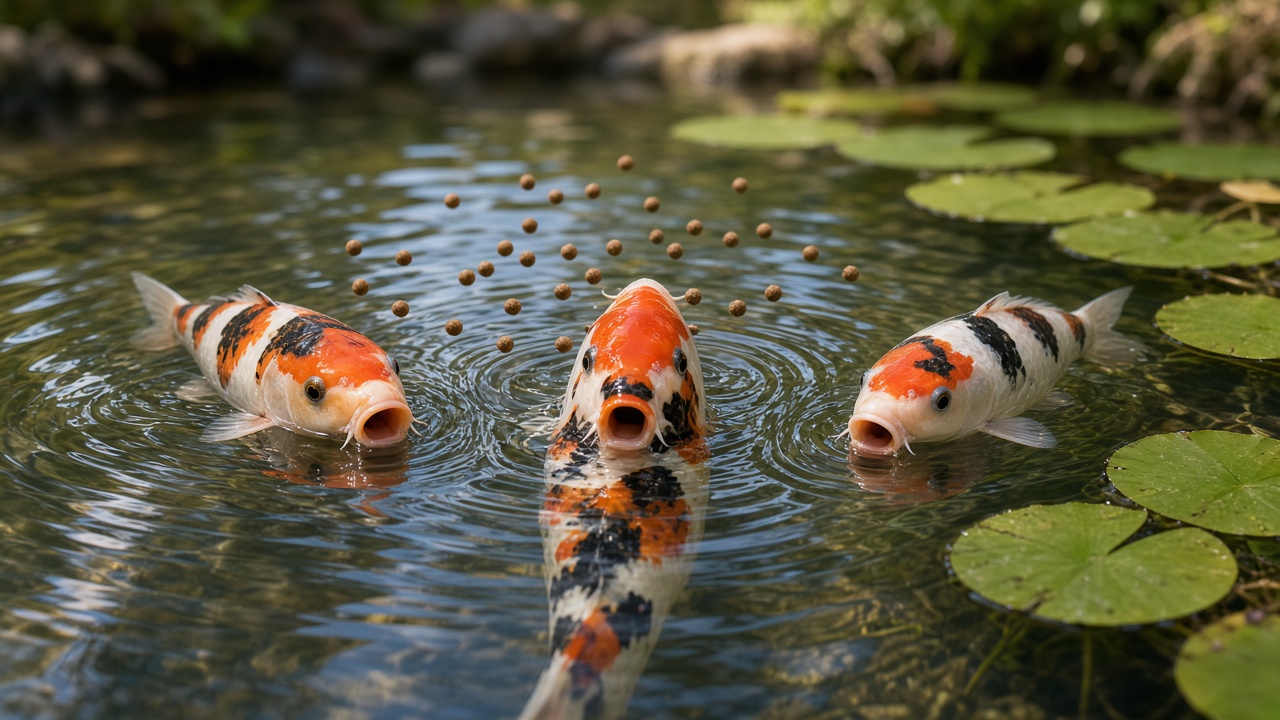
- Cut feed if fish leave pellets after 15 minutes.
- Add shade if mid-day sun cooks a shallow shelf.
Oklahoma State University Extension wants at least 6 hours of sun for plants. It also warns that mid-day sun can overheat shallow pools. Floating plants that cover 50 to 75 percent of the surface cut algae and add shade.
A holding tub is not a pond. For a short indoor move, use a large filtered tub and the same care as a fish tank setup.
Cleaning a tub follows the same waste rules as a glass tank. Remove leftover food, change water in small steps, and see our how to clean a fish tank page.
What we compared on food labels
Among four current koi diets, listed minimum crude protein runs from 32.0% to 35.0%.
The WaterPuppy Pond Spec Desk set includes only diets whose maker pages list crude protein. We compared Hikari Gold, Hikari Staple, Hikari Wheat-Germ Formula, and Kaytee Koi’s Choice Premium Fish Food.
Three of the four labels list 34.0% protein or higher, and only Hikari Wheat-Germ Formula lists 32.0%. Listed fat runs from 3.0% to 5.0%, while three Hikari pages list 10.0% maximum moisture and the Kaytee page lists 12.0%.
| Product | Crude protein (min) | Crude fat (min) | Moisture (max) | Maker feeding note |
|---|---|---|---|---|
| Hikari Gold | 35.0% | 3.0% | 10.0% | 1–2 times daily at 60–70°F; 2–4 times above 70°F |
| Hikari Staple | 34.0% | 3.0% | 10.0% | Daily diet for koi and other pond fishes |
| Hikari Wheat-Germ Formula | 32.0% | 4.0% | 10.0% | Page positions it for cooler winter climates |
| Kaytee Koi’s Choice Premium Fish Food | 35.0% | 5.0% | 12.0% | Do not feed below 40°F |
Hikari Sales USA’s page for Hikari Gold also lists 1.0% phosphorus and 8,700 IU/kg vitamin A. Hikari Staple’s page lists 8,400 IU/kg vitamin A and 180 mg/kg ascorbic acid.
Hikari Wheat-Germ Formula’s page lists 0.7% phosphorus and 2,000 IU/kg vitamin E. Kaytee’s page for Koi’s Choice lists 0.8% phosphorus and 10.0% maximum ash.
Oklahoma State University Extension growth rations for fish under one-half pound:
- Above 90°F: 1% of body weight per day
- 70–90°F: 3%
- 60–69°F: 2%
- 50–59°F: 1%
- 45–49°F: 0.5%
- Below 45°F: 0%
Maintenance rations on the same table are lower: at 70–90°F the rate is 1% of body weight, fed only 5 days per week. The page says fish should finish a meal within 5 minutes in warm water. Never feed more than they eat in 15 minutes, and do not feed below 45°F.
Kaytee’s page is slightly different at the cold end: feed every other day below 50°F, and do not feed below 40°F. Our research team did not pick a winner between those cutoffs and reports both numbers.
Hikari Sales USA’s Hikari Gold page is warmer-water food. Feed one to two times daily when water stays between 60°F and 70°F. Feed two to four times daily when water stays above 70°F, and always remove leftover food.
An 18-inch carp on the Oklahoma State length-weight table weighs 44.0 ounces, or 1,246 grams, which is about 2.75 pounds.
A 3% growth ration at 70–90°F is then about 1.3 ounces of food per day for that one fish.
Pond mates that share the same pond
Pair ghost koi with other carp-family pond fish of similar adult size, not with tropical tank fish.
We use a Three-Match Pond-Mate Rule, and a species is in only if it meets all three points:
- It is a coldwater pond fish, not a tropical aquarium fish.
- Its adult size can share space with a 3-foot carp.
- It is not kept as a predator of the koi.
Oklahoma State University Extension says water-garden fish usually come from the goldfish or koi family. It names common goldfish, shubunkin, comet, and fantail as better outdoor forms.
The same page says fancy forms are a poor outdoor match. It lists nymph, fringetail, veiltail, lionhead, curled gill, and bubble-eyed goldfish because those fish are more open to predators.
Smithsonian’s National Zoo notes a common mix-up: people think koi are large goldfish. The page says they are distinct species, both from carp.
Ghost koi will root and graze, and Oklahoma State University Extension says koi carp eat plants, so wire or plastic net enclosures protect lilies. Feeding several times a day, on that page, also cuts plant damage.
Do not add a betta, because bettas are tropical fish for heated tanks and fail the first match of our rule. For indoor community ideas, use our best betta fish tank mates page and keep that list off the pond.
Acclimate new fish the way Oklahoma State University Extension describes:
- Float the closed bag for 10 to 15 minutes.
- Keep the bag out of direct sun.
- Open the bag and add pond water slowly.
- Release the fish when bag and pond are within 2 or 3°F.
- Dip the fish out. Do not pour bag water into the pond.
Watch the new fish after release. The same page lists stress signs: no feeding, piping, flashing, whirling, shredded fins, and visible sores. Those signs mean you stop adding fish and check water; this desk does not diagnose disease.
FAQ
Can ghost koi live in an indoor tank?
Not as a long-term home. Smithsonian’s National Zoo lists a 3-foot adult, and a glass tank cannot hold that fish with stable waste and oxygen. A short holding tub is only a bridge, so set a filter and move the fish back outdoors.
How big do ghost koi get?
Smithsonian’s National Zoo says koi can grow up to 3 feet. Oklahoma State University Extension uses 18 inches as the average adult in its stocking example. Plan volume for the larger number and count fish with the smaller one until they grow.
How long do ghost koi live?
Smithsonian’s National Zoo lists a 40-year average. Oklahoma State University Extension says some koi live 60 or 70 years. Both figures assume years of stable water and food, and we did not track a pond cohort.
Can ghost koi live with goldfish?
Yes, if the goldfish are hardy outdoor forms and the pond is sized for adult koi. Oklahoma State University Extension groups common goldfish, shubunkin, comet, and fantail with koi ponds. Skip bubble-eye and lionhead forms on that same list, because they are easier prey.
What should I feed ghost koi?
Use a koi diet with a listed protein number. Hikari Gold and Kaytee Koi’s Choice both list 35.0% minimum crude protein. Hikari Staple lists 34.0%, and Hikari Wheat-Germ Formula lists 32.0%. Finish a meal in 5 to 10 minutes on the Kaytee page, or in 5 minutes in warm water on the Oklahoma State page.
When do I stop feeding?
Oklahoma State University Extension says fish do not feed below 45°F. Kaytee’s page says do not feed below 40°F. Hikari Gold’s page starts its daily schedule only after water stays above 60°F. When the readings disagree, use the colder cutoff and watch whether fish still eat.
Do ghost koi eat pond plants?
They can. Oklahoma State University Extension says koi carp eat plants and may need netted plant pockets. Cover 50 to 75 percent of the surface with shade plants if you want less algae. Keep those plants behind a barrier if the fish tear leaves.